
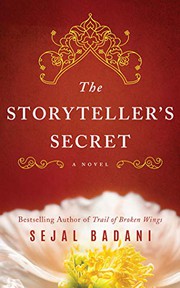
The Storyteller's Secret
2,270-word summary 10 min read 390 pages in the book
- First published
- 2018
- Publisher
- Lake Union Publishing
- Pages
- 390
- ISBN
- 9781503949089
Reading options
What's inside (9 sections)
I picked this up because the premise sounded like a riddle. A New York journalist flies to India to find out why her grandmother loved a British officer, and a servant in the family keeps the answer for forty years. Sejal Badani's second novel, after Trail of Broken Wings, was published in 2018 by Lake Union Publishing in a 390 page hardcover, ISBN 9781503949089. It runs on two timelines, colonial India in the late 1930s and 1940s on one side and a marriage coming apart in New York on the other, and the two lines get tied together by a story told out loud. I finished it in two sittings. The India sections are the better half, and not by a small margin.
A marriage coming apart in New York
Jaya is a journalist, which means she is good at noticing and bad at stopping. She is falling apart in the quiet, specific way of a person whose body has failed her three times. The third miscarriage is what cracks the book open. Her husband Patrick handles it by moving out of their apartment and then by sleeping with one of Jaya's friends, in that order, without much ceremony.
Badani refuses to make Patrick a villain, and I am glad of it. He is a decent man who has run out of language for a subject he cannot repair. What he cannot stand is the silence that follows a loss, and what Jaya cannot stand is being handled. Their separation gets described with a light hand that still stings. Two reasonable adults being reasonable at each other across a kitchen.
Her job does a particular kind of damage. Jaya reports for a living, so she knows exactly how to frame a scene until the reader sees what she wants them to see, and she has been doing it to her own marriage for two years. The miscarriage stops her editing. There is no angle on it. A reporter who cannot find the angle in her own life is not in a good place to go looking for one in a family archive.
Then a letter arrives from India. Jaya's mother, Lena, has spent her whole adult life keeping that country at a polite distance, and now she forwards a note saying that Jaya's grandfather Deepak is close to death. Deepak is a name Jaya knows mostly as a story her mother tells in a particular tone, the tone of a woman explaining a closed door. The letter gives Jaya two reasons to go. There is a family she has never met, and there is a way to avoid sitting in an apartment being slowly destroyed. She goes.
The house in the village and the man who waited
Jaya arrives at the ancestral house, which is full of rooms belonging to people she has never met. The sensory writing here is the book's best work. Badani gives you heat that sits on your skin, food arriving in steel plates, jasmine after dark, the noise of a lane where someone is always calling someone else. She also gives you the social weather of the house, who eats where, which door a person uses, who waits to be addressed. You absorb the caste arrangement of the place without anyone lecturing you about it.
Ravi is waiting for her. He was the family's servant, and specifically Amisha's servant, and he has been sitting on the secret for longer than Jaya has been alive. He is old and he is blunt in a way that startles her. He tells her that Deepak died before she arrived, and then he sets a condition. He will give her what Deepak left for Lena, and he will tell her the story of her grandmother, but only if she promises to hear all of it.
That condition is the engine of the book. Jaya does not agree quickly. She is a journalist, so being told what she will hear is professionally offensive. She agrees anyway, and the story starts.
Amisha's side of it
The flashback opens with Amisha as a young woman in colonial India, married to Deepak in an arranged marriage and restless inside a life built for her to be quiet in. She writes. That is the thing she wants, stories and the language to put them in, and her hands are never free, so the writing happens in margins, on the backs of bills, in the gaps between the household's demands.
She takes Ravi on as her personal servant, which in the village's rules puts him a long way below her and her husband. He becomes the one person who is reliably there, and Badani writes him as steady and watchful rather than saintly.
The notebook is not a diary. She is not interested in recording what happened to her. She is writing scenes and characters, a novel she will not finish, and she reads the pages back to herself at night to hear whether a line has any life in it. Badani gives the ambition real weight. Writing is not a hobby the plot lets her abandon once a man shows up. It is the part of her that survives everything else, which is why the letters later matter so much.
An English school opens nearby, and Amisha wants to go, because the school's whole purpose matches what she wants, which is to be taught to write in English. Its head, Stephen, proposes a trade. He will teach her a creative writing class in Hindi, and she will give him English writing lessons in return. They end up in the school garden a lot. He is British, and he is also a soldier, and that contradiction is what the whole novel leans on.
A love the colony would not allow
Anti-colonial protest spreads through the country. Marches, strikes, and the slow hardening of public opinion. Amisha's love for Stephen is private, and it gets less private as the politics get louder. A British officer and an Indian woman in love, in a country organizing to drive the British out, and Badani does not even have to underline the collision, though she underlines it anyway.
The colony, meanwhile, is doing what colonies do. English is the language of the school, of the courts, of the paperwork that decides what happens to a body, of the men who can sign things. Amisha wants the language of the people who hold the paperwork. That want and the want for Stephen get braided together, and Badani never untangles them cleanly, which is the point.
They pass letters through Ravi, who becomes their post office. That detail does more work than it looks like it should. It tells you how much risk they are taking, and it makes Ravi complicit in their love as well as in Amisha's marriage, which is exactly where the book wants him to sit.
Amisha becomes pregnant with Stephen's child and conceals the paternity from both men. Everyone around her believes the baby is Deepak's, and the belief holds because Ravi makes it hold. He is the only one who knows, and keeping that is his burden now.
Stephen applies for a transfer and gets sent to the front lines of the second world war. Before he goes, he comes to the house one last time, finding Amisha heavily pregnant, and asks her to come away with him. She says no. She will not leave her children. This is the hinge, and Badani earns it, because Amisha refuses as a mother first and a lover second. You can accept that and still wish she had gone.
Two promises, kept for decades
Amisha gives birth to a daughter, Lena. Weeks later a mosquito bites her and she contracts encephalitis, a swelling of the brain that kills her. On her deathbed, in the scene I would call the book's beating heart, she extracts two promises from the two men closest to her. Deepak will send Lena to America, where she will have a future. Ravi will keep her story secret until he can tell it to her daughter.
So Lena is raised in America with her mother as a locked room. That locked room is why Lena never taught Jaya about India, and it is why a letter about a dying grandfather finally moves Jaya across an ocean. There is a third secret too, one Ravi holds without being asked to. After Lena was born, Stephen came back to the house, and Ravi sent him away. He decided Amisha's happiness mattered more than Stephen's right to know. He carries that for forty years and does not mention it until it counts.
Lena grows up and marries and has Jaya, and she keeps the country folded away in a drawer. She is not cold about it. She is a woman who was handed a story with a locked door in it and nobody to hold the key, because Ravi's promise bound him to her daughter rather than to her. By the time Jaya asks questions, Lena has already become the version of the story that can be told at dinner parties, and she is tired of telling it.
What Jaya does with it
Jaya's own crisis does not resolve neatly, but it moves. Patrick comes to India, and the two of them stand in the same house and hear the same story, and something in them loosens. They decide to become parents by adopting from a local ashram, which gives Jaya a future that is not built on her own body and gives the book an ending about choosing rather than repairing.
Then Ravi gives her the inheritance. The letters Amisha and Stephen wrote to each other, the ones that passed through his hands for four decades. He has held them against his guilt and now he can hand them over, and Jaya's forgiveness is the thing that absolves him. He dies soon after, with the story told and the burden handed to the people it was meant for. That is a clean resolution, maybe too clean, but watching a servant finally set down a secret he has been carrying since the war is worth the tidiness.
The letters are the last thing the book gives you, and they are better than you expect. Amisha writes the way she wanted to write all along, in a clean quick hand full of comic asides, and Stephen writes like a man trying to be accurate in a language that keeps embarrassing him. Read together they are a love story with no excuses in it. Jaya reads them in the house where they were written, and Badani earns that choice.
What the story does to Jaya is harder to measure. She goes home with a bigger sense of her family and of what a woman is allowed to want. Her grandmother wrote her way out of a cage with a pen and a few months in a school garden. That is not nothing.
What works and what does not
Readers rate this book highly and the enthusiasm is mostly deserved. The prose is warm and concrete, the history is handled with care, and the alternating structure lets the two eras argue with each other without a line of explanation. Ravi is the best character in the book and the least rewarded on the page. He gets a good death and little else, which is thematically apt and also slightly unfair.
The complaints are ordinary and fair. Some plot beats are easy to see coming. The pregnancy and the hidden child are familiar devices and the book does not disguise them. The present-day thread is thinner than the historical one, and Jaya reads more like a container for the story than a person with wants of her own. The final stretch moves fast, with Ravi's illness and death, the adoption and the letters all arriving in a rush that undercuts the weight of what they mean. And Badani's Amisha can tip into lyricism at the emotional peaks, the prose going gauzy exactly when you want it to be steady.
None of that changed my recommendation. If you want a family saga about a woman who wanted to write and a family that made her pay for it, this is the book. If you want the past to stay politely in the background, it is not.
One more note on craft. The book is in the third person but it is Amisha's novel in the way that counts. Jaya's sections are often about waiting, and Badani is noticeably better at writing waiting when she is inside a woman who is doing something. There is a version of this book that stays in colonial India and loses half its argument about inheritance. The New York half is what makes the past land.
I kept thinking about the opening line, which comes from Amisha: "What if we all stood equal in one another's eyes and felt pride at our reflection?" The book never argues its way to an answer to that question. It shows you a house where the answer was not available, and then it hands you the letters, which is about as close as a novel gets to a reply.
If you want company for it, take a book about a family that keeps a secret across generations, because that is exactly what this is. Take it slowly. The 1930s chapters reward attention to small things, a school garden, a stack of letters, a servant who knows more than his station allows him to say.
FAQ
When was The Storyteller's Secret published and how long is it?
It came out in 2018 from Lake Union Publishing, and the hardcover runs 390 pages with ISBN 9781503949089. The paperback reprint the same year runs 399 pages.
What is the secret the title refers to?
It is the story of Amisha, Jaya's grandmother, who loved a British teacher during the colonial period. The family servant Ravi knows the whole story and keeps it until Jaya promises to hear it out.
Is this Sejal Badani's debut?
No. Sejal Badani published Trail of Broken Wings in 2015, so this is her second novel.
Similar books

The Echo of Old Books
Barbara Davis's 2023 novel sends a rare-book dealer in 1984 New Hampshire hunting for the authors of two unpublished volumes that tell opposite sides of one…
2,491-word summary · 11 min read
The Tuscan Child
After her father's death, Joanna follows a returned letter to Tuscany and uncovers his wartime love, a hidden painting and a village secret. A dual-timeline…
2,095-word summary · 9 min read
The Clockmaker's Daughter
A London archivist finds a Victorian satchel holding a photograph, a sketchbook and a letter, then follows them to Birchwood Manor, where a young woman died in…
2,886-word summary · 13 min read
Those Who Save Us
A Minnesota professor hunts her mother's hidden wartime past in Weimar, where survival came wrapped in an SS officer's protection. A dual timeline about…
2,345-word summary · 10 min read
The Keeper of Happy Endings
Barbara Davis's 2021 standalone braids a Paris dressmaker's wartime losses with a grieving Boston artist who unlocks her family's secrets through an old row…
2,437-word summary · 11 min read

The Last Letter from Your Lover
A 1960s wife with lost memory and a modern journalist chase the same lost love letters across forty years.
2,506-word summary · 11 min read
The Lake House
Detective Sadie reopens 1933 Edevane baby vanishing tied to writer Alice.
2,055-word summary · 9 min read
Midnight's Children
Saleem Sinai, born at India's independence midnight, narrates his family's saga as his life mirrors the new nation's history.
2,734-word summary · 12 min read
The Covenant of Water
Three generations of a Kerala family face a drowning affliction from 1900 to 1977, from child bride Big Ammachi to physician Mariamma who seeks its cause.
2,955-word summary · 13 min read
Violeta
A woman born in 1920 writes her life story to her grandson, from one pandemic to another, through wealth, ruin, passion, and dictatorship in South America.
2,555-word summary · 11 min read

The Shadow Sister
Star D'Apliese steps out of her sister's shadow and follows a bookshop clue into the Edwardian life of Flora MacNichol, a woman who gave up love for duty.
2,260-word summary · 10 min read

Sophie's Choice
A young Southern writer in 1947 Brooklyn befriends a brilliant, unstable couple and slowly learns the story of the Polish Catholic woman at the center of their…
2,798-word summary · 12 min read
The Lowland
Two brothers grow up beside a marshy lowland in Calcutta, and the choices of the younger one draw the older into a life of duty, distance, and quiet grief that…
2,213-word summary · 10 min read
Her Fearful Symmetry
Twins Julia and Valentina inherit a London flat above Highgate Cemetery from an aunt they never met, then find a ghost in it and a family secret.
2,057-word summary · 9 min read
Stones from the River
Trudi Montag is born a dwarf in a small German river town in 1915 and grows up to keep the town's library and its secrets, from the First World War to the…
2,818-word summary · 13 min read

Ivanhoe
A disinherited Saxon knight, a great tournament, a besieged castle and a trial by combat. Scott's most famous novel, set in England in 1194.
2,834-word summary · 13 min read
Euphoria
Three anthropologists in 1930s New Guinea turn fieldwork into a love triangle, and a real history breathes behind them.
2,048-word summary · 9 min read
Big Lies in a Small Town
A 22-year-old woman leaves prison to restore a 1940 mural, and Edenton, North Carolina, starts talking.
2,187-word summary · 10 min read

Wide Sargasso Sea
Jean Rhys gives the first Mrs. Rochester a Caribbean childhood, a marriage built on money and suspicion, and a voice that Charlotte Bronte left in the attic.
2,021-word summary · 9 min read

The Sisters Brothers
Two hired killers ride from Oregon to Gold Rush California to murder a prospector, and find their trade, their brotherhood, and the frontier myth coming apart.
2,095-word summary · 9 min read
The Silence of the Girls
Briseis, queen of Lyrnessus, is captured by Achilles and narrates the Trojan War from inside the Greek camp, where women are prizes and survival is its own…
2,098-word summary · 9 min read

The Birth of Venus
A Florentine merchant's daughter trains as an artist, marries a man who hides a secret, and survives Savonarola's bonfire of the vanities.
2,404-word summary · 11 min read
Mother Night
Howard W. Campbell Jr., a Nazi propagandist and American spy, tells the story of his double life from an Israeli prison cell while waiting to be tried for war…
1,988-word summary · 9 min read

Bring Up the Bodies
Thomas Cromwell sets out to destroy Anne Boleyn, building a case from rumor and revenge while Henry VIII waits to marry Jane Seymour.
2,066-word summary · 9 min read
The Prisoner of Heaven
Fermin Christmas past returns with a stranger and a prison debt.
2,388-word summary · 11 min read
The Buried Giant
An old couple crosses a misty post Arthur Britain searching for a son.
2,593-word summary · 12 min read
Let the Great World Spin
A wire walker crosses the towers as Bronx lives collide below.
2,338-word summary · 10 min read

Bleak House
Jarndyce and Jarndyce grinds through Chancery while Esther finds her family.
2,480-word summary · 11 min read

Song of Solomon
Milkman Dead leaves Michigan to hunt for family gold and finds instead the old song of his ancestor Solomon.
2,465-word summary · 11 min read

Burial Rites
Condemned for murder in 1829 Iceland, Agnes Magnusdottir spends her final winter on a crowded farm while a young priest listens to her story.
2,976-word summary · 13 min read