
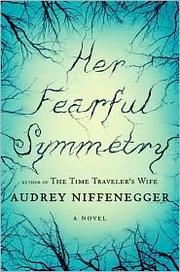
Her Fearful Symmetry
2,057-word summary 9 min read 406 pages in the book
- First published
- 2009
- Publisher
- Scribner
- Pages
- 406
- ISBN
- 9781439165393
Reading options
What's inside (9 sections)
The envelope in the mail
I picked up Her Fearful Symmetry because I had read The Time Traveler's Wife and wanted another helping of Niffenegger's games with time. What I got was a book about a woman who cannot leave a room. There are no jumps here, no lost decades, no man turning up in the wrong year with nothing on. There is a flat, a walled cemetery, and a dead woman who refuses to go.
Elspeth Noblin dies of leukaemia at forty-four and leaves her London flat to two American nieces she has never met. Julia and Valentina Poole are identical twins of twenty who live with their parents in a Chicago suburb and have so far shown little interest in colleges, jobs, or any life outside the two of them. The conditions attached to the inheritance are odd. The twins have to live in the flat for a year before it can be sold, and their parents are never allowed inside. A thick envelope brings the news to their door.
They are not the girls you would pick to hand a haunted apartment. Julia, older by a few minutes, decides things. Valentina is frightened of things, and Julia calls her Mouse. Valentina has asthma and a heart valve that never formed properly, so she tires easily and knows more about hospitals than an American teenager should. They dress identically. They finish each other's sentences. Neither seems to have existed separately, and a good deal of the novel is about one of them trying to get out.
The flat overlooks Highgate Cemetery, and the cemetery is the engine of the whole thing. Niffenegger spent a year working as a volunteer guide there before she started writing, and it shows. The grounds come with their own weather and their own rules: slopes of graves, marble gone grey-green, paths worn by people who come to be sad on a schedule. By the end I knew more about burial practices, mourning jewellery and the names of Victorian novelists than I had any intention of learning. The cemetery is the most vivid character in the book and the only one who behaves consistently.
Three floors and a pile of unfinished business
The building around Elspeth's flat fills up with people who are each carrying something they cannot put down.
Below her lives Robert, her lover, who works his way through the cemetery as a tour guide while writing a doctoral thesis about it. He is still in love with a dead woman, and that loyalty is both the most attractive and the most obstructive thing about him.
Above the twins lives Martin, a crossword setter with a crippling case of obsessive compulsive disorder. His rituals have emptied his life: the wife he loved, Marijke, has walked out because of them, and he has not left his flat in years. Julia, who has no use for therapy but plenty of nerve, starts slipping him his actual medication, clomipramine, while telling him it is a vitamin. Martin knows precisely what she is doing and plays along. He is the most quietly moving thing in the novel, and when he finally walks out of the building and crosses an ocean to find Marijke, you feel the loss of the woman in the flat and the gain in that thread of the story at the same moment.
Around them are the volunteers and regulars of the cemetery, including Jessica, who is one of the few people willing to believe Robert when the neighbours begin turning on him. The London of this novel is specific and unglamorous. Corner shops, buses, wet pavements, and the particular loneliness of an American expat who has built a life in a country that never quite adopted her.
What a ghost is allowed to do
Elspeth's ghost is the engine of the plot, and the interesting thing about her is that she starts almost powerless. She cannot leave the flat. She cannot speak. For months the twins do not know she is there at all.
Valentina notices her first, and slowly, as a mood in the room: a sense that something wants attention. Then she sees her. Elspeth signs her presence in the dust on the piano, and the twins and Robert respond the way you would expect, by producing a Ouija board and a planchette and holding a séance in the middle of a London flat. Elspeth is lonely, jealous and afraid of being forgotten. She is also, in her own view, somebody who would rather not die yet. Niffenegger said in an interview at the time that the ghost stays because she refuses to go, that her own stubborn will is what holds her in the room, which is a much better idea than a curse or a vengeful spirit.
What she can do grows as the story goes on, and the growing is where the novel gets into trouble, because the rules are never fully spelled out. She moves small objects. She reaches into people. And she can take a soul out of a body, hold it, and put it back.
The kitten, the plan and the soul
The scene that shows the reader what Elspeth is capable of arrives with a kitten. The twins find a stray near the cemetery, coax it into the flat and adopt it, and one afternoon it simply drops dead in their hands. The cause turns out to be Elspeth, who has caught the animal's soul the way you might catch a moth, and who then, with visible effort, puts it back and revives it.
This is a horror story doing something genuinely strange and good. The ghost is not malevolent. She is clumsy, avid, bored, a woman who died at forty-four with a flat full of her things and nobody to talk to. Valentina sees what happened to the kitten and understands, in a way that changes the whole book, that a soul can be separated from a body and returned to it.
What she does with that knowledge is the plot. Valentina has been told her entire life that she and Julia are one thing, and by twenty she wants a life of her own. She wants to design clothes, she wants to be asked to the party, she wants to be a separate person. She proposes the most extreme version of escape available to her, which is to have Elspeth lift her soul out of her body and hold it, so that Julia can be made to believe she has died of an asthma attack. Her funeral will be in the family mausoleum at Highgate. Afterwards she plans to walk away and start again somewhere else.
Robert is supposed to preserve the body. He refuses. Instead he does something that changes the shape of the entire novel: he goes through the diaries and letters Elspeth left him.
What the diaries say
The reading of Elspeth's papers is where the title stops being decoration and starts being an argument.
Elspeth and Edie, her identical twin, have not spoken for twenty years. The family story is that Edie ran off with Elspeth's fiance, Jack, and that Elspeth never forgave her. The diaries say something else. For decades the two of them had been taking each other's names, living as each other, moving through the world as a pair of identical women who could not bear to be told apart. There was a party on April Fool's Day and a decision taken in a state of extreme drunkenness that fixed the shape of the next twenty years. Jack knew what was going on and went along with it. The girls were born into the arrangement and raised inside it without ever being told.
When I reached this section I put the book down and walked around the block, because the reveal does not merely add a twist. It retroactively changes who Julia and Valentina are, and therefore changes what the preceding four hundred pages were about. The estrangement, the will, the flat in London, the two conditions attached to the inheritance, the parents forbidden to visit: all of it makes a different kind of sense once the reader learns that the family history the twins were raised on was assembled by two women capable of swapping lives and then living inside the swap for the rest of their days.
It is a bold piece of construction, and it is the moment the book stops being a haunted flat story and becomes a story about the violence of identity, about how much damage two people can do to everyone around them by deciding that being one person is never enough.
Sussex and the finished thesis
The plan goes wrong in the way these plans always go wrong. Elspeth lifts Valentina's soul and holds it, and then she does not put it back. Valentina's soul disperses. Elspeth wakes up in Valentina's body, and Robert finds a stranger wearing his dead lover's face.
What follows is bleak and strangely tidy. Valentina becomes the ghost in the flat, the way Elspeth was, and she spends a good while in there getting stronger and failing to be heard. Julia, who has buried a twin and then found the body was not where it should be, goes looking for the truth and turns up Robert's involvement. Meanwhile Martin does the thing Elspeth never could. He walks out of his flat, gets on a plane to Amsterdam, and goes to find his wife.
Julia eventually helps Valentina's spirit out of the flat and into the cemetery, where she finds the other dead and, at last, some peace. Elspeth, in the stolen body, gets what Elspeth always wanted. She moves to Sussex with Robert, has a baby boy, and settles into a version of domestic life that nobody inside it enjoys. Then Robert finishes his thesis, leaves it on the table and vanishes without a word.
The symmetry of that ending is deliberate and, in outline, earned, though the last pages have the slightly airless quality of a plan being ticked off. Nobody here gets what they wanted except the ghosts, and one of them is happy in a way the novel declines to explain.
Is the machinery worth it?
Plenty of readers say no, and the criticism is not unfair. Kirkus put the problem in a single line: gimmickry, supernatural and otherwise, blunts what could have been an incisive inquiry into the mysteries and frustrations of too-close kinship. Reviewers who liked the book generally liked the same things, the cemetery, the twins, the slow tightening of the leash, and the diary reveal. Both sides of that argument land on one real weakness, the metaphysics are underwritten. How exactly does a soul leave a body? What does the ghost need in order to stay solid? Why does the ghost of one sister become the prison of the other? Niffenegger answers these questions when it suits her and waves at them otherwise, and a reader who wants rules gets very few.
The twins also make hard work as characters. Their codependency is the subject, so it has to be repellent, and Niffenegger does not flinch from it. There are stretches where Julia is simply the villain of her sister's life and Valentina its victim, and the middle of the book stalls while Robert and Elspeth sort out their affair with the dead.
What survives the complaints is Niffenegger's ear for place, Martin's disorder, and the short sharp shock of the diary reveal. The title comes from Blake's poem The Tyger, which asks what immortal hand could frame such a fearful symmetry, and in London received pronunciation the last word of the title and the name of the cemetery are nearly the same, which is the kind of joke a book like this earns by accident.
If you liked The Time Traveler's Wife and want the same author with the time machine removed and a walled cemetery in its place, this is the one. If you want a ghost story that plays fair with its own rules, look elsewhere. The novel is atmospheric to the point of being almost a recording of London, which is worth knowing before you start, because the cemetery is doing work the plot is also doing.
FAQ
Is Her Fearful Symmetry a time travel novel like The Time Traveler's Wife?
No. Niffenegger's second novel uses a ghost in a London flat instead of time jumps. It was published in 2009 by Scribner in the US and Jonathan Cape in the UK.
Who is the ghost in Her Fearful Symmetry?
It is Elspeth Noblin, who died of leukaemia at forty-four and left her Highgate flat to her twin nieces. She cannot leave the flat, and for most of the book only Valentina can see her.
Is the ending of Her Fearful Symmetry satisfying?
Readers are split. Elspeth takes over Valentina's body and moves to Sussex, Robert vanishes after finishing his thesis, and Valentina's spirit is finally released in Highgate Cemetery.
Similar books
Flowers in the Attic
Four children locked in a grandmother attic learn their mother traded them for an inheritance.
2,052-word summary · 9 min read
The Thirteenth Tale
A dying novelist tells her true story at last to a bookseller's daughter, and the mystery of the Angelfield twins comes into the open.
2,928-word summary · 13 min read
The Tale of the Body Thief
Lestat trades bodies with a psychic thief for one day of mortality and ends up trapped, sick, and hunting his own vampire body.
2,069-word summary · 9 min read

The Only Good Indians
Four Blackfeet men who killed a pregnant elk are hunted by her spirit a decade later, and the only person who can end the cycle is a teenage girl who was not…
2,010-word summary · 9 min read
Lisey's Story
Two years after her novelist husband dies, Lisey Landon follows a trail of clues into his childhood and the other world that made him a writer.
1,998-word summary · 9 min read

The Storyteller's Secret
A New York journalist goes to India to learn why her grandmother loved a British officer, and why a family servant kept the truth for forty years.
2,270-word summary · 10 min read
The House We Grew Up In
The Bird family of the Cotswolds breaks apart after a suicide and spends twenty years not talking about what happened.
2,198-word summary · 10 min read

The Clockmaker's Daughter
A London archivist finds a Victorian satchel holding a photograph, a sketchbook and a letter, then follows them to Birchwood Manor, where a young woman died in…
2,886-word summary · 13 min read

Family of Liars
The prequel to We Were Liars: Carrie Sinclair finally tells the story of the summer of 1987, the boy who died on Beechwood Island, and the lie her family built…
2,072-word summary · 9 min read
The Prisoner of Heaven
Fermin Christmas past returns with a stranger and a prison debt.
2,388-word summary · 11 min read
The Awakening
Chloe Saunders flees Lyle House with Derek, Simon and friends while her necromancy wakes fully and the Edison Group hunts them.
2,428-word summary · 11 min read
The Lake House
Detective Sadie reopens 1933 Edevane baby vanishing tied to writer Alice.
2,055-word summary · 9 min read
The Amityville Horror
The Lutz family flees 112 Ocean Avenue after 28 days of cold spots, voices, and flies, following DeFeo murders.
2,088-word summary · 9 min read
Later
Boy Jamie Conklin sees dead people who must answer truthfully, pulling him into NYPD cases and a drug crew's greed.
2,009-word summary · 9 min read
Gallant
Mute Olivia Prior returns to Gallant manor where ghouls walk and a shadow Recommends.
2,081-word summary · 9 min read
The Valley of Vengeful Ghosts
A grieving therapist buys a model home in a rainy valley where the walls leak ghosts.
2,035-word summary · 9 min read

Sing, Unburied, Sing
A Mississippi family drives to Parchman prison while ghosts press close, and a dying grandmother holds the house together.
2,871-word summary · 13 min read

Heart-Shaped Box
A washed-up rock star buys a haunted suit online and must face the vengeful ghost attached to it.
2,980-word summary · 13 min read

White Teeth
Archie and Samad's wartime bond tangles their London families across generations, genes, and faith.
2,110-word summary · 9 min read
Lincoln in the Bardo
Willie Lincoln dies in 1862 and lingers while 166 cemetery voices squabble his father toward release.
2,032-word summary · 9 min read
The Summoning
Chloe Saunders sees ghosts and lands in Lyle House, a group home for troubled teens with hidden powers and a secret tied to the Edison Group.
2,579-word summary · 11 min read
The Nest
Four adult Plumb siblings wait on a shared trust in New York until brother Leo drains it after a drunk driving crash, forcing each to face debt, school bills,…
2,854-word summary · 13 min read
The Miserable Mill
Sent to work at the Lucky Smells Lumbermill, the Baudelaires face harsh labor, strange hypnotism, and a familiar villain in a new disguise.
2,662-word summary · 12 min read

The Glass Hotel
A hotel bartender marries a wealthy investor, his fund collapses in 2008, and Mandel traces the money, the guilt, and the ghosts left behind.
2,785-word summary · 12 min read
The Death of Mrs. Westaway
Broke tarot reader Hal claims a Cornish inheritance and finds attic locks and lies.
3,313-word summary · 15 min read
Black Cake
After their mother dies, estranged siblings Byron and Benny inherit a black cake and taped confession revealing her hidden life from Jamaica to London.
2,063-word summary · 9 min read
The Forgotten Garden
A Brisbane woman traces a century old abandonment from an English country house to a Cornish cove and a hidden author.
2,056-word summary · 9 min read
Odd Thomas
A twenty year old fry cook who sees the dead tries to stop a mass shooting in his desert town.
3,797-word summary · 17 min read
Mrs. Dalloway
Clarissa Dalloway gives a London party across one June day while veteran Septimus Smith faces shell shock in the same city.
2,935-word summary · 13 min read