
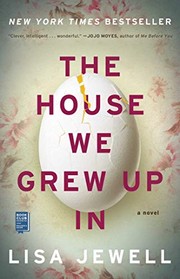
The House We Grew Up In
2,198-word summary 10 min read 416 pages in the book
- First published
- 2013
- Publisher
- Atria Books
- Pages
- 416
- ISBN
- 9781476776866
Reading options
What's inside (8 sections)
I went into this expecting a country house mystery, the kind where somebody comes home, finds a body, and every neighbour turns out to have a motive. What Lisa Jewell gives you instead is thirty years of Easter Sundays and a mother who cannot throw away a chocolate egg wrapper. There is a mystery in the book, and it is worth waiting for, but it is not the engine of the thing. The engine is a family carrying the same unexamined grief for two decades without any of them noticing that they are carrying it.
Century published it in the United Kingdom in July 2013, and Atria Books brought it out in America the following year. The Atria paperback I read runs 416 pages and carries the ISBN 9781476776866. By then Jewell had a shelf of novels about weddings and friendship behind her. This was the one that broke the pattern, and it is why it still reads as a gamble rather than a genre exercise.
The Bird House
The Birds live in a honey-coloured brick house in a Cotswold village, hard up against the pavement, with three-quarters of an acre of rambling garden behind it. Colin is a sweet gangly man with floppy hair and round glasses who still looks like a teenager. Lorelei is a beautiful hippy mother who exists entirely in the present and makes every moment sparkle. Their children are Megan, the eldest, Bethan, and the twins Rory and Rhys.
Lorelei freezes time by keeping things. She hoards the coloured foil from the Easter eggs, she hangs the children's artwork on every wall of the kitchen and across the door frames, she saves craft supplies, and she puts on an Easter egg hunt every year that the neighbours are invited to and that the children remember more clearly than anything else. From the outside it is the perfect family. From the inside, the children are already negotiating around it.
Rhys is the quieter twin. He is not popular at school, he is not close to Rory, and he does things at the edge of what a boy his age can explain. He lurks near the girls' changing rooms. He follows his mother around the house. Megan, the eldest, is the one who notices and is told by everybody else that she is making something of nothing.
Lorelei collects as well as keeps. She saves her own hair from the brush and her children's, and when a burglary frightens the family badly enough that she will not leave the house again, the Greece holiday the children were promised is quietly cancelled and never mentioned. The hoarding is present long before the tragedy, and the tragedy is what turns it into a disease.
Easter Sunday 1991
On Easter Sunday 1991, when Megan is twenty, the family finds Rhys hanging from the rafters of his bedroom. There is no note.
The day itself is the one we see in fragments for the rest of the book. There is an egg hunt in the garden, with the neighbours there and the foil wrappers being saved for later. Bethan, in her towel and shower cap, hears Rhys breathing outside the bathroom door. Bethan sees her mother come out of Rhys's room looking as though she has seen a monster. At some point that day a new neighbour called Vicky arrives with a bottle of red wine, and Lorelei drinks with her instead of telling her husband what she wants to say. The last ordinary thing that happens is also the last thing anyone could have done differently.
What follows is not grief in its usual shape. The family does not discuss it. Every Easter afterwards is the same meal with one fewer person at the table, and every Easter becomes a place where the thing cannot be said.
Then each of the four children handles it in their own way, and none of them handles it well.
Megan goes to London as soon as she can, marries Bill, and builds a household so ordered that it becomes its own kind of hoarding: ironed jeans, scrubbed nails, four children in immaculate rows. She is the one who comes back to the house in 2011 with her teenage daughter Molly to sort through what her mother has left behind.
Bethan stays. She stays into her thirties, telling herself that her mother needs her, and she develops the same collecting instinct her mother has. She also begins an affair with Bill, Megan's husband, which is the one secret in the book that does real damage.
Rory, the golden twin, goes to a commune in Spain with Kayleigh and a baby daughter called Tia, then leaves them both and ends up working for a man called Owen in a Thai strip club. When Owen betrays him and has him arrested for drugs, Rory takes five years in prison and treats the sentence as penance for something else entirely.
Colin, the father, is the most stable person in the house and the most passive. When Lorelei falls in love with the neighbour Vicky, Colin agrees to partition the house with a wall down the middle and move into the other half. Years later he moves in with Kayleigh and helps raise Tia as his own, which costs him the rest of his family.
For years the shape of the Birds is: Meg in London with four children and a house like a showroom, Bethan at home in her old room, Rory abroad and unreachable, Colin half a husband, and their mother in the middle of the house with the drawings on the walls. By 2011 the only part of the family still in contact is the part that has to be, which is Meg, who comes down from London with Molly to sort out the estate and to try to sell a house nobody can get into.
Lorelei's letters
The novel alternates between the present-day clearing of the house and the emails Lorelei wrote to a man called Jim, whom she met online in the north of England. Jim is a widower who drinks too much, and he is the only person in the book who treats Lorelei as a person rather than a problem. The emails are where she finally tells the truth about her own childhood.
It is a brutal childhood. Her father was aggressive, her mother was raped by a family friend, Lorelei was assaulted by the same man, and she had a stillborn sister named Athena. She has been collecting ever since, and she collects the children of her own house in order to give them the childhood she did not get. She never says any of this to her family.
Vicky is the neighbour who changes everything. Her daughters are Maddy and Sophie. Vicky is the only person who sees Lorelei clearly, she falls in love with her, and eventually the hoarding drives Vicky out of the house and then out of Lorelei's life. She tries to help by quietly donating things to a charity shop while Lorelei is at an appointment, which does not work at all. Vicky has her own buried grief, since her first love, Hazel, died by suicide because her family would not accept who she was. When Vicky dies of cancer, Kayleigh uses the funeral to tell Megan about Bethan and Bill, and that is the moment the family breaks off for good.
Jim turns out to have been neglected by his own mother as a child, which is why he recognises the hoarding instantly and why his own drinking mirrors it. He is the first person who gets Lorelei to say any of this out loud, and his friendship is what finally gives her back enough of herself to want to leave the house. He also fails her, because a court sends him to prison for a drunken night just before she needs him most, and he mails his apology to a dead woman.
Lorelei's illness gets worse through the winter and into the spring of 2011. She has diarrhoea she cannot explain, a chest infection that will not shift, and no appetite at all. She decides to drive north to meet Jim at last, and she dies on the road. The book is plain enough about why: she was starving, and she had undiagnosed tuberculosis.
What was in the laptop
The answer to the Easter weekend turns up while the family is clearing the house. Rory finds a slip of paper with a password on it, the initials of the four children, and it opens Lorelei's laptop, which contains everything she wrote to Jim.
In those emails she describes the night before Rhys died. He had not come out of his room all day. She took him up a bowl of pudding, sat on the edge of his bed and cuddled him because he looked lonely. He tried to kiss her. She fought him off and ran out of the room past Beth, and she never went back in, and she never told anybody. The next day was Easter Sunday. She meant to talk to Colin about it and instead had a glass of red wine with Vicky. Rhys hanged himself.
So twenty years of silence was never a question of who did it. It was a question of what he had wanted, and the answer turned out to be something nobody in that house had the tools to hold.
The ending
The clearing happens over the Easter weekend of 2011, the first without Lorelei. The house is emptied and cleaned and by June it is subdued and empty, calm and elegant again. Bethan, pregnant, takes over her mother's half. Rory lives on Colin's side. Megan's boys sleep in Rhys's old room, which is finally just a room again. Colin, Kayleigh and Tia arrive by taxi to meet Elsa Athena Rose, the newest Bird. Jim sends one final email to Lorelei the day after her funeral, saying that he went to it, and asking when the baby is born.
What works and what does not
What works is the structure. The present day keeps interrupting the past, and the emails interrupt both, so the reader assembles the picture the way the family does, in pieces and out of order. The house is a physical record of the damage: the children's art covering the kitchen, the single untouched bedroom, the rooms that stopped being usable. The two sisters are a study in opposite coping, Megan's order and Bethan's drift, and the best of the character work is in the small family scenes that have nothing to do with the mystery.
Kirkus called the book the work of a wry observer of human folly, and noted that Jewell's novels masquerade as breezy while being unpredictable and emotionally complex. That is fair. This is a very dark book with a sunny surface, and the surface is doing real work.
What does not work is more debatable. It leans hard on familiar country-house and hoarding material, and the Cotswold village is mostly a painted backdrop. Apart from Vicky and her daughters there is barely anybody in it, and the people who are there are types rather than people. Several of the characters behave in ways that strain belief: Bethan sleeping with her sister's husband for years, Rory abandoning a newborn in Spain, Colin moving in with his son's former partner. One reader compared the whole thing to a soap opera, another said it tipped into camp, and a third found the last pages so syrupy that they read as false.
The twist has divided people too. Some readers found the truth about Rhys moving and well signposted, since the book plants the idea early, and said the ending was predictable. Others think the emails are the best writing in the novel and that the reconciliation, when it comes, is earned by twenty years of detail. I am somewhere in the middle. The revelation is not a shock so much as a confirmation, and the last third is where Jewell earns most of her goodwill.
At 416 pages it could have been a hundred pages shorter. It is a book for readers who like family sagas with buried secrets and narrators who cannot be trusted, and for anyone who has ever wondered what a hoarding disorder looks like from the inside. It is also a good companion to The Family Upstairs and The Family Remains, though it is a completely separate story with no characters in common. It is not a thriller, whatever the marketing says, and readers who want a chase or a body will be disappointed by it.
I found the ending too neat and the middle too bleak, and I am not sure the two cancel each other out. What stayed with me was not the secret but the egg hunt, with Lorelei in her garden insisting the children keep the foil and look for rainbows, already half knowing that they will look away from her later. That is the part of the book that is true, and Jewell earns it.
FAQ
Is The House We Grew Up In the same story as The Family Upstairs?
No. The Family Upstairs and The Family Remains are a separate two-book series by Lisa Jewell, set in a Chelsea house. This novel stands on its own and came out several years earlier.
What happens to Rhys?
He dies by suicide on Easter Sunday 1991. The reason behind that choice sits at the centre of the novel and is only revealed as the family clears the house.
Does the book end happily?
Mostly. The family empties the house, Bethan moves in with her new baby, and the siblings start speaking again. Some readers find the last pages syrupy.
Similar books
The Storm Sister
Ally D'Aplièse loses her father and her lover within weeks, then follows a brass frog and a Norwegian biography into Anna Landvik's music and the world of…
2,376-word summary · 11 min read
Clap When You Land
Two half sisters, one in Sosúa and one in Queens, discover each other after their father dies in a plane crash, in Elizabeth Acevedo's novel in verse.
2,890-word summary · 13 min read
We Are All Completely Beside Ourselves
Rosemary tells of twin sister Fern, a chimp raised as family, and research fallout.
2,058-word summary · 9 min read
This is Where I Leave You
A separated husband sits shiva for seven days with his siblings after his father's death.
2,818-word summary · 13 min read
In Her Shoes
Philadelphia lawyer Rose takes in her wayward sister Maggie until a betrayal splits them, sending both toward their long-lost grandmother in Florida.
2,781-word summary · 12 min read
Hello Beautiful
Four sisters in Chicago love, lose, and find each other again across thirty years.
2,144-word summary · 10 min read

The Shadow Sister
Star D'Apliese steps out of her sister's shadow and follows a bookshop clue into the Edwardian life of Flora MacNichol, a woman who gave up love for duty.
2,260-word summary · 10 min read

Little Town on the Prairie
In the spring after the Long Winter, fifteen-year-old Laura sews shirts, studies for a teaching certificate, and helps send her blind sister Mary to college.
2,071-word summary · 9 min read
Mrs. Everything
Two Jewish sisters in Detroit grow up, apart and together, across seven decades of American life, from the 1950s to the 2016 election.
2,362-word summary · 10 min read

Howards End
Forster's 1910 novel follows two families, a house in Hertfordshire, and a burned note, asking whether money and feeling can ever be connected.
2,187-word summary · 10 min read

Sam's Letters to Jennifer
A grieving journalist reads her grandmother's letters and finds a decades-long love affair that changes how she sees her family.
2,310-word summary · 10 min read

We Are Okay
Marin fled San Francisco after her grandfather vanished and stopped answering anyone. When Mabel visits her college dorm, she has to say what happened.
2,253-word summary · 10 min read

Two by Two
Sparks's twentieth novel turns from first love to a marriage breaking up: Russell Green loses his wife and his job, then rebuilds his life around his…
2,192-word summary · 10 min read
Her Fearful Symmetry
Twins Julia and Valentina inherit a London flat above Highgate Cemetery from an aunt they never met, then find a ghost in it and a family secret.
2,057-word summary · 9 min read
Between Sisters
Estranged sisters Meghann and Claire reunite in Washington when Claire announces a rushed wedding, then face their mother's desertion and a medical crisis.
2,467-word summary · 11 min read

At First Sight
Jeremy and Lexie are married and expecting a baby when anonymous emails tell him the child may not be his.
2,317-word summary · 10 min read

A Spool of Blue Thread
Four generations of the Whitshank family in Baltimore, and the silences, resentments and quiet love they hand down without ever saying so.
2,408-word summary · 11 min read
Where We Belong
Marian's orderly New York life cracks when the daughter she gave up for adoption arrives, and the search for the father forces her to tell the truth.
2,056-word summary · 9 min read
In an Instant
After a family camper crashes down a snowy mountain, sixteen-year-old Finn watches from the afterlife as survivors make impossible choices and try to live with…
2,130-word summary · 9 min read
Delilah Green Doesn't Care
Delilah returns to Bright Falls to photograph her stepsister's wedding and falls for Claire, a bookstore owner and single mother, while a cruel bet threatens…
2,315-word summary · 10 min read
And Every Morning the Way Home Gets Longer and Longer
An elderly grandfather, his son, and his grandson share memories and fears as the old man's mind begins to fade, in a short novel about grief and love.
2,078-word summary · 9 min read
The Tiger's Wife
A young doctor in a war-scarred Balkan country chases the stories her grandfather left behind, including a deathless man and a deaf girl who loved an escaped…
2,232-word summary · 10 min read
Family of Liars
The prequel to We Were Liars: Carrie Sinclair finally tells the story of the summer of 1987, the boy who died on Beechwood Island, and the lie her family built…
2,072-word summary · 9 min read

The Woods
Twenty years after two teenagers were murdered and two vanished at summer camp, prosecutor Paul Copeland identifies a fresh corpse as one of the missing.
2,490-word summary · 11 min read

Someone Like You
Halley and her best friend Scarlett face a summer of grief, a surprise pregnancy, and Halley's dangerous first romance in Sarah Dessen's 1998 young adult novel.
2,218-word summary · 10 min read
Maame
Maddie Wright, 25, has spent years as the responsible one in her Ghanaian British family, and the year she finally tries to live for herself is the year…
2,108-word summary · 9 min read
Garden Spells
Two sisters reunite in their family home in Bascom, North Carolina, where an apple tree shows anyone who eats from it the biggest event of their life.
2,030-word summary · 9 min read
Beezus and Ramona
Nine year old Beezus tries to be a good older sister while four year old Ramona turns every ordinary day into a disaster, until a tenth birthday forces honesty.
2,062-word summary · 9 min read
True Colors
Three Grey sisters split over love and duty after their father judges them.
2,596-word summary · 12 min read