
Reading options
What's inside (7 sections)
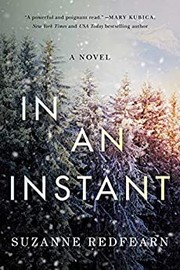
The narrator of In an Instant is dead before the end of the first act. Finn Miller is sixteen, on a ski trip with her family and family friends, when the camper she is riding in goes off a mountain road. She dies in the crash. The rest of the novel is told from where she is afterward, which is not quite heaven and not quite the living world. She can see the survivors. She can move among them. Sometimes she can hear what they are thinking. She cannot touch them, and she cannot make them listen.
That premise could turn the book into a sentimental ghost story. Suzanne Redfearn uses it for something harder. Finn's vantage lets the reader see the choices people make when they think no one is watching. Some of those choices are brave. Some are selfish. Most are both. The novel asks what survival is worth and who gets to decide, and it does not hand out easy answers.
The trip begins in Laguna Beach. Jack Miller is driving an old camper to Big Bear with his wife Ann, their daughters Chloe and Aubrey, their thirteen-year-old son Oz, and Finn's best friend Mo. The Gold family is following: Bob, Karen, and their daughter Natalie. The Millers are not a happy family. Jack and Ann's marriage is strained, Chloe is difficult, and Oz has a mental disability that requires patience the family does not always have. Jack hopes the trip will fix something. It does not.
On the way to dinner, snow starts falling hard. Jack picks up Kyle, a teenage boy stranded on the road. Then a deer appears. Jack brakes, the camper breaks through the guardrail, and they tumble down the mountainside. Finn is killed. Jack breaks his femur. The others survive, at least for now.
The first night
The survivors are trapped in the wreck with no way to call for help. They have to stay warm and wait until morning. Ann and Kyle pull Finn's body out of the camper and put it in the snow. Ann takes Finn's clothes and boots and gives them to Mo, whose own clothes are wet. Karen is furious. She thinks Natalie should have been protected first. The argument is ugly and understandable. Every parent in the camper is trying to keep their own child alive, and there is not enough warmth to go around.
Finn watches all of this. She is not a neutral narrator. She loves her family, and she is angry at them, and she is trying to understand what they are becoming. The novel's supernatural rules are loose. Finn can be in more than one place at once, sort of. She can enter a character's thoughts when the plot needs her to, and then she cannot. One reviewer found this inconsistent, and I see the point. The rules are less important than the intimacy they allow. Finn is the voice of the aftermath, the person who can see the cost of every decision.
Chloe and Vance, her boyfriend, decide to go for help. Jack and Ann tell them to wait. They go anyway. Chloe has a concussion and cannot keep up. Vance leaves her under a tree and continues alone. For a while it looks like he abandoned her. Later we learn that he kept going for help and was found near a campground, badly frostbitten. The novel is careful about that distinction. It wants us to judge Vance, then to revise the judgment, then to sit with the fact that both versions are true. He left her. He also went for help. People can do both.
At dawn, Ann and Kyle leave the crash site to find the road. Kyle ties a scarf around their wrists so they will not get separated. When Kyle falls over a ledge, Ann lets go of the scarf. He falls only a few feet and survives, but Ann has to live with the fact that she released him. She chose her own survival in that instant. The novel does not pretend the choice was simple. It also does not pretend it was evil.
Oz
The most difficult section involves Oz. Mo starts a small fire using a book and a lighter. She melts snow in a broken sunglasses case and gives water to the others. Oz wants more. When Karen reaches for the case, Oz hits her and takes it. He is scared and overwhelmed, and he does not have the skills to explain it. Bob and Karen see a dangerous boy. Bob takes Oz outside, trades him crackers for his gloves, and tells him to go find Ann.
Bob comes back alone. He says Oz wandered off. Mo suspects something is wrong, but she does not know what to do. Oz goes into the wilderness in the wrong direction and is never seen by the group again. A search follows, but no body is found. He is presumed dead. The novel treats his disappearance as a loss, but one critic has argued that Oz's disability is under-researched and that his death does not receive the mourning it deserves. That criticism is fair. Oz is the character who is least able to protect himself, and the book sometimes uses him as a moral test for the adults rather than as a full person.
Bob's role is the novel's central secret. He traded a vulnerable child's gloves for crackers and sent him into a snowstorm. Later, Mo remembers the gloves and tells Captain Burns. Burns questions whether Bob deliberately sent Oz away. A photograph shows Natalie wearing Oz's gloves. Ann confronts Bob. He insists Oz gave him the gloves, but Ann knows Oz would not have given them up. She breaks a wine bottle over Bob's forearm, ends their affair, and sends him away.
The affair is another layer. Ann and Bob had a relationship before the accident, and they resume it afterward. Bob lies to Karen about where he goes. Jack knows about the affair, though Ann does not know he knows. The revelation matters because it shows that the survivors are not only dealing with the crash. They are dealing with the people they were before it. The crash did not create their flaws. It exposed them.
The aftermath
The survivors come home to Laguna Beach, but home is not a refuge. Finn attends her own funeral. Mo returns to school in a wheelchair, her fingers and toes damaged by frostbite, and she is isolated and traumatized. Chloe hoards pain medication and writes farewell notes. She is planning to kill herself. Finn tries to warn Ann and Jack, but she cannot communicate reliably enough to stop it. Mo saves Chloe by bringing her a box of abandoned kittens. The kittens need to be fed and kept warm. They give Chloe a reason to get out of bed. It is a small, ordinary rescue, and it works better than any speech.
Ann starts throwing away Finn's belongings. She does not want to talk about Finn or Oz. Jack becomes angry and resentful. He blames Ann for leaving Oz with Bob, and he is not wrong, but he is also using the blame to avoid his own grief. Their marriage deteriorates. Jack attacks Vance, blaming him for taking Chloe into the storm. Then Jack abducts Vance and takes him to the family cabin. He forces him to spend about a month helping search for Oz. The search finds nothing, but the work helps Vance regain his physical strength and get control of his drug addiction. It is a strange, violent form of therapy, and the novel does not excuse it. It simply shows that Jack needs something to do with his rage.
Mo carries guilt about the gloves. She writes down her memories and speaks with Captain Burns. Burns's questioning is one of the novel's best scenes because it refuses to let anyone off with a clean story. Bob may not have intended Oz to die. That does not change the fact that Oz disappeared because Bob sent him away. Intent and consequence are separate things, and the book is interested in the gap between them.
Ann eventually visits Jack and Vance at the cabin. She admits her own responsibility for leaving Oz with Bob. She also says that Jack's support helped her reach the road. The scene is not a reconciliation. It is an accounting. The family is still broken, but they are telling the truth about how they broke.
The rescue is only half the story. The other half is the story the survivors tell about the rescue. Ann is praised as the hero who walked out of the snow and brought help back. Kyle tells Mo that Ann kept him alive, though he does not initially mention that she let go of him at the ledge. The town wants a clean version: a mother who saved her family, a group of friends who survived a terrible accident. Mo's account complicates that version. She remembers the gloves, the crackers, and the way Oz was sent away. Her testimony does not give the town a villain so much as a set of decisions that cannot be filed under heroism.
That gap between the public story and the private one is where the novel does its real work. The survivors are not lying on purpose, most of them. They are editing, the way people do when the truth is too heavy to carry in public. Ann edits out the ledge. Bob edits out the gloves. Jack edits out his own failures by focusing on everyone else's. Finn, who has no social self left to protect, sees all of it. Her narration is judgmental and tender at the same time, which is a difficult balance. She wants her family to be good, and she keeps catching them being human.
The tether
Finn stays in the living world because the people she loves have not found peace. The novel makes this explicit late in the book. Chloe's recovery and her relationship with Eric, a man she meets at the animal shelter, loosen her tether. Jack donates Finn's belongings and begins to let go. Mo and Kyle become romantically involved, and Finn realizes that Mo's movement toward a future weakens her hold. Finally, at Aubrey's wedding reception, Ann dances with Kyle. The dance is not a grand statement. It is a moment of acceptance, a mother allowing herself to be happy for a few minutes. Finn says goodbye and moves on.
The ending does not claim the family is cured. Grief, guilt, and responsibility remain. Bob's legal fate is left open. Oz is never found. The Millers are not restored to what they were before the crash, because that family did not exist. What changes is that they can move forward. Finn can leave because they can live without her, which is the saddest and most generous thing the book imagines.
What the book is doing
In an Instant is a moral novel disguised as a grief novel. The crash is a pressure cooker. It forces people to decide who gets the boots, who gets the water, who gets to be saved first. The book does not suggest that there is a right answer. It suggests that the answers reveal who people are, and that the survivors have to live with the answers they gave.
The writing is direct and often moving. Redfearn is good at the small physical details of survival: the snow melting in a sunglasses case, the scarf around two wrists, the kittens that need feeding. She is less good at the supernatural mechanics. Finn's omniscience is inconsistent, and the afterlife rules are vague. Some of the recoveries are tidy, especially the romantic pairings. The book also has a problem with Oz. He is written as a burden and a test, and his death does not get the same weight as Finn's.
Still, the novel earns its emotional ending. It understands that grief is not only sadness. It is anger, guilt, sexual confusion, money trouble, and the ordinary work of feeding animals. It understands that people can do terrible things and still be loved. Finn's voice holds all of that together. She is dead, but she is not detached. She is still trying to understand her family, and that trying is the book's heart.
I would recommend it to readers who like family dramas with a speculative hook and do not mind being asked to judge characters who are doing their worst. It is not a comfortable book, but it is a compassionate one. It asks what you would do in an instant, and then it asks what you would do with the rest of your life.
FAQ
Does Oz survive in In an Instant?
No body is ever found. Oz disappears after Bob sends him into the snowstorm, and the characters treat him as lost and presumed dead. The novel does not provide forensic confirmation.
Who narrates In an Instant?
Finn Miller, a sixteen-year-old who dies in the camper crash. She narrates from an afterlife vantage point where she can observe the survivors and sometimes sense their thoughts.
What happens to Bob after Oz disappears?
Mo tells Captain Burns about the gloves, and a photograph shows Natalie wearing them. Ann confronts Bob, ends their affair, and sends him away. The novel does not show a legal prosecution.
Similar books
Summer Island
A radio advice host hides a scandal, and the estranged daughter hired to write about it agrees to care for her at the family's island house.
2,325-word summary · 10 min read

The Accidental Tourist
Grieving Macon writes travel guides for haters of travel, then Muriel intrudes.
2,252-word summary · 10 min read

Kitchen
Orphan Mikage finds home in a kitchen with Yuichi and Eriko after loss.
2,597-word summary · 12 min read
The Winners
Two years on, Beartown opens a new rink, welcomes Maya and Benji home, and faces money fights and a gun at the ice.
2,366-word summary · 11 min read
Leaving Time
Thirteen-year-old Jenna searches for her mother who vanished from an elephant sanctuary ten years earlier.
3,001-word summary · 13 min read
Dear Edward
Twelve-year-old Edward Adler survives a plane crash that kills his family, then learns how to live with grief, letters, and love.
2,903-word summary · 13 min read
My Grandmother Sends Her Regards and Apologises
Seven-year-old Elsa loses her granny and best friend, then delivers apology letters to neighbours while holding onto fairy tales of Miamas and the Land of…
2,311-word summary · 10 min read
Nineteen Minutes
Sterling High student Peter Haddon commits a school shooting and lawyer Jordan McAfee defends him while Josie Cormier hides truth.
2,267-word summary · 10 min read

The Long Winter
Dakota Territory, 1880: seven months of blizzards cut a town off from the railroad, and a family survives on twisted hay, ground wheat, and a dangerous wheat…
2,210-word summary · 10 min read
Little Earthquakes
Four Philadelphia women meet during pregnancy and discover that new motherhood is nothing like the plan, while friendship becomes the thing that holds them…
1,997-word summary · 9 min read

Sam's Letters to Jennifer
A grieving journalist reads her grandmother's letters and finds a decades-long love affair that changes how she sees her family.
2,310-word summary · 10 min read
The Rumor
Two Nantucket best friends, Madeline and Grace, watch a summer of small indiscretions get retold into gossip that reshapes both their households.
2,017-word summary · 9 min read

The Girls in the Garden
Clare moves her daughters to a gated London garden where the community feels safe; at the midsummer party, twelve-year-old Pip finds her sister bleeding in the…
1,973-word summary · 9 min read

We Are Okay
Marin fled San Francisco after her grandfather vanished and stopped answering anyone. When Mabel visits her college dorm, she has to say what happened.
2,253-word summary · 10 min read

Two by Two
Sparks's twentieth novel turns from first love to a marriage breaking up: Russell Green loses his wife and his job, then rebuilds his life around his…
2,192-word summary · 10 min read
The House We Grew Up In
The Bird family of the Cotswolds breaks apart after a suicide and spends twenty years not talking about what happened.
2,198-word summary · 10 min read

At First Sight
Jeremy and Lexie are married and expecting a baby when anonymous emails tell him the child may not be his.
2,317-word summary · 10 min read

A Spool of Blue Thread
Four generations of the Whitshank family in Baltimore, and the silences, resentments and quiet love they hand down without ever saying so.
2,408-word summary · 11 min read

Where We Belong
Marian's orderly New York life cracks when the daughter she gave up for adoption arrives, and the search for the father forces her to tell the truth.
2,056-word summary · 9 min read
The Overdue Life of Amy Byler
A burned-out school librarian gets a summer to herself when her estranged husband returns, and discovers that being a mother does not have to mean losing…
2,055-word summary · 9 min read

Delilah Green Doesn't Care
Delilah returns to Bright Falls to photograph her stepsister's wedding and falls for Claire, a bookstore owner and single mother, while a cruel bet threatens…
2,315-word summary · 10 min read

Days at the Morisaki Bookshop
Heartbroken Takako moves into her uncle's tiny secondhand bookshop in Jimbocho, and the shop and its regulars slowly give her back her life.
2,011-word summary · 9 min read

And Every Morning the Way Home Gets Longer and Longer
An elderly grandfather, his son, and his grandson share memories and fears as the old man's mind begins to fade, in a short novel about grief and love.
2,078-word summary · 9 min read

The Tiger's Wife
A young doctor in a war-scarred Balkan country chases the stories her grandfather left behind, including a deathless man and a deaf girl who loved an escaped…
2,232-word summary · 10 min read
The Storm Sister
Ally D'Aplièse loses her father and her lover within weeks, then follows a brass frog and a Norwegian biography into Anna Landvik's music and the world of…
2,376-word summary · 11 min read
Olive, Again
Elizabeth Strout returns to Crosby, Maine, as Olive Kitteridge marries Jack Kennison, confronts her son, and faces old age, grief, and small-town judgment.
2,333-word summary · 10 min read

Someone Like You
Halley and her best friend Scarlett face a summer of grief, a surprise pregnancy, and Halley's dangerous first romance in Sarah Dessen's 1998 young adult novel.
2,218-word summary · 10 min read

Maame
Maddie Wright, 25, has spent years as the responsible one in her Ghanaian British family, and the year she finally tries to live for herself is the year…
2,108-word summary · 9 min read

Clap When You Land
Two half sisters, one in Sosúa and one in Queens, discover each other after their father dies in a plane crash, in Elizabeth Acevedo's novel in verse.
2,890-word summary · 13 min read

Vanishing Acts
A search-and-rescue worker's perfect life cracks when her past and her father catch up.
2,799-word summary · 12 min read