
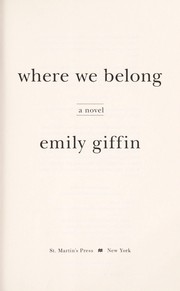
Where We Belong
2,056-word summary 9 min read 384 pages in the book
- First published
- 2012
- Publisher
- St. Martin's Press
- Pages
- 384
- ISBN
- 9780312554194
Reading options
What's inside (11 sections)
I avoided Where We Belong for years because I thought I knew what it was. The cover suggested a certain kind of women's fiction: a successful woman in a nice apartment, a secret from the past, a handsome man who might or might not deserve her. I had read enough of those books to be suspicious of the formula. Then a friend whose taste I trust handed me a copy and said the mother-daughter story was better than the romance. She was right.
Emily Giffin published the novel in 2012 through St. Martin's Press. The first edition hardcover runs 384 pages. It alternates between two narrators, Marian Caldwell and Kirby Rose, and the alternation is the engine of the book. Marian is thirty-six, a television producer in New York, and a woman who has built a life by leaving a piece of it behind. Kirby is eighteen, adopted, and trying to find out where she came from. When Kirby shows up at Marian's door, the novel becomes a conversation between two versions of the same question: what do we owe the people we did not raise?
The knock
Marian's life looks finished in the way that successful people's lives often look finished from the outside. She has a hit show, a penthouse on the Upper East Side, and a boyfriend named Peter Standish, who is the CEO of the network that airs her show. She wants to marry him. He is recently divorced and cautious. The opening scene is a small humiliation: Marian brings up marriage, Peter deflects, and she goes home alone.
Then the intercom buzzes. She expects Peter. Instead, she finds a teenage girl who says, more or less, that she thinks Marian is her mother. Marian recognizes her immediately. Kirby has the same blue-gray eyes as the boy Marian loved when she was eighteen. The recognition is not a plot device. It is a physical shock, and Giffin writes it well. Marian's carefully constructed present cracks in a single sentence.
The rest of the novel is about what happens after that crack. Marian does not immediately become a mother. She does not immediately become honest. She does the thing that people with something to hide often do: she becomes a tour guide. She takes Kirby shopping, to museums, to restaurants. She performs the role of a sophisticated New Yorker because it is easier than performing the role of a mother.
Kirby
Kirby's sections are the best part of the book. She is not a saint, and she is not a problem child. She is a girl who has spent her whole life feeling slightly out of place in her own family. Her adoptive parents, Art and Lynn Rose, are kind and steady. Her younger sister, Charlotte, is their biological child. Kirby loves them, but she has always known that she was wanted in a different way, and that knowledge has shaped her.
Kirby is a drummer. That detail matters. Music is the one place where she does not have to explain herself. She is good at it, and she knows it, and she is not sure what to do with a talent that does not come with a plan. When she visits Marian's office and drums on the table, the writers' room is impressed. It is one of the few moments in the book where Kirby feels like she has something to offer.
Kirby's decision to find Marian is not presented as a crisis. It is presented as a piece of research. She has always known she was adopted. She turns eighteen, contacts the agency, gets a name, and takes a bus to New York without telling her parents. The secrecy is both reckless and understandable. She is not trying to hurt anyone. She is trying to find out who she is.
Her adoptive parents, Art and Lynn, are not villains, and the novel is careful about that. They are ordinary people who wanted a child and got one who did not always fit. Lynn is gentle. Art is practical. They have made mistakes, but they have also shown up. When Kirby overhears them wondering whether her difficult temperament comes from her birth parents, she is hurt, but the reader can see that they are worried rather than cruel. The scene is a good example of Giffin's strengths. She lets ordinary people say the wrong thing and then lets them keep loving each other.
The title works on two levels. It refers to the search for a place where Kirby belongs, and to the search for a version of herself that Marian can accept. The novel is not subtle about this. It returns to the idea of belonging in almost every chapter. But the repetition is earned, because the characters are not asking an abstract question. They are asking where they should eat dinner, who should be at graduation, and what to call each other.
The summer that made everything
The flashbacks to Marian's eighteenth summer are the novel's second engine. Marian met Conrad Knight at a party in Chicago during a heat wave. He was an artist and a musician, good-looking in a way that made her nervous. They spent the summer together. They kept the relationship secret from her parents, who had plans for her, and from his world, which was less structured.
When Marian got pregnant, she took a test. Conrad was with her when she saw the result. She lied and told him it was negative. He was relieved, and then he said he loved her for the first time. She broke up with him soon after, citing the end of summer and her departure for college. She told her mother the truth. Her mother helped her arrange an abortion, but Marian could not go through with it. She deferred college, hid at the family's lake house in Wisconsin, and gave birth on April 1. She named the baby Katherine. Three days later, she signed the adoption papers.
The flashback chapters are painful because they are so ordinary. There is no villain. Conrad is not a monster. Marian's parents are not cruel. The adoption is not forced. It is a decision made by a frightened teenager with limited options and a mother who is trying to help. The novel understands that a decision can be both freely made and deeply coerced by circumstance.
Peter and the cost of secrecy
Marian tells Peter about Kirby, but she does not tell him everything. She leaves out the part about Conrad not knowing. Peter is shaken, but he says he still loves her. The relationship continues, but the secret sits between them. Peter is a decent man, and he is also a man who has just learned that his girlfriend is capable of keeping a very large secret for a very long time. That knowledge changes how he sees her.
The novel is smart about the way secrets damage relationships. Marian's secrecy is not a single lie. It is a habit. She has spent her adult life deciding what people do not need to know. She has told herself that she is protecting them, but she is also protecting herself. When Peter pushes her to tell Conrad, she resists. When her mother reveals that Marian's father knew about the pregnancy all along, the family's history shifts. The secret was never as contained as Marian thought.
The Peter plot is the weakest part of the book. He is more of a symbol than a character. He represents the life Marian has built, and his disappointment represents the cost of that life. The novel is not very interested in him, and neither was I. The scenes with Conrad are more charged because Conrad is not just a boyfriend. He is the road not taken.
Chicago
The trip to Chicago is the emotional climax. Marian and Kirby go to meet Conrad. Before they do, Marian sees her father. Their conversation at Gillson Park is the first honest one they have had in years. He tells her he was never disappointed in her. He tells her he cannot wait to meet his granddaughter. The scene is short, and it is one of the few places where the novel earns its tears.
Conrad is not what Marian expected. He is still a musician. He owns a bar called Zelda's. He is not rich, and he is not a failure. He is a man who has built a life without her. When Marian tells him about the pregnancy, he is angry. He has a right to be. She lied to him, and she kept his daughter from him for eighteen years. The novel does not let her off the hook.
The scene where Conrad meets Kirby is the best in the book. They bond over music. He invites her onstage. She drums while he plays guitar. The crowd gives them a standing ovation, and he introduces her as his daughter. It is a little too perfect, but it is also the kind of moment that the novel has been promising. Kirby gets a father who looks like her and understands the thing she loves. Marian gets to see the two of them together.
The ending
The ending is deliberately unresolved. Marian does not marry Peter. She breaks off the engagement because she realizes she wants something more honest. Conrad does not immediately forgive Marian. He tells her he hates what she did, and he is trying not to hate her. They have a conversation at the bar, and he leaves without promising anything. The last image is Marian alone, at peace, imagining a new story about a musician and his daughter.
I liked the ending because it did not solve the problem. Kirby has two families now. Marian has a daughter and a complicated past. Conrad has a daughter and a justified anger. None of these relationships are finished. The novel is about learning to live with the mess, not about cleaning it up.
What the book gets right
Where We Belong is very good at the texture of adoption. It does not treat adoption as a simple gift or a simple wound. It shows the adoptive parents as real people with their own insecurities. It shows the birth mother as a person who made a decision and then had to live with it. It shows the child as a person who has her own questions and her own loyalties.
The novel is also good at class. Marian's New York life is expensive and polished. Kirby's St. Louis life is more ordinary. The book does not pretend that money does not matter. It shows how money shapes the choices people can make, and how it shapes the way they present themselves to the world.
Where it creaks
The novel is predictable. The rich boyfriend is less interesting than the sensitive musician. The secret comes out. The families reconcile. The ending is open but hopeful. Readers who want surprises will not find many here.
Marian is also hard to like for long stretches. She is self-absorbed, and she treats Kirby like a project. The novel knows this, but it does not always push her hard enough. Some of the other characters, especially Peter and Kirby's adoptive parents, are underdeveloped. The book is more interested in Marian's inner life than in theirs.
The prose is serviceable rather than distinctive. Giffin is good at dialogue and at the small details of upper-middle-class life. She is less good at description. Some scenes feel like they were written to be adapted, with clean entrances and exits.
Why it works
What makes the book work is the relationship between Marian and Kirby. They are not a natural mother-daughter pair. They are two women who share a history they did not choose. The novel lets them be awkward, angry, and curious. It lets them disappoint each other. It lets them try again.
Where We Belong is not a great novel. It is a good one, and it is good at something that matters. It takes a story that could have been a soap opera and gives it enough honesty to hurt. The last chapter is not a resolution. It is a beginning, and that is the right note to end on.
FAQ
Is Where We Belong about adoption?
Yes. It alternates between Marian, who gave up a baby at eighteen, and Kirby, the daughter who finds her.
Do Marian and Conrad get back together?
The novel leaves it open. They have an honest conversation, but Conrad does not promise anything.
Does Marian marry Peter?
No. She breaks off the engagement because she wants a more honest life.
Similar books
The Rumor
Two Nantucket best friends, Madeline and Grace, watch a summer of small indiscretions get retold into gossip that reshapes both their households.
2,017-word summary · 9 min read
Between Sisters
Estranged sisters Meghann and Claire reunite in Washington when Claire announces a rushed wedding, then face their mother's desertion and a medical crisis.
2,467-word summary · 11 min read
Troubles in Paradise
In the final Paradise novel, Irene Steele rebuilds her life on St. John while the truth about Russ's death and Todd Croft's criminal empire finally surfaces.
2,471-word summary · 11 min read
The Overdue Life of Amy Byler
A burned-out school librarian gets a summer to herself when her estranged husband returns, and discovers that being a mother does not have to mean losing…
2,055-word summary · 9 min read
Ghosted
After seven perfect days with Eddie, Sarah is ghosted, and her search for answers uncovers a secret tied to the accident that changed both their lives.
2,011-word summary · 9 min read
Three Wishes
Triplet sisters Lyn, Cat and Gemma Kettle blow up their thirty-fourth birthday dinner in Sydney, then rewind a year of affairs, pregnancies and family chaos.
2,262-word summary · 10 min read
Heart of the Matter
Two Boston mothers collide after a burn injury puts a single mom in the orbit of another woman's surgeon husband.
2,585-word summary · 11 min read
All We Ever Wanted
A Nashville photo of a drunk boy over a passed out girl splits three families along money and race lines.
2,278-word summary · 10 min read

What Happened to Goodbye
Mclean has reinvented herself in four towns since her parents divorced. In Lakeview she uses her real name, and for the first time staying put becomes a choice.
2,796-word summary · 12 min read

The Japanese Lover
A Polish refugee and the son of a Japanese gardener fall in love in San Francisco in 1939, then keep the affair secret for nearly seventy years.
2,286-word summary · 10 min read

The Shadow Sister
Star D'Apliese steps out of her sister's shadow and follows a bookshop clue into the Edwardian life of Flora MacNichol, a woman who gave up love for duty.
2,260-word summary · 10 min read

Little Earthquakes
Four Philadelphia women meet during pregnancy and discover that new motherhood is nothing like the plan, while friendship becomes the thing that holds them…
1,997-word summary · 9 min read
Mrs. Everything
Two Jewish sisters in Detroit grow up, apart and together, across seven decades of American life, from the 1950s to the 2016 election.
2,362-word summary · 10 min read
The Unmaking of June Farrow
A woman in a North Carolina flower-farming family walks through a red door into 1951, where she must solve her mother's disappearance and decide whether to…
2,701-word summary · 12 min read
Ricochet
Lily Calloway tries to stay celibate for ninety days while Loren is in rehab, leaning on Rose, Connor, and Ryke as therapy forces her to face her childhood.
2,575-word summary · 11 min read
Under Locke
Iris Taylor moves to Austin broke and wary, takes a front-desk job at a tattoo shop, and spends the book learning that Dex Locke’s blunt cruelty and unexpected…
2,591-word summary · 12 min read
Summer Island
A radio advice host hides a scandal, and the estranged daughter hired to write about it agrees to care for her at the family's island house.
2,325-word summary · 10 min read

Sam's Letters to Jennifer
A grieving journalist reads her grandmother's letters and finds a decades-long love affair that changes how she sees her family.
2,310-word summary · 10 min read
Act Your Age, Eve Brown
Eve Brown crashes into a Lake District bed and breakfast, breaks the owner's arm, and talks her way into his kitchen. A grumpy-sunshine romance about work,…
2,474-word summary · 11 min read

The Girls in the Garden
Clare moves her daughters to a gated London garden where the community feels safe; at the midsummer party, twelve-year-old Pip finds her sister bleeding in the…
1,973-word summary · 9 min read

Two by Two
Sparks's twentieth novel turns from first love to a marriage breaking up: Russell Green loses his wife and his job, then rebuilds his life around his…
2,192-word summary · 10 min read
The Echo of Old Books
Barbara Davis's 2023 novel sends a rare-book dealer in 1984 New Hampshire hunting for the authors of two unpublished volumes that tell opposite sides of one…
2,491-word summary · 11 min read
The House We Grew Up In
The Bird family of the Cotswolds breaks apart after a suicide and spends twenty years not talking about what happened.
2,198-word summary · 10 min read
Euphoria
Three anthropologists in 1930s New Guinea turn fieldwork into a love triangle, and a real history breathes behind them.
2,048-word summary · 9 min read

At First Sight
Jeremy and Lexie are married and expecting a baby when anonymous emails tell him the child may not be his.
2,317-word summary · 10 min read

2 States: The Story of My Marriage
A Punjabi boy from Delhi and a Tamil Brahmin girl from Chennai meet at IIM Ahmedabad, and turn a love marriage into a campaign to convince two families.
2,634-word summary · 12 min read
What the Wind Knows
Annie scatters her grandfather's ashes on Lough Gill and is pulled into 1921 Ireland, where she becomes the missing Anne Gallagher and falls for Dr. Thomas…
2,056-word summary · 9 min read
This Is How You Lose Her
Yunior cycles through love affairs and betrayals in nine linked stories, tracing the damage he does and the family history behind it.
2,195-word summary · 10 min read
The Second Summer of the Sisterhood
Four friends share the traveling pants through a summer of grandmothers, first loves, and mothers who are learning to let go.
2,209-word summary · 10 min read
In an Instant
After a family camper crashes down a snowy mountain, sixteen-year-old Finn watches from the afterlife as survivors make impossible choices and try to live with…
2,130-word summary · 9 min read