
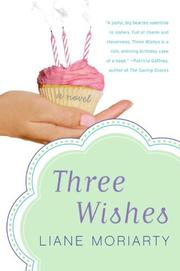
Three Wishes
2,262-word summary 10 min read 384 pages in the book
- First published
- 2003
- Publisher
- Pan Macmillan
- Pages
- 384
- ISBN
- 9780060586133
Reading options
What's inside (8 sections)
The birthday dinner where it all blows up
I picked this one up because of Big Little Lies, like half the readers who find it, and I had that little jolt you get when a writer you know for polished suspense turns out to have started somewhere much messier and warmer. Three Wishes was Liane Moriarty's first novel, written while she was studying at Macquarie University in Sydney and published by Pan Macmillan in 2003, years before the HBO deals and the number one bestseller lists. You can feel the newness in it. Not in a bad way. More like watching early footage of a band before they learned to stand still on stage.
The book opens at the end, which I loved. The Kettle triplets, Cat, Lyn and Gemma, are out at a smart Sydney seafood restaurant for their thirty-fourth birthday, and the whole scene is told through the eyes of the staff and the other diners. Nobody can quite agree on what happened. Everyone agrees it was spectacular. One sister stands up, accuses the other two of ruining her life, and throws a fondue fork. It lands in the pregnant belly of a third sister, and the night ends with all three being carted off to hospital.
That is a hell of an opening image, and Moriarty knows it. The rest of the novel rewinds almost a full year to show how three grown women walked into that restaurant in that state. The structure works because every chapter makes the fork feel a little more earned and a little more awful at the same time. By the time you circle back to the restaurant, you are dreading it.
Meet the Kettles
Cat, Lyn and Gemma Kettle are thirty-three when the main story starts, living in Sydney and attracting attention everywhere they go, which sounds glamorous until you see the cost of it. Cat and Lyn are identical blondes. Gemma is the fraternal third, a redhead, and she jokes that she is the one who did not have to share her egg in the womb. That one detail tells you most of what you need about the family pecking order. Two of them match. One of them does not, and she has spent her whole life half proud and half stung by it.
Moriarty gives each sister a distinct operating system. Cat, full name Catriona, is intense and competitive, the kind of person who keeps score without meaning to. Lyn is the overachiever, the organizer, the one with the checklists and the five year plans and the color coded everything. Gemma drifts. She works odd jobs, rents odd flats, and has a firm policy of ending every romantic relationship at around the six month mark, before anyone can get too close or ask too much of her.
The parents are a comedy act that slowly turns serious. Frank and his wife had the girls when they were only nineteen, after a backseat encounter in his father's car that the family treats as legend. By the time of the novel the parents are divorced, and the running joke is that they have started dating each other again, which horrifies and delights the daughters in equal measure. There is also a grandmother who is sharper with technology than anyone her age has a right to be, firing off emails while her granddaughters fumble. I found these older characters a genuine pleasure. They stop the book from becoming three young women complaining in a locked room, and they give the family history some weight.
What Moriarty gets right, and what made me trust her early, is the texture of triplet life. Strangers ask stupid questions. Shop assistants stare. The sisters have assigned roles they cannot resign from: the responsible one, the difficult one, the funny one. And underneath the bickering there is a loyalty so total it frightens the men who try to marry into it. Every boyfriend has to understand he is not dating one woman. He is auditioning before a panel of three.
Cat's year falls apart
Poor Cat. There is no other way to put it, and plenty of readers have said the same: of the three sisters, she draws the shortest straw by a mile, and the book sometimes feels like it is piling on.
It starts on an ordinary evening. She and her husband Dan are watching a movie, or half watching it, and he tells her, in that sideways way people confess things when they cannot look at you, that he has been having an affair. The other woman is called Angela. Cat throws him out onto the couch, then tries to take him back, then tries counseling, cycling through fury and bargaining the way people actually do instead of the way movie characters do. Moriarty writes these weeks well. The scenes in the counselor's office have that cramped, airless quality, two people performing reasonableness while thinking about who gets which friends.
Then comes the twist of the knife. Angela turns out to be the sister of Charlie, who happens to be Gemma's latest boyfriend. So Cat's private humiliation is suddenly a family group chat topic, and her messiest sister is dating the brother of the woman sleeping with her husband. You can see why the birthday dinner ends with flying cutlery.
Underneath the affair plot sits the thing Cat actually wants and cannot have. She has been trying to get pregnant for ages with no luck, while Lyn already has a daughter and keeps, without meaning any harm, being a mother all over the family gatherings. Cat does conceive at one point, and for a few chapters there is a fragile hope, and then she miscarries. I thought these passages were the strongest in the book. Moriarty does not dress the grief up. Cat is jealous of her sister and ashamed of being jealous, desperate for a baby and furious at being desperate, and the contradiction just sits there without being solved for her.
Dan, to be blunt, ends up leaving for good and building a life with Angela, which will strike some readers as the book letting the cheater off easy. I think Moriarty's point is colder and more honest than that. Sometimes the person who blows up your life does not get punished. They just move on, and you are left holding the cleanup bill. Cat ends the novel alone but pointed in a new direction, which feels right even if it does not feel fair.
Lyn holds everything together until she cannot
Lyn looks, from the outside, like the sister who won. She has the husband, the daughter, the career, the house that runs on rails. Her chapters are full of lists and schedules, and at first she reads like comic relief, the woman who would laminate the family if she could.
The slow reveal is that the competence is load bearing. Lyn manages everyone because she is terrified of what happens if she stops. Her marriage has gone stale in the specific way that long marriages do, where nobody has done anything wrong and nobody is happy either. Her husband feels sidelined by her efficiency. Work keeps demanding more. And her sisters keep arriving with emergencies that she drops everything to fix, then resents them for, then feels guilty about resenting.
There is a scene, I think about halfway through, where Lyn realizes she has been treating her own life like a project plan, with milestones for happiness that keep sliding, and it lands because Moriarty has spent a hundred pages showing you the machinery instead of just announcing the theme. Lyn's arc is the quietest of the three. She does not get the affair or the pregnancy. She gets the ordinary crisis of a woman who did everything right and still feels hollow, and she has to learn to let some plates smash instead of spinning them forever.
I will admit Lyn tested my patience in the early chapters. She can be rigid and a bit superior, especially toward Gemma, and there were moments I wanted to shake her. That is probably intentional. Sisters are allowed to annoy each other, and allowed to annoy the reader, as long as the writer knows what she is doing. By the final third I was rooting for her, not because she became perfect but because she loosened her grip on purpose.
Gemma and the question of growing up
Gemma is the sister most readers will either adore or want to throttle, sometimes within the same chapter. She is funny, warm, flaky, allergic to commitment, and completely aware of all of it. The six month rule on boyfriends is not presented as cute. It is presented as a defense system built by someone who watched closeness go wrong up close and decided never to let it get that far.
Charlie, the decent boyfriend with the unfortunate sister, is the first man who makes the system glitch. He is patient without being a saint, which is a hard balance to write, and Gemma keeps waiting for the catch. Around the same time, Gemma discovers she is pregnant, which detonates every plan she never made. She is the least prepared person imaginable for a baby and she knows it.
This is where the plot takes its biggest swing. Gemma, overwhelmed and convinced Cat would be the better mother, promises her baby to Cat. It is the kind of offer that sounds generous and selfless for about a day, until the reality of it settles over both women. Cat, starved for a child after the miscarriage, clings to the promise. Gemma, feeling the pregnancy turn real inside her, starts to pull back. Neither of them says what she means in time. If you have ever watched two people who love each other negotiate something impossible by being polite about it, you will recognize every page.
When Gemma changes her mind, at the birthday dinner, in public, with champagne involved, Cat snaps, and the fork flies. I am deliberately not smoothing this into a moral. The book does not ask you to pick a side. Gemma was wrong to offer what she could not give. Cat was wrong to build a future on it. The restaurant is where all that months long politeness finally runs out of road.
Gemma's ending is the happiest of the three, more or less: she keeps the baby, she gives Charlie a real chance, she starts showing up. Readers who dislike her will call this unearned. I thought it worked because Moriarty makes Gemma's growth small and specific instead of grand. She does not transform. She just stops running just often enough for a life to catch her.
What the fork actually means, and where the book wobbles
So what is this novel actually about, under the farce? I think it is about the year all three Kettles stop performing their assigned roles. The responsible one admits she is drowning. The lost one decides to stay. The wounded one stops waiting for her old life to be returned and starts building a different one. The final chapters bring the sisters back together without pretending the damage evaporated, and the tone of those scenes felt true to me. Families do not resolve. They regroup.
Now the fair criticism, because a debut this charming still has debut problems. The middle of the book sags. There are subplots, the parents dating, the grandmother's emails, workplace tangles, that eat pages without always earning them, and at 384 pages in the standard paperback edition the story could have lost thirty or forty without pain. Readers coming from Moriarty's later thrillers should reset their clocks: this is a comedy of manners with sad bits, not a page turner with twists. The Publishers Weekly review at the time called the plot predictable while praising the characters, and that still reads like the correct verdict.
The other complaint you will hear, and I share it, is the lopsided suffering. Cat absorbs the affair, the infertility, the miscarriage, the broken promise and the public humiliation, while her sisters' troubles stay firmly in the fixable range. It makes the ending feel uneven, like two sisters got comedies and one got a drama that wandered in from another book. Moriarty mostly pulls it off through honesty, but there were evenings I had to put the book down because Cat could not catch a break and I needed her to catch one.
Who should read it? If you like Moriarty's voice, the Sydney settings, the women's friendships that hold her later books upright, this is the prototype, looser and funnier and less controlled. If you only like her for the suspense machinery, this will feel slow and soapy, and you should start with The Husband's Secret instead. For me, the surprise was how much of her later skill is already here: the multiple viewpoints, the domestic detail, the jokes that turn sad if you look at them twice.
One last thing I keep thinking about. Moriarty wrote this book as coursework, pushed partly by watching her sister Jaclyn get published first. There is something fitting in that. A novel about three sisters competing and rescuing each other, written by a woman with writing sisters, in a burst of relief at finally doing the work every day. You can feel that relief on the page. For all its flab and all its farce, the book is having a good time, and most of the time I was having one alongside it.
FAQ
When was Three Wishes first published?
Pan Macmillan published it in Australia in 2003. Moriarty wrote it as part of her creative writing masters at Macquarie University in Sydney.
Who are the three sisters in Three Wishes?
Cat and Lyn are identical blondes and Gemma is their fraternal redheaded sister. The three are thirty-three when the story starts and turn thirty-four at the opening birthday dinner.
What happens to Cat's marriage in Three Wishes?
Dan confesses to an affair with a woman named Angela, who turns out to be the sister of Gemma's boyfriend Charlie. Cat tries counseling before the marriage ends for good.
Similar books
Where We Belong
Marian's orderly New York life cracks when the daughter she gave up for adoption arrives, and the search for the father forces her to tell the truth.
2,056-word summary · 9 min read
Troubles in Paradise
In the final Paradise novel, Irene Steele rebuilds her life on St. John while the truth about Russ's death and Todd Croft's criminal empire finally surfaces.
2,471-word summary · 11 min read
Ghosted
After seven perfect days with Eddie, Sarah is ghosted, and her search for answers uncovers a secret tied to the accident that changed both their lives.
2,011-word summary · 9 min read
When We Believed in Mermaids
ER doctor Kit flies to New Zealand when fire victim may be sister Josie.
2,020-word summary · 9 min read
The Hypnotist's Love Story
A hypnotherapist falls for a widower whose ex keeps watching from the shadows.
2,490-word summary · 11 min read

The Shadow Sister
Star D'Apliese steps out of her sister's shadow and follows a bookshop clue into the Edwardian life of Flora MacNichol, a woman who gave up love for duty.
2,260-word summary · 10 min read
The Unmaking of June Farrow
A woman in a North Carolina flower-farming family walks through a red door into 1951, where she must solve her mother's disappearance and decide whether to…
2,701-word summary · 12 min read

Shopaholic and Sister
Becky Brandon returns from a ten-month honeymoon to meet the half-sister she always wanted, then discovers that Jess is thrifty, prickly, and nothing like the…
2,591-word summary · 12 min read
The Rumor
Two Nantucket best friends, Madeline and Grace, watch a summer of small indiscretions get retold into gossip that reshapes both their households.
2,017-word summary · 9 min read
The Echo of Old Books
Barbara Davis's 2023 novel sends a rare-book dealer in 1984 New Hampshire hunting for the authors of two unpublished volumes that tell opposite sides of one…
2,491-word summary · 11 min read
Between Sisters
Estranged sisters Meghann and Claire reunite in Washington when Claire announces a rushed wedding, then face their mother's desertion and a medical crisis.
2,467-word summary · 11 min read
The House We Grew Up In
The Bird family of the Cotswolds breaks apart after a suicide and spends twenty years not talking about what happened.
2,198-word summary · 10 min read
Eligible
Austen's Bennet sisters move to modern Cincinnati, where marriage is a reality show and the house is losing its value.
2,293-word summary · 10 min read
The Overdue Life of Amy Byler
A burned-out school librarian gets a summer to herself when her estranged husband returns, and discovers that being a mother does not have to mean losing…
2,055-word summary · 9 min read

The Storm Sister
Ally D'Aplièse loses her father and her lover within weeks, then follows a brass frog and a Norwegian biography into Anna Landvik's music and the world of…
2,376-word summary · 11 min read
The Keeper of Happy Endings
Barbara Davis's 2021 standalone braids a Paris dressmaker's wartime losses with a grieving Boston artist who unlocks her family's secrets through an old row…
2,437-word summary · 11 min read
Garden Spells
Two sisters reunite in their family home in Bascom, North Carolina, where an apple tree shows anyone who eats from it the biggest event of their life.
2,030-word summary · 9 min read
True Colors
Three Grey sisters split over love and duty after their father judges them.
2,596-word summary · 12 min read

The Sky Is Everywhere
Lennie grieves Bailey while torn between Toby and Joe.
2,251-word summary · 10 min read
The Identicals
Twin sisters swap Nantucket and Martha Vineyard lives for a summer.
2,556-word summary · 11 min read
Everything We Keep
A widow questions her husband's death when a stranger claims his past.
2,307-word summary · 10 min read
The Starter Ex
A retired bad-girlfriend-for-hire takes one last job and falls for the mark.
2,092-word summary · 9 min read
The Seven Sisters
Maia follows Pa Salt clue from Geneva to Rio and Christ the Redeemer.
2,210-word summary · 10 min read
Practical Magic
Orphaned sisters Sally and Gillian Owens flee magic and love, until Gillian returns with a dead boyfriend and Sally must face the family curse.
2,974-word summary · 13 min read

Next Year in Havana
A Cuban-American writer takes her grandmother's ashes to Havana and finds a hidden 1959 love that reshapes her family story.
2,962-word summary · 13 min read
After We Fell
With Tessa's father back and a Seattle move looming, she and Hardin face family secrets that push their love to its edge.
2,121-word summary · 9 min read
The Forgotten Garden
A Brisbane woman traces a century old abandonment from an English country house to a Cornish cove and a hidden author.
2,056-word summary · 9 min read
In Her Shoes
Philadelphia lawyer Rose takes in her wayward sister Maggie until a betrayal splits them, sending both toward their long-lost grandmother in Florida.
2,781-word summary · 12 min read
The Thorn Birds
Meggie loves priest Ralph across decades on Drogheda sheep station.
2,280-word summary · 10 min read
The Lucky One
Marine Logan finds photo lucky and seeks Beth in North Carolina.
2,590-word summary · 12 min read