
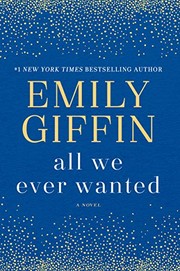
All We Ever Wanted
2,278-word summary 10 min read 368 pages in the book
- First published
- 2018
- Publisher
- Ballantine Books
- Pages
- 368
- ISBN
- 9780399178948
Reading options
What's inside (7 sections)
I have read Emily Giffin since Something Borrowed in college and came to All We Ever Wanted expecting breezy Nashville wealth with a conscience. It delivers that and more discomfort than expected. Set among private school parents, it follows three voices after a photo shows a drunk boy over a passed out girl at a party. At 368 pages it reads fast and leaves arguments about privilege, race, and consent that linger past the last porch scene.
The photo
Finch Browning, eighteen and golden with old Nashville money, attends a party where Lyla, fifteen and Black and scholarship new, drinks too much and passes out on a bed. Tom, Finch's best friend with a rougher edge, lies over her for a photo Finch snaps and shares with a joke caption. The image travels through phones before adults wake. Lyla's single father Marcus sees it at work and feels sick. Nina Browning, Finch's mother who married into wealth from modest roots, sees it and feels shame that curdles to action. Kirk Browning, father who funds private school wings, sees liability to manage.
Giffin opens with the photo rather than the party to focus on aftermath over salacious detail. What exactly happened on the bed stays disputed through most of book. Tom says nothing sexual beyond posing. Lyla remembers little through blackout and fears worse. Finch says he stopped a worse act by taking photo as joke, a defense that sounds self serving and might hold partial truth. Police find insufficient evidence for charges though school holds hearings. The ambiguity frustrates readers wanting clear villain and victim. That frustration is intentional. Real cases often lack proof beyond photo and memory gaps. Judgment must happen in communities without courts, through schools, friendships, and wallets. Messy is the point.
What works is how quickly money moves to smother. Kirk calls the school head, a friend from club, to handle quietly. Lawyers draft apologies that admit nothing. Donations are mentioned near discipline talks. Marcus, who works multiple jobs to keep Lyla in school, is offered help with bills that feels like hush. He refuses though rent looms because dignity matters more than ease. Giffin, who writes wealth from inside knowledge, shows how soft power works through concern rather than threats. We want to help, let us handle. Help that requires silence is control. Nina, who once needed help herself, recognizes the script and breaks from husband over it. That break drives the novel more than any hearing.
Nina, Marcus, and Tom's mother
Nina Browning carries the book as conscience with complicity. Raised middle class, married rich, volunteers at charities she also uses for status. She loves Finch fiercely and sees him clearly as entitled boy who needs consequences, not rescue. She pushes Kirk to let school punish, visits Lyla's father to apologize without lawyers, and befriends Tom's mother to understand rather than excuse. Her voice is warm and judgmental in ways that feel true to PTA circles. She gossips while doing good. Friends freeze her out for breaking rank by believing a scholarship girl over donors. That social cost is described with anthropological glee. Seating charts shift. Invitations vanish. Book club goes quiet when she enters. Giffin knows these rooms and shows their teeth behind smiles.
Marcus, Lyla's father, provides the book's moral spine without sainthood. Former athlete whose injury ended dreams, now working security and driving to keep Lyla in school that might lift her. He loves with high expectations that burden a teen who wants normal fun. After the photo, he wants police, expulsion, and public apology. He gets meetings where officials praise his dignity while offering private settlements. He refuses money though bills pile because accepting would teach Lyla her pain has price others set. His pride costs them comforts Nina could give easily. That pride is both strength and flaw. It protects dignity while limiting options in systems built for wealthy to pay their way out. Readers will debate whether he should have taken funds for Lyla's future. The book lets both answers stand.
Tom's mother, single and working class, loves a son who may have assaulted and who certainly posed. She defends publicly while doubting privately, a split Giffin writes with sympathy that never excuses. She works double shifts to pay lawyer consults, asks Tom for truth and gets shifting stories, and clings to Finch's family for help that comes with condescension. Her chapters show how poor white families navigate scandals without cushions rich families buy. Apologize fully and be expelled, or minimize and be hated. No third door of quiet donation and restored reputation. That inequality of consequence is the novel's sharpest point about class, sharper even than race though race intertwines. Wealth buys second chances denied to others for same acts.
School hearings and fallout
The school hearing, held without police standard of proof, becomes the book's courtroom with lower stakes and higher social costs. Testimony from teens who were drunk, texts with jokes that read cruel sober, a nurse who saw Lyla that night. Finch admits taking and sharing photo, denies assault beyond. Tom admits posing, denies more with less credibility due to prior fights. Lyla testifies through shaking about blackout and fear, brave in ways that cost sleep for weeks after. Panel suspends both boys for semesters though expulsion was possible. Parents react along money lines. Kirks accept to move on. Tom's mother weeps at lost scholarship. Marcuses find suspension too light and too heavy at once. Too light for harm, too heavy for a boy who may have done less than feared but more than admitted.
Fallout spreads through friendships and marriages rather than ending at hearing. Nina and Kirk separate over whether to protect Finch from record or let record teach. Nina moves to smaller house, volunteers more, learns to listen without fixing. Finch, sent to work with a charity mentor, begins to understand impact beyond punishment through manual labor and apologies that are not accepted on schedule. Lyla changes schools to escape stares though she did nothing wrong, a common outcome that angers. Tom disappears from Nashville circles to relatives upstate, his future narrowed. No one gets what they wanted at the start of senior year. That lack of triumph feels honest for a novel about privilege. Consequences redistribute discomfort without equalizing power. Rich still land softer, but softness now includes shame they cannot buy away because Nina and Marcus refuse to play quiet.
A fair criticism is that Black characters orbit white conscience more than lead. Lyla gets fewer chapters than Nina, Marcus fewer than Kirk. Giffin, white writer tackling race and assault, centers a white mother's awakening in ways some readers will find familiar to a fault. She tries to counter through Marcus's full interiority and Lyla's sharp observations about Nashville politeness that masks. Those voices ring true, but page time still tilts. Read with that lens open and pair with books by Black authors on same themes for fuller shelf. The novel works best as portrait of white wealth confronting itself, less as portrait of Black girlhood surviving it, though it strives toward both.
Read it for book club arguments that will run long, for Nashville private school anthropology with heart, and for a page turner that asks what justice looks like without prison. At 368 pages it moves fast with short chapters made for just one more. It will make you check your own school's discipline gaps and donation ties. Who gets suspended and who gets counseled quietly. Follow money and race through halls. Then ask what Nina asks at the end while serving meals she once only funded. How to help without controlling. Stay to wash dishes after gala. That is a start.
Finch, Tom, and Lyla's father
Finch Browning, eighteen with old money manners and new guilt, carries the book's most uncomfortable growth because he is both perpetrator and kid. He snapped the photo as joke to impress Tom, shared without thinking of Lyla as person with father who would see, then watched it travel beyond recall. His apologies evolve from lawyer drafted to handwritten to in person work at a charity his mother arranges. None satisfy Lyla, nor should they on schedule. Giffin lets him sit with being disliked by girls he wanted to impress, a punishment worse than suspension for a boy raised on approval. He learns to ask what Lyla needs rather than what restores his image, a shift that takes months and setbacks including a drunk text that reopens wounds. Growth here is slow and incomplete, which feels honest for eighteen. Change starts, does not finish, by last page.
Tom, best friend with rougher edges and less cushion, shows how class shapes consequence for same act. Where Finch gets suspension and service, Tom faces expulsion talk and lost scholarship whispers because his mother cannot donate a library. He lies more because he has more to lose from truth, a paradox that makes him less sympathetic and more pitiable. His mother defends fiercely while privately doubting his story about posing versus assaulting, a split that ages her visibly through book. When Tom disappears upstate to relatives, it reads as exile rather than escape. No charity placement, no gap year rebrand. Just gone from Nashville circles that will forget his name while remembering Finch's with pity. That disparity is Giffin's sharpest class point. Same photo, different futures based on last names and bank statements.
Marcus, Lyla's father, holds dignity under pressure that would break many written as saints. He works security nights and drives days to keep Lyla in school, refuses hush money that would pay rent for a year, and demands a hearing though lawyers warn it will traumatize Lyla more. His love includes high expectations that burden a teen who wants to disappear after humiliation. Be strong, tell truth, hold head high. Lyla tries because father asks, then resents the performance of strength when she wants to hide. Their fights about whether to fight at all ring true for Black families navigating white institutions that promise fairness while practicing familiarity. Marcus chooses fight though cost is clear. That choice, made with eyes open about odds, defines parental love as advocacy rather than protection from pain. You cannot shield. You can stand beside while they stare.
Finch, Tom, and Lyla's father (continued)
School counselors and coaches add institutional texture that keeps the novel from becoming only family drama. A counselor who likes Lyla pushes for restorative circles though head fears donor backlash. A coach who needs Tom for playoffs benches him anyway to show team rules matter, then quietly helps him transfer to protect future. Those mixed motives feel true to schools balancing mission and money. Neither hero nor villain, just adults navigating incentives Giffin maps without caricature. Even Kirk, who starts as checkbook dad, ends attending workshops on consent though uncomfortable, a small growth the book does not oversell as redemption. Change as attendance rather than transformation is enough to note without celebrating. Show up, listen, pay for counseling without controlling outcome. That is the start Nina models and others follow unevenly.
Finch Browning, eighteen with old money manners and new guilt, carries the book's most uncomfortable growth because he is both perpetrator and kid. He snapped the photo as joke to impress Tom, shared without thinking of Lyla as person with father who would see, then watched it travel beyond recall. His apologies evolve from lawyer drafted to handwritten to in person work at a charity his mother arranges. None satisfy Lyla, nor should they on schedule. Giffin lets him sit with being disliked by girls he wanted to impress, a punishment worse than suspension for a boy raised on approval. He learns to ask what Lyla needs rather than what restores his image, a shift that takes months and setbacks including a drunk text that reopens wounds. Growth here is slow and incomplete, which feels honest for eighteen. Change starts, does not finish, by last page.
Tom, best friend with rougher edges and less cushion, shows how class shapes consequence for same act. Where Finch gets suspension and service, Tom faces expulsion talk and lost scholarship whispers because his mother cannot donate a library. He lies more because he has more to lose from truth, a paradox that makes him less sympathetic and more pitiable. His mother defends fiercely while privately doubting his story about posing versus assaulting, a split that ages her visibly through book. When Tom disappears upstate to relatives, it reads as exile rather than escape. No charity placement, no gap year rebrand. Just gone from Nashville circles that will forget his name while remembering Finch's with pity. That disparity is Giffin's sharpest class point. Same photo, different futures based on last names and bank statements.
Marcus, Lyla's father, holds dignity under pressure that would break many written as saints. He works security nights and drives days to keep Lyla in school, refuses hush money that would pay rent for a year, and demands a hearing though lawyers warn it will traumatize Lyla more. His love includes high expectations that burden a teen who wants to disappear after humiliation. Be strong, tell truth, hold head high. Lyla tries because father asks, then resents the performance of strength when she wants to hide. Their fights about whether to fight at all ring true for Black families navigating white institutions that promise fairness while practicing familiarity. Marcus chooses fight though cost is clear. That choice, made with eyes open about odds, defines parental love as advocacy rather than protection from pain. You cannot shield. You can stand beside while they stare.
FAQ
When was All We Ever Wanted published?
Ballantine Books published it in 2018. It runs 368 pages with ISBN 9780399178948.
Is it part of a series?
No. It is a standalone novel about privilege and assault in Nashville.
Whose voices tell it?
Nina Browning, whose son Finch photographed Lyla with Tom, plus Lyla's father and Tom's mother.
Similar books
The Tenth Circle
After Trixie accuses Jason of rape and he dies off a bridge, parents Daniel and Laura hide guilt and grace in Alaska flight.
2,164-word summary · 10 min read

Handle with Care
Parents of brittle bone daughter Willow sue best friend OB for wrongful birth, splitting marriage and friendships.
2,231-word summary · 10 min read

This Is How You Lose Her
Yunior cycles through love affairs and betrayals in nine linked stories, tracing the damage he does and the family history behind it.
2,195-word summary · 10 min read
A Raisin in the Sun
Lorraine Hansberry's 1959 play follows the Younger family as a $10,000 insurance check, a house in a hostile neighborhood, and a stolen investment test their…
2,444-word summary · 11 min read

Song of Solomon
Milkman Dead leaves Michigan to hunt for family gold and finds instead the old song of his ancestor Solomon.
2,465-word summary · 11 min read
Change of Heart
Jodi Picoult's Change of Heart follows June Nealon, her ill daughter Claire, and death-row inmate Shay Bourne, whose wish to donate his heart forces a trial…
2,746-word summary · 12 min read
The Mothers
Nadia hides abortion from church Mothers while Luke and Aubrey circle for years.
2,078-word summary · 9 min read

House of Sand and Fog
A foreclosed California house pits recovering addict Kathy against Iranian immigrant Behrani, with a deputy whose obsession turns fatal.
2,008-word summary · 9 min read
Empire Falls
Grill manager Miles stays in dying Maine town for daughter while past pulls.
2,072-word summary · 9 min read

Sing, Unburied, Sing
A Mississippi family drives to Parchman prison while ghosts press close, and a dying grandmother holds the house together.
2,871-word summary · 13 min read
Our Missing Hearts
In a fearful future America, twelve-year-old Bird crosses the country to find the poet mother who left him.
2,434-word summary · 11 min read

Nineteen Minutes
Sterling High student Peter Haddon commits a school shooting and lawyer Jordan McAfee defends him while Josie Cormier hides truth.
2,267-word summary · 10 min read
And the Mountains Echoed
When Abdullah and Pari are split in 1952 Afghanistan, their parting echoes across decades from Kabul to Paris to California in linked stories of loss and…
2,572-word summary · 11 min read

An American Marriage
Newlywed Roy is wrongly imprisoned and Celestial loves Andre while waiting.
2,535-word summary · 11 min read

The Memory Keeper's Daughter
On a snowy night a doctor gives away his newborn daughter and tells his wife she died.
2,154-word summary · 10 min read
Everything I Never Told You
In 1977 Ohio, sixteen-year-old Lydia Lee is found dead in a lake, forcing her interracial family to face the secret pressures around race, school and duty that…
2,711-word summary · 12 min read

Little Fires Everywhere
In planned Shaker Heights, Elena Richardson rents to drifting artist Mia Warren, and a custody fight over baby May Ling splits friends and teens.
1,911-word summary · 8 min read
Where We Belong
Marian's orderly New York life cracks when the daughter she gave up for adoption arrives, and the search for the father forces her to tell the truth.
2,056-word summary · 9 min read

The Guest
Cast out of her wealthy boyfriend's Hamptons house, twenty-two-year-old Alex spends five days talking her way through other people's homes and accounts.
2,165-word summary · 10 min read
Brown Girl Dreaming
Jacqueline Woodson retells her childhood in verse, moving from Ohio to South Carolina to Brooklyn while the civil rights movement reshapes the world around her.
2,727-word summary · 12 min read

Howards End
Forster's 1910 novel follows two families, a house in Hertfordshire, and a burned note, asking whether money and feeling can ever be connected.
2,187-word summary · 10 min read

James
Percival Everett retells Huckleberry Finn from Jim's side, giving him a library, a hidden school, and a voice the novel lets loose.
2,211-word summary · 10 min read

Fathers and Sons
Arkady brings the nihilist Bazarov home to his father's estate, and a generational argument turns into love, a duel, and an early death.
2,192-word summary · 10 min read

Unaccustomed Earth
Lahiri’s second story collection follows Bengali families in America and abroad, tracing the quiet distances between parents and children, spouses, and the…
2,333-word summary · 10 min read

The Age of Miracles
A California girl grows up while the Earth's rotation slows, and ordinary adolescence continues alongside slow catastrophe.
2,417-word summary · 11 min read

Summer Island
A radio advice host hides a scandal, and the estranged daughter hired to write about it agrees to care for her at the family's island house.
2,325-word summary · 10 min read
The Rumor
Two Nantucket best friends, Madeline and Grace, watch a summer of small indiscretions get retold into gossip that reshapes both their households.
2,017-word summary · 9 min read

The Girls in the Garden
Clare moves her daughters to a gated London garden where the community feels safe; at the midsummer party, twelve-year-old Pip finds her sister bleeding in the…
1,973-word summary · 9 min read

Peace Like a River
An asthmatic boy in the early 1960s narrates his family's search for his older brother, who is accused of two killings and has escaped custody.
1,969-word summary · 9 min read

We Are Okay
Marin fled San Francisco after her grandfather vanished and stopped answering anyone. When Mabel visits her college dorm, she has to say what happened.
2,253-word summary · 10 min read