
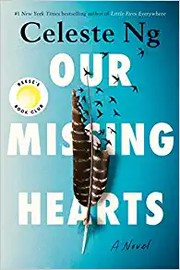
Our Missing Hearts
2,434-word summary 11 min read 352 pages in the book
- First published
- 2022
- Publisher
- Penguin Press
- Pages
- 352
- ISBN
- 9780593492543
Reading options
What's inside (8 sections)
I came to this book straight from Celeste Ng's earlier novels, expecting another precise story about family pressure in an ordinary suburb. Instead I got a dystopia. That wrong footed me for the first fifty pages, and then I understood what she was doing. Our Missing Hearts takes the themes she has always written about, mothers and children, belonging, the stories families tell, and transplants them into an America that decided fear was a governing principle. It is her least realistic novel and, in stretches, her most emotional one.
The facts first. Published in 2022 by Penguin Press, 352 pages in the US hardcover edition, this is Ng's third novel and a standalone with no series. It follows twelve year old Bird Gardner in Cambridge, Massachusetts, as he searches for the mother who left the family years earlier. Spoilers follow throughout, since this is a full summary and not a teaser.
A quiet boy in a frightened country
Bird, whose given name is Noah, lives with his father Ethan in a small apartment shadowed by rules nobody wrote down but everybody obeys. Ethan used to be a linguist at Harvard. Now he shelves books in a university library. The demotion is not about competence. It is about survival. After years of economic collapse and violence, a period everyone calls the Crisis, the country remade itself around suspicion, and suspicion landed hardest on Asian Americans. The family keeps its head down because standing out invites attention, and attention invites the state into your home.
The law that governs everything is PACT, the Preserving American Culture and Traditions Act. On paper it protects heritage and safety. In practice it allows the authorities to remove children from parents judged disloyal or dangerous, and to place those children with approved patriotic families. Libraries pull books deemed unpatriotic from their shelves. Neighbors report on neighbors. The genius of Ng's setup is how ordinary the enforcement looks. There are no stormtroopers in the streets of this book. There are forms, committees, and polite officials, which is worse, because nobody can point to a single moment when refusal was still possible.
Bird's mother, Margaret Miu, is a Chinese American poet whose collection shares the novel's title. Her work was celebrated once. Under PACT it became suspect, then contraband, then evidence. When Bird was nine, she left the family. The official story, the one Bird has repeated to himself for three years, is that she abandoned them. The unofficial truth, the one Ethan carries silently, is that her presence had become a danger to them both, and leaving was the only protection she could offer. Bird has learned not to ask about her. He has learned not to mention her poems. He follows the rules the way a kid memorizes the cracks in a sidewalk, automatically, without deciding to.
What makes the opening work is Bird's voice. He is not a rebel. He is a careful, lonely kid who eats lunch alone and recites his mother's old folktales in his head like a private radio station. Ng writes his interior life with the same close attention she gave teenagers in her earlier books. Small humiliations at school, the particular quiet of an apartment where two people avoid the same subject, the way he watches other families and does arithmetic about what is missing from his own. It is slow, deliberately so, and readers who want the plot to ignite fast may fidget. I did, a little. But the slowness is doing structural work. You need to feel how thoroughly this world has trained a child to stop wondering before you can feel what it costs him to start again.
A drawing of cats
The plot turns on an envelope. Bird receives a mysterious letter containing no real message, only a cryptic drawing of cats. To anyone else it would be nonsense or a prank. To Bird it is a flare. His mother's poems and the bedtime stories she used to tell him are full of cat imagery, including a story about cats with missing hearts, and the drawing reads like a signature only he would recognize. Someone, possibly Margaret herself, is signaling him.
Around the same time, memories of Sadie surface. Sadie was Bird's friend, a girl whose family was broken by PACT the way so many were, and her absence is one of the blank spaces in his life. Thinking about Sadie reminds Bird that disappearance in this country is not always what it looks like from the outside. People do not only vanish. Some of them go underground. The idea lodges in him and will not leave. If his mother did not simply abandon him, if she is out there somewhere in the network of the taken and the hidden, then staying quiet is a choice, not a requirement.
Bird's decision to act is the bravest thing about him, because it is so uncharacteristic. He is not brave by temperament. He is careful. But the drawing gives him something the state spent years taking away: a question with his mother's handwriting on it, metaphorically speaking. He starts pulling at threads. He listens harder to his father's evasions. He remembers more of the stories. And eventually he does what frightened twelve year olds in stories do when the adults around them have accepted the unacceptable. He leaves. His destination is New York City, where the signs point, and where his mother was last glimpsed by people who trade in whispers.
The bus trip chapters are among the best in the book. Bird navigating transit, money, and strange adults with a child's mixture of competence and terror feels completely true. Ng never lets you forget his age. He makes mistakes. He gets lucky. He cries and then gets angry at himself for crying. Every mile puts distance between him and the only safety he has known, and the reader feels the arithmetic of that risk in a way no policy summary could deliver.
The librarians underground
New York brings Bird into contact with the book's most hopeful invention: an underground network of librarians. In a country that purges shelves, the people who devoted their lives to keeping books become natural dissidents. They hide forbidden volumes. They pass messages inside ordinary library business. And, most dangerously, they help move children, hiding kids targeted for removal and reuniting separated families where they can. It is a lovely idea precisely because it grows out of real professional values. Caring for access and caring for the vulnerable turn out to be the same job.
Through this network Bird starts learning who his mother actually is, as opposed to the ghost he has been mourning. Margaret did not vanish into nothing. She became part of the resistance's cultural wing, using poetry and story as tools. Her collection, the one the state banned, keeps circulating in secret because banned books always do. People memorize the poems. They copy them by hand. Bird meets people who know his mother's work better than he does, which wounds him in a specific way. The country took his mother. Then it took her words. Now strangers hand the words back to him like borrowed clothes that almost fit.
This middle section also widens the book's moral frame beyond one family. Bird sees the placed children, kids living with approved families under new names, and the parents still searching for them years later. He meets adults who gave up careers, homes, and safety to run this network. One of the novel's quiet strengths is that it never suggests resistance is romantic. Every helper Bird meets is tired. Every safe house smells of fear. People argue about tactics. People make compromises that stain them. Ng respects the reader enough to show that opposing an unjust system costs nearly as much as submitting to it, just in a different currency.
If there is a drag here, it is pace. The New York section accumulates encounters and revelations without a sharp ticking clock, and a few chapters feel like variations on the same lesson: the system is cruel, the helpers are weary, Bird is growing up fast. None of it is bad. Some of it is beautifully written. But readers who fell for the tight domestic machinery of Little Fires Everywhere may notice the gears showing. This is a quest narrative wearing literary clothes, and quests need momentum that grief alone cannot always supply.
Margaret's half of the story
Late in the book, Ng hands the narration to Margaret, and the novel changes temperature. We finally get the full account of the poet at its center. Margaret's rise, her early success, the way the Crisis curdled public feeling against people who looked like her. Her marriage to Ethan, Bird's birth, the ordinary happiness that made the later fear so disorienting. Then the knock on the door version of her story: the moment she understood that her visibility as a Chinese American artist with a dissident readership made her a beacon that would draw fire onto her husband and son.
Her decision to leave is the novel's moral center, and Ng refuses to make it clean. Margaret believes leaving protects them. Ethan experiences it as abandonment with a good excuse. Bird experiences it as the defining wound of his life. All three readings are true at once, and the book sits inside that contradiction without resolving it. Margaret threw herself into the movement partly from conviction and partly, she admits to herself, because having a cause was easier than sitting in an empty room missing her child. That self awareness saves her from sainthood. She is not a hero who sacrificed everything without flinching. She is a mother who made an impossible choice and then built a life around justifying it.
Her account of the movement's cultural work is fascinating. Banned poems traveling like rumors. Story hours as cover for organizing. Art that says what editorials cannot. Margaret's theory, tested across the book, is that stories bypass the defenses that arguments trigger. A person who would report a neighbor for sedition might still cry at a tale about a mother cat searching for her kittens. Ng clearly believes this about her own work too, which gives these chapters a slightly exposed feeling, as if the author is showing her instrument while playing it. I found it moving rather than manipulative, but your tolerance may vary.
A story told in public
The climax gathers around a public act of defiance built from storytelling. Margaret and her allies stage a protest that is also a performance, aimed at the exact wound PACT pretends does not exist: the taken children. I will not map every beat, but the shape matters. Instead of a march or a manifesto, they offer a story, told openly, in front of witnesses, using the fairy tale logic Margaret spent her career refining. A mother searching. Children with missing pieces. A country invited to recognize itself in a fable.
Bird is there. That is the emotional gamble of the ending, and it pays off. He watches his mother step into visibility knowing exactly what visibility costs in this world. She knows the state is watching. She does it anyway, because some statements can only be made with the body present. Whether Bird reaches her, what passes between them, and what it settles all land with restraint. Ng does not give you the reunion scene a sentimental version of this book would demand. What she gives is truer to everything before it: a moment of contact inside a situation that has no clean resolution.
Afterward, Margaret does not come home. This is the choice that will divide readers, and I think it is the right one for the book Ng wrote. A homecoming would imply the world is fixed enough for private happiness. It is not. Margaret stays with the work. Bird returns to Ethan carrying something he did not have before: knowledge of who his mother is, proof that she did not discard him, and a story of his own about what he did when it mattered. The final pages suggest repair rather than restoration. The family cannot be what it was. It can be something honest, which in this world counts as hope.
Beautiful, blunt, and occasionally too tidy
Time for the reservations, stated plainly. This is Ng's most schematic novel. PACT and the Crisis are assembled from familiar dystopian parts, and readers who know the genre will spot the joins. Child removal echoes real history loudly enough that the book sometimes feels like it is pointing at its own relevance rather than trusting the story. A few plot conveniences in the New York section, messages arriving exactly when needed, helpers appearing at useful moments, ask for more goodwill than Ng's earlier clockwork plotting required.
The late shift into Margaret's perspective, powerful as it is, unbalances the book slightly. Bird carries two thirds of the novel, and just as his quest peaks, the camera moves to his mother for a long stretch. The material justifies it. The rhythm wobbles anyway. And the fairy tale register, gorgeous in the poems and stories, occasionally smooths over questions the realist in me wanted pressed harder. How exactly does the placement system process thousands of cases? What does the rest of the world think? The book gestures at these and moves on, because its interest is allegorical. Fair enough, but readers who want systems will find dreams instead.
Against that, the strengths are considerable. The librarian network is the rare dystopian invention that feels both fresh and inevitable. Bird is a fully alive child protagonist, never a mascot. The prose stays controlled without going cold, and the mother cat stories threaded through the book earn their emotional weight honestly. Most of all, the novel asks a real question and refuses a comforting answer: what do you owe your own child versus everyone else's children, when the state forces you to choose? Margaret's answer costs her everything. Bird's answer costs him his innocence. Ethan's answer, quiet endurance, may cost the most of all, and the book honors it.
Read it if you like literary fiction with speculative edges, stories about mothers and children that skip sentimentality, or novels where libraries matter. Readers who need hard edged worldbuilding or fast plots should adjust expectations. This is a fable told in a minor key, sad and stubborn, about refusing to stop telling stories in a country that banned them. I finished it thinking about the poems inside it, which is exactly what Margaret would have wanted.
FAQ
Is Our Missing Hearts part of a series?
No, it is a standalone novel, Ng's third after Everything I Never Told You and Little Fires Everywhere.
What is PACT in the novel?
The Preserving American Culture and Traditions Act lets authorities remove children from suspect parents and purge libraries of unpatriotic books.
Does Bird find his mother?
He reaches her circle in New York and the two connect, but Margaret stays with the resistance while Bird returns to his father.
Similar books
Everything I Never Told You
In 1977 Ohio, sixteen-year-old Lydia Lee is found dead in a lake, forcing her interracial family to face the secret pressures around race, school and duty that…
2,711-word summary · 12 min read
Little Fires Everywhere
In planned Shaker Heights, Elena Richardson rents to drifting artist Mia Warren, and a custody fight over baby May Ling splits friends and teens.
1,911-word summary · 8 min read
The School for Good Mothers
A mother sent to a reform school fights to keep her daughter under cold surveillance and strict rules.
2,114-word summary · 9 min read

The Age of Miracles
A California girl grows up while the Earth's rotation slows, and ordinary adolescence continues alongside slow catastrophe.
2,417-word summary · 11 min read

This Is How You Lose Her
Yunior cycles through love affairs and betrayals in nine linked stories, tracing the damage he does and the family history behind it.
2,195-word summary · 10 min read
Flight Behavior
Dellarobia Turnbow is stuck in a Tennessee farm marriage until a valley full of monarch butterflies, and the scientist who comes to study them, force her to…
2,051-word summary · 9 min read
Song of Solomon
Milkman Dead leaves Michigan to hunt for family gold and finds instead the old song of his ancestor Solomon.
2,465-word summary · 11 min read
The Mothers
Nadia hides abortion from church Mothers while Luke and Aubrey circle for years.
2,078-word summary · 9 min read
All We Ever Wanted
A Nashville photo of a drunk boy over a passed out girl splits three families along money and race lines.
2,278-word summary · 10 min read
Sing, Unburied, Sing
A Mississippi family drives to Parchman prison while ghosts press close, and a dying grandmother holds the house together.
2,871-word summary · 13 min read
The Bean Trees
Taylor Greer flees Kentucky, inherits Cherokee toddler Turtle, and roots with Tucson strays.
2,082-word summary · 9 min read
We Need to Talk About Kevin
In letters to her dead husband, Eva reconstructs how her son Kevin grew from a cold child into a school killer.
2,041-word summary · 9 min read
Brown Girl Dreaming
Jacqueline Woodson retells her childhood in verse, moving from Ohio to South Carolina to Brooklyn while the civil rights movement reshapes the world around her.
2,727-word summary · 12 min read
Little Earthquakes
Four Philadelphia women meet during pregnancy and discover that new motherhood is nothing like the plan, while friendship becomes the thing that holds them…
1,997-word summary · 9 min read

Mrs. Everything
Two Jewish sisters in Detroit grow up, apart and together, across seven decades of American life, from the 1950s to the 2016 election.
2,362-word summary · 10 min read

Howards End
Forster's 1910 novel follows two families, a house in Hertfordshire, and a burned note, asking whether money and feeling can ever be connected.
2,187-word summary · 10 min read
James
Percival Everett retells Huckleberry Finn from Jim's side, giving him a library, a hidden school, and a voice the novel lets loose.
2,211-word summary · 10 min read

Fathers and Sons
Arkady brings the nihilist Bazarov home to his father's estate, and a generational argument turns into love, a duel, and an early death.
2,192-word summary · 10 min read

Unaccustomed Earth
Lahiri’s second story collection follows Bengali families in America and abroad, tracing the quiet distances between parents and children, spouses, and the…
2,333-word summary · 10 min read
Peace Like a River
An asthmatic boy in the early 1960s narrates his family's search for his older brother, who is accused of two killings and has escaped custody.
1,969-word summary · 9 min read

We Are Okay
Marin fled San Francisco after her grandfather vanished and stopped answering anyone. When Mabel visits her college dorm, she has to say what happened.
2,253-word summary · 10 min read

The Chosen
A shattered pair of glasses in a 1944 Brooklyn softball game starts a friendship between a Hasidic boy and his Orthodox neighbor, and their fathers pull them…
2,443-word summary · 11 min read

Sing You Home
A music therapist, her new wife and an evangelical ex-husband end up in court over three frozen IVF embryos.
2,952-word summary · 13 min read

A Spool of Blue Thread
Four generations of the Whitshank family in Baltimore, and the silences, resentments and quiet love they hand down without ever saying so.
2,408-word summary · 11 min read

Wide Sargasso Sea
Jean Rhys gives the first Mrs. Rochester a Caribbean childhood, a marriage built on money and suspicion, and a voice that Charlotte Bronte left in the attic.
2,021-word summary · 9 min read
The Overdue Life of Amy Byler
A burned-out school librarian gets a summer to herself when her estranged husband returns, and discovers that being a mother does not have to mean losing…
2,055-word summary · 9 min read
On the Come Up
Bri Jackson, a sixteen-year-old rapper in Garden Heights, chases a record deal while a viral song turns her into a symbol she never wanted to be.
2,034-word summary · 9 min read
I Who Have Never Known Men
Forty women in a cage, one child who remembers nothing, and a nearly empty world above the bunker. Harpman's quiet, unexplained dystopia.
2,025-word summary · 9 min read

And Every Morning the Way Home Gets Longer and Longer
An elderly grandfather, his son, and his grandson share memories and fears as the old man's mind begins to fade, in a short novel about grief and love.
2,078-word summary · 9 min read

The Tiger's Wife
A young doctor in a war-scarred Balkan country chases the stories her grandfather left behind, including a deathless man and a deaf girl who loved an escaped…
2,232-word summary · 10 min read