
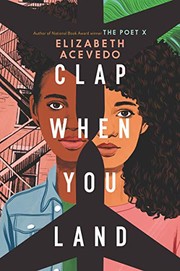
Clap When You Land
2,890-word summary 13 min read 432 pages in the book
- First published
- 2020
- Publisher
- Quill Tree Books
- Pages
- 432
- ISBN
- 9780062882769
Reading options
What's inside (10 sections)
I picked this one up because I wanted to see how a novel in verse handles a plane crash, and I finished it in two nights. Elizabeth Acevedo's Clap When You Land came out in 2020 from Quill Tree Books, an imprint of HarperCollins, 432 pages in hardcover. It is her third novel and her second written in poems, and it doubles the trick she pulled in The Poet X: one first-person voice becomes two. Two narrators, two cities, two households, one dead father, and a secret that sits in the middle like an unexploded thing neither girl knows is there.
One father, two daughters, one long summer
Camino Rios is sixteen and lives in Sosúa, on the north coast of the Dominican Republic, in a barrio where mud gets into everything. Her aunt, Tía Solana, is a curandera and doula, the woman the neighborhood calls when someone is sick, pregnant, or dying, and Camino has followed her on those visits since she was small. Her mother, Mamá, died of dengue fever about nine years before the book opens. That leaves one parent, and he lives in New York.
Papi visits for a few months every summer. He arrives with money, cologne, and plans, and for that stretch the house feels full. He pays for Camino's private school, which is what makes her future possible: good grades, then Columbia University, then medical school, then obstetrics. Every part of that plan depends on checks from a man who is never actually there. Camino knows this and hates knowing it, so she pins her joy to the airport gate instead. The day his flight is due, she skips school, helps Tía cook a pot of sancocho, and gets a ride to the airport from Don Mateo, a neighbor who runs an unofficial taxi.
Yahaira Rios is also sixteen, and she lives in Queens, in the apartment her parents bought in a co-op when Mami was pregnant with her. Her father taught her chess when she was small, and she turned out to be very good, good enough for trophies, tournaments, and a coach who still checks in. She used to like it. Lately she does not play at all, and the reason has nothing to do with the game. Her girlfriend, Dre, lives next door, grows plants in whatever patch of ground she can find, and drags Yahaira into planning for an environmental protest. Meanwhile, Mami manages a spa uptown and keeps the apartment immaculate, and every summer, when Papi leaves for his three months in the Dominican Republic, the mood in that apartment turns to glass.
Neither girl knows about the other. Neither knows that the man who sends the checks and the man who leaves every June are the same person wearing two lives. The book lets you see the shape of the secret before either of them does, and that gap is where most of the tension lives. When Camino imagines her father's summer, she imagines him missing her. When Yahaira watches him pack, she assumes he is working. Both are right. Both are wrong.
The plane goes down
The crash arrives on an ordinary morning. Camino is at the airport, craning for the gate, when she notices clusters of people around a television. Then crying. Then more crying. Before anyone bothers to tell her anything, she understands. The ground seems to open and swallow her, which is close to how she describes it. In New York, Yahaira is called out of class to the principal's office, where Mami is waiting with her face already wrecked. They walk home without saying much. Yahaira, the rule follower, becomes the adult of the house within the hour: answering the phone, turning off the stove, heating food Mami will not eat.
A few days later the news confirms what everyone suspected. No survivors. For a while, both girls orbit the crash without touching it. Camino swims, because the sea is the one place Papi taught her to be at home. Yahaira skips school and sits on the fire escape of an apartment that has become a shrine to a man she is furious at and desperate for.
Acevedo has said in interviews that the disaster is inspired by American Airlines Flight 587, which went down in Belle Harbor, Queens, in November 2001 and killed 265 people, most of them Dominican. She was thirteen when it happened, and she has talked about how the crash was swallowed by the news cycle two months after 9/11, how the grief of one community barely registered on television. That idea sits under the whole novel like a second foundation. In the book itself, though, the flight is never named, the year is never stated, and the wreckage stays offstage. The crash does not function as a mystery or a spectacle. It is a door. Once it opens, a second family walks out.
What each girl was already hiding
Yahaira's secret goes back a year. After a chess tournament she was assaulted by a stranger on the subway, and when she tried to reach Papi for comfort, he was away for the summer and would not pick up. Searching for a work number so she could try again, she found something else in his things: a marriage license with another woman's name on it, a woman in the Dominican Republic. She quit chess. She stopped speaking to her father. When he finally called, it was to yell about her abandoning the team, and she never told him what she had found or what had happened on the train. So when the crash kills him, she is mourning a man she had already caught lying and never got to confront. That is a specific, ugly kind of grief, and the book does not flinch from it.
Camino's secret is money, and it is not abstract. Papi's checks paid the school, the food, the small repairs, the future. Without him there is no tuition, no visa help, no safety net, and Tía's healing work pays in favors and faith more often than in cash. Worse, there is El Cero, a young man in town who makes his living off vulnerable girls. For years Papi paid him a yearly fee to stay away from Camino. With Papi gone, the payments stop, and El Cero starts appearing on the beach where she swims, then following her, then filming her from the shore with his phone. When Tía notices him sniffing around, she hints that Camino might be inviting the attention, and Camino, who cannot stand the idea of her aunt thinking that, decides she cannot ask for help at all.
Her other lifeline is Carline, her best friend, who is pregnant and whose Haitian family is too poor and too frightened to get her proper care. One night Carline goes into labor weeks early, and Tía and the Saints she prays to pull the baby into the world. It arrives exactly when the book needs it.
Verse, voices, and the clock
Acevedo's form deserves its own section, because it is doing more work than decoration. Most poems are labeled by narrator and by distance from the crash: Camino, one day after; Yahaira, fourteen days after; Camino, nineteen days after. The flashbacks have no label at all, which means the reader has to work out from the voice and the details whether a poem is happening now or months ago. The punctuation is sparse, the ampersands do the work of "and," and the lines are short enough to make a two-page scene feel like a held breath. When a poem lands, it lands with the force of an argument compressed into a few lines. When it does not, it reads like a sketch for the poem that should have been there.
The twin-voice structure is the engine of the whole book. Camino and Yahaira share a father, a name, a face from photographs, and almost nothing else, and yet their poems keep rhyming with each other in ways they cannot see. Both girls protect the people around them by staying quiet. Both want to be good daughters of a man who did not deserve the loyalty. Early on it is genuinely easy to lose track of who is speaking, and some readers will find that frustrating. The confusion is a deliberate cost of the design, and it mostly pays off, because once the sisters finally meet, the distinctions harden fast: Camino is earthy, fierce, and quick to anger; Yahaira is orderly, contained, and strategic. By the last act the poems come in faster alternation, call and response, as if the two voices were learning to breathe on the same count.
Half a million dollars and a request
The airline, hoping to avoid lawsuits, offers Papi's family half a million dollars. Mami and Tío Jorge, Papi's brother, are stunned. Tía hears about it through the family phone tree, and that is how Camino finally learns the truth she was never told: Papi had a wife in New York named Zoila, and a second daughter there. The Dominican marriage was never legal, because he was already married. Camino can claim part of the settlement as one of his dependents, though she should expect a fight. She is shocked, then angry, then practical. Money was always the thing standing between her and her future, and here it is, wearing her father's face.
In New York, once word of the payout gets around, relatives start appearing at the apartment to ask for help, and Mami, who is too proud to say no, writes checks to everyone. Yahaira watches her mother pay for a funeral that is also a performance, and hates it. At the same time, Camino goes looking for the sister she has just been told about and finds Yahaira on social media. She sends a message. Weeks pass. Yahaira has not logged on since the crash. When she finally does, she finds a friend request from a girl in Sosúa whose profile picture is a photo of her with Papi. Yahaira screams for Mami, and Mami finally tells the truth she had been carrying alone: there was another family, another marriage, another daughter, and she had decided long ago to let Yahaira keep her hero.
The two girls message. Then they video chat. Then Camino, who is running out of food money and options, does something that is hard to watch and hard to blame: she tells Yahaira she will not share the funeral details unless Yahaira wires her ten thousand dollars. Yahaira sends it immediately and says it is Camino's money too. Camino hates herself afterward, tapes the cash to a photograph of Papi on Tía's altar, and waits.
Mami has forbidden Yahaira from going to the Dominican Republic, so Yahaira buys a ticket with her mother's credit card, leaves after the wake in New York, and flies down with her father's body. On the plane, an older woman explains the local custom: when this plane touches Dominican ground, the passengers will clap, to give thanks for arriving safely. It is the first time the reader hears the phrase that gives the book its title, and it arrives as comfort rather than fanfare. In Sosúa, Camino cooks sancocho for a guest she has never met, and Don Mateo drives her to the airport. The sisters meet in the terminal, two girls who look like each other and like their father, with nothing to say that does not hurt. Tía Solana welcomes Yahaira into the house. Mami calls, furious, and then shows up the next day anyway, because whatever else she is, she is not a woman who lets her daughter handle catastrophe alone.
A funeral, a birthday, a machete
Papi's funeral is enormous. The whole neighborhood comes. There are two funerals for one man in two countries, which is the cleanest metaphor the book ever allows itself, and it works because the details stay concrete: the crowd, the heat, the food, the quiet competition between two versions of the same man. It is also Camino's seventeenth birthday, something nobody at the burial seems to know, and she keeps that private. By midnight she has made a decision. She packs what she can, takes cash, leaves Tía a note, and walks to the beach to say goodbye to the one place that has always been hers.
The storm rolls in, and El Cero is waiting. He takes the money and the passport, and he tries to take more. Back at the house, Yahaira finds the note and the empty bed. She, Mami, and Tía Solana pile into a car and drive to the shore. What follows is the book's best sequence. Tía steps out of the trees with her machete. Mami, who has every reason to despise this girl, tells El Cero exactly who she is and what she will do to him if he ever comes near her family again. Yahaira puts her body between the man and her sister and thinks in the language of chess she abandoned, about queens covering the board, about how a sacrifice only matters if someone is there to answer it. Camino, on the sand, finds her voice and demands her things back. He runs. Nobody dies. The women stand in the dark, breathing.
That night, everyone sleeps close to Camino. Mami takes the corner of the room, as if standing watch over a daughter she refused to acknowledge a week earlier. It is the point where the book stops being a story about a lie and becomes a story about what a family will do with the pieces of it.
Bring her home
In the morning, Yahaira tells Mami they cannot leave Camino behind, and Mami, who has connections at the consulate, starts working the phones. Three days of paperwork and appointments follow, with Camino and Mami driving around the island together, two women who share a dead husband and are beginning to share something else. The visa comes through. Camino says goodbye to Tía Solana, to Carline and her baby, who is finally thriving, to the old woman with cancer who met Tía halfway back to health, and to the water. Then she boards a plane beside her sister, headed for New York, a city she has spent years dreaming about for reasons that no longer match the reasons she has now.
The final page is not a wedding or a graduation. It is a plane on final approach, two sisters holding on to each other, and Yahaira telling Camino to expect the sound of clapping when the wheels touch the ground. The book has spent four hundred pages teaching you what it means to arrive somewhere safely and have no one waiting. That last image, in a verse novel full of arrivals, is doing quiet, heavy work. It is not an ending so much as a first landing.
What works, and what does not
The best thing Clap When You Land does is refuse to make grief tidy. Papi is not a villain and not a saint. He is a man who loved two families and lied to both, and the book holds all of that at once: the girls' love for him, their anger at him, and the fact that his secret gave them each other, which is not a redemption, just a fact they have to live inside. The money thread is handled with unusual honesty for young adult fiction: tuition, meals, visas, and a half-million-dollar settlement, all of it asking the reader to think about what survival actually costs. And the two motifs that carry the whole book, chess for Yahaira and open water for Camino, arrive early and pay off late without ever being underlined.
The criticism is real too. Once El Cero is driven off, the ending moves very fast. Mami's reversal, the emergency visa, and the sisters' friendship all resolve inside a handful of poems, and a story that spent its first half earning every feeling suddenly starts handing out solutions. Some readers will find the El Cero plot the least convincing thread in the book, a thriller problem bolted onto a domestic story, and Camino's repeated returns to the beach have annoyed more than one reviewer, even though the novel is careful to tell us the sea is also her church. The poems themselves are uneven. When they work they are the whole argument in ten lines; when they do not, they feel like notes for a scene the reader has to finish alone. I would have traded a few poems for more of Tía Solana, who never quite gets her due.
None of that stops it from being a book worth handing to the teenager who thinks poetry is homework, or to the adult who thinks young adult means simple. It won the Goodreads Choice Award for Young Adult Fiction in 2020, and it earns the shelf space. It stands alone, so you do not need The Poet X first, though reading them together is its own small education in how far Acevedo's range reaches. The shortest way to describe it: two girls inherit the same lie and turn it into a family. The clapping is the sound of them deciding to land.
FAQ
Is Clap When You Land based on a true story?
The plane crash is inspired by American Airlines Flight 587, which went down in Queens in November 2001 and killed 265 people. The sisters and their families are fictional.
What does the title Clap When You Land mean?
It comes from the Dominican tradition of clapping when a plane lands, to give thanks for a safe arrival. Yahaira tells Camino to expect the applause on their flight to New York.
Do I need to read The Poet X before Clap When You Land?
No. Clap When You Land is a standalone novel in verse. It shares an author and a style with The Poet X but no characters or plot.
Similar books

Someone Like You
Halley and her best friend Scarlett face a summer of grief, a surprise pregnancy, and Halley's dangerous first romance in Sarah Dessen's 1998 young adult novel.
2,218-word summary · 10 min read
Long Way Down
Will rides an elevator with ghosts to decide if he will avenge his brother Shawn.
2,172-word summary · 10 min read

The Poet X
Harlem teen Xiomara finds voice in slam poetry against strict mother, church, and a love she must hide.
2,056-word summary · 9 min read

What Happened to Goodbye
Mclean has reinvented herself in four towns since her parents divorced. In Lakeview she uses her real name, and for the first time staying put becomes a choice.
2,796-word summary · 12 min read
Love Letters to the Dead
A fifteen-year-old writes letters to dead artists because they cannot ask questions, and slowly tells the one story she has been hiding about her sister's…
2,520-word summary · 11 min read
Brown Girl Dreaming
Jacqueline Woodson retells her childhood in verse, moving from Ohio to South Carolina to Brooklyn while the civil rights movement reshapes the world around her.
2,727-word summary · 12 min read

Little Town on the Prairie
In the spring after the Long Winter, fifteen-year-old Laura sews shirts, studies for a teaching certificate, and helps send her blind sister Mary to college.
2,071-word summary · 9 min read

We Are Okay
Marin fled San Francisco after her grandfather vanished and stopped answering anyone. When Mabel visits her college dorm, she has to say what happened.
2,253-word summary · 10 min read
The House We Grew Up In
The Bird family of the Cotswolds breaks apart after a suicide and spends twenty years not talking about what happened.
2,198-word summary · 10 min read

The Second Summer of the Sisterhood
Four friends share the traveling pants through a summer of grandmothers, first loves, and mothers who are learning to let go.
2,209-word summary · 10 min read
On the Come Up
Bri Jackson, a sixteen-year-old rapper in Garden Heights, chases a record deal while a viral song turns her into a symbol she never wanted to be.
2,034-word summary · 9 min read

Aristotle and Dante Dive into the Waters of the World
Ari and Dante return for senior year in El Paso, navigating first love, AIDS, family grief, and the cost of being openly gay in 1987 Texas.
2,188-word summary · 10 min read
American Born Chinese
Three stories, a monkey king, a Chinese-American boy and a sitcom cousin, converge in a graphic novel about shame, assimilation and learning to accept yourself.
2,107-word summary · 9 min read
The Storm Sister
Ally D'Aplièse loses her father and her lover within weeks, then follows a brass frog and a Norwegian biography into Anna Landvik's music and the world of…
2,376-word summary · 11 min read
Maame
Maddie Wright, 25, has spent years as the responsible one in her Ghanaian British family, and the year she finally tries to live for herself is the year…
2,108-word summary · 9 min read

The Sky Is Everywhere
Lennie grieves Bailey while torn between Toby and Joe.
2,251-word summary · 10 min read

Wintergirls
After her ex-best friend dies, eighteen year old Lia fights anorexia, guilt and a ghost while her family tries to pull her back.
2,740-word summary · 12 min read

We Are All Completely Beside Ourselves
Rosemary tells of twin sister Fern, a chimp raised as family, and research fallout.
2,058-word summary · 9 min read

Sadie
Sadie hunts sister killer while podcast chases her in split narrative thriller.
2,091-word summary · 9 min read
Life As We Knew It
Sixteen-year-old Miranda keeps a diary while an asteroid strike on the moon brings tsunamis, blackouts, and a frozen year of hunger to her Pennsylvania town.
2,485-word summary · 11 min read
Tell the Wolves I'm Home
A grieving fourteen year old secretly befriends her late uncle's boyfriend in 1980s New York, testing family loyalty and love.
3,014-word summary · 13 min read

Me and Earl and the Dying Girl
A self-protective Pittsburgh senior is pushed to befriend a classmate with leukemia, and a clumsy film with Earl changes all three.
2,773-word summary · 12 min read
This Girl
Honeymoon retelling as Will recalls first love, classroom ban, loss, fights, and vows that stick.
2,526-word summary · 11 min read

Lola and the Boy Next Door
Costume maker Lola must choose between older Max and inventor Cricket while her two dads hold home steady.
2,045-word summary · 9 min read
The DUFF
Bianca Piper hates Wesley Rush for calling her the DUFF, until a secret arrangement during her parents' divorce forces both teens to grow up.
2,323-word summary · 10 min read
Dear Edward
Twelve-year-old Edward Adler survives a plane crash that kills his family, then learns how to live with grief, letters, and love.
2,903-word summary · 13 min read

The Truth About Forever
A grieving teen trades a dull library summer for catering work and learns to let people in again.
2,088-word summary · 9 min read

In Her Shoes
Philadelphia lawyer Rose takes in her wayward sister Maggie until a betrayal splits them, sending both toward their long-lost grandmother in Florida.
2,781-word summary · 12 min read

Along for the Ride
Insomniac Auden spends a beach summer with her dad and learns biking, parties, and love from Eli.
1,938-word summary · 9 min read