
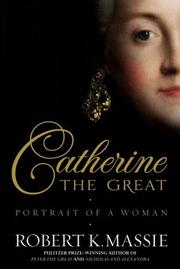
Catherine the Great: Portrait of a Woman
2,065-word summary 9 min read 625 pages in the book
- First published
- 2011
- Publisher
- Random House
- Pages
- 625
- ISBN
- 9780679456728
Reading options
What's inside (12 sections)
Robert Massie spent a career writing about Russian rulers, and Catherine the Great is the warmest of his major books. His Nicholas and Alexandra is tragedy, his Peter the Great is a monument, and this one is closer to a portrait hanging in a private room. The subtitle, Portrait of a Woman, tells you the angle. Massie has the politics, the wars, the court intrigues, and the reforms, but what he really wants to understand is the person underneath the crown, and he uses her own letters and memoirs to do it.
That is both the book's charm and its limitation. If you want a full account of Russian administration in the second half of the eighteenth century, this is not the deepest study on the shelf. If you want to feel what it was like to be a bright, lonely German girl who talked her way onto the throne of the largest empire in the world and then tried to govern it according to ideas she read in French, Massie delivers.
A German princess in a Russian court
Sophie Friederike Auguste of Anhalt-Zerbst was born in 1729 in Stettin, the daughter of a minor German prince and a domineering mother. She was bright, plain by the standards of the day, and ambitious in the way that only someone with limited prospects can be. Her life changed when the Empress Elizabeth of Russia selected her as a bride for her nephew and heir, Peter, and summoned her to Russia at fourteen.
The transformation that followed is one of the great survival stories in royal history. Sophie converted from Lutheranism to Russian Orthodoxy, took the name Catherine, and learned the language so thoroughly that she spoke it better than most of the court. She understood, at fourteen, that Russia would never accept a German girl, so she set out to become Russian. That instinct, Massie suggests, defined her whole career. She was always auditioning for a role she had not been given yet.
The marriage was a disaster from the start. Peter was immature, obsessed with playing soldiers, and openly contemptuous of his wife. Elizabeth kept the couple under surveillance and took an interest in their failure to produce an heir that was both political and suffocating. When Catherine finally gave birth to a son, Paul, in 1754, Elizabeth took the baby away and raised him herself, and Catherine was left to wonder, along with most of the court, who Paul's father really was. She had taken a lover, Sergei Saltykov, and Massie treats the paternity question honestly, which means he leaves it open.
The coup of 1762
The years between the marriage and the throne are the best part of the book, because Catherine's survival required her to be patient, watchful, and discreet while everyone around her misjudged her. Peter, once Elizabeth died in 1762, became Emperor Peter III, and immediately began alienating the people who mattered. He was pro-Prussian to the point of seeming to betray Russia's own war effort, he mocked the Orthodox Church, and he talked about divorcing Catherine and marrying his mistress.
Catherine did not simply wait. She cultivated the guards, especially the Orlov brothers, and when the moment came she moved. The coup was swift, and Peter was deposed and imprisoned. He died days later, in circumstances that have never been fully explained, almost certainly killed in a scuffle with one of the Orlovs, most likely Alexei. Catherine's involvement in the murder is the great unanswered question of her accession, and Massie is careful not to absolve or condemn her outright. What he does show is a woman who understood that the alternative to action was a lifetime in a cell, and who chose action.
Shortly after, the imprisoned Ivan VI, a rival claimant who had been held since infancy, was killed by his guards during a rescue attempt. This one was not Catherine's plan, but it removed a threat, and it set the pattern for a reign that combined Enlightenment language with the cold logic of power.
The puzzle of Paul
Massie devotes a lot of attention to Catherine's relationship with her son, and it is the novelistic heart of the biography. Paul was taken from her as an infant, raised by Elizabeth, and returned to her as a stranger who resented her. Catherine found him unstable, and the two of them spent decades in a wary, mutual disappointment. She had favorites she loved more, including her grandsons, especially Alexander, in whom she saw the heir she actually wanted.
Her plan, late in life, was to bypass Paul entirely and name Alexander as her successor. She drafted the document. She never signed it before her death in 1796, and Paul took the throne and promptly undid much of her work, which gives the story a sad symmetry. Catherine spent a lifetime trying to shape the future, and the future went to the son she could not love.
Enlightenment, and the limits of it
Catherine considered herself a philosopher on a throne. She read Montesquieu, corresponded with Voltaire and Diderot, and wrote the Nakaz, or Instruction, a document of legal principles that she hoped would guide a new code of laws. She convened a Legislative Commission to reform Russia's legal system, and she was genuinely interested in improving education, founding schools, and promoting inoculation against smallpox, a decision she made personal when she had herself and her son inoculated to prove it was safe.
Massie is fair about the gap between the ideas and the reality. The Nakaz was censored before it was published and the Commission produced little. Her reforms strengthened the nobility and merchants while leaving the serfs exactly where they were, and in some ways made things worse. Russia's serfdom was harsh, and under Catherine it deepened, spreading into regions where it had been lighter and reducing what little legal protection the peasants had. She corresponded about liberty with French philosophers while ruling an empire built on unfree labor, and the contradiction sits at the center of any honest account of her reign.
Lovers and power
The book is famously frank about Catherine's love life, and Massie treats it as central rather than scandalous. She had a long series of favorites, and the important ones were genuine partners, not just diversions. Grigory Orlov, who helped put her on the throne, was her lover for years. Grigory Potemkin, the most consequential of them all, became her closest advisor and the architect of her southern expansion, and there is strong evidence that the two of them married in secret. He was a brilliant, erratic man who could organize an empire and then withdraw into melancholy, and their alliance was the most durable relationship of her life.
The later favorites, including Alexander Lanskoy, Alexander Dmitriev-Mamonov, and finally the much younger Platon Zubov, are usually read as signs of loneliness and diminishing judgment. Massie does not mock them. He shows a woman who needed affection and companionship in a court where almost nobody could be trusted, and who grew increasingly dependent on young men who wanted her power. It is a portrait of the private cost of absolute rule.
War, Crimea, and Poland
The foreign policy chapters move quickly, and Massie is good on the broad strokes. Catherine's Russia fought the Ottoman Empire twice and won territory that opened the Black Sea, annexed Crimea in 1783, and founded new cities in the south as showcases of her ambition. Her partnership with Potemkin produced the idea of a Greek Project, a plan to push the Ottomans out of Europe entirely, which never came off but shows the scale of her thinking.
The partitions of Poland are the darker chapter. Catherine, along with Prussia and Austria, carved up the Polish-Lithuanian Commonwealth in stages, erasing a state from the map in a series of deals that combined greed, fear, and the rhetoric of restoring order. Massie notes that Catherine found justification in Poland's internal chaos, and that the result was one of the great political crimes of the century, accomplished with the calm of a woman who believed she was doing the practical thing. He does not exonerate her, but he does not dwell, and this is one place where a sharper history would push harder.
Pugachev and the dark side
The most frightening event of the reign was Pugachev's Rebellion, a Cossack revolt that began in 1773 and grew into a full uprising of peasants, Cossacks, and ethnic minorities along the Volga. Its leader, Yemelyan Pugachev, claimed to be Catherine's murdered husband Peter III returned, which shows how unstable her claim to legitimacy still was a decade into her reign. The rebellion is often compared to a civil war, and its suppression was brutal and total. Pugachev was captured, taken to Moscow in an iron cage, and executed. The revolt convinced Catherine that any relaxation toward the serfs was dangerous, and it hardened her.
The plague riot in Moscow in 1771 belongs to the same story, a public health catastrophe that turned into a mob, and it shows how thin the state's control could become when the people were frightened enough. Catherine's response was firm and effective, and Massie gives her credit, but the pattern across the book is consistent. She could improve the machinery of the state, but she always chose order over liberty when forced to decide.
Old age and legacy
Catherine died in 1796, after a long reign, in circumstances that were embarrassing rather than dramatic, and Paul inherited the throne she had meant to deny him. The book's closing pages are elegiac. Massie gives the final word to the gap between the empress she made and the woman she was, a person who described herself as happy almost never, who worked constantly, who read and wrote and loved and ruled, and who left Russia larger, more cultured, and more unequal than she found it.
The court, and how Catherine used it
One of the quieter pleasures of the book is the way Massie sketches the machinery of court life as Catherine operated it. She was ceaselessly sociable, writing notes, hosting small dinners, walking in the gardens at Tsarskoye Selo, and using informality as a tool. Where Peter the Great had forced change through terror and decree, Catherine preferred charm, conversation, and the impression that she was approachable. That instinct was not only personal. It was political. An empress who is loved is harder to depose, and Catherine had seen how quickly a ruler can be removed.
She was also, by the standards of her time, unusually tolerant of the men and women around her, forgiving slights and keeping difficult people close because she found them interesting. Her correspondence with Voltaire is full of flattery and self-presentation, and Massie reads it as both genuine and calculated, a woman who believed the ideas and understood the value of being seen to believe them. Her relationships with the great families, the Orlovs, the Panins, the Potemkin clan, were a constant negotiation between affection and interest, and the book is very good at showing how personally she took politics, and how politically she handled people.
What works and what sags
Massie is a superb storyteller, and the access he gives to Catherine's own voice is what makes this book last. The court intrigue, the coup, the Potemkin partnership, and the family tragedy with Paul are all told with real feeling, and the pacing rarely drags for a book of its length.
The cost of the portrait approach is that the larger history can feel like background. The reforms, the economic policies, and the administrative machinery get less attention than the letters and the lovers, and readers who want a rigorous account of the reign will need to supplement it. Massie also lets Catherine's own perspective dominate at times, which makes the book sympathetic in a way that occasionally softens the hard edges of her rule.
Still, as a life, it is gripping. Catherine the Great is the story of an outsider who became one of the most powerful people on earth and spent forty years pretending to be exactly what Russia needed, and Massie tells it with the affection of a writer who has spent his life among these people. Start here for the woman, then go elsewhere for the state.
FAQ
Who was Catherine the Great?
Catherine II ruled Russia from 1762 until 1796. Born Sophie of Anhalt-Zerbst in Germany, she married the future Peter III, led a coup against him, and became one of the most powerful rulers in Europe.
When was Catherine the Great: Portrait of a Woman published?
Random House published Robert K. Massie's biography on November 8, 2011. The hardcover runs 625 pages with ISBN 9780679456728.
What does the book focus on?
Massie focuses on Catherine as a person, using her letters and memoirs to tell the story of her life, while covering the politics, wars, and reforms of her reign.
Similar books

Long Walk to Freedom
Mandela's account of a Thembu childhood, a law practice, a banned movement, twenty-seven years in prison, and the negotiation that ended apartheid.
2,454-word summary · 11 min read
The Wright Brothers
David McCullough tells the story of two self-taught Ohio brothers, working largely alone and out of a bicycle shop, who solved the problem of flight before…
2,027-word summary · 9 min read
The Letters of Vincent van Gogh
Vincent van Gogh's letters to his brother Theo, in a Penguin Classics selection edited by Ronald de Leeuw, trace a decade of work, faith, and obsession.
2,611-word summary · 12 min read
The Warmth of Other Suns
Three migrants ride north out of Jim Crow toward Chicago and LA.
2,561-word summary · 11 min read
The Emperor of All Maladies
A biography of cancer from Galen to chemo through one doctor cases.
2,255-word summary · 10 min read
Killing Lincoln
Booth plots as Lincoln pushes war end and reunion in 1865.
2,486-word summary · 11 min read
Hidden Figures
Black women computers at Langley launch rockets past Jim Crow.
2,385-word summary · 11 min read
Wild Swans
Three generations of women survive warlords, revolution, and the Cultural Revolution in Jung Chang's family memoir.
2,356-word summary · 10 min read
The Surgeon of Crowthorne
James Murray built the Oxford dictionary with Broadmoor inmate William Minor, whose thousands of slips shaped this 1998 HarperCollins story of murder, madness…
2,775-word summary · 12 min read
Cleopatra: A Life
Pulitzer winner Schiff restores Cleopatra as a capable ruler, from Ptolemy debts and Caesar to Antony, Actium, and her death in 30 BC, built from coins and…
3,586-word summary · 16 min read
The Splendid and the Vile
Larson follows Churchill circle through Blitz year with diaries and bombing nights.
2,038-word summary · 9 min read

American Sniper: The Autobiography of the Most Lethal Sniper in U.S. Military History
Navy SEAL sniper Chris Kyle recounts Texas roots, SEAL training, four Iraq tours, and the strain combat placed on his marriage and health.
2,011-word summary · 9 min read
A Beautiful Mind
Mathematician John Nash's brilliant game theory rise, schizophrenia collapse, and Nobel return, with wife Alicia's care.
2,142-word summary · 10 min read
Cosmic Music
The first full biography of Alice Coltrane, from Detroit church piano to ashram guru.
2,048-word summary · 9 min read
Einstein: His Life and Universe
Isaacson traces Einstein from patent clerk to world fame using newly opened papers, through 1905, relativity, exile, and the long unified theory search.
2,773-word summary · 12 min read
In the Garden of Beasts
Ambassador Dodd takes his family to 1933 Berlin and watches charm curdle into terror.
1,927-word summary · 9 min read
1776
Washington's amateur army from Boston siege to Trenton through mud and doubt.
2,139-word summary · 10 min read
John Adams
McCullough follows Adams from Braintree lawyer to second president.
2,515-word summary · 11 min read
Unbroken
Louis Zamperini survives a Pacific crash, sharks and POW camps after running in the Berlin Olympics.
3,263-word summary · 15 min read

The Zookeeper's Wife: A War Story
The directors of the Warsaw Zoo hid roughly three hundred Jews in empty cages and outbuildings after the German invasion, while Jan worked for the resistance.
2,065-word summary · 9 min read
Sybil
A 1973 case study of a woman treated for multiple personalities, and the book that made dissociative identity disorder a household phrase.
2,054-word summary · 9 min read
1491: New Revelations of the Americas Before Columbus
Charles C. Mann gathers archaeology, ecology, and demography to argue that the Americas before Columbus were older, fuller, and more deliberately shaped than…
2,712-word summary · 12 min read
The DaVinci Code: A Quest for Answers
A short 2006 dialogue in which three friends test Dan Brown's claims about Jesus, Mary Magdalene, Nicaea, and the canon.
2,088-word summary · 9 min read

Nothing to Envy
Barbara Demick follows six defectors from Chongjin through the North Korean famine, showing how ordinary people lived, believed, and finally left.
2,068-word summary · 9 min read

Infidel
Ayaan Hirsi Ali's memoir of a Somali childhood, a forced marriage, a Dutch asylum claim, and the political fight that followed the murder of Theo van Gogh.
2,041-word summary · 9 min read

Down and Out in Paris and London
Orwell's account of washing dishes in Paris hotels and tramping through London does not ask for pity, only for a clear look at how poverty actually works.
2,282-word summary · 10 min read
The Girl with Seven Names: A North Korean Defector's Story
Hyeonseo Lee crossed the frozen Yalu River at seventeen, spent years hidden in China, escaped to South Korea, and later returned to rescue her family.
2,404-word summary · 11 min read
Lone Survivor: The Eyewitness Account of Operation Redwing and the Lost Heroes of SEAL Team 10
Marcus Luttrell's account of the 2005 SEAL mission in Afghanistan that killed three of his team and left him alone.
2,144-word summary · 10 min read

Life
The Rolling Stones guitarist tells his own story: a Dartford childhood, the band's first gigs, the drug raids, the tax years and Patti Hansen.
2,761-word summary · 12 min read

Bury My Heart at Wounded Knee: An Indian History of the American West
Dee Brown's 1970 retelling of the American West from the point of view of the people it destroyed.
2,233-word summary · 10 min read