
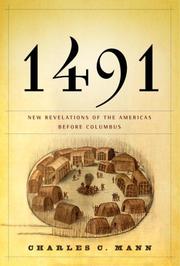
1491: New Revelations of the Americas Before Columbus
2,712-word summary 12 min read 480 pages in the book
- First published
- 2005
- Publisher
- Knopf
- Pages
- 480
- ISBN
- 9781400040063
Reading options
What's inside (7 sections)
I bought my copy at a library sale for two dollars, mostly because the title annoyed me. A year without a century, a whole hemisphere summed up by the day before everything changed. I assumed I was getting a cabinet of curiosities: lost cities, giant mounds, a chapter on whether the Vikings got here first. What I got instead was a long, patient argument about evidence, and about how much of the American past I had absorbed without noticing that it was a story with a moral attached. Charles C. Mann published the book with Knopf in 2005; my edition runs 480 pages, and it took me most of a winter to read.
Mann is a science journalist, not an archaeologist, and that shapes the book in ways both good and bad. He is good at explaining radiocarbon dates, soil samples, and genetic markers. He is less good at hiding which researchers he finds charming. The book is organized into three parts, and the titles are worth remembering: Numbers from Nowhere, Very Old Bones, Landscape with Figures. Population, origins, ecology. Around those three questions Mann builds a case that the hemisphere before Columbus was fuller, older, and more deliberately managed than the textbooks of my childhood allowed.
Numbers from Nowhere
The book opens in New England, which is a clever move. Most readers think they know that story: hard winters, helpful Indians, corn, Thanksgiving. Mann starts with Tisquantum, the Patuxet man the Pilgrims called Squanto, and follows the circuit that took him to England, to Spain, and home again to a village that no longer existed. The epidemic that emptied coastal New England before the Mayflower was probably smallpox or leptospirosis or something else; the point is that it arrived ahead of the settlers and did most of the killing. By the time the Pilgrims landed, they were walking into a catastrophe they could not see.
That is the hinge of the first section. The "pristine" continent was not empty because nobody lived there. It was empty because almost everybody had died. Pizarro's capture of Atahualpa at Cajamarca looks less like a miracle of Spanish arms when you remember that smallpox had already killed the Inca emperor Huayna Capac, touched off a civil war between his sons, and left the empire divided before Pizarro reached the Andes. The Spanish had steel, horses, and guns, and Mann does not pretend those were irrelevant. But the microbes traveled faster than any army and did not need to be aimed.
Then comes the numbers fight, which is the part of the book that has aged most visibly. Henry Dobyns, the great high counter, argued in the 1960s that the hemisphere held something like ninety to a hundred million people in 1492. Other scholars thought that was fantasy built on a chain of guesses. David Henige wrote a whole book, Numbers from Nowhere, attacking the high counters' method; Dean Snow and others warned that the contact-era accounts are too thin to support such precision. Mann lays out the quarrel fairly and then leans toward the high end, which is a defensible choice but a choice. The honest summary is that nobody knows, and that the range of respectable estimates is enormous.
What makes the section work is the implication rather than the final figure. If the Americas held tens of millions of people, the post-contact die-off was one of the largest demographic disasters in human history, and the societies Europeans met were often the battered remnants of something much larger. Mann's phrase for the old view, that Indians were people without history because they did not change their environment, is the thing he wants to break. The first section ends with the reader suspecting that the emptiness was an artifact of timing.
Very Old Bones
The second part is about arrival, and it is the most technical stretch of the book. For most of the twentieth century, the Clovis culture was the starting line: fluted spear points, big-game hunters, a land bridge, about thirteen thousand years ago. Then Tom Dillehay began digging at Monte Verde in southern Chile, and the dates came back older, with preserved seaweed, wooden stakes, and plant remains that did not fit a quick march down the Rockies. The fight over Monte Verde lasted years. Mann is good on how a site gets accepted or dismissed, and on what it costs a young archaeologist to push a date the senior people do not like.
From there he moves to Kennewick Man, the roughly nine-thousand-year-old skeleton found in Washington State in the 1990s. The skull looked unusual to some anatomists, and for a while the bones were dragged into arguments about whether the first Americans were European, Polynesian, or something else. Native tribes claimed the remains under federal law; scientists wanted to study them. Mann treats the case as a lesson in how quickly bones become politics, and he notes that skull measurements are a weak guide to ancestry. The genetic evidence then available pointed toward Asia, and later work proved him right on that point.
The section also covers the Solutrean hypothesis, the idea that Ice Age Europeans crossed the Atlantic along the ice edge and gave rise to Clovis. Dennis Stanford and Bruce Bradley made the case; most archaeologists found it far-fetched, and Mann presents it as a minority view. He is more interested in the collapse of the Clovis-first consensus. Once the earliest dates moved back, possibilities opened up: coastal migrations, multiple waves, a long pause in Beringia before anyone moved south. The map of the first Americans became less like a single arrow and more like a braid.
The middle of the book turns to agriculture, and to maize. Teosinte is a scraggly Mexican grass with a few hard seeds; corn is a genetic absurdity that cannot reproduce without human help. Mann explains the domestication as a long, accidental project in the Balsas Valley, and uses it to set up his point about isolation. Mesoamericans could not borrow the wheel from a neighboring civilization because there was no neighboring civilization with a wheel to borrow. They domesticated few large animals. What they had was corn, beans, squash, cotton, potatoes, and a range of environments, and they made a great deal out of that package.
The Norte Chico section is the one I keep thinking about. On the coast of Peru, Ruth Shady and others excavated Caral and a cluster of related sites that date back roughly five thousand years, with platform mounds, sunken courts, and a society built on cotton and fish rather than on grain surpluses. No pottery. No writing that anyone has deciphered. No obvious army. Mann uses Norte Chico to complicate the old checklist of civilization, which usually starts with Mesopotamia and ends with something that looks like a European city. The Americas had at least two independent starts, one in the Andes and one in Mesoamerica, and neither followed the script.
Landscape with Figures
The third part made the book famous, and it has attracted the most pushback. Mann goes to the Amazon, where the old picture was of a humid, nutrient-poor forest that could support only small, scattered groups. The new picture is of dark earth, terra preta, a charcoal-rich soil that holds nutrients where rain normally leaches them away. William Woods and Joseph McCann studied it; Eduardo Neves traced its spread. The soil is full of pottery fragments and organic matter, and it appears to regenerate when farmers take it away in small amounts. Mann visits a site where people quarry it for potting soil and are told to leave the bottom third because it will grow back.
From the soil he moves to the earthworks of the Beni in Bolivia, where Clark Erickson documented raised fields, causeways, canals, and fish weirs across a savanna that floods for part of every year. The standard view had been that the Beni could not support a complex society. Erickson's work suggested it had supported one for centuries, and that its people engineered the hydrology rather than surrendered to it. Betty Meggers, one of the most respected Amazon specialists of her generation, was not convinced. She thought the evidence was thin and the conclusions wishful. Mann quotes her objections, though he clearly finds Erickson's story more exciting.
The Xingu chapter is the most speculative and the most memorable. Michael Heckenberger worked with the Kuikuro people and mapped settlements with plazas, roads, and defensive ditches, arranged in a pattern that looked planned. He called them garden cities, or something close to it, and argued that the southern Amazon had supported dense populations without destroying its forests. If that is right, the choice between a crowded Amazon and a forested Amazon is a false one. People can live densely and still keep the trees. That idea has obvious relevance to modern debates, which is why it needs to be handled carefully.
Then Mann comes north, to Cahokia. Anyone who has driven past the Mississippi near St. Louis has seen the outline of Monks Mound, the largest earthwork north of Mexico. In its heyday around 1100, Cahokia covered several square miles and held perhaps fifteen thousand people, with a plaza, a woodhenge, palisades, and dozens of smaller mounds. Mann reconstructs the city with a novelist's eye: canoes on the river, cook smoke, maize fields, plastered houses. He also notes the evidence of human sacrifice, which complicates the romantic version of the peaceful mound builders. The city was abandoned long before Europeans arrived, and nobody knows exactly why.
The Maya get a similar treatment. For a long time the story was ecological hubris: the Maya cut down their forests, exhausted their soils, and collapsed. Mann shows a more interesting picture, with dense cities, reservoirs, intensive agriculture, and a collapse that was probably a mix of drought, warfare, and political breakdown. Tikal and its neighbors were not a peaceful theocracy of astronomers. They were competing states with armies and a taste for capturing each other's kings. The old image of the Maya as mysterious people who vanished is mostly a European confusion: the Maya did not vanish, they moved, and their descendants are still there.
The Inca close the section. Mann describes terraces that turn mountainsides into farmland, a road system thousands of miles long, storehouses, and a bureaucracy that kept records in knotted cords. The Spanish thought the Inca had no writing, which was true in the narrow sense and false in every way that mattered. The Inca had wheeled toys but no wheeled vehicles, and no horses, which is why their roads were built for people and llamas. Mann's point is not that the Inca were just like Europeans. They were solving different problems with different tools, at a scale the conquistadors did not appreciate until it was too late.
The final chapter is about wilderness. Mann argues that the "wild" America Europeans found was in part a garden that had been abandoned. When the Indigenous population collapsed, the managed landscape rewilded. Bison and passenger pigeons exploded in number, forests thickened, and the grassland settlers crossed was not a timeless condition but a recent consequence of catastrophe. William Denevan had made a similar argument in his 1992 essay on the pristine myth, and Mann builds on it. Columbus did not discover a wilderness; he arrived just after the gardeners had gone.
The parts that wobble
The book has real weaknesses, and they are worth naming. Mann is a journalist synthesizing other people's work, and he is drawn to the researcher with the best story. The reader gets a lot of Erickson and Heckenberger and less of the skeptics, even though the skeptics are quoted. The Amazon chapters can feel like a tour of the most exciting claims rather than a survey of the evidence. Terra preta is real; the estimate that it covers a tenth of Amazonia is a guess, and the estimate that the whole forest is anthropogenic is a much bigger guess. Meggers thought the new picture was politically dangerous because it could justify development, and her worry about how the science gets used is not silly.
The numbers are softer than the prose sometimes suggests. Dobyns's hundred million is not a measurement; it is an extrapolation from fragmentary accounts, and Henige's critique has never been fully answered. Mann knows this and says so, but the narrative momentum favors the big number. A reader who remembers "ninety million" may not remember that the range runs from perhaps ten million to more than a hundred million depending on whom you ask. That range changes what the word "catastrophe" means.
Then there is the age of the science. The book is from 2005, and the peopling debate has moved a lot since. Ancient DNA has given us a much clearer picture of a Beringian standstill and multiple migrations; the Kennewick remains were sequenced and turned out to be closely related to Native Americans; the White Sands footprints in New Mexico, published in 2021, pushed human presence back to roughly twenty-one thousand years ago, with some researchers arguing for even earlier. None of this destroys Mann's argument. Some of it makes him look conservative. But a reader who wants the current state of the field should read the book as a snapshot, not a verdict.
There is also a critique from Indigenous studies that the book still organizes Native history around 1492. The title itself does that. However much Mann insists that these societies had their own histories, the frame is the arrival of Europeans, and the final chapter's elegy can slide into a story about what was lost rather than what persisted. The book is better than most popular writing at insisting that the Maya, the Inca, and the Amazonian peoples were not waiting to be discovered. It is not immune to the romance of the vanished city.
And there is the opposite critique, from readers who think Mann is too eager to overturn the old story. A few reviewers called the book pseudoarchaeology, which is unfair as a blanket label but points at a real habit: Mann sometimes builds a large claim on a small trench. The strongest version of the criticism is not that he makes things up. It is that he makes the evidence sound more settled than it is, because a settled story sells better than a fight among specialists.
What I tell people now
I still recommend the book, but I recommend it differently than I did the first time. I tell people to read the first and third parts closely and to treat the middle as a guided tour of a debate that has moved on. I tell them to notice how often Mann says "probably" and "some researchers believe," and to notice how easily those hedges fall out of memory. And I tell them that the book's real value is not any single number or date. It is the habit of asking who was already managing the place before you arrived.
The scene I keep coming back to is not a pyramid or a mound. It is the dark earth itself, the soil that people made by living somewhere for a long time and putting their waste, their charcoal, and their broken pots back into the ground. It is a modest kind of monument. You cannot visit it in a postcard. But it suggests a way of being human that is neither noble nor savage, just skilled and persistent and capable of changing a forest without destroying it. Mann's book is at its best when it lets that idea sit without turning it into a slogan.
The last thing I would say to a friend is this: do not read 1491 to replace one set of myths with another. Read it to see how much of the past is still under negotiation. The book is a report from the argument, written by a clever journalist who talked to the people doing the digging. Some of the digging has since gone deeper, and some of the conclusions have shifted. The questions are still the right ones, and the continent looks different once you have asked them.
FAQ
When was 1491 published and by whom?
Charles C. Mann's 1491 was published by Knopf in 2005. The edition cited here runs 480 pages.
What is the book's central claim about the pre-Columbian Americas?
Mann argues that Indigenous populations were larger, arrived earlier, and shaped their environments more extensively than the old "pristine wilderness" story allowed.
Did 1491 settle the debates it describes?
No. Mann presents competing estimates, and later research, including ancient DNA and older footprint sites, has changed parts of the picture.
Similar books
Bury My Heart at Wounded Knee: An Indian History of the American West
Dee Brown's 1970 retelling of the American West from the point of view of the people it destroyed.
2,233-word summary · 10 min read
The Wright Brothers
David McCullough tells the story of two self-taught Ohio brothers, working largely alone and out of a bicycle shop, who solved the problem of flight before…
2,027-word summary · 9 min read
Killers of the Flower Moon: The Osage Murders and the Birth of the FBI
In 1920s Oklahoma, Osage oil wealth makes tribal members targets for murder, forcing the young FBI under Tom White to expose the conspiracy behind the Reign of…
2,403-word summary · 11 min read
The Zookeeper's Wife: A War Story
The directors of the Warsaw Zoo hid roughly three hundred Jews in empty cages and outbuildings after the German invasion, while Jan worked for the resistance.
2,065-word summary · 9 min read

Long Walk to Freedom
Mandela's account of a Thembu childhood, a law practice, a banned movement, twenty-seven years in prison, and the negotiation that ended apartheid.
2,454-word summary · 11 min read
The DaVinci Code: A Quest for Answers
A short 2006 dialogue in which three friends test Dan Brown's claims about Jesus, Mary Magdalene, Nicaea, and the canon.
2,088-word summary · 9 min read
Nothing to Envy
Barbara Demick follows six defectors from Chongjin through the North Korean famine, showing how ordinary people lived, believed, and finally left.
2,068-word summary · 9 min read

Too Much and Never Enough: How My Family Created the World's Most Dangerous Man
Mary L. Trump's 2020 memoir traces how a cold, zero-sum Queens household shaped her uncle, and uses family tax documents to challenge his self-made story.
2,059-word summary · 9 min read

Down and Out in Paris and London
Orwell's account of washing dishes in Paris hotels and tramping through London does not ask for pity, only for a clear look at how poverty actually works.
2,282-word summary · 10 min read
Columbine
Ten years of reporting on the 1999 school massacre, including a journalist's correction of the myths he helped create in the first hours.
2,232-word summary · 10 min read

Lone Survivor: The Eyewitness Account of Operation Redwing and the Lost Heroes of SEAL Team 10
Marcus Luttrell's account of the 2005 SEAL mission in Afghanistan that killed three of his team and left him alone.
2,144-word summary · 10 min read
At Home: A Short History of Private Life
Bill Bryson tours his own Norfolk rectory room by room to explain how private life and the modern home got built.
2,334-word summary · 10 min read

America (The Book): A Citizen's Guide to Democracy Inaction
Jon Stewart and the Daily Show writers turn a high school civics textbook inside out, with a foreword from beyond the grave.
2,511-word summary · 11 min read
Prisoners of Geography: Ten Maps That Tell You Everything You Need to Know About Global Politics
Tim Marshall explains how mountains, rivers, coasts, and resources shape the choices of nations, from Russia's flat borders to the chokepoints of the South…
2,328-word summary · 10 min read
The Lost City of Z: A Tale of Deadly Obsession in the Amazon
David Grann retraces Percy Fawcett's 1925 disappearance in the Amazon and finds that the lost city he sought was not entirely a fantasy.
2,493-word summary · 11 min read
The Letters of Vincent van Gogh
Vincent van Gogh's letters to his brother Theo, in a Penguin Classics selection edited by Ronald de Leeuw, trace a decade of work, faith, and obsession.
2,611-word summary · 12 min read
The World Is Flat: A Brief History of the Twenty-first Century
Thomas L. Friedman's 2005 bestseller argues that technology, trade, and open borders leveled the global playing field, and it names the ten forces that did it.
2,369-word summary · 11 min read
Catherine the Great: Portrait of a Woman
A German princess survives a miserable marriage and a coup to rule Russia for thirty-four years, torn between Enlightenment ideas and absolute power.
2,065-word summary · 9 min read
The Warmth of Other Suns
Three migrants ride north out of Jim Crow toward Chicago and LA.
2,561-word summary · 11 min read

The New Jim Crow: Mass Incarceration in the Age of Colorblindness
How mass incarceration became a racial caste system after civil rights.
2,413-word summary · 11 min read
The History of the Hobbit, Part One: Mr. Baggins
Rateliff traces every draft of Bilbo from 1930 notes to print.
2,410-word summary · 11 min read

The Emperor of All Maladies
A biography of cancer from Galen to chemo through one doctor cases.
2,255-word summary · 10 min read
Killing Lincoln
Booth plots as Lincoln pushes war end and reunion in 1865.
2,486-word summary · 11 min read
In the Heart of the Sea: The Tragedy of the Whaleship Essex
The whaleship Essex sunk by a whale leaves men in boats for ninety days.
2,750-word summary · 12 min read
Hidden Figures
Black women computers at Langley launch rockets past Jim Crow.
2,385-word summary · 11 min read
Wild Swans
Three generations of women survive warlords, revolution, and the Cultural Revolution in Jung Chang's family memoir.
2,356-word summary · 10 min read
The Perfect Storm
Gloucester's Andrea Gail vanished in the October 1991 nor'easter; Junger joins the crew, storm science, and Tamaroa rescues into a plain and hardworking sea…
2,592-word summary · 12 min read
The Hot Zone
Ebola and Marburg move from African outbreaks to a Virginia monkey house and an Army response in suits.
2,291-word summary · 10 min read
On the Origin of Species
Darwin's 1859 case for evolution by natural selection, from Beagle finches and breeding pigeons to fossils and anatomy.
2,589-word summary · 12 min read

How to Be an Antiracist
Kendi blends memoir and history to argue that fair policy, not self fixing, creates an equal society.
2,513-word summary · 11 min read