
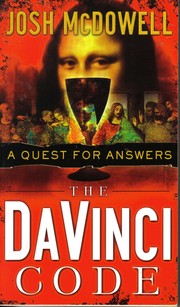
The DaVinci Code: A Quest for Answers
2,088-word summary 9 min read 112 pages in the book
- First published
- 2006
- Publisher
- Green Key Books
- Pages
- 112
- ISBN
- 9781932587807
Reading options
What's inside (10 sections)
This is a strange little book to find on a shelf in 2026. It was published in 2006, when Dan Brown's novel was still selling millions of copies and the film adaptation was about to arrive in theaters. Churches across the United States were looking for something short and cheap they could hand to a neighbor or a teenager who had just finished the novel and was asking whether any of it was true. Josh McDowell, an evangelical apologist best known for Evidence That Demands a Verdict, wrote this as a quick response. It runs about a hundred pages, moves fast, and assumes the reader has already absorbed Brown's plot.
What makes it unusual is the form. McDowell did not write a straight essay or a scholarly rebuttal. He wrote a fictional dialogue. Three friends, Chris, Matt, and Andrea, meet in a coffee shop after seeing the film and work through the claims one by one. Chris is the skeptic who has been shaken by Brown's story. Matt is the informed believer who has done some reading. Andrea sits between them, asking the questions a general reader would ask. The whole book is basically one long conversation, broken into short chapters.
That choice is both the book's charm and its main weakness. It is easy to read. It is also a bit wooden. The friends are not characters so much as positions, and they agree with each other too quickly. But if you want a map of the major objections Brown raised, and a set of counterarguments in plain English, the format does the job.
The Claims Being Answered
Dan Brown's novel rests on a set of interlocking assertions. Jesus was married to Mary Magdalene and had a child with her. The bloodline survived in France and was protected by a secret society called the Priory of Sion. The early church suppressed the truth, and the Emperor Constantine invented the doctrine of Christ's divinity at the Council of Nicaea in 325. The biblical canon was chosen for political reasons, and the Gnostic gospels were the real records until the winners erased them. Leonardo da Vinci encoded the secret in The Last Supper and other works. Opus Dei, a conservative Catholic group, is involved in a cover-up.
McDowell's three friends take these claims in roughly that order. The book is not a line-by-line annotation of Brown's novel. It is a response to the underlying historical picture. The questions it addresses are the ones a reader is most likely to carry away: Was Jesus married? Did Constantine make Jesus divine? Was the Bible assembled by a vote? Did the church suppress women and the sacred feminine? Is any of this historically grounded?
Mary Magdalene and the Marriage Question
The first and most sensational claim is that Jesus and Mary Magdalene were lovers and possibly married. McDowell's response is straightforward. The New Testament never mentions a marriage. Mary Magdalene appears in all four Gospels, but always as a disciple and witness, never as a wife. The idea of a romantic relationship is not in the earliest Christian documents. It comes from later, non-canonical texts, especially the Gnostic gospels, and even there the evidence is thin and ambiguous.
The book points out that Brown's novel treats a fourth-century legend and a modern conspiracy theory as if they were historical records. The Priory of Sion, the organization at the center of the novel, was not a medieval secret society. It was a small French group founded in the 1950s, and its documents were later exposed as a hoax. That is one of the more useful corrections in the book, because many readers assumed the Priory was real.
McDowell also makes a textual argument. The Gnostic Gospel of Philip contains a line about Jesus kissing Mary, but the manuscript is damaged and the sentence is incomplete. The novel fills in the gap with a romantic reading that the text does not support. Even if it did, a kiss in that cultural setting would not automatically mean marriage. The book is careful to say that the burden of proof is on the person making the extraordinary claim.
Where the book is less careful is in its tone. It sometimes treats the Gnostic texts as uniformly unreliable, when scholars of early Christianity would make finer distinctions. Some Gnostic writings are weird and late. Others preserve traditions that are worth studying. McDowell's goal is to reassure, not to give a graduate seminar, and the simplification shows.
Nicaea and the Divinity of Christ
The second major claim is that Constantine invented the divinity of Jesus at the Council of Nicaea in 325. This is the claim that gets the most space, and it is the one McDowell handles best. The historical record is clear that Christians were calling Jesus divine long before Constantine. The Gospel of John opens with the Word being God. Paul's letters, written in the 50s and 60s, already treat Jesus as Lord and as the agent of creation. The letters of Ignatius of Antioch, written around 110, call Jesus God. Justin Martyr, writing in the second century, argues for the divinity of Christ. Origen and Tertullian debate the details long before Nicaea.
Nicaea did not invent the doctrine. It settled a dispute. Arius, a priest in Alexandria, taught that the Son was a created being, subordinate to the Father. The council condemned that view and produced a creed affirming that the Son is of the same substance as the Father. The vote was not a close political fix. The vast majority of bishops present rejected Arius. Constantine convened the council, but he did not dictate its theology, and he was not even baptized until much later.
McDowell makes this point with a list of pre-Nicene sources. The list is not exhaustive, but it is enough to show that the novel's timeline is wrong. The book also notes that Brown's claim that the council chose which Gospels to include is false. Nicaea did not settle the canon. The canon developed over centuries through use in churches, and the process was messy and human, but it was not a single imperial vote.
This is the strongest section of the book. If a reader takes nothing else from it, the Nicaea correction is worth the price of a used copy.
How the Bible Was Chosen
The third cluster of claims concerns the canon. Brown's novel suggests that the Bible was assembled by Constantine and that the Gnostic gospels were suppressed for political reasons. McDowell responds that the canon emerged from the practice of the early churches. Certain letters and Gospels were read in worship, copied, and circulated because they were believed to come from apostles or their companions. The process was gradual. Lists from the second and third centuries show most of the New Testament already in place. The Council of Carthage in 397 affirmed a canon that looked like the one we have, but it did not create it from nothing.
The book also addresses the charge that the Bible has been changed beyond recognition. McDowell points to the number of manuscripts and the relatively small number of textual variants. He argues that the variants are mostly spelling differences and word order, and that no central doctrine depends on a disputed passage. This is a standard apologetic argument, and it is broadly right, though the book oversimplifies. There are real textual problems, and some famous passages, such as the story of the woman caught in adultery, are later additions. A reader who wants the full picture should read a good introduction to textual criticism. McDowell gives the short version.
The Grail, the Priory, and the Art
The novel's conspiracy depends on the idea that the Holy Grail is not a cup but a person, namely the bloodline of Jesus and Mary Magdalene. McDowell treats this as a modern invention with no historical basis. The medieval Grail romances are literature, not secret history. They were composed centuries after the events they claim to describe, and they contradict each other. The Priory of Sion, as noted, was a twentieth-century fabrication.
The book also spends time on Leonardo. Brown's novel reads The Last Supper as a code, with Mary Magdalene seated beside Jesus and Peter making a threatening gesture. McDowell points out that the figure Brown identifies as Mary is conventionally read as John the Evangelist, and that Leonardo's composition follows established iconography. The novel's reading is an interpretation, not a discovery. This section is entertaining, but it is also the thinnest. Art history is not McDowell's field, and the argument boils down to "the experts disagree with the novel."
The Resurrection as the Hinge
The final chapters turn from defense to invitation. McDowell argues that the resurrection is the central claim of Christianity, and that the other questions matter because of it. He runs through the standard evidence: the empty tomb, the appearances, the transformation of the disciples, the rapid growth of the movement in a hostile environment. He ends with the familiar trilemma, that Jesus was either a liar, a lunatic, or Lord.
This is where the book stops being a fact-check and becomes a evangelistic tract. That is not a criticism of its honesty. McDowell is clear about what he believes and why. But a reader who wanted only a historical response to Dan Brown may feel the shift. The last chapters are preaching, and the quality of the argument drops. The trilemma is a rhetorical device, not a proof. It ignores the possibility that Jesus was sincerely mistaken, or that the Gospel writers shaped the story over time. McDowell does not engage those options.
Where the Book Is Weak
The biggest problem is the dialogue. Chris raises an objection, Matt answers it, and Chris immediately concedes. Real conversations do not work that way. The friends never get angry, never misunderstand each other, and never need time to think. The result is a book that feels like a script for a youth group lesson. That is fine for its intended audience, but it makes the counterarguments seem easier than they are.
The second problem is selectivity. McDowell answers the claims he can answer cleanly and skips the ones that are harder. Brown's novel makes some legitimate criticisms of church history, including the church's treatment of women and the political compromises of the institutional church. The book acknowledges these only briefly. A reader who was moved by the novel's critique of patriarchy will not be persuaded by a few paragraphs saying that Christianity elevated women.
The third problem is the book's age. It was written for a specific moment, and some of its references are dated. It also predates the later scholarship on the Gnostic gospels and the historical Mary Magdalene that has become more widely available. A reader in 2026 would do better with a good academic introduction, or with a book that engages Brown's claims without the fictional frame.
Who It Is For
This is a book for the person who has just finished The Da Vinci Code and wants a quick, confident answer. It is not for the person who wants a balanced history of early Christianity. It is also not for the person who wants to understand why the novel was so appealing in the first place. McDowell is not interested in Brown's skill as a storyteller, and he does not ask why so many readers wanted to believe that the church had hidden something.
The book is also a snapshot of a particular kind of evangelical response. It assumes that the reader is a Christian who has been shaken, or a seeker who is curious. It does not imagine a reader who is Muslim, Jewish, or secular. That narrowness is not a flaw in the book's logic, but it does limit its usefulness. A better response would take the novel seriously as a cultural phenomenon and ask why it resonated. McDowell mostly wants to win the argument.
Read it as a period piece. It captures a moment when a thriller became a referendum on Christian history, and when apologists had to answer a novel on its own terms. The Nicaea chapters are genuinely useful. The rest is a mixed bag, but a fast one. If you want the short version of the counterargument, this will give it to you in an afternoon. If you want the long version, you will have to look elsewhere.
FAQ
Is this book fiction or nonfiction?
It is a nonfiction apologetics book that uses a fictional dialogue among three friends to answer Dan Brown's claims.
Does McDowell accept any of Brown's claims?
He accepts that the novel is entertaining but rejects its historical assertions about Jesus's marriage, Nicaea, the canon, and the Priory of Sion.
When was it published?
Green Key Books published it in 2006, as a short paperback of about 112 pages.
Similar books
The Case for Christ
An atheist journalist cross-examines scholars on the Gospels, the tomb, and the resurrection to test the evidence for Jesus.
2,882-word summary · 13 min read
Blue Like Jazz
Donald Miller leaves youth group faith in Texas for Portland and Reed College, where a confession booth and shared house life reshape his view of Christian…
2,366-word summary · 11 min read
The Holy Bible: King James Version
The 1611 King James Bible in a 1,472-page Thomas Nelson edition: from Genesis to Revelation, law, prophets, Gospels, and letters.
2,904-word summary · 13 min read
The Zookeeper's Wife: A War Story
The directors of the Warsaw Zoo hid roughly three hundred Jews in empty cages and outbuildings after the German invasion, while Jan worked for the resistance.
2,065-word summary · 9 min read

Long Walk to Freedom
Mandela's account of a Thembu childhood, a law practice, a banned movement, twenty-seven years in prison, and the negotiation that ended apartheid.
2,454-word summary · 11 min read
1491: New Revelations of the Americas Before Columbus
Charles C. Mann gathers archaeology, ecology, and demography to argue that the Americas before Columbus were older, fuller, and more deliberately shaped than…
2,712-word summary · 12 min read
Nothing to Envy
Barbara Demick follows six defectors from Chongjin through the North Korean famine, showing how ordinary people lived, believed, and finally left.
2,068-word summary · 9 min read

Infidel
Ayaan Hirsi Ali's memoir of a Somali childhood, a forced marriage, a Dutch asylum claim, and the political fight that followed the murder of Theo van Gogh.
2,041-word summary · 9 min read

Down and Out in Paris and London
Orwell's account of washing dishes in Paris hotels and tramping through London does not ask for pity, only for a clear look at how poverty actually works.
2,282-word summary · 10 min read
The Wright Brothers
David McCullough tells the story of two self-taught Ohio brothers, working largely alone and out of a bicycle shop, who solved the problem of flight before…
2,027-word summary · 9 min read

Lone Survivor: The Eyewitness Account of Operation Redwing and the Lost Heroes of SEAL Team 10
Marcus Luttrell's account of the 2005 SEAL mission in Afghanistan that killed three of his team and left him alone.
2,144-word summary · 10 min read

Bury My Heart at Wounded Knee: An Indian History of the American West
Dee Brown's 1970 retelling of the American West from the point of view of the people it destroyed.
2,233-word summary · 10 min read
At Home: A Short History of Private Life
Bill Bryson tours his own Norfolk rectory room by room to explain how private life and the modern home got built.
2,334-word summary · 10 min read
Prisoners of Geography: Ten Maps That Tell You Everything You Need to Know About Global Politics
Tim Marshall explains how mountains, rivers, coasts, and resources shape the choices of nations, from Russia's flat borders to the chokepoints of the South…
2,328-word summary · 10 min read
The Lost City of Z: A Tale of Deadly Obsession in the Amazon
David Grann retraces Percy Fawcett's 1925 disappearance in the Amazon and finds that the lost city he sought was not entirely a fantasy.
2,493-word summary · 11 min read
The Letters of Vincent van Gogh
Vincent van Gogh's letters to his brother Theo, in a Penguin Classics selection edited by Ronald de Leeuw, trace a decade of work, faith, and obsession.
2,611-word summary · 12 min read
Exodus
Leon Uris's sweeping 1958 novel follows Jewish refugees, Haganah fighters, and Holocaust survivors from Cyprus to the founding of Israel and the 1948 war.
2,529-word summary · 11 min read

The World Is Flat: A Brief History of the Twenty-first Century
Thomas L. Friedman's 2005 bestseller argues that technology, trade, and open borders leveled the global playing field, and it names the ten forces that did it.
2,369-word summary · 11 min read
Catherine the Great: Portrait of a Woman
A German princess survives a miserable marriage and a coup to rule Russia for thirty-four years, torn between Enlightenment ideas and absolute power.
2,065-word summary · 9 min read
The Warmth of Other Suns
Three migrants ride north out of Jim Crow toward Chicago and LA.
2,561-word summary · 11 min read
The New Jim Crow: Mass Incarceration in the Age of Colorblindness
How mass incarceration became a racial caste system after civil rights.
2,413-word summary · 11 min read
The History of the Hobbit, Part One: Mr. Baggins
Rateliff traces every draft of Bilbo from 1930 notes to print.
2,410-word summary · 11 min read
The Fire Next Time
Baldwin writes his nephew and faith on race in America.
2,463-word summary · 11 min read
The Emperor of All Maladies
A biography of cancer from Galen to chemo through one doctor cases.
2,255-word summary · 10 min read
Killing Lincoln
Booth plots as Lincoln pushes war end and reunion in 1865.
2,486-word summary · 11 min read
In the Heart of the Sea: The Tragedy of the Whaleship Essex
The whaleship Essex sunk by a whale leaves men in boats for ninety days.
2,750-word summary · 12 min read
Hidden Figures
Black women computers at Langley launch rockets past Jim Crow.
2,385-word summary · 11 min read
God Is Not Great
Hitchens argues religion poisons life across history and texts.
2,545-word summary · 11 min read
Wild Swans
Three generations of women survive warlords, revolution, and the Cultural Revolution in Jung Chang's family memoir.
2,356-word summary · 10 min read
The Perfect Storm
Gloucester's Andrea Gail vanished in the October 1991 nor'easter; Junger joins the crew, storm science, and Tamaroa rescues into a plain and hardworking sea…
2,592-word summary · 12 min read