
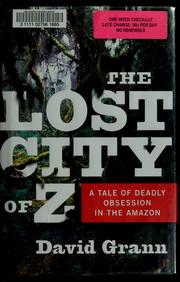
The Lost City of Z: A Tale of Deadly Obsession in the Amazon
2,493-word summary 11 min read 339 pages in the book
- First published
- 2009
- Publisher
- Doubleday
- Pages
- 339
- ISBN
- 9780385513531
Reading options
What's inside (8 sections)
I came to this after The Wager, expecting another disaster story with a courtroom at the end. The Lost City of Z is stranger and less tidy. Published by Doubleday in 2009 and running 339 pages, it grew out of a 2005 New Yorker article, and you can feel its magazine structure. What surprised me is how much of the book is about the people who went looking for Fawcett rather than Fawcett himself. The lost city is a hole in the map, and people keep pouring their lives into it.
The man who wanted a blank spot
Percy Harrison Fawcett was born in Torquay, Devon, in 1867, into a family that had money and lost it. He went to Woolwich, was commissioned in the Royal Artillery in 1886, and spent years in Ceylon, where he walked in the forests and met Nina Paterson, the daughter of a colonial judge. They married in 1901 and had three children: Jack, Brian, and Joan. By then he had joined the Royal Geographical Society to learn surveying and done a turn in Morocco that mixed mapmaking with intelligence work.
The first South American expedition came in 1906, when the RGS sent him to survey the border between Bolivia and Brazil. The job suited him: he was tall, lean, and almost frighteningly fit, with a high tolerance for hunger and a low tolerance for company. He also had a theory of how to survive in Indian country: carry little, bring gifts, never fire first, and treat the people you meet as people. Once, when surrounded, he had his men play instruments and sing instead of shooting.
Fawcett was not a modern anthropologist. He sorted Indians into categories, believed that a truly advanced Amazonian civilization must have had a European origin, and wrote things that read today as racist. Grann does not hide this, but he also shows Fawcett learning dialects, admiring pottery, and hating the way rubber traders destroyed indigenous communities. Both things are true.
His early expeditions made his name. In 1907 he claimed to have shot a giant anaconda and was mocked by scientists. In 1908 he traced the Rio Verde and nearly starved. He came back with Henry Costin and James Murray, maps of places no outsider had mapped, and a reputation for surviving what killed other men. The RGS gave him its gold medal. He also acquired a rival.
Alexander Hamilton Rice was an American doctor with a private fortune and a genius for equipment. He brought radio, a plane, and a large staff into the Amazon; Fawcett brought a machete and a handful of men. The contrast embarrassed the RGS, which liked Rice's results and Fawcett's legend but not his secrecy. Fawcett began to suspect that Rice would find Z first, and the suspicion curdled into mania.
The city in the worm-eaten document
The idea of Z came to Fawcett through a document in the National Library of Brazil. Manuscript 512, attributed to a Portuguese bandeirante named João da Silva Guimarães, claimed that a party had found a ruined city in the interior in 1753: stone arches, a statue, a temple with hieroglyphics, wide roads. It was vague and not exactly reliable, but Fawcett treated it as a map.
He had other evidence, or what he took for evidence: pottery, raised earthworks, Spanish accounts of large settlements along the river. He believed that the Amazon had once held a complex society, and he gave its capital the single letter Z. In his imagination it was a city on a hill, approached by a stone road, with low windowless houses and a pyramidal temple. He kept the route secret because he feared being scooped and believed rescue parties would only add more bodies to the forest.
Archaeologists of the era thought the Amazon's soil could not support a large population, that heat and disease kept people scattered, and that Spanish accounts were exaggerations. Betty Meggers later called the Amazon a counterfeit paradise, a phrase Grann uses for the consensus Fawcett argued against. Fawcett was an amateur, a mystic, and a man with a racial theory. It was easy to dismiss him. That is part of why the book works: the reader sees both the crank and the person asking a real question.
The First World War interrupted everything. Fawcett was nearly fifty but volunteered, commanded an artillery brigade in Flanders, and won the DSO. The war deepened his disgust with what he called civilization. He came back to Brazil in 1920, tried to reach Z, got fever, shot his failing pack animal at a place he named Dead Horse Camp, and retreated. He was broke, famous, and increasingly difficult. The RGS gave him a small grant; American institutions and newspapers put up more. He told the society he could not reveal his route, because these things leak out.
Three men, two dogs, and a last letter
The final expedition began in early 1925. Fawcett sailed from New Jersey in January, stopped in Rio, and reached Cuiabá in March with his son Jack, twenty-one, and Jack's friend Raleigh Rimell. Jack was tall, strong, and eager; Raleigh, the son of a naval surgeon, was more relaxed and already suffering from a tick bite that would swell his foot. They hired two Brazilian laborers, bought horses and mules, and took a pair of dogs. On April 20 they walked out of Cuiabá.
The first weeks were almost pleasant: open scrub, ranches, seven or ten miles a day. Fawcett, who was fifty-seven, set a pace that left the younger men behind; Jack wrote to his mother that they lost him for a night. At a ranch owned by a local strongman, Hermenegildo Galvão, they rested and showed their host a stone idol that Fawcett believed was a relic of Z. It had come from H. Rider Haggard, and he carried it like a talisman.
They reached the Bakairí Post, a settlement of about twenty huts. Jack turned twenty-two there on May 19. They saw naked Indians from the Xingu, took photographs, and put on a concert with a ukulele and a piccolo. Then they went north, into country with no path. The forest closed over them. They hacked through vines, crossed streams, and fought the flies that Fawcett called the wickedest on earth. After nine days they reached Dead Horse Camp, where the bones of his old pack animal were still visible.
From there Fawcett sent the Brazilian laborers back with letters. Raleigh could have gone; his foot was ulcerated and the skin was peeling. He refused to leave Jack. The three men went on together, east, toward the Xingu. Fawcett's last letter to Nina was dated May 29. It was optimistic. You need have no fear of any failure, he wrote. The Kalapalo later said the Englishmen stayed in their village, accepted fish and manioc bread, gave fishhooks and knives, and ignored warnings about hostile Indians to the east. For five days the Kalapalo saw smoke from their camp. Then the smoke stopped.
That is the last hard fact. Everything after it is inference.
The searchers and the stories they told
The RGS declared Fawcett and his companions lost in 1927, and the search became an industry. George Miller Dyott went in, came out with a story about a tribe called the Aloique, and was not convincing. A New Zealand schoolteacher released a carrier pigeon saying he died happy, believing in Fawcett's city. A missionary reported a white child living among the Kuikuro, supposedly Jack's son; the boy turned out to be albino. Nina Fawcett kept the door open for decades. In 1951 Orlando Villas-Boas announced that the Kalapalo had confessed to murder and produced bones. The bones were not Fawcett's. In 1979 Fawcett's signet ring turned up in a pawnshop in Cuiabá.
The death toll is part of the legend, and Grann is honest about how shaky it is: one estimate put the dead at a hundred, and the historian John Hemming later argued that the real figure was closer to one. The point is that the story attracted people willing to die for a rumor. James Lynch's 1996 expedition went in with jeeps, boats, GPS, and a forensic anthropologist; Kuikuro villagers held the team for three days after a ransom that reportedly reached thirty thousand dollars. Satellites had not made the forest safer. They had only made the failure more expensive.
Grann goes to Brazil himself in 2005, leaving his wife and a one-year-old son in Brooklyn and taking out extra life insurance. His guide in Cuiabá is Paolo Pinage, a fifty-two-year-old former samba dancer with a cigarette, a camouflage vest, and a deep knowledge of the region. Pinage is the book's best comic character. He negotiates with chiefs, explains the politics of the Xingu, and keeps telling Grann that the jungle is not a playground. They drive north on a terrible highway, pass soy fields where forest used to be, and reach the Kalapalo village, where the chief, Vajuvi, wants money for the visit. There is a tense negotiation, then a boat trip, then fish and manioc bread.
The scene I remember is Grann alone. He is carrying a box and a computer bag, following a path, and the water rises to his waist. He loses sight of his guide. For a few pages the book becomes a survival story, and Grann is honest about the fear, which is the ordinary panic of a man who has read too much about the forest. Then Kuikuro children appear, laughing, and swim him across in a canoe. The comedy and the terror are close together, which is true of the whole book.
The ditches under the trees
The payoff is a series of ditches.
Michael Heckenberger, an archaeologist who has worked in the Xingu for years, shows Grann a circular moat in the forest near the Kuikuro village. It is nearly a mile across, once twelve to sixteen feet deep and about fifty feet wide. Radiocarbon dating puts it around 1200 A.D. Around it are roads, causeways, and plazas. Some roads are almost a hundred and fifty feet wide. The settlements were built of wood, palm, and earth, which is why they rotted away and why Fawcett, looking for stone, could walk through them without seeing them.
Heckenberger's team mapped a network of towns and villages, each cluster holding perhaps two thousand to five thousand people. They found dark earth, terra preta, created by generations of composting and burning, which made the poor soil farmable. The modern Kuikuro village is still laid out on the same cardinal axes as the old settlements, though the people who live there no longer know why. The Amazon, in this account, was not an empty wilderness. It was a built landscape, densely populated in places, and then it was destroyed by disease after European contact. The counterfeit paradise was a graveyard with a forest growing over it.
This is where Fawcett looks prophetic and also small. He was right that complex societies had lived in the Amazon. He was wrong about their origin, wrong about a single stone city, and wrong about the racial hierarchy he used to explain them. Grann does not claim that Fawcett found Z or that Z was one place. He claims that the question Fawcett asked was better than the answer he wanted. The archaeology is the book's real discovery, but it arrives late, after hundreds of pages of sweat and mules, and can feel like a better magazine piece bolted onto the adventure.
The fate of the three men remains unresolved. The Kalapalo oral history says they went east and were probably killed by a hostile tribe, perhaps the Suyá, though hunger, disease, or exposure are also possible. Fawcett's ring, the bones, the contradictory confessions, and the fake white child all keep the story spinning. Grann does not solve it. He comes back with a more interesting sentence: the forest is not empty, and the people who live in it have their own history of the place.
What the book does well, and where it strains
The Lost City of Z is a very good piece of narrative nonfiction. Grann can write a scene. The wreck of Fawcett's health at Dead Horse Camp, the tick bite, the flies, the moment the laborers turn back, the silence after the smoke: these are rendered with restraint and pace. The double structure keeps it from becoming a straight biography. The portraits of Nina, who believed her husband would walk through the door, and Brian, who spent years defending his father's story, are sharp. The comedy of the RGS is dry and welcome.
The criticisms are real. The book repeats the hundred dead estimate, then qualifies it so quickly that the qualification can get lost. It is more interested in Fawcett's endurance than in the politics of his racism, even when it quotes the ugliest passages. The middle chapters, with their cycles of mules, rain, and fever, can blur together. Some later searchers are introduced and dropped so fast that they feel like entries in a list. And the ending, while honest, may frustrate readers who want a solution. The book is a mystery that turns into an archaeology story and then refuses to close either case.
It is also, deliberately, a book about obsession, and obsession is repetitive. If you want a tight expedition narrative, The Wager is tighter. If you want a full history of Amazonian peoples, this is not it. The book gestures at a reckoning with the colonial imagination but keeps returning to the romance of the blank spot. That romance is both the point and the limitation.
What stays with me is the moat. A circle in the woods, a palisade rotted away, a road that leads to another town that is also gone. Fawcett spent his life looking for a city that would prove the past was grander than anyone thought, and the proof was under his feet in dark earth, broken pottery, and a ditch the Kuikuro ancestors dug. The city was not lost. It was demolished by disease and violence and then covered by trees, and the people who survived kept living in its ruins.
Only the forest knows all, Pinage says near the end.
That is a good line for this book, because the book is less interested in the answer than in the cost of asking. Fawcett went into the green dark with his son and his son's friend and a theory, and none of them came out. Grann went in with a guide, a satellite phone, and a notebook, and came out with a better question. The difference between them is luck, equipment, and the fact that the forest had already been mapped by the people who were there first.
FAQ
Did Percy Fawcett ever find the Lost City of Z?
No. Fawcett disappeared in 1925, and his fate remains unknown. Later archaeology found large Amazonian settlements, but not the specific stone city he described.
Is The Lost City of Z a true story?
It is narrative nonfiction. Grann traveled to the Xingu and reports what is known about Fawcett, leaving the disappearance unresolved.
What happened to Fawcett's son Jack?
Jack Fawcett was twenty-one when the party left Cuiabá and disappeared with his father. The Kalapalo oral history says the three men went east and were likely killed, but no remains have been confirmed.
Similar books
Endurance: Shackleton's Incredible Voyage
Trapped and crushed in Antarctic ice, Shackleton and 28 men survive floes, open boats, and an 800 mile sea crossing. Lansing tells it from their diaries.
2,818-word summary · 13 min read

Down and Out in Paris and London
Orwell's account of washing dishes in Paris hotels and tramping through London does not ask for pity, only for a clear look at how poverty actually works.
2,282-word summary · 10 min read
In the Heart of the Sea: The Tragedy of the Whaleship Essex
The whaleship Essex sunk by a whale leaves men in boats for ninety days.
2,750-word summary · 12 min read
The Perfect Storm
Gloucester's Andrea Gail vanished in the October 1991 nor'easter; Junger joins the crew, storm science, and Tamaroa rescues into a plain and hardworking sea…
2,592-word summary · 12 min read
Around the World in Eighty Days
Fogg bets half his fortune to circle the globe in eighty days with one bag and a valet.
1,995-word summary · 9 min read
The Wager: A Tale of Shipwreck, Mutiny and Murder
Thirty starved men reach Brazil as heroes in 1742, then three more land in Chile calling them mutineers, and Grann sorts the wreck.
2,995-word summary · 13 min read
Killers of the Flower Moon: The Osage Murders and the Birth of the FBI
In 1920s Oklahoma, Osage oil wealth makes tribal members targets for murder, forcing the young FBI under Tom White to expose the conspiracy behind the Reign of…
2,403-word summary · 11 min read

The Zookeeper's Wife: A War Story
The directors of the Warsaw Zoo hid roughly three hundred Jews in empty cages and outbuildings after the German invasion, while Jan worked for the resistance.
2,065-word summary · 9 min read

Long Walk to Freedom
Mandela's account of a Thembu childhood, a law practice, a banned movement, twenty-seven years in prison, and the negotiation that ended apartheid.
2,454-word summary · 11 min read
1491: New Revelations of the Americas Before Columbus
Charles C. Mann gathers archaeology, ecology, and demography to argue that the Americas before Columbus were older, fuller, and more deliberately shaped than…
2,712-word summary · 12 min read
The DaVinci Code: A Quest for Answers
A short 2006 dialogue in which three friends test Dan Brown's claims about Jesus, Mary Magdalene, Nicaea, and the canon.
2,088-word summary · 9 min read
The Beach
A young backpacker follows a dead man's map to a hidden island community, then discovers what the people there are willing to do to keep it secret.
2,067-word summary · 9 min read

Nothing to Envy
Barbara Demick follows six defectors from Chongjin through the North Korean famine, showing how ordinary people lived, believed, and finally left.
2,068-word summary · 9 min read
The Wright Brothers
David McCullough tells the story of two self-taught Ohio brothers, working largely alone and out of a bicycle shop, who solved the problem of flight before…
2,027-word summary · 9 min read
Lone Survivor: The Eyewitness Account of Operation Redwing and the Lost Heroes of SEAL Team 10
Marcus Luttrell's account of the 2005 SEAL mission in Afghanistan that killed three of his team and left him alone.
2,144-word summary · 10 min read
Bury My Heart at Wounded Knee: An Indian History of the American West
Dee Brown's 1970 retelling of the American West from the point of view of the people it destroyed.
2,233-word summary · 10 min read
At Home: A Short History of Private Life
Bill Bryson tours his own Norfolk rectory room by room to explain how private life and the modern home got built.
2,334-word summary · 10 min read
Travels with Charley
Steinbeck drives across America with his poodle Charley, looking for the country he remembers and finding a place that has changed.
2,039-word summary · 9 min read
Prisoners of Geography: Ten Maps That Tell You Everything You Need to Know About Global Politics
Tim Marshall explains how mountains, rivers, coasts, and resources shape the choices of nations, from Russia's flat borders to the chokepoints of the South…
2,328-word summary · 10 min read
The Letters of Vincent van Gogh
Vincent van Gogh's letters to his brother Theo, in a Penguin Classics selection edited by Ronald de Leeuw, trace a decade of work, faith, and obsession.
2,611-word summary · 12 min read
The World Is Flat: A Brief History of the Twenty-first Century
Thomas L. Friedman's 2005 bestseller argues that technology, trade, and open borders leveled the global playing field, and it names the ten forces that did it.
2,369-word summary · 11 min read
Catherine the Great: Portrait of a Woman
A German princess survives a miserable marriage and a coup to rule Russia for thirty-four years, torn between Enlightenment ideas and absolute power.
2,065-word summary · 9 min read
The Warmth of Other Suns
Three migrants ride north out of Jim Crow toward Chicago and LA.
2,561-word summary · 11 min read
The New Jim Crow: Mass Incarceration in the Age of Colorblindness
How mass incarceration became a racial caste system after civil rights.
2,413-word summary · 11 min read
The Little Book of Hygge
Denmark happiness researcher tours candles, cake and cozy winter light.
2,582-word summary · 11 min read
The History of the Hobbit, Part One: Mr. Baggins
Rateliff traces every draft of Bilbo from 1930 notes to print.
2,410-word summary · 11 min read
The Emperor of All Maladies
A biography of cancer from Galen to chemo through one doctor cases.
2,255-word summary · 10 min read
Killing Lincoln
Booth plots as Lincoln pushes war end and reunion in 1865.
2,486-word summary · 11 min read
Hidden Figures
Black women computers at Langley launch rockets past Jim Crow.
2,385-word summary · 11 min read
Wild Swans
Three generations of women survive warlords, revolution, and the Cultural Revolution in Jung Chang's family memoir.
2,356-word summary · 10 min read