
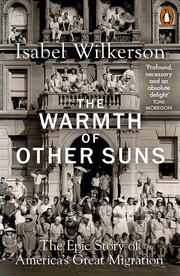
The Warmth of Other Suns
2,561-word summary 11 min read 622 pages in the book
- First published
- 2010
- Publisher
- Random House
- Pages
- 622
- ISBN
- 9780679444329
Reading options
What's inside (8 sections)
I picked this up because Caste had already rearranged how I thought about American history, and I kept hearing that this earlier book was the one that made Wilkerson's name. The Warmth of Other Suns, first published in 2010 by Random House, runs 622 pages in the hardcover edition with ISBN 9780679444329. It took Wilkerson years of work and more than a thousand interviews to put together. I read it slowly over two weeks, a chunk each night, and by the end I felt like I had lived alongside three families for decades.
The basic subject is the Great Migration, the movement of almost six million Black Americans out of the South between 1915 and 1970. Wilkerson treats it as an immigration inside one country, an exodus without a border crossing. People left Mississippi, Florida, Louisiana, Georgia, Texas and the Carolinas for Chicago, Detroit, New York, Philadelphia, Los Angeles and Oakland. They were fleeing Jim Crow law, sharecropping debt, lynching and daily humiliation, and they were chasing factory wages, schools that went past eighth grade, and the right to vote without risking their lives. The book follows three people who made that trip in different decades, and uses their lives to carry the larger history.
Ida Mae Gladney left Chickasaw County, Mississippi for Chicago in 1937. George Starling left Eustis, Florida for Harlem in 1945. Robert Foster left Monroe, Louisiana for California in 1953, eventually settling in Los Angeles. Wilkerson interviewed them extensively toward the ends of their lives and then checked their accounts against census pages, draft cards, train schedules and town records. The result reads like three biographies braided with history chapters in between.
Ida Mae, George, and Robert
Ida Mae Brandon Gladney was a sharecropper's wife in Mississippi, picking cotton alongside her husband George Gladney. She was quiet, churchgoing, steady. In 1937, after a relative got into a violent dispute with a white landowner and the whole extended family felt the danger closing in, she and George packed up their small children and boarded a train north. Chicago was the promised place because relatives had already gone and sent back word about jobs at Swift and other plants, and about a neighborhood called Bronzeville where southern people were remaking city blocks.
George Starling was almost the opposite in temperament. He was sharp, outspoken, quick to anger at unfairness. He picked citrus in Florida and watched Black workers get cheated on pay and pushed to the back of every line. He had done well in school and wanted more than seasonal labor would ever give him. In 1945 he fled after a confrontation with a white foreman made it unsafe to stay, taking a segregated train to Harlem where he hoped to find work on the railroads. He left his wife and small children behind at first, planning to send for them, which was a common pattern.
Robert Foster was the most ambitious of the three in a conventional career sense. He trained as a surgeon, served in the Army, and came home to Louisiana to find that Black doctors could not get hospital privileges or white patients no matter how good their grades were. In 1953 he drove west to California almost on impulse, buying a new car and pointing it toward Los Angeles where his brother was already living. He later became a well known doctor in the Black community in Los Angeles, treating patients like Ray Charles, buying a large house with a pool, throwing parties, and driving expensive cars. His story shows the Migration as a bid for professional dignity as much as safety.
What I liked about this trio is that none of them is a symbol. Ida Mae is cautious and patient. George is political and restless. Robert is flamboyant and driven. Wilkerson lets them disagree with each other in spirit. Ida Mae endures. George argues. Robert performs success. Between them you get a sense of how wide the Migration was.
The trip out
Some of the best pages describe the actual leaving. Wilkerson is very good on trains. Black migrants in the 1930s and 1940s rode in segregated cars, often the oldest cars, near the engine smoke. They packed fried chicken and boiled eggs because dining cars would not serve them. They carried as little as possible and told as few white neighbors as possible, because leaving could be treated as disloyalty. Landowners sometimes blocked the roads on payday or threatened workers who tried to catch the northbound Illinois Central.
Ida Mae's trip takes up a long chapter. She nursed a baby on the train, worried about milk, about bathrooms, about whether Chicago relatives would really meet them at the station. Wilkerson slows down for the sound of the train, the smell of the car, the way the landscape changed from cotton fields to city smoke. It works because it stays close to what Ida Mae remembered and what schedules confirm, rather than reaching for poetry.
George's departure was more frantic. He had to leave quickly and quietly, and he spent the ride replaying what he had said to the foreman and whether men would come looking for him. Wilkerson uses his train ride to explain how information traveled in Black southern towns, through Pullman porters, returning relatives, and the Chicago Defender newspaper, which was passed hand to hand even where it was banned. The Defender listed jobs, rents, church addresses, and warnings. For a lot of readers this will be the first time the mechanics of the Migration become clear. People did not wander north. They followed addresses.
Robert drove, which gives his section a different feel. He stopped for gas where he could, slept where he could, learned which towns to pass through without stopping. His drive west in a shiny car as a young Black man in 1953 carried its own risk. Police attention was constant. Wilkerson pairs his road story with data on how car ownership changed migration after the war, letting people skip the train stations where they were most watched. Robert arrives in Los Angeles sunburned and broke and full of plans, and the city opens and closes in front of him at the same time.
Chicago, Harlem, and Los Angeles
Arrival did not mean relief. It meant a new set of rules.
Ida Mae and George Gladney landed in Chicago and found work, but also found cold that hurt their lungs, landlords who charged southern newcomers extra for kitchenette apartments, and a color line that was enforced by contract rather than by sign. Wilkerson explains restrictive covenants and how Bronzeville became overcrowded because Black renters could only rent in a few wards. Ida Mae cleaned houses, worked in food plants, raised children, went to church on Sundays. She voted, which she could not do safely in Mississippi. When she was very old she voted for Barack Obama when he ran for the United States Senate from Illinois, a scene Wilkerson handles without pushing it too hard. Ida Mae did not become rich or famous. She achieved what she wanted, which was steady pay, a home she owned, and children who finished school.
George found railroad work as a porter and later in a post office job, the kind of federal employment that anchored Black middle class life in New York. Harlem in the late 1940s was crowded and alive, full of southern transplants, jazz clubs, storefront churches, and political meetings. George got involved in union organizing and civil rights arguments at work, which made him respected by coworkers and watched by bosses. Wilkerson is honest about his family breaking under the strain. Long hours, cramped housing, and his temper wore down his marriage. He eventually found steadiness in faith in his later years, which reads as earned rather than tidy, because Wilkerson shows how long it took.
Robert's Los Angeles story is the flashiest and the saddest. He built a thriving medical practice, bought the grand house he had dreamed about, hosted gatherings with music and food that mixed Louisiana and California. He was the personal physician to Ray Charles for a period, which Wilkerson uses to show both his skill and the narrow channels open to him. White hospitals still limited him. White neighborhoods still resisted him. He worked punishing hours to pay for the life he displayed. His relationship with his wife and daughters suffered from his absences and his pride. When he died, Wilkerson notes who came to the funeral and what they remembered, which was competence and generosity more than the cars.
Across all three cities Wilkerson keeps returning to small details that accumulate weight. Southern food cooked in northern kitchens. Churches splitting and replanting with the same hymns. Barbershops and beauty shops as newsrooms. Children code switching between southern home speech and northern school speech. These passages explain how migrants changed the North and West, bringing food, faith and music that later counted as American culture, while the cities changed them with factory discipline, union rules, cold winters and new forms of segregation.
Why she calls it an immigration
Between the life stories Wilkerson inserts shorter history chapters. Some readers will love these. Some will skim them. I mostly liked them because they answer the question the title raises.
The title comes from Richard Wright, who wrote about migrants seeking the warmth of other suns. Wilkerson argues the Great Migration belongs in the same conversation as other large migrations in history, movements where people crossed a desert or an ocean for a chance to live as full citizens. She compares the Black migrants to immigrants arriving at Ellis Island, noting that European immigrants could eventually blend into whiteness while Black migrants carried the color line with them. She draws on immigration scholarship, labor statistics, lynching records, housing maps and school enrollment data. The point is not that every detail matches. The point is that calling it a migration rather than a reshuffling forces us to see the courage and cost involved.
She also tracks what the South lost and what the North gained. The South lost workers and taxpayers and some of its best teachers and preachers. Northern factories gained the labor that powered wartime production. Northern politics gained Black voters who tipped mayoral and presidential races. Culture gained the blues in Chicago, jazz uptown, soul food menus, and church traditions that fed the civil rights movement. Wilkerson quotes labor agents, mayors, pastors and sociologists to show contemporaries noticed this at the time, even if textbooks later flattened it.
One strong chapter follows housing. Another follows schools. Another follows the way crime papers in Chicago blamed newcomers for crowding that landlords created. These sections can feel dense after the vivid train chapters. I found myself slowing down and reading them with a pencil. Stick with them. They keep the book from becoming only three nice stories. They show the structure the three lives moved inside.
How she found all this
Wilkerson spent years finding her three main subjects and confirming their stories. She interviewed more than a thousand people total, then narrowed to Ida Mae, George and Robert because their journeys covered different decades, different southern states, and different northern and western destinations. She sat with them for many hours, recorded them, visited their hometowns, walked their old streets, and pulled census manuscripts and military files.
You feel that labor in the texture. She knows what cotton paid per hundred pounds in a given year, what a Pullman ticket cost, what shift porters worked, what rent a kitchenette commanded on the South Side. She names funeral homes, high schools, bus routes. That specificity builds trust. When she describes Ida Mae wringing chickens or George learning railroad protocol or Robert studying anatomy, you believe she asked how it was actually done.
Her background matters here. Wilkerson won the Pulitzer Prize for feature writing while at The New York Times and taught journalism at several universities. Her parents themselves migrated from Georgia and southern Virginia to Washington, D.C., where she was born. She does not make herself a character, which I appreciated. A short note explains her connection and then steps aside. The focus stays on the three families.
The method has limits and she mostly admits them. Memory after fifty years is imperfect. Three lives cannot stand for six million. Wilkerson handles this by checking memories against paper whenever possible and by saying plainly when something comes only from one person's account. She also brings in other migrants briefly to fill gaps, so Ida Mae, George and Robert do not have to carry every theme alone.
What drags and who will love it
This is a long book and it reads long in places. At 622 pages it needs its length for the history chapters, but the middle third repeats certain beats. Another train arrival. Another cold winter. Another landlord. Another job lost to discrimination. Repetition is partly the point, since the structure repeated for migrants, but as a reading experience it can blur. I started reading the history interludes in the morning and the life stories at night to keep both fresh.
Wilkerson's prose is careful and often beautiful. She favors full sentences and clear images over slang or flash. Some readers will wish for more edge or humor. The tone stays respectful throughout, which suits Ida Mae especially well and sometimes smooths George's angrier edges. Robert's section has the most spark because Robert himself had spark. If you want a fast narrative, this may test you. If you want to understand how Jim Crow pushed people out and how northern housing rules boxed them in again, the patience pays off.
Criticism from historians has mostly been about framing rather than facts. A few argued the immigration comparison stretches in places, since leaving Mississippi for Chicago did not mean learning a new language or crossing a legal border. Others wanted more on migrants who went to smaller cities, or who returned South later in life, or on women beyond Ida Mae. Those are fair points. The book is stronger on the push from the South and the first decade after arrival than on the second generation. Still, as an account of why people left and what leaving cost, it has held up well since 2010 and won major prizes for good reason, including the National Book Critics Circle Award.
Who should read it. Anyone who liked Caste and wants the earlier foundation. Anyone teaching twentieth century American history who needs human faces for statistics. Anyone from a family that moved north or west who wants to see the train, the kitchenette, the church pew and the union hall described with care. Pair it with a novel like Native Son for Chicago or a memoir from Harlem to feel fiction and fact side by side.
I finished with Ida Mae in mind more than the arguments. She left Mississippi with children and little money, worked for decades in Chicago, bought a house, buried a husband, voted late in life for a man who carried her history into office. Wilkerson lets that life stand as its own answer to whether the trip was worth it. Three migrants rode north and west out of Jim Crow toward Chicago, Harlem and Los Angeles. Millions followed. The country they made is the one we live in now.
FAQ
When was The Warmth of Other Suns published and how long is it?
It was first published in 2010 by Random House. The hardcover runs 622 pages with ISBN 9780679444329.
Who are the three main people followed in the book?
Ida Mae Gladney who left Mississippi for Chicago in 1937, George Starling who left Florida for Harlem in 1945, and Robert Foster who left Louisiana for Los Angeles in 1953.
Is The Warmth of Other Suns part of a series?
No, it stands alone. It pairs well with Wilkerson's later book Caste, but there is no series order.
Similar books
Caste: The Origins of Our Discontents
Wilkerson argues America runs on a hidden caste system, tracing eight pillars across the US, India, and Nazi Germany.
2,629-word summary · 12 min read
Killing Lincoln
Booth plots as Lincoln pushes war end and reunion in 1865.
2,486-word summary · 11 min read
Hidden Figures
Black women computers at Langley launch rockets past Jim Crow.
2,385-word summary · 11 min read
John Adams
McCullough follows Adams from Braintree lawyer to second president.
2,515-word summary · 11 min read

Long Walk to Freedom
Mandela's account of a Thembu childhood, a law practice, a banned movement, twenty-seven years in prison, and the negotiation that ended apartheid.
2,454-word summary · 11 min read
The Wright Brothers
David McCullough tells the story of two self-taught Ohio brothers, working largely alone and out of a bicycle shop, who solved the problem of flight before…
2,027-word summary · 9 min read
The Blind Side: Evolution of a Game
Michael Lewis traces how the left tackle became a premium position and tells the story of Michael Oher, a homeless Memphis teenager whose size and speed made…
2,038-word summary · 9 min read

The Letters of Vincent van Gogh
Vincent van Gogh's letters to his brother Theo, in a Penguin Classics selection edited by Ronald de Leeuw, trace a decade of work, faith, and obsession.
2,611-word summary · 12 min read
Catherine the Great: Portrait of a Woman
A German princess survives a miserable marriage and a coup to rule Russia for thirty-four years, torn between Enlightenment ideas and absolute power.
2,065-word summary · 9 min read
The New Jim Crow: Mass Incarceration in the Age of Colorblindness
How mass incarceration became a racial caste system after civil rights.
2,413-word summary · 11 min read

The Emperor of All Maladies
A biography of cancer from Galen to chemo through one doctor cases.
2,255-word summary · 10 min read
Wild Swans
Three generations of women survive warlords, revolution, and the Cultural Revolution in Jung Chang's family memoir.
2,356-word summary · 10 min read

How to Be an Antiracist
Kendi blends memoir and history to argue that fair policy, not self fixing, creates an equal society.
2,513-word summary · 11 min read
The Surgeon of Crowthorne
James Murray built the Oxford dictionary with Broadmoor inmate William Minor, whose thousands of slips shaped this 1998 HarperCollins story of murder, madness…
2,775-word summary · 12 min read

Cleopatra: A Life
Pulitzer winner Schiff restores Cleopatra as a capable ruler, from Ptolemy debts and Caesar to Antony, Actium, and her death in 30 BC, built from coins and…
3,586-word summary · 16 min read

The Splendid and the Vile
Larson follows Churchill circle through Blitz year with diaries and bombing nights.
2,038-word summary · 9 min read

American Sniper: The Autobiography of the Most Lethal Sniper in U.S. Military History
Navy SEAL sniper Chris Kyle recounts Texas roots, SEAL training, four Iraq tours, and the strain combat placed on his marriage and health.
2,011-word summary · 9 min read
A Beautiful Mind
Mathematician John Nash's brilliant game theory rise, schizophrenia collapse, and Nobel return, with wife Alicia's care.
2,142-word summary · 10 min read
Cosmic Music
The first full biography of Alice Coltrane, from Detroit church piano to ashram guru.
2,048-word summary · 9 min read
Benjamin Franklin: An American Life
Isaacson traces Franklin from Boston runaway to printer, scientist, London agent, Paris diplomat, and founder across 590 vivid pages.
2,149-word summary · 10 min read
Einstein: His Life and Universe
Isaacson traces Einstein from patent clerk to world fame using newly opened papers, through 1905, relativity, exile, and the long unified theory search.
2,773-word summary · 12 min read
In the Garden of Beasts
Ambassador Dodd takes his family to 1933 Berlin and watches charm curdle into terror.
1,927-word summary · 9 min read
A People's History of the United States
A bottom-up history of the United States from Columbus to Clinton, told through workers, women, Native nations and Black voices against elite rule.
2,398-word summary · 11 min read

1776
Washington's amateur army from Boston siege to Trenton through mud and doubt.
2,139-word summary · 10 min read
Between the World and Me
Coates writes to his son about the Black body in America, from Howard to the loss of Prince Jones.
2,234-word summary · 10 min read
Unbroken
Louis Zamperini survives a Pacific crash, sharks and POW camps after running in the Berlin Olympics.
3,263-word summary · 15 min read

The Zookeeper's Wife: A War Story
The directors of the Warsaw Zoo hid roughly three hundred Jews in empty cages and outbuildings after the German invasion, while Jan worked for the resistance.
2,065-word summary · 9 min read

Sybil
A 1973 case study of a woman treated for multiple personalities, and the book that made dissociative identity disorder a household phrase.
2,054-word summary · 9 min read
1491: New Revelations of the Americas Before Columbus
Charles C. Mann gathers archaeology, ecology, and demography to argue that the Americas before Columbus were older, fuller, and more deliberately shaped than…
2,712-word summary · 12 min read
The DaVinci Code: A Quest for Answers
A short 2006 dialogue in which three friends test Dan Brown's claims about Jesus, Mary Magdalene, Nicaea, and the canon.
2,088-word summary · 9 min read