
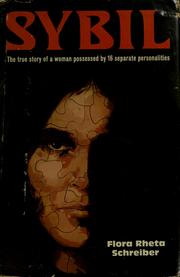
Sybil
2,054-word summary 9 min read 359 pages in the book
- First published
- 1973
- Publisher
- Warner Books
- Pages
- 359
- ISBN
- 9780809200016
Reading options
What's inside (10 sections)
In 1954, a young woman walked into a New York psychiatrist's office and told her that she lost time. Not minutes here and there. Whole days, whole weeks, stretches of her life that belonged to someone else. She had been treated before, briefly, in Omaha, and the treatment had ended badly. She had tried to finish college and had been asked to leave until she got help. She was bright, shy, and exhausted in a way that made her seem older than twenty-nine. Her name, in the book, is Sybil Dorsett.
Flora Rheta Schreiber's 1973 book tells the story of what happened next. It became a bestseller, then a television movie with Sally Field, then a shorthand for multiple personality disorder in the popular imagination. It is also a book that has been argued over for decades, and any honest account of it has to hold two things at once: it is a gripping narrative about a woman in pain, and it is a piece of reporting whose central claims have been seriously challenged.
The case
The book opens with Sybil as a child in a small Midwestern town, the daughter of Hattie and Willard Dorsett. Hattie is rigid, religious, and frightening. Willard is passive and absent. Sybil grows up learning to be quiet, to be good, to disappear. Schreiber presents the household as a pressure cooker, and the personalities as the steam that had to go somewhere.
By the time Sybil reaches Dr. Cornelia Wilbur, she has already developed a set of alternate selves who take over when the pressure gets too high. Peggy Lou is a child, angry and volatile. Vicky is composed, sophisticated, and worldly, everything Sybil is not. There are others: Peggy Ann, Marsha, Mike, Sid, Nancy, Ruthie, Clara, Helen, Marjorie, Vanessa. Schreiber counts sixteen in all. They have different voices, different postures, different handwriting. Some of them know about the others. Some do not.
Wilbur's treatment is the spine of the book. She uses hypnosis and sodium pentothal, the so-called truth serum, to bring the other personalities forward and to recover memories Sybil has buried. The sessions are dramatic. Personalities argue with each other, interrupt, refuse to leave. Vicky becomes Wilbur's ally and, in effect, a co-therapist, explaining the system from the inside. Over years, Wilbur works to integrate the selves, aging them forward, convincing them that they are all parts of one woman.
The book is structured like a novel. Schreiber reconstructs scenes, supplies dialogue, and moves between Sybil's present and her childhood. It reads fast. It is also, by design, a case study with a thesis: that severe childhood abuse can produce dissociation so complete that the mind splits into separate identities, and that careful, patient therapy can put the pieces back together.
The abuse
The most disturbing material in the book is Sybil's recovered memory of what her mother did to her. Hattie is portrayed as mentally ill and sadistic. There are scenes of physical punishment, of humiliation, of sexualized abuse that Schreiber describes in detail. The book presents these memories as the origin of the disorder. Each personality, in this reading, exists to hold a piece of the trauma that Sybil could not survive as a whole person.
That narrative was enormously influential. It shaped how clinicians, writers, and filmmakers thought about dissociation for a generation. It also gave readers a way to understand a condition that had been sensationalized and dismissed. Schreiber writes about Sybil with sympathy. The book is on her side. When Sybil finally confronts her mother, when she begins to feel anger instead of terror, the reader feels the release.
The problem is that memory recovered under hypnosis and barbiturates is not reliable. That was known in 1973, though it was not as widely discussed as it is now. The book treats the recovered scenes as fact. It does not seriously entertain the possibility that some of them were shaped by the therapy itself, or by the expectations of everyone in the room. That omission is the book's central weakness, and it is not a small one.
The personalities
The book's most memorable passages are the ones in which the other selves speak. Peggy Lou is a child who sulks and rages and wants to be loved. Vicky is a woman of the world who smokes, wears nice clothes, and handles the practical business Sybil cannot. Peggy Ann is quieter, Marsha is domestic, Mike is a boy who wants to be a carpenter, Sid is a man who wants to be a lumberjack. Nancy, Ruthie, Clara, Helen, Marjorie, Vanessa: each has a function, a voice, a way of holding herself.
Schreiber writes them as characters, and that is both the book's strength and its problem. They are vivid. They are also suspiciously well organized, like a cast assembled for a play. Vicky in particular is almost too useful, explaining the system to Wilbur, translating between selves, keeping the story moving. Real dissociation is messier than this, and later clinicians have pointed out that the book's tidy roster of sixteen looks more like a literary invention than a clinical record.
Still, the personalities give the book its emotional range. Sybil herself is quiet and frightened. The others are allowed to be angry, sexual, ambitious, childish. They hold the feelings she cannot. When Wilbur begins to integrate them, the novel becomes a story about a woman learning to own her own life, and that story is moving even if the diagnosis is contested.
The controversy
In 2011, the journalist Debbie Nathan published Sybil Exposed, a detailed investigation of the case. Nathan argued that Wilbur and Schreiber had between them created the disorder they claimed to discover. Wilbur, in this account, was ambitious and convinced of her own theory. Schreiber was a writer who needed a bestseller. The two women became close, and the book they produced was less a neutral case study than a collaboration.
Nathan also raised questions about Sybil's real identity. The woman behind the pseudonym was Shirley Ardell Mason, an art teacher who lived quietly in Lexington, Kentucky, and died in 1998. Nathan found evidence that Mason had been a suggestible patient, that Wilbur had prescribed large amounts of barbiturates, and that some of the symptoms may have been produced or amplified by treatment. She argued that Mason's underlying problems may have included a physical illness that was never properly diagnosed.
Not everyone accepts Nathan's conclusions. Some clinicians who knew the case defend Wilbur's work. The book's defenders point out that dissociative identity disorder is a real diagnosis, that it is recognized in the DSM, and that abuse and dissociation are genuinely linked. The existence of the disorder does not depend on the truth of this one case. But the case itself, as Schreiber tells it, is not a reliable window into it.
That is the honest position. Sybil is a powerful book and a problematic one. It is not fiction, but it is not straight reporting either. It is a reconstruction, shaped by a theory, written for a popular audience, and it has to be read with that in mind.
The film and the diagnosis
The 1976 television movie, with Sally Field as Sybil and Joanne Woodward as Dr. Wilbur, made the story famous. It won Emmys, it was watched by a huge audience, and it fixed the image of multiple personality disorder in the public mind: a woman with a flicker in her eyes, a change in her voice, a new name. The movie is more restrained than the book, and Field's performance is genuinely good, but it simplified the case further. It turned a messy clinical argument into a story with a beginning, a middle, and a cure.
The book also arrived at a moment when the diagnosis was expanding. Multiple personality disorder, later renamed dissociative identity disorder, became a cultural phenomenon in the 1970s and 1980s, with a wave of cases, memoirs, and lawsuits. Sybil was the template. The book's structure, the hidden abuse, the heroic therapist, the integration, became the shape that later stories followed, whether or not the facts supported them.
That legacy is double-edged. On one side, the book helped people recognize that dissociation is real and that abuse can fracture a person's sense of self. On the other, it created a script that some patients and therapists may have followed too closely. The recovered memory movement of the 1980s and 1990s produced real harm as well as real healing, and Sybil is one of the texts that made that movement possible.
What the book gets right
For all its problems, Sybil is a remarkable piece of writing about inner life. Schreiber has a novelist's sense of scene and a clinician's patience with detail. The therapy sessions are vivid, and the personalities are distinct without becoming caricatures. Vicky in particular is a wonderful creation, whether or not she existed in the way the book presents her. She is witty, capable, and a little sad, and her loyalty to Sybil is the emotional thread that holds the narrative together.
The book is also good on the experience of losing time. Sybil's terror at finding herself in a strange place, wearing clothes she does not remember putting on, holding objects she does not recognize, is rendered with real empathy. That feeling is not invented, even if its explanation is contested. Anyone who has cared for someone with a dissociative condition will recognize the helplessness.
And the book is, in its way, a feminist document. It takes a woman's suffering seriously. It connects that suffering to the powerlessness of a daughter in a patriarchal household. It insists that what happened to Sybil mattered. That insistence was valuable in 1973, and it is still valuable now, even if the specifics do not hold up.
The prose and the pace
Schreiber writes clearly and often well, but she is not a subtle stylist. The book has a tendency to explain its own significance. A scene will end, and then a paragraph will tell you what the scene meant. The childhood sections are especially heavy, with a lot of italicized dread and ominous weather. The therapy sections are better, because the drama is built into the situation.
The book is long, and the middle sags under the weight of repeated sessions. Readers who come for the story will find it, but they will also find a lot of case history, a lot of theory, and a lot of reconstructed conversation. The pacing is that of a popular psychology book from the 1970s, which is exactly what it is.
Why it still matters
Sybil is worth reading for two reasons. The first is historical. It is the book that put dissociative identity disorder on the cultural map, and its influence is everywhere from film to memoir to the way people talk about trauma. You cannot understand the conversation without it. The second is human. Whatever the truth of the diagnosis, Shirley Mason was a real woman who suffered, and the book, at its best, honors that suffering.
The right way to read it is with respect and skepticism at the same time. Respect for the pain. Skepticism about the certainty. The book wants you to believe every word, and that is precisely why you should not. It is a case study that became a myth, and the myth is more complicated than the book admits.
It is also a book about a relationship. Wilbur and Sybil spend years together, sometimes several sessions a week, and the intimacy of that work is part of what makes the story compelling. Wilbur is patient, curious, and clearly attached to her patient. Whether that attachment was therapeutic or damaging is the question the book cannot answer, because it never really asks it. The doctor is the hero of the narrative, and heroes do not get cross-examined.
That does not make it worthless. It makes it a document of its moment, and a cautionary tale about what happens when a compelling story outruns the evidence. Wilbur and Schreiber believed they were helping. They may have been. They also may have harmed the woman they were trying to save, and the book does not let the reader see that possibility. The reader has to bring it.
FAQ
Was Sybil a real person?
Yes. Sybil Dorsett was a pseudonym for Shirley Ardell Mason, an art teacher who was treated by Dr. Cornelia Wilbur and died in 1998.
How many personalities did Sybil have?
The book describes sixteen, including Peggy Lou, Vicky, Peggy Ann, Marsha, Mike, and Sid. Later investigations questioned whether the count and the diagnosis were shaped by treatment.
Is Sybil considered accurate today?
It is widely regarded as unreliable in its details. Debbie Nathan's 2011 book Sybil Exposed argues that Wilbur and Schreiber influenced the symptoms, though dissociative identity disorder remains a recognized diagnosis.
Similar books
What Happened to You?
Oprah Winfrey and psychiatrist Bruce Perry explain how early experience shapes the brain, and why asking what happened to someone works better than asking what…
2,238-word summary · 10 min read
Columbine
Ten years of reporting on the 1999 school massacre, including a journalist's correction of the myths he helped create in the first hours.
2,232-word summary · 10 min read
Smoke Gets in Your Eyes: And Other Lessons from the Crematory
A young medieval history graduate takes a job at an Oakland crematory and becomes a mortician, confronting the physical reality of death and the funeral…
2,003-word summary · 9 min read

The Emperor of All Maladies
A biography of cancer from Galen to chemo through one doctor cases.
2,255-word summary · 10 min read
Hidden Valley Road: Inside the Mind of an American Family
The Galvin family raises twelve children while six sons develop schizophrenia across decades of shifting science.
2,492-word summary · 11 min read
A Beautiful Mind
Mathematician John Nash's brilliant game theory rise, schizophrenia collapse, and Nobel return, with wife Alicia's care.
2,142-word summary · 10 min read
The Body Keeps the Score
A psychiatrist explains how trauma lives in the body and what helps people recover, from EMDR to movement and connection.
2,172-word summary · 10 min read
The Man Who Mistook His Wife for a Hat
Twenty four case histories where strange neurology meets full personhood.
1,930-word summary · 9 min read
Nudge: Improving Decisions About Health, Wealth, and Happiness
Thaler and Sunstein show how defaults, framing, and social cues steer choices, and argue for choice architecture with an opt-out.
3,146-word summary · 14 min read

Long Walk to Freedom
Mandela's account of a Thembu childhood, a law practice, a banned movement, twenty-seven years in prison, and the negotiation that ended apartheid.
2,454-word summary · 11 min read
The Courage to Be Disliked: The Japanese Phenomenon That Shows You How to Change Your Life and Achieve Real Happiness
A philosopher and an angry young man argue over five nights about Adlerian psychology, trauma, approval, and the freedom to be disliked.
2,054-word summary · 9 min read

In Order to Live: A North Korean Girl's Journey to Freedom
A young North Korean girl crosses the Yalu, survives trafficking in China, and rebuilds her life in Seoul in this unsparing memoir.
2,027-word summary · 9 min read

Too Much and Never Enough: How My Family Created the World's Most Dangerous Man
Mary L. Trump's 2020 memoir traces how a cold, zero-sum Queens household shaped her uncle, and uses family tax documents to challenge his self-made story.
2,059-word summary · 9 min read
Moonwalking with Einstein: The Art and Science of Remembering Everything
A journalist spends a year training for the U.S. Memory Championship and discovers that extraordinary memory is mostly technique, attention, and a lot of…
2,027-word summary · 9 min read

Infidel
Ayaan Hirsi Ali's memoir of a Somali childhood, a forced marriage, a Dutch asylum claim, and the political fight that followed the murder of Theo van Gogh.
2,041-word summary · 9 min read
The Total Money Makeover: A Proven Plan for Financial Fitness
Dave Ramsey lays out seven Baby Steps, from a $1,000 starter fund to a paid-off house, with the debt snowball at the center.
2,663-word summary · 12 min read

The Girl with Seven Names: A North Korean Defector's Story
Hyeonseo Lee crossed the frozen Yalu River at seventeen, spent years hidden in China, escaped to South Korea, and later returned to rescue her family.
2,404-word summary · 11 min read
Don't Sweat the Small Stuff ... and It's All Small Stuff: Simple Ways to Keep the Little Things from Taking Over Your Life
Richard Carlson’s 1997 bestseller offers one hundred short chapters on lowering the volume on daily irritations, and it is more pragmatic than its title…
2,502-word summary · 11 min read
The Wright Brothers
David McCullough tells the story of two self-taught Ohio brothers, working largely alone and out of a bicycle shop, who solved the problem of flight before…
2,027-word summary · 9 min read
Made to Stick: Why Some Ideas Survive and Others Die
The Heath brothers break down why some ideas vanish on contact while others lodge in memory, tracing six traits that make a message stick.
2,527-word summary · 11 min read
Four Thousand Weeks: Time Management for Mortals
Oliver Burkeman turns the whole productivity project on its head, arguing that a human lifespan of roughly four thousand weeks is not a problem to optimize…
2,447-word summary · 11 min read
Cultish: The Language of Fanaticism
Amanda Montell argues that the real machinery of a cult is its vocabulary, and she traces how loaded language from 1960s communes to modern wellness brands and…
2,087-word summary · 9 min read
Breath: The New Science of a Lost Art
Journalist James Nestor investigates how modern humans learned to breathe badly, and what researchers, athletes, and breathwork practitioners have found about…
2,011-word summary · 9 min read
Beautiful Boy: A Father's Journey Through His Son's Addiction
David Sheff recounts watching his son Nic slide into meth addiction, and his own desperate, humbling search for how to help without destroying them both.
2,076-word summary · 9 min read
Life
The Rolling Stones guitarist tells his own story: a Dartford childhood, the band's first gigs, the drug raids, the tax years and Patti Hansen.
2,761-word summary · 12 min read
The Road Less Traveled: A New Psychology of Love, Traditional Values and Spiritual Growth
M. Scott Peck argues that maturity begins with accepting difficulty, then builds discipline, love, and spiritual growth through honest, often painful work.
2,200-word summary · 10 min read
The Blind Side: Evolution of a Game
Michael Lewis traces how the left tackle became a premium position and tells the story of Michael Oher, a homeless Memphis teenager whose size and speed made…
2,038-word summary · 9 min read
Attached
A psychiatrist and a psychologist explain adult attachment styles and show how anxious, avoidant, and secure patterns shape dating, conflict, and the search…
2,157-word summary · 10 min read

The Letters of Vincent van Gogh
Vincent van Gogh's letters to his brother Theo, in a Penguin Classics selection edited by Ronald de Leeuw, trace a decade of work, faith, and obsession.
2,611-word summary · 12 min read
Lucky
Alice Sebold's memoir of the 1981 rape she survived as a college freshman, the courtroom that followed, and a conviction later proven to be a case of mistaken…
2,091-word summary · 9 min read