
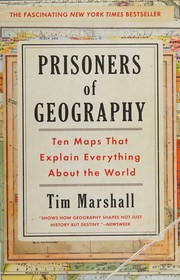
Prisoners of Geography: Ten Maps That Tell You Everything You Need to Know About Global Politics
2,328-word summary 10 min read 320 pages in the book
- First published
- 2015
- Publisher
- Scribner
- Pages
- 320
- ISBN
- 9781501121470
Reading options
What's inside (13 sections)
- Russia and the Flat Land
- China and the Sea
- The United States and the Mississippi
- Europe and the Power of Division
- Africa and the Middle East
- The Middle East and the Sykes-Picot Line
- India, Pakistan, and the Himalayas
- Korea, Latin America, and the Arctic
- Korea, Japan, and the Sea
- Latin America and the Arctic
- The Limits of the Argument
- Key takeaways
- FAQ
I read Prisoners of Geography with an atlas open on my phone, which is probably the best way to read it. The book is full of maps, borders, rivers, and mountain ranges, and it makes more sense when you can see the shapes it describes. Tim Marshall's argument is simple: geography does not determine everything, but it sets the terms on which politics happens. Leaders can ignore mountains and rivers, but they do so at their cost.
The book was published in 2015 by Elliott & Thompson in the UK and Scribner in the US. The subtitle is "Ten Maps That Tell You Everything You Need to Know About Global Politics," which is a marketing promise the book cannot keep. It does not tell you everything. It gives you a way of looking at the world that is useful, limited, and occasionally frustrating. The edition I read runs 320 pages.
Marshall is a British journalist who has reported from conflict zones in the Balkans, the Middle East, and elsewhere. He is not an academic, and the book is not a work of original research. It is a primer. It takes familiar ideas from geopolitics and explains them through regional case studies. That is a modest ambition, and it is executed well. The book became a bestseller because it makes complicated things feel clear.
The introduction lays out the case. Geography affects transport costs, defensive exposure, food supply, access to resources, and the practical reach of state authority. A country with a warm-water port has options that a landlocked country does not. A country with a flat western border is vulnerable to invasion. A country with a navigable river system can move goods more cheaply than a country without one. These are not new ideas, but Marshall makes them concrete.
He also makes a distinction that matters. Geography is not destiny. Technology can overcome distance. Air power, railways, pipelines, and the internet change what states can do. But technology changes the tools more often than it abolishes the constraints. Mountains still slow armies. Deserts still limit settlement. Rivers still cross borders. The physical world remains a factor that every generation has to interpret.
The book is organized into ten chapters, each focused on a region. The chapters are not equally strong. The early ones, on Russia, China, and the United States, are the most convincing. The later ones, on Latin America and the Arctic, are thinner. Marshall is best when he has a clear strategic puzzle to explain. He is less compelling when he is summarizing a continent.
Russia and the Flat Land
The Russia chapter is the book's signature. Marshall explains that Russia has no natural barriers on its western border. The North European Plain is flat, wide, and open. Moscow sits in the middle of it. Invaders have come from the west repeatedly, from Napoleon to Hitler. Russian rulers have responded by pushing outward, creating buffer zones in Eastern Europe and Central Asia. The Soviet Union was the largest buffer of all.
When the Soviet Union collapsed, Russia lost that buffer. NATO expanded into countries that had been part of the Soviet sphere. Marshall argues that this feels threatening to Moscow, regardless of NATO's intentions. He is not justifying Russian aggression. He is explaining the geographic logic that Russian leaders use. The annexation of Crimea in 2014 is presented as a response to the loss of a warm-water port at Sevastopol. It is a controversial claim, and the book does not pretend that geography is the only reason.
Russia's size is also a problem. Siberia is rich in resources, but it is sparsely populated and expensive to control. The country's population is concentrated in the west, near Europe. The east is a vast, cold frontier. Marshall shows how geography creates both strength and insecurity. Russia is large enough to absorb an invasion, but it is also exposed. That combination shapes its politics.
China and the Sea
China's chapter is about the shift from land power to sea power. Historically, China was a continental state. Its population lived on the North China Plain, between the Yellow and Yangtze rivers. The Grand Canal connected the rivers, and the Great Wall marked the northern border. China's main threats came from the steppe, not the sea.
Marshall argues that China's modern strategy is different. The country depends on imported oil and gas, and it exports manufactured goods. It needs secure sea lanes. The Strait of Malacca, between Malaysia and Indonesia, is a chokepoint. Most of China's oil imports pass through it. If a rival power controlled the strait, China would be vulnerable. That is why China is building ports in Pakistan and Myanmar, and why it is asserting control over the South China Sea.
The chapter also covers Tibet and Xinjiang. Marshall treats them as buffer zones. Tibet is important because its mountains separate China from India, and because three major rivers rise there. Xinjiang is important because it borders eight countries and contains resources. The book describes the infrastructure and demographic policies that Beijing uses to hold these regions. It is a strategic account, not a moral one. Marshall acknowledges the human rights issues, but he does not dwell on them.
The United States and the Mississippi
The United States chapter is the most optimistic. Marshall explains why the US has an unusual set of advantages. It has two oceans, which reduce the threat of invasion. It has a vast network of navigable rivers, especially the Mississippi basin, which is one of the largest in the world. It has fertile land, natural harbors, and a continent-sized domestic market.
The Louisiana Purchase doubled the country's territory and gave it control of the Mississippi. The Transcontinental Treaty with Spain gave it access to the Pacific. The Mexican-American War added Texas and California. Marshall argues that the US expanded to its natural borders and then built a navy that could project power beyond them. The result was a superpower with a secure base.
The chapter also discusses the limits of American power. The US can project force, but it cannot control every outcome. Vietnam and Iraq are examples of the gap between military capability and political success. Marshall argues that American leadership depends on alliances, logistics, and the credibility of its commitments. Geography helps, but it does not guarantee success.
Europe and the Power of Division
Europe's geography is a story of fragmentation. The continent has many mountains, peninsulas, and unconnected river systems. That made it difficult for one power to unite the whole region. It also made it easy for many small states to develop. Marshall contrasts Europe with the United States, which has a single large river system and a more uniform landscape.
The Gulf Stream gives Western Europe a mild climate, which supports agriculture and population growth. The northern countries industrialized earlier because they had coal, iron, and access to the sea. The southern countries had less favorable conditions. Marshall uses this to explain the economic gap between north and south, though he acknowledges that institutions and politics matter too.
The European Union is presented as an attempt to manage division. After World War II, France and Germany chose cooperation over rivalry. The EU and NATO turned enemies into partners. But the 2008 financial crisis exposed fault lines. The euro created a shared currency without a shared fiscal policy. The result was austerity, resentment, and a rise in populism. Marshall wrote before Brexit, so the book does not cover it. That makes the chapter feel dated, but the underlying argument still holds.
Africa and the Middle East
The Africa chapter is the one that has been criticized most. Marshall argues that Africa's geography has made integration difficult. The Sahara is a barrier. Many rivers are not navigable for long distances. The coastline has few natural harbors. These conditions made it hard to build large states and long-distance trade.
He also argues that colonial borders cut across existing communities. European powers drew lines on maps without regard for ethnic, linguistic, or political boundaries. Those lines became the borders of independent states, and many of them have been sources of conflict. The chapter explains why some African states are fragile and why regional integration has been slow.
The criticism is that this account ignores the role of slavery, colonialism, Cold War intervention, and corrupt elites. Geography is part of the story, but it is not the whole story. Marshall does acknowledge these factors, but he gives them less weight than the physical landscape. The chapter can feel like an apology for determinism. It is the weakest part of the book.
The Middle East and the Sykes-Picot Line
The Middle East chapter is about borders that were drawn by outsiders. After World War I, Britain and France divided the Ottoman Empire into spheres of influence. The Sykes-Picot Agreement and the subsequent mandates created states that did not match the region's older patterns of tribe, sect, and trade. Iraq, Syria, Lebanon, and Jordan were assembled from pieces.
Marshall argues that these artificial borders have contributed to instability. Iraq's sectarian divisions, Syria's civil war, and Lebanon's fragile power-sharing system are all shaped by the way the states were constructed. He also discusses the importance of oil, water, and chokepoints. The Strait of Hormuz, the Suez Canal, and the Bosporus are strategic locations. Control over them matters.
The chapter is informative, but it is also simplified. The Middle East is not just a product of European mapmaking. Local actors, religious movements, and economic forces have their own histories. Marshall knows this, but the chapter's frame makes it easy to forget. The book is at its best when it explains a specific geographic constraint. It is at its weakest when it tries to explain an entire region.
India, Pakistan, and the Himalayas
The India and Pakistan chapter is one of the best. Marshall explains that the Himalayas protect India from invasion from the north. The mountains are a barrier, but they also create a disputed border. Kashmir is the flashpoint. It is a region where geography, religion, and national identity collide. India and Pakistan have fought wars over it, and both countries claim the whole territory.
The chapter also discusses water. The Indus River system flows through both countries, and agriculture depends on it. The Indus Waters Treaty, signed in 1960, divides the rivers. It has survived wars, but it is under pressure. Marshall shows how geography creates interdependence and conflict at the same time.
He also discusses Afghanistan. Pakistan has used Afghanistan as strategic depth in its rivalry with India. India has supported Afghanistan to counter Pakistan. The result is a complicated regional game that is not just about mountains and rivers. Marshall is good at showing how the physical landscape shapes the political one.
Korea, Latin America, and the Arctic
Korea, Japan, and the Sea
The Korea and Japan chapter is about vulnerability. The Korean Peninsula is small, mountainous, and surrounded by larger powers. It has been invaded many times. Japan is an island nation, which has protected it from invasion but also made it dependent on sea trade. Both countries are close to China and Russia, and both are allied with the United States.
Marshall explains the strategic importance of the Korean Peninsula. China does not want a unified Korea aligned with the United States on its border. Japan worries about North Korean missiles. The United States maintains bases in both countries. The result is a delicate balance that has lasted for decades.
The chapter is short, and it feels less developed than the others. Marshall does not say much about Japanese politics or Korean reunification. He focuses on the geographic basics. That is enough to understand the headlines, but not enough to understand the region in depth.
Latin America and the Arctic
The Latin America chapter is the weakest. Marshall discusses the Andes, the Amazon, and the Panama Canal. He explains how geography has shaped settlement patterns and trade. Most of Brazil's population lives near the coast. The Amazon is vast and difficult to develop. The Andes create isolated communities and complicate integration.
The Arctic chapter is more interesting. Climate change is melting the ice, which is opening new shipping routes and exposing resources. Russia has the longest Arctic coastline. Canada, Norway, Denmark, and the United States also have claims. The chapter argues that the Arctic will become a zone of competition. It is a preview of the future, and it is one of the few parts of the book that looks forward rather than backward.
The Limits of the Argument
The main criticism of Prisoners of Geography is that it is too deterministic. Geography matters, but so do institutions, ideas, leadership, and luck. The book acknowledges this in the introduction, but the chapters often slip into a simpler story. The result is a book that explains a lot and overexplains some things. It is a good starting point, not a final answer.
The book is also dated. It was published in 2015, before Brexit, before the full rise of China's navy, before the war in Ukraine in 2022. Some of its predictions have not aged well. That is not Marshall's fault. It is the nature of a book about current events. The geographic facts remain, but the political context has changed.
I would recommend it to readers who want a readable introduction to geopolitics. It is not rigorous enough for a specialist, and it is not neutral enough for a critic of geographic determinism. But it is a useful map of the questions. It teaches you to look at a country and ask: what does it need, what does it fear, and what does the land make easy or hard? Those are good questions, even when the answers are more complicated than the book suggests.
FAQ
Is Prisoners of Geography politically neutral?
No. Marshall writes from a British realist perspective, and critics say the book favors geographic explanations over political and economic ones.
Does the book include maps?
Yes. The chapters are built around maps, though some editions reproduce them in black and white.
What is the main argument?
Geography shapes politics by setting constraints and opportunities, but it does not determine everything.
Similar books
The World Is Flat: A Brief History of the Twenty-first Century
Thomas L. Friedman's 2005 bestseller argues that technology, trade, and open borders leveled the global playing field, and it names the ten forces that did it.
2,369-word summary · 11 min read
Nudge: Improving Decisions About Health, Wealth, and Happiness
Thaler and Sunstein show how defaults, framing, and social cues steer choices, and argue for choice architecture with an opt-out.
3,146-word summary · 14 min read

Long Walk to Freedom
Mandela's account of a Thembu childhood, a law practice, a banned movement, twenty-seven years in prison, and the negotiation that ended apartheid.
2,454-word summary · 11 min read

Nothing to Envy
Barbara Demick follows six defectors from Chongjin through the North Korean famine, showing how ordinary people lived, believed, and finally left.
2,068-word summary · 9 min read

Down and Out in Paris and London
Orwell's account of washing dishes in Paris hotels and tramping through London does not ask for pity, only for a clear look at how poverty actually works.
2,282-word summary · 10 min read
The New Jim Crow: Mass Incarceration in the Age of Colorblindness
How mass incarceration became a racial caste system after civil rights.
2,413-word summary · 11 min read

How to Be an Antiracist
Kendi blends memoir and history to argue that fair policy, not self fixing, creates an equal society.
2,513-word summary · 11 min read
Empire of Pain: The Secret History of the Sackler Dynasty
How the Sackler family sold OxyContin and shaped an overdose crisis while giving to museums.
2,048-word summary · 9 min read

Say Nothing
Patrick Radden Keefe traces Jean McConville's 1972 disappearance through the Price sisters, Brendan Hughes, and Gerry Adams, using Boston College tapes to…
2,846-word summary · 13 min read

Cleopatra: A Life
Pulitzer winner Schiff restores Cleopatra as a capable ruler, from Ptolemy debts and Caesar to Antony, Actium, and her death in 30 BC, built from coins and…
3,586-word summary · 16 min read
The Big Short: Inside the Doomsday Machine
Outsiders who read the bonds shorted subprime and watched the machine eat itself in 2008.
2,194-word summary · 10 min read
The Communist Manifesto
Marx and Engels trace class struggle from bourgeoisie to proletarians, review rival socialisms, and close with a call to opposition parties. Notes on the 1848…
2,570-word summary · 11 min read
The 48 Laws of Power
Robert Greene turns court history into 48 blunt power laws, each taught through stories like Fouquet and Louis XIV, plus reversals that show when each law…
2,846-word summary · 13 min read
A Promised Land
First-volume memoir from Iowa 2008 through the 2011 bin Laden raid, crisis management and doubt.
2,243-word summary · 10 min read
A People's History of the United States
A bottom-up history of the United States from Columbus to Clinton, told through workers, women, Native nations and Black voices against elite rule.
2,398-word summary · 11 min read

The Prince
Machiavelli advises Lorenzo on rule through fear and love, fortune, cruelty and mercy.
2,204-word summary · 10 min read
Between the World and Me
Coates writes to his son about the Black body in America, from Howard to the loss of Prince Jones.
2,234-word summary · 10 min read

The Zookeeper's Wife: A War Story
The directors of the Warsaw Zoo hid roughly three hundred Jews in empty cages and outbuildings after the German invasion, while Jan worked for the resistance.
2,065-word summary · 9 min read

Heretics of Dune
Fifteen centuries after Leto II, the Bene Gesserit raise a new Duncan Idaho while the Honored Matres return and Rakis burns.
2,673-word summary · 12 min read
1491: New Revelations of the Americas Before Columbus
Charles C. Mann gathers archaeology, ecology, and demography to argue that the Americas before Columbus were older, fuller, and more deliberately shaped than…
2,712-word summary · 12 min read
The DaVinci Code: A Quest for Answers
A short 2006 dialogue in which three friends test Dan Brown's claims about Jesus, Mary Magdalene, Nicaea, and the canon.
2,088-word summary · 9 min read

In Order to Live: A North Korean Girl's Journey to Freedom
A young North Korean girl crosses the Yalu, survives trafficking in China, and rebuilds her life in Seoul in this unsparing memoir.
2,027-word summary · 9 min read

Too Much and Never Enough: How My Family Created the World's Most Dangerous Man
Mary L. Trump's 2020 memoir traces how a cold, zero-sum Queens household shaped her uncle, and uses family tax documents to challenge his self-made story.
2,059-word summary · 9 min read

Infidel
Ayaan Hirsi Ali's memoir of a Somali childhood, a forced marriage, a Dutch asylum claim, and the political fight that followed the murder of Theo van Gogh.
2,041-word summary · 9 min read
The Total Money Makeover: A Proven Plan for Financial Fitness
Dave Ramsey lays out seven Baby Steps, from a $1,000 starter fund to a paid-off house, with the debt snowball at the center.
2,663-word summary · 12 min read

The Girl with Seven Names: A North Korean Defector's Story
Hyeonseo Lee crossed the frozen Yalu River at seventeen, spent years hidden in China, escaped to South Korea, and later returned to rescue her family.
2,404-word summary · 11 min read
The Wright Brothers
David McCullough tells the story of two self-taught Ohio brothers, working largely alone and out of a bicycle shop, who solved the problem of flight before…
2,027-word summary · 9 min read
Lone Survivor: The Eyewitness Account of Operation Redwing and the Lost Heroes of SEAL Team 10
Marcus Luttrell's account of the 2005 SEAL mission in Afghanistan that killed three of his team and left him alone.
2,144-word summary · 10 min read

Bury My Heart at Wounded Knee: An Indian History of the American West
Dee Brown's 1970 retelling of the American West from the point of view of the people it destroyed.
2,233-word summary · 10 min read
At Home: A Short History of Private Life
Bill Bryson tours his own Norfolk rectory room by room to explain how private life and the modern home got built.
2,334-word summary · 10 min read