
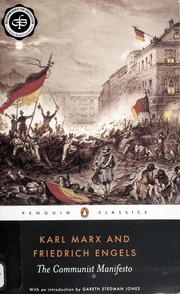
The Communist Manifesto
2,570-word summary 11 min read
- First published
- 1848
- Publisher
- Penguin Books
- ISBN
- 9780140447576
Reading options
What's inside (8 sections)
I finally read The Communist Manifesto this year because I was tired of hearing it quoted by people who clearly had not. It comes up everywhere, in arguments about housing, in debates about tech layoffs, in memes that reduce a whole century of politics to one line. I wanted to know what the thing actually says when you sit with it for an evening. It turns out to be short, rude, and much stranger than its reputation.
The facts first, since they matter here. It is a pamphlet from 1848, first published in German in London, written by Karl Marx with Friedrich Engels. The edition I used is the Penguin Books printing. It runs about twenty or thirty pages depending on the introduction, which means there is no excuse for summarizing it from hearsay, and I say that as someone who did exactly that for years. The post author on this page stays Karl Marx per the site's list, but the co authorship is real and I keep coming back to it. Engels was not a bystander. He pushed, edited, and signed off, and some passages carry his cadence.
My honest first reaction was surprise at the tone. I expected something dry and theoretical. What I got reads more like a campaign leaflet written by two young men who are furious and certain. Marx was not yet thirty. Engels was younger still. They write like people who believe history has a direction and they have spotted it. That confidence is thrilling on some pages and grating on others, and both reactions feel worth keeping.
A pamphlet written for a year of revolts
You cannot make sense of this text without 1848. Europe was shaking. Crowds filled streets in Paris, Vienna, and Berlin. Old regimes wobbled and workers demanded votes, bread, and constitutions. A small international group of radicals, the Communist League, asked Marx and Engels to write down what the movement stood for. The result was published just as the uprisings spread.
That commission explains the shape of the thing. This is not a textbook. It is a statement of purpose meant to be read aloud in meetings and passed hand to hand. The sentences are built for rhythm. The arguments move fast and skip steps a scholar would fill in. When I read it I kept picturing a crowded room, someone standing on a chair, the pages rattling in his hands.
London matters too. Marx lived there in exile, broke and buried in newspapers, reading about factory conditions and parliamentary fights. Engels had spent time observing mill workers in Manchester, and his notes on their housing and hours fed directly into the pamphlet's anger. So the book's picture of industry is English as much as German. Smokestacks, crowded tenements, children working long days. The authors generalize from what they saw around them to the whole modern world, which is both the power and the problem of the argument.
One more piece of context helped me. Marx and Engels were writing against other reformers as much as against factory owners. The left of 1848 was crowded with rival clubs, papers, and prophets, each claiming to speak for workers. Part of the pamphlet is a turf war. Marx wants readers to pick his faction over the rest, and he is not polite about the competition. Keeping that in mind kept me from reading every insult as pure theory. Some of it is just politics, the kind where you call your rival confused because there is a meeting next Tuesday and you need the room on your side.
Bourgeoisie and proletarians
The first section is the famous one, and it is where most of the pamphlet's lasting images live. Marx and Engels open with the image of a spectre haunting Europe, the spectre of communism, and then they offer their reading of history. Every past society, they say, divided into oppressors and oppressed. Freeman and slave, lord and serf, and now, in their day, bourgeoisie and proletarians. Owners of capital on one side, people who must sell their labor to live on the other.
What struck me rereading this is how much admiration sneaks into the attack. Marx clearly thinks the bourgeoisie, meaning the capitalist class that rose with modern industry, accomplished something staggering. He describes how it swept aside guild rules, local custom, and old obligations, and tied the world together with trade. Distant regions that once barely knew of each other now depend on the same markets. Old crafts give way to factories. Everything solid seems to melt under competition. He means this as an accusation, but the energy of the passage reads like awe. These people rebuilt the planet in a century, he says, and now they cannot control what they built.
Then comes the turn. The same system that creates such wealth keeps producing crises, he argues. Goods pile up that workers cannot afford to buy. Firms collapse. Trade freezes. Capitalists respond by cutting wages, shedding jobs, and finding new markets abroad, which only sets up the next crash on a larger scale. Meanwhile the workers, crowded into cities and factories, start to see their shared position. They form unions, then parties. They learn to act together because the factory itself teaches them cooperation. The bourgeoisie, in this telling, trains its own opposition every working day.
I found this section the most readable and the least careful. Readable because the story has a drive to it, almost a plot, with each phase of industry producing a more organized working class. Least careful because huge claims slide past without evidence. That all history is class struggle. That small traders and farmers must sink into the proletariat. That crises grow worse by necessity rather than by policy or accident. Marx states these as facts of motion, like physics, and the pamphlet form gives him no room to defend them. If you already agree, the pages fly. If you do not, you will be writing objections in the margins, as I was.
What the communists actually want
The second section answers a plain question. If you are communists, what do you want, and how are you different from every other workers party? Marx gives two answers. First, communists back the shared interests of workers across countries and across immediate fights. Second, they keep the final goal in view, a reorganization of society without private ownership of productive property, even while supporting near term reforms.
Then he takes on the objections one by one, in a stretch that reads like a debate transcript. You want to abolish property, critics say, which means theft and ruin. Marx replies that the property in question is capital, the kind that lets one person live off another's labor, and not your coat or your garden. You want to abolish the family, critics say. He answers that the bourgeois family, in his portrait, already runs on money and inheritance, and that preaching family values to people whose children work in mills rings hollow. You want to abolish nations and religion, critics say. He answers that workers already have no country in the sense of a stake in its profits, and that law and belief mostly reflect who holds power.
Some of this is sharp. The passage on how every objection assumes the permanence of current arrangements still bites. Every era treats its own setup as nature, and Marx is good at naming that habit. Some of it is evasive. The family argument in particular moves fast and brushes past what care, loyalty, and home mean to ordinary people, including workers. I kept thinking of the very mill families Engels described. They might have agreed that factory life was crushing them while still rejecting the claim that their family ties were a mere money form. The pamphlet rarely pauses for that kind of mixed feeling.
Near the end of this section comes a list of measures proposed for advanced countries of the time. I will describe them in broad strokes rather than recite them, since the exact items belong to 1848 and translations vary. They include public control of banking and transport, extension of public industry, obligations around labor, combination of farming with manufacturing, public schooling for children, and steps against inheritance and land rents of the old style. Reading them now is a strange experience. Some look like ordinary postwar policy in many countries. Others look foreign and tied to a moment when states did far less. The list reminds you that this was a program for immediate agitation, not a timeless blueprint, whatever later readers made of it.
Other socialisms on trial
The third section surprised me most, because nobody quotes it and it takes up real space. Here Marx sorts through rival socialist writing and dismisses nearly all of it. He divides the competition into types. There is reactionary socialism, which wants old hierarchies back with a kindly face. There is conservative or bourgeois socialism, which wants to fix the worst abuses while keeping the system intact. And there is critical utopian socialism, the dreamers who draw up ideal communities in books while the real fight passes them by.
The tone here is rough, sometimes funny, often unfair. Marx accuses one group of mourning feudalism while eating its bread. He accuses another of offering charity and paperwork instead of change. He treats the utopians with a mix of respect for their early insight and contempt for their refusal to pick a side now that workers are organizing. I laughed once or twice and then felt uneasy. Some of the portraits are caricatures. You can tell Marx has specific pamphlets and personalities in mind, and he is settling scores under the cover of categories.
Still, I am glad I read it, because it corrects a common picture of 1848 as Marx versus the bosses. It was Marx versus half the left as well. The section shows a movement arguing with itself about strategy. Should workers ally with middle class reformers, or keep their distance? Should they build model villages, or fight for state power? Should they preach peace, or prepare for force? Those questions did not die in 1848. They still split meetings today, and Marx's answers here, harsh as they are, help explain why later socialist parties kept quoting him and fighting over him at the same time.
A friend asked me if this section is skippable, and I said no, but with a warning. The names and books under review are mostly forgotten, so some pages feel like listening to one side of an old phone call. The value is in watching Marx draw boundaries. He is telling readers who counts as a real ally and who is a distraction. Every later split in labor history, between gradual reform and rupture, between party discipline and loose movements, has a small ancestor in these pages.
Which parties to back, country by country
The final section is short and practical. Marx runs through several countries and says where communists should stand in each local fight. In one place they back democratic reformers against monarchy. In another they support a workers party pushing past liberal limits. The details are tied to thrones and parliaments long gone, so I will not pretend they map onto anything now. What matters is the method. Support every movement that weakens the old order, he says, while keeping your own organization distinct and your longer goal in view. Never dissolve into someone else's campaign. Never trade independence for a seat at their table.
Then comes the close, and even people who never opened the pamphlet know its shape. Marx tells the ruling classes that their overthrow is coming, calls on workers of all countries to unite, and declares they have nothing to lose but their chains. I am paraphrasing the closing lines on purpose rather than printing them as slogans, because on the page they land as a speech ending, not a proof. The pamphlet earns its finale the way a rally earns applause, by tempo and nerve rather than by settling every doubt raised earlier.
Reading this section with 1848 in mind gave me a small chill. The authors expected the fight to come soon. They thought Germany's coming revolution would be the opening of a larger workers revolt across Europe. Within months there were barricades, and within a few years most of them had been cleared. The confidence of these pages comes from people who think the tide is already rising under them. Knowing the tide went back out does not make the writing foolish, but it changes the feel. It reads like a bet placed loudly in public, and history kept the receipt.
Where it holds up and where it fails
Let me give the pamphlet its due before the criticism, because the due is real. As a description of capitalism's restlessness, parts of section one still sting. Firms really do chase new markets, upend habits, and reshape cities within a lifetime. Work really does throw strangers together and teach them their shared interests. Anyone who has watched a neighborhood change around a new plant, or watched an industry vanish into software, will recognize the motion Marx describes. He caught something true about a system that must keep growing or stall, and he said it in prose that still moves.
The foresight has limits, and they are large. The middle layers of society did not vanish the way the pamphlet expects. Small owners, professionals, and salaried managers grew in number rather than sinking as one body into the factory class. Revolutions broke out in largely peasant empires rather than in the most industrialized states. Wages and political rights rose in many countries through unions, parties, and laws, which the pamphlet treats as unlikely to last or matter much. A reader in 2026 has to admit that capitalism proved more flexible, and workers' politics more varied, than this text allows.
The determinism is the deeper flaw. The pamphlet often writes as if victory is guaranteed by the direction of history. That tone comforts believers and excuses laziness about evidence. It also fed something darker later. When parties claiming this text took power in the twentieth century, some used the promise of a guaranteed outcome to justify coercion, censorship, and terror. Marx did not order those crimes from his London desk, and blaming a pamphlet for everything done in its name would be lazy. But the text's certainty, its dismissal of rivals, and its thin account of freedom after victory left tools that authoritarians picked up gladly. A fair reading holds both thoughts. The critique of exploitation can be serious while the politics built on certainty remain dangerous.
So who should read it now? Anyone who argues about markets, class, or labor should spend the evening it takes. It is short enough that summary alone is a poor substitute, and the experience of its speed and temper teaches what no excerpt can. Pair it with a good history of 1848 and with something written by one of Marx's targets, so the score settling in section three has a second voice. I came away admiring the first section, irritated by the third, and sobered by the gap between the closing call and what followed. That seems like the right mix. A pamphlet this influential deserves attention and argument in equal measure, and it repays both.
FAQ
Who wrote The Communist Manifesto?
Karl Marx wrote it with Friedrich Engels, and it was first published in German in London in 1848.
What are the four parts of the pamphlet?
They cover bourgeoisie and proletarians, the aims of communists, critiques of other socialist writing, and the communists' stance toward opposition parties.
Why does it still matter if some predictions failed?
It shaped labor movements and later states for over a century, so readers study it for its influence and its errors alike.
Similar books
The Prince
Machiavelli advises Lorenzo on rule through fear and love, fortune, cruelty and mercy.
2,204-word summary · 10 min read

Fathers and Sons
Arkady brings the nihilist Bazarov home to his father's estate, and a generational argument turns into love, a duel, and an early death.
2,192-word summary · 10 min read
Prisoners of Geography: Ten Maps That Tell You Everything You Need to Know About Global Politics
Tim Marshall explains how mountains, rivers, coasts, and resources shape the choices of nations, from Russia's flat borders to the chokepoints of the South…
2,328-word summary · 10 min read
The World Is Flat: A Brief History of the Twenty-first Century
Thomas L. Friedman's 2005 bestseller argues that technology, trade, and open borders leveled the global playing field, and it names the ten forces that did it.
2,369-word summary · 11 min read
The Dispossessed: An Ambiguous Utopia
Physicist Shevek leaves anarchist Anarres for capitalist Urras to share time theory, finding walls both places.
2,288-word summary · 10 min read
The Republic
Socrates debates justice and sketches a city ruled by philosophers, with the cave and the soul.
2,167-word summary · 10 min read
The Unbearable Lightness of Being
Surgeon Tomas loves Tereza yet keeps mistresses, while artist Sabina and professor Franz test freedom around the 1968 Soviet invasion of Prague.
2,427-word summary · 11 min read
Nudge: Improving Decisions About Health, Wealth, and Happiness
Thaler and Sunstein show how defaults, framing, and social cues steer choices, and argue for choice architecture with an opt-out.
3,146-word summary · 14 min read

Long Walk to Freedom
Mandela's account of a Thembu childhood, a law practice, a banned movement, twenty-seven years in prison, and the negotiation that ended apartheid.
2,454-word summary · 11 min read
Rosencrantz and Guildenstern Are Dead
Stoppard's 1966 play retells Hamlet from the wings, where two minor courtiers wait, joke, and walk toward a death they cannot see.
2,021-word summary · 9 min read

Nothing to Envy
Barbara Demick follows six defectors from Chongjin through the North Korean famine, showing how ordinary people lived, believed, and finally left.
2,068-word summary · 9 min read
Foundation's Edge
Exiled councilman Golan Trevize hunts for the Second Foundation and the lost world of Earth, and finds a planet with one mind waiting to change the galaxy.
2,335-word summary · 10 min read

Down and Out in Paris and London
Orwell's account of washing dishes in Paris hotels and tramping through London does not ask for pity, only for a clear look at how poverty actually works.
2,282-word summary · 10 min read
The Dharma Bums
Ray Smith rides freight trains, climbs Matterhorn Peak and argues about Zen with the poet Japhy Ryder in Kerouac's 1958 road novel.
2,729-word summary · 12 min read
Out of the Silent Planet
A Cambridge philologist is kidnapped and taken to Mars, where the natives are civilized and the humans are the dangerous invaders.
2,612-word summary · 12 min read
Exodus
Leon Uris's sweeping 1958 novel follows Jewish refugees, Haganah fighters, and Holocaust survivors from Cyprus to the founding of Israel and the 1948 war.
2,529-word summary · 11 min read

Beyond Good and Evil: Prelude to a Philosophy of the Future
A guide to Friedrich Nietzsche's Beyond Good and Evil: its attack on moral prejudice, the will to power, master and slave morality, and the philosopher of the…
2,597-word summary · 12 min read
The New Jim Crow: Mass Incarceration in the Age of Colorblindness
How mass incarceration became a racial caste system after civil rights.
2,413-word summary · 11 min read
Leaves of Grass
Free verse songs of self, America, bodies and democracy.
2,240-word summary · 10 min read
Edge of Eternity
Five families cross civil rights, Cold War and Berlin Wall to the eighties.
2,489-word summary · 11 min read
A Canticle for Leibowitz
After nuclear war, monks save books across centuries while the world rebuilds and falls again.
2,381-word summary · 11 min read
The Fall
A fallen Paris lawyer confesses in an Amsterdam bar, tracing guilt from Paris success to a bridge he failed to face.
2,220-word summary · 10 min read
The Black Swan
Taleb argues rare shocks shape history more than models admit, and urges safer exposure over prediction.
2,588-word summary · 12 min read

Solaris
Kelvin reaches a silent station above Solaris and finds grief made solid when the ocean returns his dead wife Rheya, testing memory, science, and the limits of…
2,548-word summary · 11 min read
On the Origin of Species
Darwin's 1859 case for evolution by natural selection, from Beagle finches and breeding pigeons to fossils and anatomy.
2,589-word summary · 12 min read
How to Be an Antiracist
Kendi blends memoir and history to argue that fair policy, not self fixing, creates an equal society.
2,513-word summary · 11 min read
Empire of Pain: The Secret History of the Sackler Dynasty
How the Sackler family sold OxyContin and shaped an overdose crisis while giving to museums.
2,048-word summary · 9 min read
Twelve Years a Slave
Free violinist Solomon Northup tells how Brown and Hamilton lured him south into twelve years of Louisiana bondage until Bass letters brought rescue in January…
2,931-word summary · 13 min read
Say Nothing
Patrick Radden Keefe traces Jean McConville's 1972 disappearance through the Price sisters, Brendan Hughes, and Gerry Adams, using Boston College tapes to…
2,846-word summary · 13 min read
One Day in the Life of Ivan Denisovich
One freezing day with prisoner Shch-854 in a Soviet camp: roll call, bricklaying in the cold, bread rations, and small wins that let Shukhov call the day…
2,668-word summary · 12 min read