
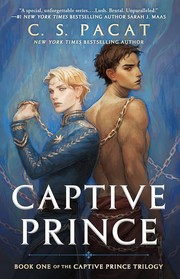
Captive Prince
2,063-word summary 9 min read 304 pages in the book
- First published
- 2013
- Publisher
- Berkley
- Pages
- 304
- ISBN
- 9780425274262
- Series
- Captive Prince (#1)
Reading options
What's inside (7 sections)
Captive Prince began life as an online serial before it became one of the most talked-about fantasy trilogies of the 2010s, and reading it now, you can feel both of those origins in it. The chapters move with the propulsion of serial fiction, ending on hooks and reversals, and the whole thing has the intensity of a story written by someone who was in love with her own characters. I came to it late, after hearing it recommended in the same breath as the best political fantasy of the decade, and I understand the reputation now.
I also understand why it is not for everyone. This is a dark book about a society built on sexual slavery, and it opens with its narrator enslaved. There is on-page sexual violence, the sexual abuse of a child is a fact of the setting, and the romance that the trilogy is famous for is barely a romance in this first volume. If you need your fantasy comfortable, this one will not be.
A prince in chains
The novel opens with the fall of Damianos, heir to the throne of Akielos. His half-brother Kastor seizes power in a coup, kills everyone who knows about the prince's capture, and sells him south to Vere, the enemy kingdom Akielos defeated six years earlier at the battle of Marlas. There, Damianos is renamed Damen, trained for service, and handed as a pleasure slave to the crown prince of Vere, Laurent.
The twist that powers the whole book is that no one in Vere knows who Damen is. At Marlas, Damen killed Auguste, Laurent's beloved older brother, and in Vere he is remembered as the Prince-Killer, the man every citizen has been raised to hate. Laurent's household has no idea that the famous barbarian is in their custody. Damen figures this out quickly and holds onto the secret with both hands, because the one rule of his survival is that he must never reveal his true identity. The man he needs is the man who would hate him more than anyone alive.
Pacat sets up the chessboard with real economy. Laurent is beautiful, cold, and dangerous, and he treats Damen as a tool from the first scene. The Veretian court around him is a nest of factions and appetites, ruled in practice by Laurent's uncle, the Regent, who governs while Laurent approaches the age that will end the regency. The book establishes early that Vere's cruelty is not incidental. It is the system.
The court of Vere
The arena sequence is where the reader learns the rules of the world. Veretian courtiers keep pets, people who are not legally enslaved but belong to their patrons as ornaments and sex objects, and the entertainments include fights that end in assault. Damen is pitted against Govart, a soldier of the Regent's Guard, and wins in a way that embarrasses the Veretians, who hate seeing an Akielon beat one of their own. His refusal to touch Nicaise, the Regent's thirteen-year-old pet, earns him an enemy with power.
Pacat uses the arena to show how power flows in Vere. Damen spending the middle of the book in Laurent's household, among guards like Jord and Orlant and the steward Radel, watching the daily humiliations of the pets, is the education he needs to understand his position. He also learns that his own kingdom is not innocent. In Akielos, slavery is part of the social order too, dressed in different language. The novel does not let Damen keep his moral comfort, and that is the first step of a much longer arc.
The bath scene halfway through the first act is the hinge. Laurent invites Damen to share his bath, and Damen reads it as an advance and moves on him. Laurent is not aroused. He is not testing Damen's desire. He is testing his obedience, and he punishes the mistake by ordering Damen strapped to a wooden cross and whipped. It is a brutal sequence, and it teaches both of them something. Damen learns that Laurent's body is not a door into his trust. Laurent learns, when the guards and servants begin to sympathize with Damen afterward, that his punishment achieved the opposite of what he wanted.
The pets culture is the sharpest piece of worldbuilding in the book, because it makes power visible in a way speeches could not. A pet is status, affection, and property at once, and the court reads itself by who owns whom and how well they are kept. Nicaise, the Regent's favorite, is a case study in how the system recruits its own victims: charming, spiteful, and disposable the moment he stops being young. Damen's refusal to touch him is a mercy and a miscalculation at once, because in Vere a refused gift is an insult, and insults in this court have long memories.
The Regent's response to the incident defines the central political conflict. He punishes Laurent at a Council meeting by stripping away lands, money, and men, and Laurent accepts it, because the alternative is worse. The Regent wants Laurent out of the capital and off the board, ideally dead in an accident that can be blamed on Akielos, which is divided enough after Kastor's coup to be the perfect scapegoat. Laurent's refusal to go to Delpha, the disputed border territory, is the only defensive move he has left.
Erasmus and Torveld
The plot's middle act concerns the enslaved Akielons that Kastor sent to Vere as a diplomatic gift, and it is the best-written section of the book. They are being abused in the palace, and Damen cannot help them on his own. The opening arrives in the form of Prince Torveld of Patras, who is visiting to negotiate a treaty, and whose country, like Akielos, has a culture that values enslaved people differently than Vere does.
Damen goes to Laurent with a bargain. He will submit fully, publicly, take whatever punishment the Regent's politics demand, and perform the role of the tamed barbarian, if Laurent will work to send the Akielons to Patras instead of leaving them in Vere. Laurent, who needs a political win, agrees to try, and both of them know better than to trust the other's motives.
What follows is a masterclass in court politics. Laurent spends a day charming Torveld, who becomes infatuated with him, and at a banquet the whole plan nearly collapses because Nicaise, who has his own reasons, plots to embarrass the prince. Then the pets perform for the guests. Ancel, one of the more memorable side characters, performs with fire, and Erasmus, who was branded in Akielos, panics at the flames. Torveld, seeing the state of the man, stops the entertainment to save him and decides to demand the Akielons as part of the treaty. Laurent's plan works, and Pacat lets the reader appreciate how many moving pieces were required.
Damen gets the job of handling the transfer, which gives him access to news from home, and the news is bad. Kastor is failing to unify the kyroi, the provinces of Akielos, and the people who knew about Damen's capture are dead. Any hope of a clean return keeps getting further away.
Fire, poison, and the Regent's game
The last act is a cascade of violence, and it is where the book stops being a slow study of manners. Guards wake Damen in the night and deliver him to Laurent's chambers as a joke about the prince finally taking his slave to bed. The guards attack both of them, and Laurent and Damen kill them together, which is the first time they fight on the same side. Then Damen notices that Laurent has been poisoned. He leaves Laurent in a bad state and tries to escape across the rooftops, and he is caught by Govart, saved from summary execution by the Prince's Guard, and delivered back into a situation he cannot read.
The resolution of the attack is pure Laurent. Everyone assumes the assassins came for Damen, and Laurent lets them believe it, even though he was the true target, because naming the real culprit would expose the Regent and start a war he cannot win. When he and Damen finally talk, Laurent tells the truth about the order and the plan behind it. The Regent intends to kill Laurent and pin it on Akielos so that Vere can go to war against a divided neighbor and unite the countries under his rule. Damen offers his help, and Laurent refuses.
In between those two decisions, the novel shows why Laurent is the most dangerous person in either kingdom. He lets the court believe Damen was the target because the lie buys him three things at once. It shields him from the Regent's plans, it deepens Damen's debt to him, and it keeps the truth in his own pocket for a day when it will be worth more. None of this is explained at the time. Part of the pleasure of reading Pacat is assembling the strategy afterward, from the wreckage of a scene, and realizing the losses were priced in too.
Then the refusal reverses. Laurent orders Damen to ride out with him to Delpha, the posting that was meant to be a death sentence, and he gives Damen armor and a sword and a place at his side in the prince's colors. Damen pledges to protect him and privately plans never to return to Vere at all. The book ends with the two of them on the road, allied by necessity, ignorant of each other's real identities, with the series' real game just beginning.
What works and what does not
The strengths are the plotting and the tension. Pacat is ruthless about consequence. Every kindness has a price, every gesture is observed by someone who will use it, and the political machinery operates on the reader exactly as it operates on the characters. Laurent is one of the great creations of modern fantasy, a man who does everything through indirection because directness has been trained out of him, and the slow reveal of why he is the way he is has been handled with impressive patience across the trilogy. The slow burn between him and Damen is barely a flicker in this volume, which is correct, because the power imbalance between a prince and his slave has to change before anything else can.
The weaknesses are real and they start with the content. The amount of sexual violence in the first half is punishing, and the fact that the setting treats children as sexual currency is presented as background more often than it is challenged on the page. Readers who need a story to push back against its own cruelty will find that pushback in later volumes, but this one mostly documents the cruelty. Some readers have also criticized the books for the same terse, withholding style that makes the secrets land, arguing that the interior lives of the side characters, especially the enslaved ones, get less space than the chess moves. And the central device, that no one recognizes the most famous face in two kingdoms, requires a certain amount of genre goodwill, though Pacat does give it reasons.
The prose is another acquired taste. It is clipped, controlled, and allergic to exposition, which makes the first hundred pages feel like walking into a conversation already in progress. Vere's titles and customs arrive without a glossary, and the reader is expected to keep up or fall behind. The difficulty seems deliberate and the payoff is real, but it is worth knowing before you start that this is a series that explains itself late, and that some of its most rewarding passages are the ones that made no sense on the first pass.
Still, as the opening move of a trilogy, Captive Prince is remarkable. It is a book about what power does to people who have it and people who do not, dressed as a court intrigue with a slow-burning alliance at the center, and it sticks its landing with a last chapter that makes you pick up the next book immediately. Start it knowing what it contains, and know that the series is a single story. This is book one of three, and it ends on chapter one of a much longer game.
FAQ
Is Captive Prince suitable for young readers?
No. It is adult fiction that depicts slavery, sexual violence, and the sexual exploitation of a child character as part of its setting. Readers should check content warnings before starting.
Can Captive Prince be read as a standalone?
No. It is the first of three volumes and ends mid-arc. The story continues in Prince's Gambit and concludes in Kings Rising.
Does Captive Prince contain romance?
The relationship between Damen and Laurent is the heart of the trilogy, but in this first volume it is antagonism more than romance. The slow burn develops across all three books.
Similar books
More from Captive Prince first, then related titles.

Vow of Thieves
Kazi and Jase return to Tor's Watch to find it occupied, and their marriage is tested by captivity, betrayal, and a war for the town of Hell's Mouth.
2,059-word summary · 9 min read

The Rose & the Dagger
Shahrzad is pulled from her Caliph husband and left in a desert camp of rebels, needing to break his curse and end a war before it ends her.
2,520-word summary · 11 min read

Cemetery Boys
A trans brujo in East Los Angeles summons the ghost of a boy who refuses to move on, and together they uncover a murder hidden beneath Día de los Muertos.
1,997-word summary · 9 min read

Wayward Son
Simon and Baz road trip America after the war to decide what normal means.
2,505-word summary · 11 min read
The Traitor Queen
Exiled Lara returns to free Aren and break her father hold.
2,328-word summary · 10 min read

Queen of Air and Darkness
Emma and Julian face the Cohort, Thule, and the parabatai curse in Cassandra Clare's 880-page Dark Artifices finale of love, Faerie bargains, battle, weddings,…
2,653-word summary · 12 min read
King of Battle and Blood
A bride sent to marry vampire king Adrian plans to kill him, fails, and must survive his court.
2,465-word summary · 11 min read

The Kiss of Deception
Princess Lia flees an arranged marriage and hides in a village, unaware one stranger is a prince and the other an assassin.
2,196-word summary · 10 min read
The Shadows Between Us
Alessandra plans to woo the Shadow King, marry him, and kill him for his throne, then finds someone else wants him dead first.
2,571-word summary · 11 min read

Every Day
A wakes in a new teen body daily until falling for Rhiannon breaks rules.
2,215-word summary · 10 min read
Under the Whispering Door
Workaholic Wallace dies and must learn tea, apology, and love before crossing the upstairs door.
2,031-word summary · 9 min read

Carry On
Simon Snow returns to Watford for his last year as a failing Chosen One, with his roommate Baz missing and the Humdrum wearing his face.
2,662-word summary · 12 min read

Red, White & Royal Blue
America's First Son fakes a friendship with a British prince after a cake disaster, but private emails turn into a secret romance during a tense reelection…
2,496-word summary · 11 min read

Six Scorched Roses
A dying scholar bargains with a reclusive vampire for blood, and six roses turn a transaction into a slow, dangerous romance.
2,663-word summary · 12 min read

The Lost Sisters
Taryn Duarte writes a letter to her twin, Jude, explaining how she fell for Locke and why she stayed silent while he used them both.
1,914-word summary · 9 min read

Magic Burns
A magic flare hits Atlanta, and mercenary Kate Daniels must recover stolen maps, find a missing witch, and keep a teenage girl alive while Celtic gods try to…
2,021-word summary · 9 min read
At Grave's End
Cat and Bones face Max, a zombie-raising ancient vampire, and a prophecy that ties their marriage to Patra's death in the third Night Huntress novel.
2,061-word summary · 9 min read

Lioness Rampant
Alanna searches for the Dominion Jewel with the Shang Dragon, then returns to Tortall to face Duke Roger at Jonathan's coronation.
2,478-word summary · 11 min read

Blood Bonds
Oleander is chained in a Resistance camp, and her five Bonds have to find her before Silas Davies finishes what he started in this third Bonds that Tie book.
2,018-word summary · 9 min read

Archenemies
Nova steals for the Anarchists while Adrian hides his Sentinel identity, and a serum that erases prodigy powers puts them both at risk.
2,485-word summary · 11 min read

The Siren
Saved from a shipwreck in 1930, Kahlen becomes a siren who sings men to their deaths for the Ocean, until a boy in a college library makes her want a life she…
2,369-word summary · 11 min read

Cruel Beauty
A girl raised to kill the demon prince who rules her cursed land instead falls in love with him, in a retelling that mixes Beauty and the Beast with Bluebeard…
2,669-word summary · 12 min read

I Kissed Shara Wheeler
Shara Wheeler kisses her rival Chloe Green at prom and disappears, leaving a scavenger hunt that forces Chloe to rethink everything she knew about her.
2,083-word summary · 9 min read

Demonglass
Sophie Mercer spends the summer at the Council's English estate, where two new demons, a suspicious host, and Archer's return complicate her plan to remove her…
2,771-word summary · 12 min read

Born at Midnight
Kylie Galen is sent to a camp for troubled teens and discovers it is a haven for vampires, werewolves, and witches, and that she may be something stranger…
2,310-word summary · 10 min read
Lover Unleashed
Paralyzed vampire warrior Payne and surgeon Manny Manello collide in an adult paranormal romance, as Xcor's Band of Bastards arrives in Caldwell for revenge.
2,374-word summary · 11 min read

The Queen of the Tearling
Nineteen-year-old Kelsea leaves the woods to take her throne, ends a shipment of human captives, and draws the Red Queen's revenge.
2,357-word summary · 10 min read

The First to Die at the End
On the night Death-Cast launches, a boy with a bad heart meets a model with everything ahead of him, and one of them gets the call.
2,908-word summary · 13 min read

Last Night at the Telegraph Club
The 2021 National Book Award winner follows Lily Hu, a Chinese American teenager in 1954 San Francisco, as she falls for Kath and learns what it costs to be…
2,336-word summary · 10 min read

Fool's Errand
FitzChivalry Farseer has lived in exile for fifteen years. When Prince Dutiful vanishes before his betrothal, Fitz returns to Buckkeep to find him, with a wolf…
2,606-word summary · 12 min read