
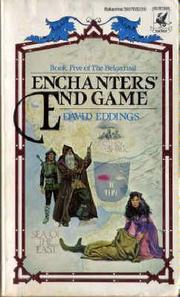
Enchanters' End Game
2,557-word summary 11 min read 372 pages in the book
- First published
- 1984
- Publisher
- Del Rey
- Pages
- 372
- ISBN
- 9780345300782
- Series
- The Belgariad (#5)
Reading options
What's inside (9 sections)
I finished this one standing at the kitchen counter, because I could not sit down. The paperback had split at the spine, the map had come loose, and the last hundred pages had the momentum of a series cashing in every promise it had made. The Belgariad is not a subtle set of books. It is a long, friendly, sometimes infuriating story about a farm boy who turns out to be a king, and this fifth volume is the one where all the pieces have to land.
Del Rey published it in 1984, the same year as "Castle of Wizardry," and the two books together close the series. The title is a chess term, as all the Belgariad titles are: pawn, queen, gambit, castle, end game. By this point the board is nearly empty. The Orb is back in Rivan hands. Garion has been crowned. Ce'Nedra has an army. Torak is waking in the east. What remains is the last move.
Where the board stands
The book assumes you have read the first four, though it pauses now and then to remind you who everyone is. Garion is no longer the kitchen boy of "Pawn of Prophecy." He is Belgarion, the Rivan King, and he carries the Orb of Aldur, a blue stone with a will of its own. Ce'Nedra is his betrothed, a Tolnedran princess who has spent four books being underestimated and has decided to become a commander. Belgarath is still the old sorcerer with a drinking habit and a thousand years of grudges. Polgara is still his daughter, still the most formidable person in any room, still inclined to treat Garion like a boy who has misplaced his boots.
The war is simple to state. Torak, the maimed god of the Angaraks, is stirring in Cthol Mishrak, the ruined city in Mallorea. He wants the Orb. He wants the west. He wants Polgara, according to the Mallorean prophecy, because her love would give him the confidence to win. The dark prophecy also promises Ce'Nedra to Torak if Garion fails, which is the kind of detail that makes a wedding feel like a military objective.
Garion's job is to go east and kill a god. Ce'Nedra's job is to lead the armies of the west and keep Torak's people too busy to notice him. The book alternates between those two roads. That structure is the best thing about it. The war is not a backdrop. It has its own weather, its own logistics, its own mistakes.
The road east
Garion travels with Belgarath and Silk. They slip through Gar og Nadrak, the land of the Nadraks, passing as traders and trying not to attract the attention of Mallorean recruiters. The early chapters are a travelogue: bad inns, suspicious officials, a mining town where a drunk Nadrak says the western army is led by a queen. There is a Drasnian trader, a hermit in the forest, a Nadrak dancer named Vella, a pack of wolves. The details are not essential to the plot, but they keep the world feeling lived in.
Then the recruiters catch them. Garion and Silk are pressed into the Mallorean army, and Belgarath escapes in the confusion. The rescue comes from Yarblek, a Nadrak trader with a taste for trouble, who delivers them to Drosta lek Thun, the Nadrak king. Drosta is one of the few Angaraks in the book with a personality. He is fat, cynical, and looking for a way out of the war. He lets them go because he thinks the west might win. That is not loyalty. It is a bet.
The road gets harder. They turn north across Morindland, a cold, hostile country, and cross the land bridge into Mallorea. Beldin, the hunchbacked sorcerer, catches up with them and delivers two pieces of news. The west's fleet is moving into the Sea of the East. And the Orb is going to restore Torak's ruined face. The second piece is the one that matters. The prophecy says the stone will undo the damage it did when Torak tried to crack the world. Nobody knows why. Garion spends the rest of the journey wondering whether he is walking toward a victory or a trap.
Torak whispers to him on the road. The god offers him a family: himself as a father, Polgara as a mother, a place in a world that would be ordered and safe. It is a tempting offer, because Garion grew up without parents and has spent five books being moved around by other people's plans. He refuses, and he does it loudly. He tells Torak he is coming to kill him. Belgarath is furious, because the announcement tells every Grolim in the district where they are. The Hounds of Torak come after them. A storm saves them, and the dry voice says it set the storm in motion the previous spring. Garion and Belgarath take wolf form to slip past the guards. Then they are in Cthol Mishrak.
The queen's war
Ce'Nedra's half of the book is the more interesting one. She has the Cherek fleet, the Drasnian pikes, the Mimbrate knights, the Ulgo zealots, and a coalition of kings who do not agree on much. She also has Polgara, Durnik, and Errand, the boy who will later be called Eriond. Her army sails down the River Mardu and attacks Thull Mardu, the island city of the Thulls.
The assault is a good set piece. Relg and the Ulgos go in first, smeared with soot, to open the gate. Barak commands a ship and steers it toward the bridge. The Mimbrate knights charge. The city falls. For a few pages, it looks like the west has won the war in a single night.
Then the plain fills with Murgos. The Malloreans come from the north. The Grolims raise a fog, and Polgara and Beldin burn themselves out clearing it. Polgara collapses. Ce'Nedra, who has been trying to hold the alliance together, makes a series of mistakes: she rides outside the fortifications, she loses her temper, and Adara is shot. The book does not let her be a flawless commander. It lets her be a young woman with a crown and a temper, which is more believable.
The capture comes in the moment of victory. Zakath, the Mallorean emperor, takes Ce'Nedra, Polgara, Durnik, and Errand prisoner and hands them to Zedar. Readers who know Zakath from the Malloreon should not expect that book's version here. In this volume he is a brief, cold presence, the man who takes the prisoners and hands them over. The man who does the most damage is Zedar, the fallen disciple of Aldur, who has been Torak's servant since the beginning.
They are taken across the sea to Cthol Mishrak, where Zedar meets them. Before the battle, Polgara had told Ce'Nedra the part of the prophecy that matters: the prophecy names Polgara as the bride Torak wants, and her resistance may decide the duel. That is a strange burden to put on a young commander. It also gives Polgara something to do besides heal people and scold them. She has to hold her own mind against a god.
The tower
Cthol Mishrak is a dead city: black stone, broken towers, a sky that never quite lightens. The iron tower at its center is Torak's tomb. Zedar holds the prisoners in the chamber where the god sleeps. Durnik charges him. Zedar kills him. It is a quick, ugly death, and it lands harder than any battle in the book because Durnik is the most ordinary person in the story. He is a smith. He fixes things. He loves Polgara without saying so. Killing him is the moment where the book stops protecting its characters.
Belgarath's response is the best scene in the novel. He does not shout. He does not make a speech. He seals Zedar alive inside the stone of the mountain. It is a terrifying, quiet act, and it reminds you that Belgarath is not a kindly old man with a pipe. He is a sorcerer who has been holding a grudge for centuries.
Then Torak wakes. He is still the maimed god, one side of his face ruined, and he is frightening because he has had centuries to think about what was taken from him. He tries to pull Polgara to him. He offers her a place beside him, a world ordered by his will, the kind of peace that comes from giving up. She is close to breaking. Garion, who has reached the chamber by then, sends her images of Durnik: the smith's hands at work at his forge, the quiet sound of his voice, the good man's unspoken love for her. It is a sentimental move, and it works, because the book has earned the sentiment over four previous volumes.
The duel itself is short. Garion and Torak swell into something larger than men, burst out of the tomb, and fight among the ruins as the two prophecies meet. Garion has the Sword of the Rivan King, with the Orb set in its pommel. He rejects Torak one last time, and he kills him. Torak's final word is "Mother!" It is a strange, naked cry from a god who has been alive for thousands of years, and it lands somewhere between pity and horror. The other gods come for the body. Garion lays the Orb on Torak's chest, and the stone undoes the damage it did so long ago, leaving a calm, unmarked face on a dead god. Then the gods take him away.
What follows is the part that divides readers. UL, the father of the gods, allows Garion to bring Durnik back. Mara objects, because his slaughtered Marags are still dead while a foreign smith gets a second chance, but he relents when Belgarath reveals Taiba, a Marag woman who can help rebuild his people. Durnik returns with the Will and the Word. Polgara, who had agreed to give up her own power so that their marriage could be a partnership of equals, discovers that she does not have to. The book ends with two weddings: Polgara and Durnik in a private chapel, then Garion and Ce'Nedra in the great hall at Riva.
What the ending gets right
The Belgariad is not a series that worries much about moral ambiguity, but it does care about its people. The ending works because the emotional debts have been set up for four books. Durnik's death matters because we have watched him fix hinges and love Polgara quietly. Polgara's temptation matters because we have watched her carry the world on her back. Garion's refusal matters because we have watched him grow from a boy who sulked in the kitchen to a man who can stand in front of a god and say no.
The two-track structure pays off, too. Garion's journey is a quest, and Ce'Nedra's war is a siege, and the book cuts between them at the right moments. When Garion is in the tower, we want to know what is happening on the plain. When Ce'Nedra is captured, we want to know whether Garion will arrive in time. That is basic storytelling, done well.
The banter is still the series' best special effect. Silk gets the best lines. Belgarath complains about the food. Polgara tells everyone to stop being an idiot. Barak turns into a bear when Garion is in danger, which the book explains as the Prophecy's work rather than a random shape change. The humor keeps the book from collapsing under its own solemnity.
And the last chapter is lovely. Belgarath, half drunk, wanders the halls after the wedding and finds the Orb glowing on the pommel of the sword. He talks to it. He tells it that it understands hate and loyalty but not love, and the Orb ignores him, and then it blushes. It is a small, silly, tender scene, and it closes the series better than a battle ever could.
What creaks
The book is a product of 1984, and some of it has not aged well. The Angaraks are mostly a faceless mass: Murgos are cruel, Thulls are stupid, Grolims are fanatics. Drosta is the exception, and he is looking out for himself. The west is brave and free, the east is dark and hierarchical, and the book does not spend much time asking whether that is true. For a series about a prophecy that supposedly contains everything, the moral geography is very tidy.
The women have a harder time. Ce'Nedra gets a real arc, but the narration keeps calling her flighty, little, and temperamental, even when she is doing the work of a general. Polgara's happy ending is marriage and a compromise about her power. Vella exists mostly to be looked at. The book is not cruel to its women, but it has a narrow idea of what a happy ending looks like for them.
The prophecy is another problem. Garion is the Child of Light, and the voice in his head has been guiding him since the first book. That can make his choices feel like plot mechanics rather than decisions. The book tries to answer this by having him refuse Torak, and the refusal is genuinely his. But the larger war is won by a script written before he was born. Readers who want agency in their fantasy will notice the seams.
The middle sags. The journey through Gar og Nadrak and Morindland is full of inns, recruiters, and narrow escapes, and some of it is more travelogue than story. The final battle is over quickly, and the gods arrive to sort out the afterlife, which takes the cost out of Durnik's death. The resurrection is a happy ending, but it is also a reversal that softens the one real loss. The book wants to give everyone a wedding and a future, and it does.
The prose is plain. Eddings writes clean, serviceable sentences, but he is not a stylist. He repeats "he said" and "she said" until the pages blur. The recap is generous, especially in the first hundred pages. If you have not read the previous four books recently, you will be grateful for the reminders. If you have, you will skim.
The last move
I closed the book on a Sunday morning with the rain coming down and the coffee cold. The last line is not a battle cry or a prophecy. It is Belgarath alone in a hall, teasing a stone. After five books of gods and armies and a boy who had to become a king, the series ends with an old man talking to his oldest friend. That is the right note. The game is over, the board is clear, and the people who survived get to sit in the quiet and be ordinary for a while.
Would I start here? No. This is the fifth book, and it assumes you care about Durnik before it kills him. Start with "Pawn of Prophecy" and let the farm kitchen do its work. But if you have come this far, the ending delivers what the series promised, and then it lets the quiet in. It is not subtle. It is not trying to be. By the last page, the long game has earned its quiet.
FAQ
Is Enchanters' End Game the last Belgariad book?
Yes. Del Rey published it in 1984 as the fifth and final volume, after Castle of Wizardry. The Malloreon is a separate sequel series.
Does Garion kill Torak?
Yes. Garion faces Torak in Cthol Mishrak and kills him with the Sword of the Rivan King, which carries the Orb in its pommel. Torak's last word is "Mother!"
Do Garion and Ce'Nedra marry in this book?
Yes. After the war, Polgara marries Durnik and Garion marries Ce'Nedra at Riva. The novel ends with Belgarath talking to the Orb.
Similar books
More from The Belgariad first, then related titles.
Pawn of Prophecy
Farm boy Garion learns sorcerers watch him as an old Orb wakes.
2,331-word summary · 10 min read

Magician's Gambit
Garion and his companions cross haunted Maragor and the caves beneath Rak Cthol to recover the Orb of Aldur.
2,391-word summary · 11 min read
Fool's Errand
FitzChivalry Farseer has lived in exile for fifteen years. When Prince Dutiful vanishes before his betrothal, Fitz returns to Buckkeep to find him, with a wolf…
2,606-word summary · 12 min read
The Sword of Shannara
A young half-Elf and a company of companions set out to recover a magic sword before the Warlock Lord destroys the Four Lands.
2,474-word summary · 11 min read

The Blinding Knife
Kip trains to join the Blackguard while the Prism hides his true identity, loses his colors, and fights a war against a rogue drafter who wants to birth a god.
2,049-word summary · 9 min read

Secrets of the Dragon Sanctuary
Kendra is replaced by a plant copy and held by the Society, while Seth steals a unicorn horn so the family can enter a dragon sanctuary.
2,590-word summary · 12 min read

Lioness Rampant
Alanna searches for the Dominion Jewel with the Shang Dragon, then returns to Tortall to face Duke Roger at Jonathan's coronation.
2,478-word summary · 11 min read

Homeland
Drizzt Do'Urden is born into the cruel drow city of Menzoberranzan, where his father teaches him to fight and to doubt everything his family believes.
2,303-word summary · 10 min read

The Queen of the Tearling
Nineteen-year-old Kelsea leaves the woods to take her throne, ends a shipment of human captives, and draws the Red Queen's revenge.
2,357-word summary · 10 min read
Magician: Apprentice
An orphan kitchen boy and a smith's son grow up in a frontier castle just as invaders from another world open a rift and begin a war that will change both of…
2,114-word summary · 9 min read
The Tower of the Swallow
Ciri flees as a bandit while Geralt gathers allies to find her.
2,580-word summary · 11 min read
The Emperor's Soul
Forger Shai must stamp a new soul for the dying emperor in 100 days.
2,313-word summary · 10 min read
Shadow's Edge
Kylar fakes death as a king killer while Vi hunts him for the Godking.
2,245-word summary · 10 min read
New Spring
Moiraine and Lan hunt the newborn Dragon before the Black Ajah finds him.
2,475-word summary · 11 min read
Furies of Calderon
Furyless Tavi defends Calderon Valley when the Marat return and lords scheme.
2,587-word summary · 11 min read
Stone of Tears
After the veil tears, Richard seeks training from the Sisters while Kahlan holds a fracturing Midlands and Zedd hunts the missing Stone.
2,483-word summary · 11 min read
The Farthest Shore
Archmage Ged and Prince Arren sail to the far west to stop Cob, whose bid for endless life drains magic across Earthsea in Le Guin's sad 1972 third volume.
2,800-word summary · 12 min read
Edgedancer
Hungry street thief Lift and her vine-like friend Wyndle cross the Herald Nale in Tashikk when a child emperor shows Radiant signs and she refuses to step…
2,328-word summary · 10 min read
Dragons of Autumn Twilight
Old friends reunite at the Inn of the Last Home, guard a glowing Blue Crystal Staff, face black dragon Khisanth, and free slaves at Pax Tharkas in this 1984…
2,803-word summary · 12 min read
The Eyes of the Dragon
In the kingdom of Delain, a jailed prince and his younger brother face a magician whose long plot for the throne turns on a napkin clue.
2,018-word summary · 9 min read
The City of Brass
Cairo con artist Nahri summons djinn Dara and is drawn to Daevabad where Ali questions pureblood rule.
1,993-word summary · 9 min read
The Black Prism
Dying Prism Gavin Guile hides a secret son while war brews over color magic in the Seven Satrapies.
2,169-word summary · 10 min read
Gardens of the Moon
Empire, gods, and mages collide over Darujhistan as Bridgeburners bleed for Empress Laseen.
2,188-word summary · 10 min read
Crossroads of Twilight
Rand cleansed saidin and the whole world felt it. Book ten follows each faction as they react, stall, and choose sides.
2,264-word summary · 10 min read
Lord of Chaos
Rand offers amnesty to men who can channel while Egwene is raised Amyrlin in exile. Book six of The Wheel of Time builds toward rescue and reckoning at Dumai's…
2,255-word summary · 10 min read
A Crown of Swords
After Dumai's Wells, Rand holds Cairhien while Egwene besieges Tar Valon and Elayne and Nynaeve hunt relief in Ebou Dar. Book seven crowns kings and queens at…
2,828-word summary · 13 min read
Wizard's First Rule
Woods guide Richard joins Kahlan and wizard Zedd to find the Boxes of Orden before Darken Rahl, learning why people believe lies.
2,220-word summary · 10 min read
The Hero of Ages
Vin and Elend face ash, mist, and Ruin itself as the prophecies fail and Sazed searches old faiths for answers.
2,559-word summary · 11 min read
The Thief
A boastful young thief is pulled from a prison to steal a legendary stone for the king's magus, and the story he tells about himself is not the whole story.
2,514-word summary · 11 min read
Ship of Magic
A sentient ship wakes when her captain dies, and the family that owns her starts to come apart over who gets to sail her.
2,026-word summary · 9 min read