
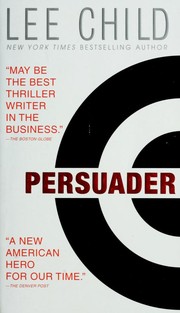
Persuader
2,278-word summary 10 min read 496 pages in the book
- First published
- 2003
- Publisher
- Dell
- Pages
- 496
- ISBN
- 9780440241003
- Series
- Jack Reacher (#7)
Reading options
What's inside (9 sections)
A lot of Reacher books begin with a man arriving somewhere. This one begins with a man seeing a ghost. Reacher is in Maine, on a street, in the cold, and Francis Xavier Quinn walks past him. Ten years earlier Quinn tortured and murdered Dominique Kohl, a military police colleague Reacher had worked with and mentored, and Reacher believed he had killed Quinn in the aftermath. The sight of him alive is not a puzzle to be solved. It is an insult that has to be answered.
That is the engine of Persuader, and it is why the book sits near the top of the series for me. Child has written tighter plots and bigger conspiracies, but he has rarely written a motive this clean. Reacher is not investigating a stranger's death. He is correcting his own mistake, and the correction is personal in a way that makes the violence feel less like choreography and more like consequence.
Reacher is between things, the way he always is, and the sighting has the quality of a wrong number on a phone: nothing to do with the day he planned, impossible to ignore. Child does not spend pages explaining how Quinn could have survived. He spends them on Reacher's reaction, which is mostly stillness and then a decision, and the speed of that decision is the whole character in miniature.
There is also a smaller pleasure in watching Child set up the pieces. A man is seen, a name is attached to him, a woman with a badge appears, and within thirty pages Reacher is inside a house he should not be in. The book is not interested in whether you believe the coincidence. It is interested in what a man like Reacher does once the coincidence has happened.
The plan, and the boy
The setup is a DEA operation. Susan Duffy, an agent, is working Zachary Beck, a businessman who appears to import oriental rugs and is suspected of moving drugs under that cover. There is also Teresa Daniels, a DEA agent who went undercover in an off-the-books operation and is believed to be captured. Duffy's team wants Beck. Reacher wants Quinn, though at this point he does not know how the two are connected.
The way in is a staged kidnapping. Reacher and Duffy's people take Beck's son Richard off the street, and then Reacher appears as the man who rescues him. It is a con built on a boy's fear, and Child sells it by keeping Richard believable: he is frightened, he is embarrassed about being frightened, and when Reacher brings him back he attaches himself to the one adult who behaved like an adult. Richard asks Reacher to take him home. That is the door opening.
Duffy is the one who sells the plan, and she is good at it because she does not pretend it is clean. The team works out of a motel, with the particular flat lighting of an operation that has been running too long. Reacher's part requires him to frighten a kid and then comfort him, and Child lets that sit uneasily. Richard is not a prop. He is a boy with a father he is afraid of, and the fake kidnapping lands on real fear.
I like how undramatic the infiltration is. There is no disguise, no fake accent, no elaborate backstory. Reacher simply looks like what he is, a very large man who can handle himself, and lets Beck's people draw their own conclusions. Most of the tension comes from other characters deciding what he must be.
Inside the house
Beck's house is a fortress on the Maine coast, and Child has fun with it: the gate, the cameras, the hired men, the sense of a compound built by someone who expects to be visited. The rug warehouse is the other half of the setting, all dust and roll ends and the smell of wool, and it is a good place for a fight because it is full of things that fall over.
Reacher becomes a hired gun and bodyguard, or at least that is the role he is allowed to play. He gains Beck's confidence slowly, by being useful and by not asking the questions a cop would ask. Richard stays close. Beck's wife, Elizabeth, is in the house and is clearly not free. The book is good at the texture of a household under pressure: the way people lower their voices, the way a child watches his father for a cue.
There is violence, and it is practical. Reacher has to eliminate several of Beck's men to keep them from exposing him, and Child writes these scenes short. No long choreography, no wisecracks, no aftermath. A man is a problem, the problem is solved, the book moves on. That restraint is one of the series' best habits, and it is on display here.
Beck is a more interesting creation than the plot strictly needs. He is vain, careful, and genuinely frightened, and his hospitality has a trapped quality. Richard orbits him, wanting approval, and Reacher's presence gives the boy an alternative adult to measure himself against. Elizabeth watches all of it from the edge of the room, and the novel is smart enough to let her silence read as fear rather than emptiness.
The housemaid, and the wrong theory
One of the best turns in the book is the discovery that the housemaid is also undercover, an ATF agent investigating arms smuggling against Beck. It is a good joke at the expense of the DEA and a good complication for Reacher, who now has to keep two operations from colliding. It also means he has to prevent an attack on Beck while maintaining his own cover, which is the kind of knot Child ties well.
The ATF agent is a nice piece of plotting because she changes the moral math. Reacher cannot simply use Beck's household as a staging ground, because someone else in it is also pretending. The two operations do not trust each other, and the scenes where they circle each other are among the tensest in the book. It also lets Child show Reacher's professional respect for competence, which is one of the few forms of warmth he allows the character.
Then the DEA learns it was wrong about the business and tries to pull Reacher out. He refuses. This is the hinge of the novel. Duffy's operation is about drugs and a missing agent. Reacher's operation is about Quinn, and he will not leave until that is finished. The institutional logic and the personal logic separate, and the book is honest that Reacher is being selfish, or at least single-minded, in a way that puts other people at risk.
The pullout attempt is where the book's institutions show their limits. Duffy's superiors see a failed theory and want to cut losses. Reacher sees a man he has been hunting for a decade. Neither position is stupid, and Child does not make the bureaucracy cartoonish. The friction is believable, and it raises the stakes without adding a new villain.
Quinn
Quinn is Beck's boss. He forced Beck into working for him by threatening his family, which makes Beck a criminal and a hostage at the same time. It is not a complicated reveal, but it reorganizes everything before it: the fortress, the fear in the house, the way Beck behaves like a man who is not in charge of his own business.
The Kohl material is what gives the book its weight. Child does not overdo it. There are a few passages about her, about the work she did and the way she died, and Reacher's grief is expressed as arithmetic: ten years, one man, a debt. That is the register he operates in, and it is more affecting than a paragraph of mourning would be.
Quinn himself is less a person than a pressure. He is polite in the way that men who enjoy hurting people are sometimes polite, and Child uses that politeness to make the violence worse. The backstory with Kohl arrives in pieces, and each piece makes the ten-year gap feel longer. Reacher's failure was not that he could not save her. It was that he believed he had finished the job and had not.
The rescue, and the end of it
The last act is a rescue and a killing. Reacher gets Richard, Elizabeth, and Teresa Daniels out of Quinn's hands. He kills Quinn. Beck is left to be arrested. Duffy and Reacher part ways, which is the series' usual ending and still lands here because Duffy is one of the better partners he has had.
I will not pretend the ending is emotionally rich. It is efficient. The rescue is tense, the violence is fast, and the book closes the way these books close, with Reacher moving on. What makes it satisfying is that the personal debt is paid. Quinn's death is not a plot requirement. It is the reason the plot exists.
The rescue itself is a sequence of small physical problems: a locked house, a man with a gun, a woman who has been held long enough to be unsure whether she is being saved. Child is good at this kind of arithmetic, and he keeps the geography clear enough that you can follow the whole thing without a diagram. Elizabeth's escape is the thinnest part of the resolution, and it happens fast, as if the book has run out of patience for anyone who is not Reacher.
How Child writes it
Persuader is first person, which matters more than it sounds. Reacher narrates in short declaratives, and the effect is a kind of procedural certainty: he tells you what he sees, what it means, and what he is going to do, and the reader trusts him because he is usually right. The voice is calm even when the situation is not, and that calm is the series' signature.
Child is also very good at physical space. The house, the warehouse, the coast road, the motel where Duffy's team works: you always know where the doors are and who is standing near them. That is not a small skill. It is why the action reads clearly, and why the book can get away with a plot that depends on coincidence.
The cold Maine coast does a lot of work too. The book is full of wind and water and the particular gray of a place that is beautiful for about six weeks a year. It makes the house feel isolated and the violence feel local, as if it is happening in a place where no one would hear.
The dialogue is stripped to the point of rudeness, and that is deliberate. People in this book answer questions with the shortest true thing they can manage, and the evasion is where the tension lives. Child also ends chapters on small hooks, which is a craft choice rather than a literary one, and it works on a train or a plane, which is where these books are meant to be read.
The title is doing something quiet as well. A persuader is a person who convinces, and the novel keeps returning to the question of who is being persuaded and by what. Reacher persuades Beck that he is useful. Quinn persuades Beck that his family is in danger. Duffy persuades her superiors to keep an operation alive. None of it is subtle, but it gives the book a spine that a pure revenge story would not have.
Where it slips
The female characters are thin. Duffy is competent and has a personality, but she is mostly a function of the plot, and Elizabeth and Teresa are defined by what has been done to them. Child has never been especially interested in writing women, and this book is not the place where that changes.
The infiltration depends on implausible luck. Reacher happens to be exactly the kind of man Beck needs, at exactly the right moment, and several of the steps that get him deeper into the house rely on other people making the convenient choice. It is not fatal, because the book moves fast enough that you do not stop to audit it, but it is there.
The sadism is occasionally gratuitous. Quinn is a monster, and Child wants you to feel that, but some of the cruelty is staged for effect rather than for meaning. The ending is more efficient than emotionally satisfying, and readers who want the Kohl thread to pay off in feeling rather than in a body will find it a little cold.
The pacing also sags in the middle, though less than in some of the other books. There are only so many scenes of Reacher walking through a warehouse before the reader starts to feel the repetition, and the novel's middle third is more about maintaining cover than about moving forward. Child's chapters are short enough to hide it, but the structure is thinner than the premise.
None of that changes my view that this is one of the stronger Reacher books. The personal revenge gives the violence a point, and the undercover structure gives Child a reason to write restraint instead of spectacle. It was shortlisted for the CWA Steel Dagger, and it became season 3 of the Reacher television series in 2025, which is a fair sign of how well the material holds up. If you have only read the first Reacher novel, this is the one that shows you what the series can do when Reacher has a reason to care.
FAQ
Do I need to read the other Jack Reacher books first?
No. Persuader is the seventh Reacher novel but stands alone, with a self-contained case and only light references to Reacher's past.
Is Persuader the basis for Reacher season 3?
Yes. The third season of the television series adapts this novel, with Alan Ritchson playing Reacher.
Who is Francis Xavier Quinn?
Quinn is a former military officer who tortured and killed Reacher's colleague Dominique Kohl. Reacher believed he had killed Quinn years earlier, and the novel begins when he sees him alive in Maine.
Similar books
More from Jack Reacher first, then related titles.

Killing Floor
Ex-military policeman Jack Reacher is arrested for murder in Margrave, Georgia, then learns the victim was his brother.
2,872-word summary · 13 min read
Tripwire
In Key West, Jack Reacher follows a murdered detective's trail to New York, an old mentor's files, and a loan shark stealing a dead soldier's name.
2,688-word summary · 12 min read
Running Blind
Jack Reacher must catch a killer who murders women with no forced entry and no trace.
2,008-word summary · 9 min read

Echo Burning
Reacher hitches a ride with a Texas woman who wants her abusive husband killed, then has to prove she did not murder him when he comes home.
2,209-word summary · 10 min read
Without Fail
Reacher is asked to test vice presidential security by planning to kill.
2,084-word summary · 9 min read

The Enemy
In January 1990, MP major Jack Reacher investigates a dead general, a stolen briefcase, and three murders tied to an Army power struggle.
2,123-word summary · 9 min read

One Shot
Six shots, five dead in Indiana, and James Barr asks for Jack Reacher. Reacher leaves Miami to test the proof in this 2005 Delacorte Press thriller, 376 pages,…
2,972-word summary · 13 min read

Bad Luck and Trouble
A deposit of $1,030 summons Jack Reacher back to his old army unit, which is being picked off one name at a time.
2,366-word summary · 11 min read
Gone Tomorrow
Reacher stops a suicide bomber on the subway, then hunts her handlers.
2,308-word summary · 10 min read

61 Hours
A bus crash strands Jack Reacher in a snowbound South Dakota town where a drug gang, a corrupt police force, and a single witness are on a collision course.
2,227-word summary · 10 min read

Worth Dying For
Reacher stops for one night in rural Nebraska and finds a family that runs the county, a missing girl and a shipment worth killing for.
2,021-word summary · 9 min read

The Affair
In 1997, Reacher goes undercover in a Mississippi town where a murder near an army base collides with a senator's power. The case that ends his military career.
2,039-word summary · 9 min read

What She Knew
Rachel lets her eight-year-old son run ahead in a Bristol park, and the nine-day search turns her into a suspect in the public eye.
2,952-word summary · 13 min read

The Beach House
A young valet is beaten to death at a Hamptons party, and his law-student brother spends a year building a case against the family that covered it up.
2,049-word summary · 9 min read

Six Years
A professor who promised to forget the woman he loved sees her husband's obituary and discovers that the wedding, the marriage, and the woman herself may never…
2,076-word summary · 9 min read

Rules of Prey
Minneapolis detective Lucas Davenport hunts a killer who leaves a new rule at every scene and treats murder as a game of wits.
1,914-word summary · 9 min read

4th of July
Lindsay Boxer shoots two armed teenagers in self-defense, faces a wrongful-death trial, and spends her leave chasing a string of throat-slashing murders in…
2,192-word summary · 10 min read

The Chemist
A former government interrogator on the run takes one last job, then learns the case she was handed was built to pit her against him.
2,249-word summary · 10 min read

Still Missing
A realtor is abducted at a Vancouver Island open house and held for more than a year. Told through therapy sessions, the novel follows her escape and the hunt…
2,466-word summary · 11 min read

3rd Degree
The third Women's Murder Club novel follows a San Francisco terror cell and a three-day killing schedule, and it costs the club a member.
2,685-word summary · 12 min read

The Ex
Cassie thinks her new boyfriend's ex is the woman harassing her, but Freida McFadden's thriller keeps rearranging who the ex actually is.
2,103-word summary · 9 min read

Say You're Sorry
A widowed prosecutor defends the teenager accused of killing her babysitter, uncovering a small town's secrets and a killer hiding in plain sight.
2,116-word summary · 9 min read

The Drowning Woman
Living in her car in Seattle, Lee saves a wealthy stranger from drowning. The friendship that follows draws her into abuse, murder, and a plan to disappear.
2,578-word summary · 11 min read

Girl, Forgotten
A rookie US marshal guards a judge with a stalker and ends up reopening the 1982 prom-night murder of the judge's pregnant daughter.
2,111-word summary · 9 min read

The Woods
Twenty years after two teenagers were murdered and two vanished at summer camp, prosecutor Paul Copeland identifies a fresh corpse as one of the missing.
2,490-word summary · 11 min read

The Redbreast
Harry Hole chases an ageing sniper through modern Oslo while two Norwegian volunteers on the Eastern Front carry a fifty-year-old betrayal toward a royal…
2,453-word summary · 11 min read

The Boy from the Woods
Wilde, found feral in a New Jersey forest in 1986, hunts for a missing teenager while a senator's secrets tear a wealthy town apart.
2,270-word summary · 10 min read

Razorblade Tears
Two ex-con fathers, one Black and one white, hunt their murdered sons' killers in a Richmond that never gave the boys a fair shake.
2,880-word summary · 13 min read

Gray Mountain
A Manhattan associate furloughed after the financial crash takes a year of unpaid legal aid work in Appalachian coal country, and finds the case of her life…
2,026-word summary · 9 min read
False Witness
A defense attorney is forced to represent the grown son of the man she and her sister killed as teenagers, and he has the tape of the murder.
2,094-word summary · 9 min read