
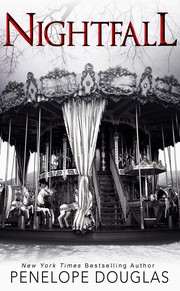
Nightfall
2,339-word summary 10 min read
- First published
- 2020
- Publisher
- Penelope Douglas LLC
- ISBN
- 9781952646072
- Series
- Devil's Night (#4)
Reading options
What's inside (10 sections)
The content warning at the front of this book is not decorative. Nightfall is the fourth main novel in the Devil's Night series, it is written for adults, and it contains domestic abuse, sexual assault, violence, and a great deal of behavior that would be intolerable in a person you actually knew. I mention that first because the phrase dark romance can make the material sound like a mood rather than a list of events. Douglas is not subtle about any of it. She is also not gratuitous in the way that matters most, because the cruelty in this book is structural. It is the material the plot is built out of, not a flavor added on top.
I came to it after the earlier books, which is the right way to come to it and also the only way that fully works. Nightfall is not a standalone. It assumes you already know the Four Horsemen, the town, the old stories, and the particular kind of loyalty that holds this series together. Read cold, it will still make sense, but a lot of the emotional weight will land as information rather than recognition.
A house with no easy way out
The book opens with Emory Scott waking up in Blackchurch. She is an architect, she is not a teenager anymore, and she has no idea how she got there. Blackchurch is a secluded mansion in an undisclosed location, a place where wealthy and powerful families send sons who have misbehaved, not to be punished exactly, but to be kept away from scrutiny until whatever they did stops being interesting.
Taylor Dinescu is the one who explains the house and its rules, and the explanation is deliberately incomplete. Emory learns that Will Grayson is one of the prisoners. That is the moment the floor drops, because she once signed a statement that helped send Will and his friends to prison. She is in a house full of people with reasons to hate her, and the man who has the most reason is somewhere inside it.
Will finds her before she finds a way out. He takes her to the cellar, where she meets Micah Moreau, Rory Geardon, and Aydin Khadir. Aydin tells her the men will not hurt her, which is not the same as saying she is safe. He also warns her that the wilderness around the estate is more dangerous than the house, and that running is a good way to die of exposure or something worse. That warning sets the shape of the middle of the book. Emory is trapped, but she is not passive, and the tension comes from watching her test the cage instead of throwing herself at the walls.
The house as a problem to solve
The best passages in Nightfall are the ones where Emory treats Blackchurch like a building. She studies it. She learns the routines, the doors, the schedules, the places where sound carries. She makes a weapon out of fishhooks. She trades cooking for training with Micah, which is one of the few relationships in the book that develops through work rather than declaration. She starts saving food. She looks for a way out with the patience of someone who understands that escape is a project, not a gesture.
Will watches her through a two-way mirror, which is creepy and also consistent with who he is in this series. The mirror is a good image for the whole book. Everyone is watching everyone, and almost nobody is saying the true thing directly. Emory knows she is being observed and keeps working anyway. That stubborn competence is the most attractive thing about her, and Douglas is smart enough to let it carry long stretches without much plot.
I liked the mundane detail more than the dramatic set pieces. The food inventory, the improvised tools, the way a locked house becomes a map in your head. Survival stories often skip the boring parts, and the boring parts are where the tension actually lives. By the time the book reaches its bigger action beats, I believed Emory could survive them because I had watched her count calories and test hinges.
Nine years earlier
The present-day story is only half the book. The other half goes back nine years, to Emory as a work-study student at Thunder Bay Preparatory. Her older brother Martin is a police officer, and he beats her and controls her while their grandmother lies bedridden in the house. Emory hides the abuse from everyone, including Will, who is one of the Four Horsemen alongside Michael Crist, Damon Torrance, and Kai Mori.
Will teases her in public and shows her tenderness when nobody is looking. That combination is the engine of the past timeline. Emory pushes him away for the same reason she pushes everyone away, which is that closeness means discovery and discovery means losing the version of her life she has managed to keep upright. The book is careful to show that her secrecy is not stupidity. It is triage. Martin has power over her, and he has power over the person she loves most, and she has calculated, correctly, that telling the wrong person at the wrong time would make everything worse.
Douglas uses the dual timeline to revise the reader's judgment. In the present, Emory looks like the woman who lied about a group of men and sent them to prison. In the past, you see the pressure that produced the lie. The structure is not subtle, and there are moments when the alternation feels mechanical, but the underlying idea works. You cannot understand what Emory did until you understand what she was protecting, and the book makes you wait for that understanding.
Adventure Cove and the legend underneath
Will takes Emory to Adventure Cove and tells her the town's Cold Point legend. In 1954, Reverie Cross died on the rocks, and Edward McClanahan jumped after leaving a confession. The legend hangs over the whole series, and here it does double duty. It is a ghost story that gives the town a mythology, and it is a template for the kind of ending these characters keep circling: love, violence, and a body in the water.
Will tells Emory that he feels most like himself at nightfall. It is the kind of line that could be embarrassing, and in context it is not, because the book has established that daytime is performance for both of them. Their bond deepens in the small spaces around that confession. Emory still hides the bruises. The reader knows what Will does not, and the gap between his tenderness and her silence is where the past timeline gets its ache.
After Martin beats her, Emory finds a hidden room in the town cathedral and makes it a refuge. She calls it the Carfax Room. It is the one place in the book that belongs to her, and Douglas uses it well, as a physical space that holds the person Emory is when nobody is watching. At Homecoming she fights back, escapes to the room, and then goes to the dance dressed as Reverie Cross, with her real bruises worked into the costume. That is the best image in the novel. A girl turning the evidence of her abuse into a costume so she can go to a dance is funny and awful at the same time, and the book knows it.
She and Will leave the dance together and have sex for the first time. Later, Will sees the bruises and realizes they are real. That discovery is the hinge the whole past timeline has been waiting for, and Douglas handles it with more restraint than I expected. He does not become a savior. He becomes a person who now knows something he cannot fix.
Devil's Night and the statement
The past timeline does not stop at romance. On Devil's Night, Emory witnesses Damon strangling his abusive mother and helps cover up the death. Damon asks her to look after his hidden sister, Banks, if anything happens to him. It is a measure of how far Emory has been pulled into this world that she agrees. Will finds her and Damon together, assumes they have slept together, and attacks Damon. Emory cuts Will off. The breakup is not a misunderstanding in the usual romantic sense. It is the moment the series' violence and Emory's secret life become the same problem.
Two years after graduation, Will, Damon, and Kai beat Martin after catching him with a sixteen-year-old girl. Martin retaliates by coercing Emory into signing a false statement that accuses the Horsemen of abusing her. He threatens their grandmother's care and uses Emory's real bruises as fabricated evidence. She signs because she is frightened and because she is trying to keep an old woman alive. Will, Kai, and Damon accept a plea deal and serve two and a half years.
This is the part of the book that justifies its length. The statement is not a betrayal in the ordinary sense. It is a coerced act by a person with no good options, and the novel is honest about the fact that coercion does not make the harm disappear. The men went to prison. Emory stayed free. Both of those things are true, and the book refuses to resolve them into a single verdict.
What Emory was doing in the house
Back at Blackchurch, Emory keeps working toward escape and learns to control her fear during a greenhouse exercise with snakes. The exercise is one of the few scenes where the book slows down enough to show her inner mechanics rather than announcing them. She does not become fearless. She becomes functional, which is a more believable goal.
Then the plot turns. Emory discovers that Alex Palmer, a woman she befriended the previous spring, has been hiding in the house's secret passages with a satellite phone and blueprints. Alex came to get Will out. Aydin catches her and admits that he arranged Emory's kidnapping to hurt Will, whom he resents for being close to Alex, the woman Aydin loves. The reveal reorders the present-day story. Emory was not brought to Blackchurch because of her own history. She was a weapon aimed at someone else.
A fire starts in the foyer. The Four Horsemen and their partners reach the estate through a private train in tunnels under the coast and evacuate the group. Aydin and Taylor are left behind. On the train, Will confronts Emory over the statement that put his friends in prison. She explains Martin's threats and apologizes for keeping quiet. Damon reminds Will that their own past actions were cruel too. Michael tells Emory to stay in Thunder Bay and repay what she owes.
That train scene is the emotional center of the book for me. Nobody is fully right. Will has a legitimate grievance and a history of his own violence. Emory has a legitimate fear and a decision that hurt people. The scene does not resolve into forgiveness. It resolves into a debt, which is a colder and more interesting outcome.
The wedding, the explosion, and the water
The climax moves back to Thunder Bay. Rika Fane arranges a group wedding at a wrought-iron gazebo that Damon built from Emory's abandoned plans. An explosion at the Cove interrupts the ceremony. Will reveals that he asked his grandfather, Senator Grayson, to send him to Blackchurch so he could get sober and recruit Micah and Rory for the Horsemen's company, Graymor Cristane. The senator says Evans Crist, Michael's father, arranged the group's imprisonment and used Martin to carry it out.
Martin shoots Alex in the shoulder. During the fight, Martin and Will fall from Cold Point into the sea. Will breaks Martin's neck underwater and is pulled to safety with a rope left by Athos, a child living in the tunnels beneath the abandoned Cove theme park. Evans is arrested, and Alex survives.
Then the book does something I did not expect from this series. Emory proposes to Will. He shows her a family ring he has kept for nearly ten years. A judge completes the group wedding at midnight. Months later, Emory is expecting a child, and the book hints that Senator Grayson may be connected to the old Cold Point legend.
What works and what strains
The survival material at Blackchurch is the strongest writing in the book. Emory's competence is specific and practical, and Douglas lets her be good at things without making her invincible. The dual timeline, whatever its mechanical moments, does the job it was built to do: it makes the reader revise a judgment they were invited to make too quickly.
The weaknesses are real. The book leans heavily on earlier installments, and a reader who has not read them will spend the first hundred pages reconstructing relationships. The dual timeline can feel like a schedule, cutting away just when a scene has earned more time. The dialogue is stylized in a way that some readers will find intoxicating and others will find exhausting. The dark romance conventions include possessive behavior that the book mostly treats as devotion, and some readers will not be able to make that leap.
The ending also resolves several arcs quickly. After hundreds of pages of pressure, the final chapters dispatch a villain, arrest a patriarch, deliver a proposal, and complete a wedding in a rush. I wanted one more quiet scene between Emory and Will before the ceremony, something that acknowledged how much had changed since the Carfax Room.
Still, the book gives the series a real conclusion while leaving a thread open, which is harder than it sounds. It is not a standalone, and it is not for everyone. If you have read the other Devil's Night books and you want the story to close, this one closes it. If you are here for a romance with no rough edges, this is the wrong house to walk into.
FAQ
Is Nightfall a standalone?
No. It is the fourth main novel in the Devil's Night series and depends heavily on events and relationships from the earlier books.
Who are the main characters in Nightfall?
Emory Scott, an architect, and Will Grayson, one of the Four Horsemen. The novel moves between their present at Blackchurch and their past in Thunder Bay nine years earlier.
Does Nightfall have a happy ending?
It ends with a wedding and a pregnancy, but the tone is dark and several arcs are resolved quickly. The series leaves one thread about Senator Grayson open.
Similar books
More from Devil's Night first, then related titles.
Corrupt
College student Rika Fane faces Michael Crist and his friends three years after Devil's Night put them in prison.
2,870-word summary · 13 min read
Hideaway
Ex-con Kai hunts a hotel secret while Banks hides who she really is.
2,481-word summary · 11 min read
Kill Switch
Out of prison, Damon moves into Winter's house with keys and a plan, and old lies about that night crack open.
2,732-word summary · 12 min read

Deviant King
A scholarship student at an elite boarding school is targeted by the king of the Four Horsemen, who seems to know her forgotten past.
2,384-word summary · 11 min read

The Sinner
Sin, a Lord at Barrington, rigs his secret society's rules to claim Elli, the girl he has protected since killing her abuser, while the conspiracy around her…
2,059-word summary · 9 min read

Her Soul to Take
A paranormal vlogger in a cult-run town summons a bound demon, and the only way to survive the god beneath the mine is to give him her soul.
2,089-word summary · 9 min read

There Are No Saints
Two rival artists circle a struggling San Francisco painter. Cole Blackwell wants her, Alastor Shaw wants her dead. Book one of the Sinners duet.
2,190-word summary · 10 min read
Savage Bonds
Oli's deadly gift is out in the open, her Bond runs the show, and the Resistance is closer than ever in the second Bonds that Tie novel.
2,431-word summary · 11 min read

Pen Pal
A grieving widow receives letters from a man in prison who signs himself Dante, and the haunting in her house turns out to be the story of her own death.
2,066-word summary · 9 min read
The Finish Line
Tobias King seeks forgiveness from Cecelia as the Ravenhood past closes in.
2,868-word summary · 13 min read

The Darkest Temptation
Sheltered Mila flies to Moscow and falls for captor Ronan, a Russian enforcer seeking revenge.
2,023-word summary · 9 min read

Never Never
Charlie and Silas wake with no memory of each other, and the notes their past selves left raise darker questions in part one of the Hoover and Fisher series.
2,516-word summary · 11 min read
God of Malice
Rina Kent's God of Malice fully retold: Glyndon King, Killian Carson's fixation, secret societies, and the Devlin twist that resets everything.
2,849-word summary · 13 min read

The Maddest Obsession
Sharp-tongued Gianna spars with secretive Christian Allister in this 2019 Made #2 mafia romance, where teasing hides danger and lies.
3,903-word summary · 17 min read
Den of Vipers
Handed to the four Vipers over her father's debt, Roxy fights to hold her ground in their guarded house and busy club in this long 2020 dark romance.
4,247-word summary · 19 min read

The Sweetest Oblivion
Sheltered Elena Abelli catches the eye of feared made man Nicolas Russo after her sister flees an arranged match.
3,342-word summary · 15 min read
Hunting Adeline
Trafficked and caged, Adeline fights back while Zade tears the underworld apart to find her.
2,730-word summary · 12 min read

Too Late
Sloan is trapped with drug lord Asa until undercover Luke offers a way out.
2,958-word summary · 13 min read
Bully
Tate returns from France to face Jared, the boy who bullied her for years and still will not leave her alone.
1,934-word summary · 9 min read

Birthday Girl
Homeless Jordan moves in with boyfriend Cole and his father Pike sparking tension.
2,383-word summary · 11 min read

Credence
An orphaned teen spends a mountain winter with her guardian and his two sons, and lines blur.
2,723-word summary · 12 min read
Punk 57
Pen pals Misha and Ryen turn cruel at school while hiding who writes the letters and who takes the hits.
2,909-word summary · 13 min read

Six Scorched Roses
A dying scholar bargains with a reclusive vampire for blood, and six roses turn a transaction into a slow, dangerous romance.
2,663-word summary · 12 min read

Lick
Evelyn wakes up married to the lead guitarist of Stage Dive after a Las Vegas birthday she cannot remember, and the annulment gets complicated.
1,989-word summary · 9 min read
Blood Bonds
Oleander is chained in a Resistance camp, and her five Bonds have to find her before Silas Davies finishes what he started in this third Bonds that Tie book.
2,018-word summary · 9 min read

Ricochet
Lily Calloway tries to stay celibate for ninety days while Loren is in rehab, leaning on Rose, Connor, and Ryke as therapy forces her to face her childhood.
2,575-word summary · 11 min read

My Dark Romeo
A debutante ball kiss traps Dallas Townsend in a marriage to Romeo Costa, a man who wants her as leverage in a war against his father and her fiance.
2,530-word summary · 11 min read
Under Locke
Iris Taylor moves to Austin broke and wary, takes a front-desk job at a tattoo shop, and spends the book learning that Dex Locke’s blunt cruelty and unexpected…
2,591-word summary · 12 min read

Reason to Breathe
Emma Thomas is a star student with a careful, invisible life at home. Evan Mathews notices the cracks, and the novel follows what happens when kindness gets…
2,197-word summary · 10 min read
Persuader
Reacher goes undercover in a Maine crime family to find a missing DEA agent and the man he once failed to kill, and Lee Child keeps the whole thing tight,…
2,278-word summary · 10 min read