
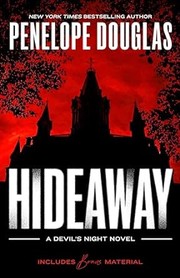
Hideaway
2,481-word summary 11 min read 512 pages in the book
- First published
- 2017
- Publisher
- Berkley
- Pages
- 512
- ISBN
- 9780593642016
- Series
- Devil's Night (#2)
Reading options
What's inside (8 sections)
I came to Hideaway straight after Corrupt because Kai Mori was the one Horseman I could not figure out. Michael had been loud about what he wanted. Damon was openly frightening. Will went along with whoever spoke last. Kai just watched. Penelope Douglas first published this book in 2017 as the second Devil's Night novel, and the Berkley paperback runs 512 pages. It keeps the same town, the same masked games, the same warnings. This is adult dark romance, listed as suitable for readers 18 and older, with threats, break ins, and sexual situations where consent gets pressured and blurry. I will describe what happens and why it matters without writing graphic detail.
If you have not read Corrupt, here is the short version. On Devil's Night in Thunder Bay, four rich boys in masks pulled stunts that crossed into real crime. Videos spread. Kai, Will, and Damon went to prison. Michael stayed free. Three years passed. Now the three are out, and each of them wants something different from freedom. This book belongs to Kai.
Kai Mori went inside at nineteen or so and came out at twenty two with a stillness that other people read as calm. It is not calm. Prison taught him to wait, to listen through walls, to learn a room before he steps into it. He played lacrosse before his arrest, and he still moves like an athlete, but the sport does not matter much now. What matters is that he has property in his name, family money with strings on it, and one fixed idea: the Pope hotel and the secret inside it.
The boy who came home quiet
The opening stretch follows Kai as he tries to live like a normal rich kid and fails at it. He has a house on a hill above Thunder Bay, big windows, too many empty rooms. Friends come by. Michael talks plans. Will tries jokes that fall flat. Damon drifts at the edges, already sliding toward his own obsessions. Kai nods along and then goes off alone.
What I liked here is how Douglas writes his habits. He checks locks twice. He sleeps lightly. He notices which floorboard creaks in someone else's hallway. He eats standing up. Little prison habits he cannot shake. People in town still see the Mori money and the old lacrosse photos and assume he picked up where he left off. He has not. He tells almost no one what the nights inside were like. You get flashes. A cell door sound. A smell of bleach. Enough to understand why he flinches at sudden noise and why he needs to be the one who locks the door now.
His family situation adds weight. The Moris have standing in Thunder Bay and a stake in old buildings, including the Pope. Kai grew up hearing stories about that hotel the way other kids hear ghost stories. Only now he believes at least part of them. Someone has been in that building. Lights where no lights should be. A door that was shut last week standing open today. He starts going there at night with a flashlight and a crowbar. No joking over the radio this time. He hunts alone.
One early scene shows who he has become. He catches a kid trying to break into a car near the hotel and holds him still, asking questions in a low voice until the kid talks. No yelling. No hitting. Just pressure that does not let up. It works, and it scares Kai a little, because that tone is something he learned inside.
The Pope and the twelfth floor
The Pope is the best setting in the series so far, and Douglas clearly loves writing it. It sits in a rough part of the city, boarded up, water stained, half stripped by thieves. The lobby still has the front desk with its little mail slots. The ballroom still has a chandelier under a sheet. Elevators frozen between floors. Stairwells that smell like wet stone.
The legend goes like this. The hotel was built with eleven floors, but there is a hidden twelfth, sealed off, reachable only if you know which stairs to take and which doors are false. On that floor, the story says, a guest checked in years ago and never checked out. Staff stopped going up. Owners stopped talking about it. Kids dare each other to spend Devil's Night on the stairs.
Kai believes the floor exists because his family papers hint at altered blueprints, and because he has heard movement up there himself. He also believes the guest, if real, connects to old Thunder Bay money and to crimes nobody was punished for. Getting inside that floor becomes his reason to get up in the morning. It gives him a puzzle that is not about Rika and Michael, not about prison, not about pity. Just a locked door and a man who may or may not be breathing behind it.
I found these exploration chapters the strongest part of the book. Douglas writes buildings well. You feel the dust in your throat. A passage where Kai maps the elevator shafts with chalk marks had me holding my breath, though nothing even chases him. The hotel itself does the work. Every corridor looks like the last one until one does not. A room number skips. A window opens onto brick. He finds bedding that is too fresh for an abandoned place. Someone's food wrappers. A woman's hair tie on a stair rail. He pockets it and tells no one.
Fair point to raise. If you want fast romance, these pages will feel slow. There are many nights of Kai walking empty halls alone. I did not mind, because the hotel acts as the other main character.
Banks, the girl in the walls
Banks is the person leaving those traces, and she is a great creation. She is small, quick, and furious, living inside the Pope in hidden rooms and service passages, eating sparingly, washing in sinks, keeping watch over someone she will not name. She knows every shortcut in the building. When Kai breaks in, she is already listening from the other side of the wall, holding a knife she knows how to use.
Her daytime life is a cover. She works odd jobs around Thunder Bay, keeps her head down, lets people think she is just another broke young woman. At night she becomes the hotel's guard. She moves through dark halls without a light. She has rigged noise traps from cans and wire. She sleeps in short stretches with her shoes on.
What makes her more than a runaway is her history with Kai. She has known of him since she was a kid. She watched the Horsemen from a distance the way Rika once watched Michael, except Banks was younger and poorer and angrier. Kai looked at her once, years ago, and really saw her, and she never forgot it. Now he looks through her because she has changed her hair, her habits, her whole manner. That gap between being seen and being missed drives a lot of her choices.
Their first real meetings are electric. He catches her scent in a room. She steals his chalk marks. He leaves a door wedged and she unwedges it. She talks back to him when cornered, which nobody does, and it stops him cold. He starts calling her Little One, half teasing and half protective, and she hates how much she likes hearing it. Douglas writes their dialogue with a snap the Corrupt couple took longer to find. Banks refuses to be impressed by Mori money. Kai refuses to be lied to. Both keep lying.
Both leads are adults in the present story. The problems come from secrecy and pressure, not age. He withholds what prison made him. She withholds who she guards and why. Every kind moment sits next to a threat, and the book never pretends that is healthy.
Cat and mouse through Thunder Bay
The middle of the book turns into a long chase, and this is where the Devil's Night games return. Kai decides the way to draw out the hotel's secrets is to rattle Banks. He shows up where she works. He follows her bus. He leaves notes in her hiding spots. She answers by breaking into his house on the hill, which is a wonderful reversal. He has an alarm system, cameras, strong doors. She studies them the way he studied the hotel and slips through anyway, leaving a small mark so he knows she was there.
These mirrored invasions carry the romance. Each one proves they are paying attention. He learns she likes a certain cheap candy and stocks it, then denies it means anything. She learns he sleeps with a light on and leaves the hallway light on for him, mocking him all the way. Between the taunts there are chases through the hotel stairwells, across roofs, into the woods behind his house. Douglas stages pursuit well. You always know where the exits are and which one is blocked.
The Horsemen thread through all of it. Michael checks on Kai and warns him not to get tied to the hotel or the girl. Damon shows up without warning and frightens Banks badly in one scene that reminded me why people fear him. Will tries to lighten things and only shows how lost he feels without a shared plan. A Devil's Night party sequence about two thirds in pulls all four boys plus Banks into one building, with masks, dares, and a game of hide and seek that stops being fun. Someone gets locked in. Someone bleeds. Kai has to choose between chasing the hotel answer and protecting Banks, and for the first time he picks a person over a puzzle without hesitating.
One more warning because it matters. Kai corners Banks more than once. He uses his size, his house, and things he knows about her daytime life to keep her close. She fights back, tricks him, runs, and sometimes returns on her own, but the pattern still involves pressure and intimidation mixed with desire. There are scenes with restraints, orders, and punishments framed as games. Douglas marks the book 18 plus for this reason. If coercion dynamics ruin a book for you, even when the heroine pushes back hard, skip this one.
What the hotel was hiding
The last quarter finally opens the twelfth floor, and I will keep this vague enough to preserve the discovery. The guest is real. He is old, damaged, and tied to Thunder Bay families in ways that explain why the hotel was sealed rather than sold. Banks has been feeding and guarding him because of a promise tied to her own family. Her true identity lands here, and it reframes everything. She is no random squatter. She is a Torrance, Damon's sister, carrying the same bruised pride and refusal to ask for help that marks the Horsemen families. Her fear of Damon now reads as family fear, tangled with love.
Kai's reaction is the emotional high point. He came to the hotel wanting answers and control over one thing after years of having none. Faced with a frail old man and a girl who gave up her own bed to keep that man alive, his hunt collapses into shame. He does what he can to help instead of expose. He brings medicine, food, and blankets. He sits watch so Banks can sleep a full night for the first time in months. These quiet caretaking scenes do more for the romance than any chase. You see the man he could be outside prison logic.
There are reveals about the Mori family too. Papers Kai finds suggest his people knew about the sealed floor all along and let the hotel rot on purpose. That thread connects to the series theme. Rich families in Thunder Bay bury problems in buildings, in payouts, in silence. The kids inherit the burying places and mistake them for treasure. Kai decides to stop digging for weapons and start clearing a way out instead. It is a simple turn, stated without speeches, and it works.
The climax mixes a storm, a power cut in the hotel, and Damon arriving at the worst moment. Without spoiling the order of events, Banks gets trapped, Kai gets hurt getting to her, and the guest's fate forces both of them to accept help from Michael and Will. The rescue works because each Horseman does the one thing he does best. Michael plans. Will charms a witness. Damon terrifies the right man. Kai refuses to leave. For one night they are brothers again instead of ex cons watching each other.
The length, the heat, and who it fits
At 512 pages in the Berkley edition, Hideaway is long for what it does, and I felt it in two places. The middle game of break ins repeats. He catches her, lectures her, lets her go, catches her again. After the third round I started predicting beats. A subplot about town cops sniffing around the hotel fades without paying off, which reads as setup for later books.
The toxic edges deserve direct talk. Kai stalks Banks by any plain definition. He tracks her routes, enters her rooms, uses information as chains. She steals from him, lies to his face, and puts him in danger to protect her secret. Douglas frames this as two damaged people testing whether the other will stay. If you read possessiveness as love, you will swoon through the whole middle. If you read it as control, you will want to shake both of them. I landed in between. Banks talks back enough and sets enough terms that she never felt like a prop to me. But I would not hand this book to someone looking for a gentle or equal romance. It is not that book.
What kept me reading past the flaws was the atmosphere and the central pair. The Pope is memorable. Banks is sharper and funnier than Rika, quicker to name what a boy is doing. Kai's damage feels specific rather than decorative. He counts exits. He hates being touched from behind. He apologizes by fixing things instead of talking. When he finally tells Banks a short, plain version of what prison cost him, the scene lands because he has refused to trade on it until then.
Read Corrupt first. Hideaway works as a romance on its own, but the prison backstory and the Horsemen bonds will feel thin without it. Go in expecting suspense with heat rather than a mystery with clues, and expect a hero who has to earn the word protector. I closed it liking Kai far more than I expected and wanting Damon's book next, which is exactly what a second book in a dark series should do.
FAQ
Is Hideaway part of a series?
Yes. It is Devil's Night book two and continues events from Corrupt, so reading Michael and Rika's story first makes the prison backstory and the Horsemen bonds far clearer.
Is Hideaway appropriate for teen readers?
No. The author marks it 18 plus for threats, stalking, and pressured sexual situations, and this summary keeps those scenes non graphic.
When was Hideaway published and how long is it?
It first appeared in 2017. The Berkley paperback runs 512 pages with ISBN 9780593642016.
Similar books
More from Devil's Night first, then related titles.
Corrupt
College student Rika Fane faces Michael Crist and his friends three years after Devil's Night put them in prison.
2,870-word summary · 13 min read
Kill Switch
Out of prison, Damon moves into Winter's house with keys and a plan, and old lies about that night crack open.
2,732-word summary · 12 min read
Nightfall
Emory Scott wakes in Blackchurch, a remote house for the sons of the powerful, where the boy she once loved is imprisoned and the story she told about him…
2,339-word summary · 10 min read

Deviant King
A scholarship student at an elite boarding school is targeted by the king of the Four Horsemen, who seems to know her forgotten past.
2,384-word summary · 11 min read

The Sinner
Sin, a Lord at Barrington, rigs his secret society's rules to claim Elli, the girl he has protected since killing her abuser, while the conspiracy around her…
2,059-word summary · 9 min read

Her Soul to Take
A paranormal vlogger in a cult-run town summons a bound demon, and the only way to survive the god beneath the mine is to give him her soul.
2,089-word summary · 9 min read

There Are No Saints
Two rival artists circle a struggling San Francisco painter. Cole Blackwell wants her, Alastor Shaw wants her dead. Book one of the Sinners duet.
2,190-word summary · 10 min read

Savage Bonds
Oli's deadly gift is out in the open, her Bond runs the show, and the Resistance is closer than ever in the second Bonds that Tie novel.
2,431-word summary · 11 min read

Pen Pal
A grieving widow receives letters from a man in prison who signs himself Dante, and the haunting in her house turns out to be the story of her own death.
2,066-word summary · 9 min read
The Finish Line
Tobias King seeks forgiveness from Cecelia as the Ravenhood past closes in.
2,868-word summary · 13 min read

The Darkest Temptation
Sheltered Mila flies to Moscow and falls for captor Ronan, a Russian enforcer seeking revenge.
2,023-word summary · 9 min read

Never Never
Charlie and Silas wake with no memory of each other, and the notes their past selves left raise darker questions in part one of the Hoover and Fisher series.
2,516-word summary · 11 min read
God of Malice
Rina Kent's God of Malice fully retold: Glyndon King, Killian Carson's fixation, secret societies, and the Devlin twist that resets everything.
2,849-word summary · 13 min read

The Maddest Obsession
Sharp-tongued Gianna spars with secretive Christian Allister in this 2019 Made #2 mafia romance, where teasing hides danger and lies.
3,903-word summary · 17 min read

Den of Vipers
Handed to the four Vipers over her father's debt, Roxy fights to hold her ground in their guarded house and busy club in this long 2020 dark romance.
4,247-word summary · 19 min read

The Sweetest Oblivion
Sheltered Elena Abelli catches the eye of feared made man Nicolas Russo after her sister flees an arranged match.
3,342-word summary · 15 min read

Hunting Adeline
Trafficked and caged, Adeline fights back while Zade tears the underworld apart to find her.
2,730-word summary · 12 min read

Too Late
Sloan is trapped with drug lord Asa until undercover Luke offers a way out.
2,958-word summary · 13 min read
Bully
Tate returns from France to face Jared, the boy who bullied her for years and still will not leave her alone.
1,934-word summary · 9 min read

Birthday Girl
Homeless Jordan moves in with boyfriend Cole and his father Pike sparking tension.
2,383-word summary · 11 min read

Credence
An orphaned teen spends a mountain winter with her guardian and his two sons, and lines blur.
2,723-word summary · 12 min read

Punk 57
Pen pals Misha and Ryen turn cruel at school while hiding who writes the letters and who takes the hits.
2,909-word summary · 13 min read

Six Scorched Roses
A dying scholar bargains with a reclusive vampire for blood, and six roses turn a transaction into a slow, dangerous romance.
2,663-word summary · 12 min read

Lick
Evelyn wakes up married to the lead guitarist of Stage Dive after a Las Vegas birthday she cannot remember, and the annulment gets complicated.
1,989-word summary · 9 min read

Blood Bonds
Oleander is chained in a Resistance camp, and her five Bonds have to find her before Silas Davies finishes what he started in this third Bonds that Tie book.
2,018-word summary · 9 min read

Ricochet
Lily Calloway tries to stay celibate for ninety days while Loren is in rehab, leaning on Rose, Connor, and Ryke as therapy forces her to face her childhood.
2,575-word summary · 11 min read

My Dark Romeo
A debutante ball kiss traps Dallas Townsend in a marriage to Romeo Costa, a man who wants her as leverage in a war against his father and her fiance.
2,530-word summary · 11 min read
Under Locke
Iris Taylor moves to Austin broke and wary, takes a front-desk job at a tattoo shop, and spends the book learning that Dex Locke’s blunt cruelty and unexpected…
2,591-word summary · 12 min read

Reason to Breathe
Emma Thomas is a star student with a careful, invisible life at home. Evan Mathews notices the cracks, and the novel follows what happens when kindness gets…
2,197-word summary · 10 min read
Persuader
Reacher goes undercover in a Maine crime family to find a missing DEA agent and the man he once failed to kill, and Lee Child keeps the whole thing tight,…
2,278-word summary · 10 min read