
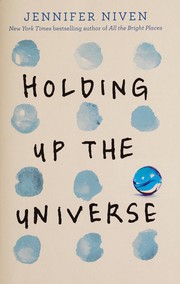
Holding Up the Universe
2,979-word summary 13 min read 400 pages in the book
- First published
- 2016
- Publisher
- Knopf Books for Young Readers
- Pages
- 400
- ISBN
- 9780385755924
Reading options
What's inside (8 sections)
I picked this one up because All the Bright Places had stayed with me and I wanted to see what Jennifer Niven would do with a different kind of high school story. A friend said this was the warmer book, still sad in places but more about standing tall. That matched my read. It was published October 4, 2016 by Knopf Books for Young Readers, 400 pages in hardcover, ISBN 9780385755924, and it follows two juniors in Indiana who take turns narrating.
Libby Strout is coming back to school after years away. Her mother died when she was younger, and grief plus bullying kept her inside until her weight reached a point where she had to be cut out of her house. The papers called her Americas Fattest Teen, a label she hates. Since then she has done therapy, worked on panic, lost more than three hundred pounds, and decided she wants every possibility life has to offer. Her dad loves her and still looks tired around the edges. Home feels quiet without her mom. Libby decides her part at MVB High will be the girl who can do anything.
Jack Masselin looks like the opposite. He is popular, quick with jokes, good with his hands, able to fix and rebuild almost anything mechanical. He has a girlfriend, a best friend, a house full of brothers, and a habit of giving people the version of himself they want. No one knows he cannot recognize faces. Not his parents. Not his friends. He has prosopagnosia, face blindness, so even his own brothers can look like strangers. He keeps track of people with identifiers like hair, walk, voice, clothes, and seating charts. He plays it cool because exposure feels dangerous.
Chapters alternate, Libby then Jack then back and forth. Libby sounds direct and funny. Jack sounds faster, always scanning. Letting them misunderstand each other for a while feels honest.
Back at MVB High
Libby walks in expecting stares and gets them. Some kids remember the rescue. Some only know the nickname. A few teachers try too hard to be kind.
On day one she meets Iris, another bigger girl crying in the hall after boys pull a mean stunt. Libby has been on the receiving end of that kind of laughter, so she snaps. She chases Dave Kaminski, called Kam, who started it. Kam is Jacks best friend, loud and careless in the way senior boys sometimes get when other boys are watching.
Jack notices Libby because she runs fast for someone people assume is slow. He also notices she does not shrink. That surprises him. Most people shrink around Kam.
Then comes the part I found hardest to read. A group of boys run something they call Fat Girl Rodeo. The idea is to grab a heavy girl and hold on while friends cheer. It is cruel and specific, and Niven does not soften it. Kam declares Libby the grand prize. Jack hates the game but has gone along with the culture around it, laughing when he should have stopped it. He gets what he thinks is a clever idea. He will grab Libby himself in the cafeteria, make a scene so ugly the game dies, then slip her a letter explaining. It is one of those plans that sounds better in a boys head than in daylight.
He grabs her from behind at lunch. Libby panics, swings, and splits his lip. She knocks him flat in front of everyone. Good for her, honestly. I cheered, then felt sick, because both of them get sent to punishment.
Do I buy Jacks reasoning? Partly. Teen boys do stupid protective things that are still selfish. He wanted to end the game without losing status. Libby calls that out later, and she is right. The book lets him be wrong here without turning him into a villain. That balance matters, because the rest of the story depends on believing he can grow.
Circle time and bleachers
Their punishment is Conversation Circle, a group counseling setup, plus painting the school bleachers for community service. Forced proximity is a familiar setup, but Niven uses it for actual talk instead of montages.
In Circle they have to listen. Libby talks about her mom, about years inside, about learning to leave the house again. She is blunt about fear. She still checks exits. She still has nights where grief sits heavy. Jack mostly deflects with humor at first. He has practice. When everyone shares wounds, he shares something safe and polished.
The bleachers do more work. Painting is boring, which leaves room for side comments that turn real. Jack slips Libby a letter where he finally says the true thing. He tells her he has prosopagnosia. She is the first person his age he has told. He explains he did not mean to hurt her, that the grab was meant to kill the game. Libby does not forgive him on the spot, which I respected. She asks questions. She tells him to look into testing instead of guessing alone on the internet.
So he does. He meets with a researcher, talks through history, hears that his case looks severe. The likely cause was a fall from a roof when he was six, hitting his head. There is talk of the fusiform gyrus, the part of the brain that helps with face recognition, misfiring. For Jack, having a name and a test result is both relief and dread. Relief because he is not making it up. Dread because now it is documented, which makes hiding feel more dishonest.
Libby, meanwhile, reconnects with an old friend and starts to build a small circle. Iris matters here. So does the simple fact of being back in classrooms, learning teachers names, finding where to sit. Niven is good at those small school details. The squeak of bleachers. The smell of paint. The way lunch tables sort themselves without anyone announcing rules.
My one complaint here is pacing. Some Circle scenes repeat the same beat, and two sessions could have been tightened. Still, the letter device works. Writing lets Jack say what speaking blocks.
Pizza King and pulling away
Friendship turns into dating in a way that felt natural to me. They text. They argue about music and books. Libby leaves her copy of We Have Always Lived in the Castle around like a flag for who she is. Jack loves taking things apart and putting them back together, and Libby loves that about him, his patience with broken objects even if he has less patience with himself.
He takes her to Claras Pizza King in Richmond, a place tied to happy childhood memories. I liked that date because it is specific. Breadsticks, arcade noise, a booth with history. Libby wonders, though, if he picked a town away so no one from school would see them together. Jack wonders the same thing about himself, which is worse. He tells himself he wanted privacy. Part of him knows he wanted cover.
That tension drives the next section. Jack likes Libby. He also fears what happens when he cannot pick her out in a hall, or waves at the wrong girl, or forgets a shared look because faces slide. He keeps thinking love requires recognition he cannot guarantee. So he does the classic move. He cools off. He says they cannot keep going. He frames it as protecting her.
Libby is hurt and angry, and she should be. She has done hard work to show up as herself. Being hidden as someone elses secret feels like being pushed back inside the house. She tells him so in plain words. No speechifying. Just hurt.
I found Jack frustrating here, in a way that felt intentional. He has told Libby the truth about his brain but not the truth about his shame. He will admit the diagnosis to one person while still performing swagger for everyone else. That split is exhausting, and Niven shows the cost. He forgets who knows what. He laughs at jokes he hates. He stays close to Kam even when Kam is awful, because Kam is social shelter.
Caroline, Jacks girlfriend before Libby, or ex depending on the week, adds pressure. She expects him to know her on sight, to act like a normal boyfriend in crowded rooms. He cannot, so he fakes, and faking breeds more faking. When friends make cracks about Libby, Jack does not defend her the way he should. He tells himself he is keeping peace. Readers will see avoidance.
Is this stretch too romance heavy? A little. But the pause earns the later fallout. Libby wants to be wanted openly. Jack wants to be known without pity.
Letters and the purple bikini
While the romance wobbles, school gets meaner. Libby finds notes in her locker saying You arent wanted. At first one, then more. She tries out for the Damsels, the school dance team, because she danced as a kid and wants her body to do joyful things in public. She does not make it. Soon after, another note arrives, sharper, as if the writer watched tryouts and enjoyed the cut.
Niven keeps the sender question alive without turning it into a thriller. The point is the drip of it. How one sentence can ruin a hallway. How Libby starts checking corners again. Her dad tries to help and mostly hovers. Friends say ignore it, which is easy to say when the note is not in your locker.
Libbys answer is the scene everyone remembers. She walks into the main hall in an electric purple bikini with I AM WANTED written across her stomach. She hands out copies of a short piece she wrote about being wanted by family and friends and, more to the point, by herself. She invites other kids who have heard the same lie to stop believing it.
I expected to find this corny. On the page it plays as brave and specific. She is not claiming the whole school loves her. She is claiming her body in a place that tried to vote on it. The color matters. Purple is loud on purpose. The handout matters too, because Libby is a writer. She fights with sentences.
Does it solve bullying? No, and the book does not pretend it does. Some kids cheer. Some film. Some sneer. Administrators get involved. But Libby walks out taller. For a girl who once feared she would never have a life, taking up space on purpose is the point.
Around this, Niven threads Jacks testing and family silence. He has not told his parents. He tells himself they have enough stress, that his brothers need room, that he can manage with tricks. Every chapter where he almost tells them and backs out tightened my chest. I kept thinking of how much energy secrecy eats. He spends whole school days memorizing jackets and backpacks like passwords.
A small detail I loved: Libby realizing Jack lives across the street from her old house, the one that had to be opened to get her out. She used to watch three boys playing outside and gave them names from television, Dean and Sam and Castiel, making up companions when she was lonely. Those boys were Jack and his brothers. She did not know. He did not know she watched. It reframes a lonely memory as a shared one without making it cute. It just sits there, sad and kind.
My criticism here is about the letter mystery. When the sender is clear, the motive feels thin compared to the damage. That may be the point, since cruelty often is thin, but I wanted one more scene that made the why stick. As written, the notes function more as fuel for Libbys stand than as a full subplot. Fine, but slightly lopsided.
The party fight
Parties in YA books are often where secrets blow up, and this one earns it. Jack goes to an after school party, drinks too much, and the room becomes a wash of similar faces. Alcohol makes face blindness much worse, which Niven shows without lecturing. Loud music, low light, everyone moving. He kisses the wrong girl, thinking she is someone he once dated, and it turns out to be connected to Caroline. Chaos follows. Someone shouts. Someone pushes.
Jack panics and blurts the truth. He says he cannot recognize faces. Most kids laugh, assuming it is a drunk joke or an excuse for cheating. That laughter hurt to read. He finally says the real thing and the room treats it as a bit.
Outside it gets physical. Moses Hunt and friends jump him. Libby steps in and fights them off. She is strong, she is furious, and she has had enough of boys deciding what happens to bodies. It is messy and fast, not choreographed. A reader who needs tidy comeuppance may feel shorted. I thought mess was right.
After, Libby drives Jack home. He is shaky and sober enough to be ashamed. He shows her his street, his house, and says he watched her rescue years ago. He tells her he wrote her a letter in the hospital, rooting for her, though they had never met. Libby remembers getting letters from strangers. One of them was his. That lands quietly. No swelling music. Just two kids on a curb realizing their histories touched before they did.
That night Jack stops hiding at home. He wakes his parents, gets everyone together, mom and dad and his brothers, and explains prosopagnosia and what it does day to day. His mom starts searching on her phone while he talks, practical and scared. His dad asks plain questions. One brother asks if the roof fall caused it. Their mom says the adults will carry the weight now, that kids get to be kids. It is a warm scene, almost too smooth, but after so much dread I allowed it. Families can rise when finally asked.
For readers who want realism, note that one talk does not fix school. Classmates still joke. Kam texts something surprisingly decent, saying everyone has something odd and damaged, then slides back into insult humor because that is their language. Change comes in small moves here, not speeches. I found that believable.
What stays with me
The last stretch belongs to Libby and Jack separately before they come back together. Libby sits with grief and names how her mothers absence and her own weight got tangled in her head. She decides to set down what she can. She meets a friend at the park, talks about starting an inclusive dance group with Bailey, leaves her beloved book on a bench for a stranger. Those are small releases, not grand cures. Letting go as practice.
Jack lies awake feeling light for the first time in months. He runs through what he knows about Libby, her laugh, her stride, the way she fills a room, and understands none of it is about size. Then he pictures her face. He cannot picture his parents or brothers or Caroline with the same clarity, but Libbys eyes and freckles and smile arrive whole. He tests himself part by part. It holds. He believes love helped him see her, not as magic but as attention. He paid the kind of attention that sticks.
They meet and choose each other without pretending problems are gone. Jack still has face blindness. Libby still gets stared at. Notes may come again. College and jobs and new towns will bring new rooms full of strangers. The difference is they will face those rooms as people who have told the truth at home and at school.
What did I carry away? A few things. First, Niven writes fat heroines who want more than to become small. Libbys arc is about visibility on her terms, dancing, dating, speaking, taking up hall space. Second, invisible conditions get careful treatment. Jacks tricks, his fear of pity, his slow move toward testing, all read as lived rather than pasted on. Third, being seen is shown as action. Remembering someones laugh. Asking a second question. Sitting through Circle without checking a phone.
I should name what bothered me too, because this book is loved and still imperfect. The Fat Girl Rodeo setup uses assault as a meet cute engine, and even though Niven condemns it, the structure still needs that assault to start the romance. Some readers will flinch and put the book down there. I almost did. Jacks breakup reasoning circles for a while, and his voice in those chapters repeats the same worry with new words. A trim would help. Adults outside Libbys dad and Jacks mom stay sketchy. Teachers run Circle but rarely follow up one on one. Given the themes, more adult steadiness would model help better. And the ending, where Jack can suddenly picture Libby, risks reading as love curing neurology. Niven frames it as exception tied to deep attention, not cure, but it still lands neat. I wished for one extra scene showing Jack still failing with Libby sometimes, asking for help, getting it, moving on.
Who is this for? Readers fourteen and up who want romance with weight, for lack of a better word. If All the Bright Places wrecked you, this will feel steadier. There is bullying, grief, panic, fat shaming, drinking at a party, a fight, and hate notes. No graphic self harm focus like the earlier book. Humor helps. Pizza King helps. Brothers bickering helps.
I finished feeling fond of both leads and protective of Libby in particular. She walks through a school that once treated her as headline and insists on being a person. Jack learns to stop performing okay and start asking for what he needs. That is a solid place to leave them. Not fixed. Just seen, and willing to stay visible.
FAQ
When was Holding Up the Universe published?
It was first published October 4, 2016 by Knopf Books for Young Readers. The hardcover runs 400 pages with ISBN 9780385755924.
Who are the main people in the book?
Libby Strout, Jack Masselin, his family and friends, plus classmates like Iris, Kam, Caroline and Moses.
Is Holding Up the Universe part of a series?
No. It is a standalone novel, separate from All the Bright Places.
Similar books
All the Bright Places
Grieving Violet and struggling Finch wander Indiana for a school project and each other.
2,208-word summary · 10 min read

What Happened to Goodbye
Mclean has reinvented herself in four towns since her parents divorced. In Lakeview she uses her real name, and for the first time staying put becomes a choice.
2,796-word summary · 12 min read

Dumplin'
Willowdean Dickson enters her town's beauty pageant as a protest and discovers that confidence is harder to keep once she lets someone close.
1,922-word summary · 9 min read
I Kissed Shara Wheeler
Shara Wheeler kisses her rival Chloe Green at prom and disappears, leaving a scavenger hunt that forces Chloe to rethink everything she knew about her.
2,083-word summary · 9 min read

Amy & Roger's Epic Detour
Amy Curry has not driven since the crash that killed her father. With Roger at the wheel and a box of maps between them, a cross-country trip becomes a slow…
3,034-word summary · 13 min read
Dash & Lily's Book of Dares
Two lonely New York teenagers trade dares in a red notebook left at the Strand, falling for each other on the page before they meet.
2,228-word summary · 10 min read
Every Last Word
A girl with OCD finds poetry and friends who know her secrets.
2,434-word summary · 11 min read
The Upside of Falling
Two teens fake-date for a summer dare and end up facing grief, family secrets, and first love.
2,274-word summary · 10 min read

Since You've Been Gone
Shy Emily spends summer finishing her vanished best friend Sloane list of thirteen dares, finding Frank, Dawn, and courage.
2,566-word summary · 11 min read
Isla and the Happily Ever After
Shy Isla Martin finally dates longtime crush Josh Wasserstein after a Manhattan summer and senior year at SOAP Paris, then learns love needs honesty to last.
2,293-word summary · 10 min read
The Statistical Probability of Love at First Sight
Hadley misses a flight, meets Oliver to London, and faces her father wedding in one day.
2,002-word summary · 9 min read
The Do-Over
Emilie relives awful Valentine Day with cheating boyfriend until Nick helps fix it.
2,071-word summary · 9 min read
Nick and Charlie: A Heartstopper Novella
Nick is off to university and Charlie is staying behind. One last summer to decide if first love can survive distance.
2,329-word summary · 10 min read
Lola and the Boy Next Door
Costume maker Lola must choose between older Max and inventor Cricket while her two dads hold home steady.
2,045-word summary · 9 min read
Binding 13
Shy Shannon Lynch transfers to Tommen College for a fresh start and crosses paths with rugby star Johnny Kavanagh, sparking a slow friendship tested by injury,…
2,950-word summary · 13 min read
Perfect Chemistry
Perfect rich girl and gang tied boy tutor each other into love that must survive threats.
2,029-word summary · 9 min read

Always and Forever, Lara Jean
Senior year brings college letters, distance from Peter, and a dad wedding Lara Jean helps hold together.
2,037-word summary · 9 min read
Without Merit
Merit Voss feels invisible in a crowded converted church home until Sagan, Luck, and a painful night force the truth out.
3,300-word summary · 15 min read
Better than the Movies
A rom com obsessed senior hires her annoying next door neighbor to win her crush, then finds real love is messier and kinder than any movie plot.
2,438-word summary · 11 min read

Anna and the French Kiss
Anna Oliphant is sent to Paris boarding school and falls for Etienne while misreading Bridget and Matt.
3,262-word summary · 14 min read

To All the Boys I've Loved Before
Lara Jean's secret love letters get mailed and she fake-dates Peter Kavinsky to dodge Josh.
3,683-word summary · 16 min read
The Fault in Our Stars
John Green's The Fault in Our Stars: Hazel and Augustus in Amsterdam, the unfinished manuscript, and how the novel handles illness, humor, and dying without…
2,192-word summary · 10 min read
Size 12 Is Not Fat
Former teen pop star Heather Wells investigates two dorm elevator deaths while juggling her ex, her crush, and a size-12 wardrobe.
2,805-word summary · 12 min read

Anatomy: A Love Story
In 1817 Edinburgh, a noblewoman who wants to be a surgeon disguises herself to study anatomy and falls for the grave robber who supplies her with bodies.
2,031-word summary · 9 min read
Alone With You in the Ether
Two people in Chicago agree to six conversations, and the experiment becomes a love affair that is also a study of bipolar disorder, obsession, and the shape…
2,713-word summary · 12 min read

Vow of Thieves
Kazi and Jase return to Tor's Watch to find it occupied, and their marriage is tested by captivity, betrayal, and a war for the town of Hell's Mouth.
2,059-word summary · 9 min read
The Lost Sisters
Taryn Duarte writes a letter to her twin, Jude, explaining how she fell for Locke and why she stayed silent while he used them both.
1,914-word summary · 9 min read

Masquerade
After Cordelia's death, Schuyler flies to Venice to find her exiled grandfather, then returns to the Blue Bloods as they prepare for a masked ball and a hidden…
2,543-word summary · 11 min read

Archenemies
Nova steals for the Anarchists while Adrian hides his Sentinel identity, and a serum that erases prodigy powers puts them both at risk.
2,485-word summary · 11 min read

The Siren
Saved from a shipwreck in 1930, Kahlen becomes a siren who sings men to their deaths for the Ocean, until a boy in a college library makes her want a life she…
2,369-word summary · 11 min read