
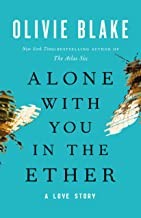
Alone With You in the Ether
2,713-word summary 12 min read 288 pages in the book
- First published
- 2020
- Publisher
- Tor Books
- Pages
- 288
- ISBN
- 9781250888167
Reading options
What's inside (8 sections)
I picked this up because a friend called it the most annoying book she had ever loved, which is a better recommendation than most blurbs. I read the 2022 Tor Books hardcover (ISBN 9781250888167), 288 pages, though the novel first appeared in 2020 when Blake was still self-publishing. It is a standalone, which is worth saying because the book feels like it could keep going. The title sounds like science fiction. The jacket copy promises time travel. What you actually get is two people in Chicago talking at each other in complete sentences for a year, and one of them is drawing hexagons on everything.
That gap between promise and delivery decides the whole experience, I think. If you come in wanting the speculative novel the marketing implies, you will spend 288 pages waiting for a machine to switch on. If you come in willing to sit with two unwell people who are very eloquent about being unwell, the book will get its hands into you. I read most of it in two sittings and then spent a week irritated by how often I thought about the ending.
The armory
The meeting happens in the armory of the Art Institute of Chicago. Aldo Damiani is sitting on the floor with a notebook, drawing hexagons and working through a private argument about the shape of time. Regan, a docent, tells him he cannot sit there. He looks up and says something about her seeming too young to be giving tours. It is not a meet-cute so much as a collision between two people who have each decided that the ordinary rules do not apply to them.
Regan gives tours of the collection and is good at it, which matters, because the book needs you to believe she has a real eye before it asks you to believe she is an artist. She lives off family money in a messy apartment, has a boyfriend named Marc who parties hard, uses cocaine, and treats her like a problem to be managed, and sees a court-appointed therapist because she was caught counterfeiting foreign currency. She is not sorry in the way the court would like. She is mainly sorry that the whole episode confirmed something she already suspected about herself, which is that she can do almost anything except the one thing she wants.
Aldo is a doctoral student in theoretical mathematics who teaches badly and knows it. He has a routine for everything. He counts. He calculates. He thinks about time travel not because he expects to build a machine but because the problem gives his brain a track to run on, and when the track disappears his thoughts turn on him. His father, Masso, calls to check on him. Aldo is a recovering addict who overdosed once, and the book is careful about the fact that his rituals are both a survival mechanism and a cage.
The two of them are, in the terms the novel keeps offering, opposites: art and math, impulse and order, a woman who lies easily and a man who cannot stop auditing her. That sounds like a schematic for a romance, and it is. What saves it for a while is that Blake lets them be weird in specific ways. Regan is not a free spirit; she is a person with a mood disorder who has learned that charm can cover a lot. Aldo is not a machine; he is a frightened man with a very good vocabulary.
Six conversations
Their second encounter produces the book's central device. Aldo finds Regan at the museum and asks about her arrest. She explains that she made foreign bills digitally and exchanged them for American money, mostly because she wanted to see if she could. He is fascinated, and a little alarmed, and he starts trying to catch her in lies. Over lunch she agrees to five more conversations, which makes six total, as if they are running an experiment rather than falling for each other.
The six conversations are the best part of the novel. He turns up on one of her tours and asks which painting she loves most. She takes him to Whistler's Nocturne: Blue and Gold and says she likes it because it is not trying to tell a story. He tells her about honeybees, how the hive is a matriarchy, how the male bees exist for one purpose and die. She finds him most attractive while he is explaining this, which is the kind of detail that makes a character feel observed rather than designed.
Then there is the phone call at four in the morning, when she tells him that ripples in water form perfect circles. He argues. She insists. They talk for hours about hexagons, the multiverse, and the people they love. By morning she has invited herself to church with him. In the pew he starts drawing equations in his notebook, and she takes his hand and tells him to write on her thigh instead. He does, with his finger, and she feels like a surface he is using to think. It is a strange, intimate scene, and it works because the book does not wink at it.
The haircut scene is the other one people remember. She goes to his apartment, cuts his hair, and they stand in front of the mirror with his head against her stomach. Nothing happens. Everything happens. She leaves quickly because she does not know what to do with a moment that is not sex and not friendship and not yet love.
Around this time Regan invites Aldo to her parents' anniversary party instead of Marc. Marc takes this with a calm that is worse than anger. He tells her she will come back to him, that Aldo will tire of her, that she is predictable in her unpredictability. Before she leaves, she calls Aldo from the bathroom and talks to him while touching herself, then has sex with Marc, then drives to pick Aldo up. It is a horrible, plausible sequence, and it establishes the book's willingness to let its heroine be unkind without turning her into a villain.
The problem of being seen
At the party, Regan becomes the daughter her parents expect, and Aldo notices the change. Her mother, Helen, is cold in the way that only someone who knows you very well can be. Her sister, Madeline, is warmer. Aldo is miserable and quiet and occasionally forgets to respond when spoken to. He tells Madeline that Regan is an infinitely complex problem he would like to spend a lifetime solving. It is meant as devotion. It also sounds like a man describing a project.
That night Regan comes to his room and tries to seduce him. He refuses. He says he wants to see her art. She hears it as rejection, maybe because it is both a kindness and a demand. She goes to her father's office, looks at a painting he bought years ago, a painting she has wanted to be worthy of since she was a child, and realizes it is only average.
So she copies it. Exactly. She has the skill; that has never been the issue. The issue is that copying is safe, and making something of her own would expose her to the possibility that she is not good. The next morning she and Aldo leave without saying goodbye, and she tells him she wants space. She also stops taking her medication. She tells her doctor she has started painting again. The doctor hears the rest of it in what she does not say.
Then she asks Aldo to model for her. She goes to his apartment, asks him to undress, and poses him. She draws him for hours, studying his body in a way that keeps sliding between clinical and erotic. She tells him she has a diagnosed problem that requires medication. He says he sees nothing wrong with her. It is the most romantic thing anyone says in the book, and it is also the most dangerous, because it is not true. She leaves before they can kiss.
When she comes back, they have sex on the kitchen counter and start the relationship properly. She breaks up with Marc. She and Aldo have their first fight, and she is relieved when he fights back, because Marc never did. Aldo's need for her grows until it frightens him. She changes the way he thinks about time, or at least she gives him a reason to stop treating it as an enemy. He takes her to California to meet Masso, who is polite and then warns him that Regan is too impulsive, that she reminds him of Aldo's mother. Aldo decides to prove him wrong.
Regan flies home a week early and discovers she does not know how to be in Chicago without him. She thinks about inventing an emergency to bring him back, then feels ashamed. On New Year's Eve she runs into Marc at a bar, and he tells her she will ruin this the way she ruins everything. She calls Aldo. They talk about being alone in the ether, about how everyone is sealed inside their own head and love is the brief, improbable overlap. It is the book's thesis, and it lands because they have earned the metaphor by then.
They move in together. She negotiates with her doctor to stay off her medication. This is where the novel becomes genuinely uncomfortable, and where it is doing something more interesting than a standard romance.
The crack
The last part of the book is the sound of a relationship coming apart in slow motion. Regan throws herself into painting. She stops sleeping. She disappears for whole days. She does not tell Aldo about the show she is preparing. He watches her and tells himself he can keep up, then stops believing it. The things he loved about her, the unpredictability and the intensity, become the things he cannot live inside.
At her father's birthday party, Marc is there, invited by her parents, and he warns Aldo that Regan is caught in a pattern and that Aldo is just the latest person in it. Aldo goes into her father's office and finds the painting. Not the original. Her copy, hanging where the original should be. He understands immediately that she has taken it, and he hears the whole relationship click into a shape he recognizes: she has not changed, she has only found a new audience.
He asks her, "You really haven't changed, have you?" and breaks up with her. The line is cruel and also accurate in the way that a diagnosis can be accurate and still miss the person. Regan is shocked, then furious, then numb. Later she thinks she should have argued. She had been changing, just not in a way he could see from inside his own fear.
This is the part where the book is hardest on both of them. Aldo is not wrong that she lied and stole and disappeared. He is wrong to reduce her to a pattern, and he knows it later. Regan is not wrong that she was becoming an artist. She is wrong to think that becoming an artist excuses the lying. The novel does not resolve this by picking a side. It lets them both be right enough to hurt each other.
A perfect circle, or close enough
After the breakup, Regan keeps painting. She makes a triptych called Alone with You in the Ether: a blurred landscape built out of tiny golden hexagons. It is the first thing she has made that is entirely hers. Aldo goes to the museum and stands in front of it for a long time. A passerby calls it pretty. He is offended on Regan's behalf, because he can see the whole argument of her life in it, the loneliness and the math and the attempt to make something that does not have to mean anything in order to mean everything.
He calls Masso and says Regan is not like his mother. He says she is his source of hope. He decides that if she wants him back, he will be there.
Regan is watching him from across the gallery. She imagines walking over, imagines a wedding, imagines children. She calls him instead. She tells him their love is a perfect circle, and that if time moves in a hexagon, then every corner is a chance to turn toward each other again. He agrees. They go home.
The narrator closes by saying that their problems did not vanish. They found their own version of healthy, which is a modest ending and the right one for this book. Nobody is cured. Regan is still a person who has to decide every day how to live with her mind. Aldo is still a person who needs routine and reassurance. They have simply decided to keep choosing each other while they figure it out.
What the book earns and what it doesn't
The prose is the thing people either fall for or cannot stand. Blake writes in aphorisms. Her characters talk like people in a 1940s comedy who have read too much philosophy. At its best the style is genuinely seductive; the bees speech, the thigh scene, and the museum ending all work because the language is doing something besides being pretty. At its worst it is a stack of lines that sound profound until you look at them directly. A lot of this book could be printed on a poster above a bed, and some of it deserves to be.
The structure is six parts, which mirrors Aldo's hexagons, and the opening chapters include stage directions and a narrator who keeps interjecting before mostly disappearing. I found that narrator more of a tic than a device. If the book wants to be about fate and pattern, the voice could have stayed; if it wants to be intimate, the voice should have gone from the start. As it is, the trick feels like a first draft that survived into print.
The characterization is thin in places. Regan is bipolar and impulsive; Aldo is obsessive and withdrawn. Those are the poles, and the novel keeps returning to them. Helen is a disapproving mother, Madeline a sympathetic sister, Marc a warning with a phone number. The book is more interested in the texture of Regan and Aldo's minds than in the rest of the world, and you feel that narrowness. Chicago is a backdrop. The Art Institute is a stage.
The bigger issue is the medication arc. Regan goes off her medication, becomes manic, and the book treats the episode as the door to her art. It is honest about the cost, but it also makes the mania look like the price of making something real. Blake's author's note says the story is not prescriptive and that she has bipolar disorder herself. That note helps, but it does not erase the way the novel lingers on the creative high. Readers who have watched someone go off their meds may find the whole arc irresponsible, and I would not argue with them. The book knows more than it says about this, and it should have said more.
What it does better than most love stories is the fear of being someone's whole reason to live. Aldo and Regan both want to be necessary, and both discover that necessity is a trap. The scene where she thinks about faking an emergency to bring him home is awful in the most ordinary way. The scene where he stands in front of her painting and calls it the meaning of life is the same fear from the other side.
If you liked Normal People and can tolerate a book that is more in love with its own sentences than with plot, this will stay with you. If you want likable characters, a clean position on mental illness, or the time-travel novel the cover suggests, it will annoy you. I ended up on the annoying side and the loved side at once, which is probably the most honest place to be with a book like this.
FAQ
When was Alone With You in the Ether first published?
It was first self-published in 2020. The edition cited here is the 2022 Tor Books hardcover, 288 pages, ISBN 9781250888167.
Is Alone With You in the Ether part of a series?
No, it is a standalone novel.
Does the novel recommend going off medication?
It does not give a simple answer. Blake has said she has bipolar disorder and that the book is not prescriptive, but it links Regan's manic episode to her art in a way some readers find irresponsible.
Similar books

Big Swiss
A transcriptionist for a sex coach falls for one of his clients, the tall Swiss gynecologist she calls Big Swiss, in a funny novel about work and secrets.
2,523-word summary · 11 min read
The Marriage Plot
At Brown in 1982, Madeleine loves Austen while torn between brilliant Leonard and steady Mitchell.
2,804-word summary · 12 min read

Eligible
Austen's Bennet sisters move to modern Cincinnati, where marriage is a reality show and the house is losing its value.
2,293-word summary · 10 min read

By the River Piedra I Sat Down and Wept
Pilar, 29, meets her childhood friend again in Madrid and finds a rumored miracle worker. One winter week through the Pyrenees to the river Piedra, and the…
2,845-word summary · 13 min read
Every Last Word
A girl with OCD finds poetry and friends who know her secrets.
2,434-word summary · 11 min read

Where Rainbows End
Told in letters and emails, Rosie Dunne and Alex Stewart grow from Dublin childhood to midlife, missing chances at love while raising Katie.
1,943-word summary · 9 min read
The Silver Linings Playbook
A man leaves a mental facility sure his wife waits, then dance practice and hard truths reshape him.
2,981-word summary · 13 min read
Beautiful World, Where Are You
Two friends Alice and Eileen trade letters while navigating love with Felix and Simon.
2,872-word summary · 13 min read
All the Bright Places
Grieving Violet and struggling Finch wander Indiana for a school project and each other.
2,208-word summary · 10 min read
Ugly Love
Colleen Hoover's Ugly Love retold: Tate and Miles, the rules, the past with Rachel, and the lake letter.
2,339-word summary · 10 min read
Normal People
Normal People retold: Connell and Marianne from Sligo school to Trinity, class and love.
2,066-word summary · 9 min read
Me Before You
Me Before You retold: Lou cares for Will in a Welsh annexe, trips and talks, choice and loss.
1,989-word summary · 9 min read
It Ends with Us
It Ends with Us from Lily's flower shop to her marriage: alternating past and present, Ryle's cycles of violence, and why the ending refuses a clean romantic…
2,381-word summary · 11 min read

What Happened to Goodbye
Mclean has reinvented herself in four towns since her parents divorced. In Lakeview she uses her real name, and for the first time staying put becomes a choice.
2,796-word summary · 12 min read

The Japanese Lover
A Polish refugee and the son of a Japanese gardener fall in love in San Francisco in 1939, then keep the affair secret for nearly seventy years.
2,286-word summary · 10 min read

Size 12 Is Not Fat
Former teen pop star Heather Wells investigates two dorm elevator deaths while juggling her ex, her crush, and a size-12 wardrobe.
2,805-word summary · 12 min read

Memories of My Melancholy Whores
A ninety-year-old journalist pays for a night with a teenage girl, cannot go through with it, and discovers love for the first time in García Márquez's late…
2,101-word summary · 9 min read

Dumplin'
Willowdean Dickson enters her town's beauty pageant as a protest and discovers that confidence is harder to keep once she lets someone close.
1,922-word summary · 9 min read

Shopaholic and Sister
Becky Brandon returns from a ten-month honeymoon to meet the half-sister she always wanted, then discovers that Jess is thrifty, prickly, and nothing like the…
2,591-word summary · 12 min read

Sam's Letters to Jennifer
A grieving journalist reads her grandmother's letters and finds a decades-long love affair that changes how she sees her family.
2,310-word summary · 10 min read
Mr. Maybe
Libby Mason wants a rich husband, but the wealthy man who proposes is dull and the broke writer she cannot forget is not offering forever.
2,322-word summary · 10 min read
I Kissed Shara Wheeler
Shara Wheeler kisses her rival Chloe Green at prom and disappears, leaving a scavenger hunt that forces Chloe to rethink everything she knew about her.
2,083-word summary · 9 min read

Amy & Roger's Epic Detour
Amy Curry has not driven since the crash that killed her father. With Roger at the wheel and a box of maps between them, a cross-country trip becomes a slow…
3,034-word summary · 13 min read

One to Watch
A plus-size fashion blogger takes the lead role on a reality dating show to prove she belongs on television, and finds she might want what the cameras offer.
2,478-word summary · 11 min read
Between Sisters
Estranged sisters Meghann and Claire reunite in Washington when Claire announces a rushed wedding, then face their mother's desertion and a medical crisis.
2,467-word summary · 11 min read

On Chesil Beach
Two newlyweds spend one terrible night on Chesil Beach in 1962, and the rest of their lives is decided by it.
2,456-word summary · 11 min read

Ivanhoe
A disinherited Saxon knight, a great tournament, a besieged castle and a trial by combat. Scott's most famous novel, set in England in 1194.
2,834-word summary · 13 min read
Euphoria
Three anthropologists in 1930s New Guinea turn fieldwork into a love triangle, and a real history breathes behind them.
2,048-word summary · 9 min read

A Spool of Blue Thread
Four generations of the Whitshank family in Baltimore, and the silences, resentments and quiet love they hand down without ever saying so.
2,408-word summary · 11 min read
Wedding Night
Lottie marries an old flame days after a breakup, then flies to a Greek island while her sister quietly works to sabotage the honeymoon. A farce about memory,…
2,213-word summary · 10 min read