
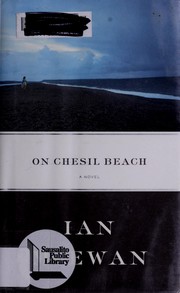
On Chesil Beach
2,456-word summary 11 min read 203 pages in the book
- First published
- 2007
- Publisher
- Nan A. Talese
- Pages
- 203
- ISBN
- 9780385522403
Reading options
What's inside (9 sections)
I read On Chesil Beach in a single sitting on a train, which is either the ideal way to read it or the worst. The whole thing runs to roughly the length of a long essay, and I kept looking up to check the stations. What stayed with me afterwards was not the sex scene, which is one of the most uncomfortable hundred pages in modern English fiction, but the decades of ordinary life that come after it, in the novel's quiet coda, where two people spend forty years not talking about one night.
Jonathan Cape published the book in London on 5 April 2007, and the American edition followed in June from Nan A. Talese in New York. The edition I used is that US hardcover, which runs 203 pages and carries the ISBN 9780385522403; the British edition was a slimmer 166 pages. The novel was shortlisted for the 2007 Booker Prize, lost the prize to Anne Enright's The Gathering, and was named Book of the Year at the 2008 British Book Awards. It was filmed in 2017 by Dominic Cooke, with Saoirse Ronan as Florence and Billy Howle as Edward.
Dinner in the honeymoon suite
The novel opens in the present and stays there: one evening in July 1962, in a small Georgian inn overlooking Chesil Beach in Dorset. Edward Mayhew and Florence Ponting married that morning at St Mary's in Oxford and have driven down in Florence's mother's car. They eat in their room, at a table by French windows that open towards the Channel and the pale shingle below, because it is raining too hard to eat on the terrace.
The food is period furniture: melon decorated with a single glazed cherry, roast beef in a thickened gravy, potatoes of a bluish hue, sherry truffle, Cheddar and mint chocolates, and French wine from a bottle with a swallow on the label. Two youths in dinner jackets serve them from a trolley in the corridor, nervous enough that their hands shake as they set the dishes down. Downstairs, the older guests are listening to the wireless for the ten o'clock news and hearing Harold Macmillan talk about the arms race.
Both of them are terrified, and they are terrified of different things. Edward is a first in history from University College London, and his specific fear is that he will arrive too soon, which has happened to him once before. Florence's fear is older and deeper and she cannot put it into words, even to herself. What she has instead is a handbook for young brides, and its cheerful vocabulary of mucous membranes and penetration makes her physically sick. The two of them sit through a meal neither of them wants, making small talk about their future house, Edward's job with her father's firm, Florence's music, and the money her father gave them, and neither says a word about what is actually going to happen tonight.
They were young, educated, and both virgins on this, their wedding night, and they lived in a time when a conversation about sexual difficulties was plainly impossible.
McEwan keeps the scene at the temperature of that dinner. Nobody raises their voice. The closest thing to conflict before the bedroom is a joke about the news, and the reader understands that this is a couple using language as a place to hide.
Edward
Edward is twenty-two, and the novel gives him a childhood with as much care as it gives the wedding night. His family lives in a cramped cottage in the Chiltern Hills, and his father Lionel is a schoolmaster with rigid expectations about homework and a habit of keeping Sunday mornings to himself. His mother, Marjorie, has never been quite right, and the reason is given early and plainly. In December 1944 she was standing on a railway platform at Wycombe when a traveller got off a moving train, opened the door too early, and the heavy metal edge of it struck her forehead, fracturing her skull and taking her personality, intelligence and memory with it. She spent a week in a coma and never came back.
Edward grows up protected by the absence of a word for it. His father calls her artistic, eccentric, charming, probably a genius, and the family makes a game of protecting that fiction. The change comes when Edward is fourteen and his father takes him into the garden under a big elm and uses the term: brain-damaged. The word, McEwan writes, dissolved intimacy and measured his mother by a public standard. Edward understands at once that he is not her, that he is not his family, and that one day he will leave and come back only as a visitor. It is a devastating little scene, and it explains the man he becomes: decent, guarded, in a hurry to get away.
He is also, quietly, a disappointment. He wanted to write history. His final undergraduate essay was on the great man theory of history, a sweeping argument about force and luck that his tutor considered outmoded, and it earned a B minus. His plan is to write short biographies of half-famous people. He falls in love with Florence because she is the most extraordinary person he has ever met, and because she is so hard to read that he keeps mistaking her silence for shyness.
Florence
Florence is the first violin of a string quartet, and she leads it. The playing is described with real precision: she is fluent and confident with the bow, exact in the passages, and completely hopeless with a teacup. Her father has spent years arranging her life for her, and months before the wedding, at her suggestion, he offered Edward a job with the family firm. He is a frightening man, and he gets what he wants from her by a mixture of charm and pressure. Her mother is an intellectual who retreats into long words when she wants to talk about something difficult. Her sister Ruth is too young to be told anything.
Into this, McEwan drops hints and never explains them. There are references to Florence's childhood, to her relationship with her father, and to an incident of some kind that the novel refuses to describe. He said in a 2007 interview that the detail was there as a shadowy fact for readers to make of it as they wished, and that many readers would miss it altogether, which is fine. The New York Times called the suggestion incestuous and the depiction of her past sketchy. It is the one part of the book that stays out of reach, and Edward, characteristically, never asks.
What we do see is a woman who loves Edward warmly and deeply but has no idea what to do with being entered or penetrated by anyone. She reads her handbook's language and understands, literally, that she is to become a kind of corridor he will pass through. She thinks about babies and likes the idea of them. She can be tender and playful and funny, and she is capable of enormous patience, but the physical part of marriage frightens her in a way that has nothing to do with Edward, and she has never found a way to say so. Because she cannot say it, and he cannot read it, both of them spend a year and more arranging a wedding around a silence.
The bedroom and the beach
He kisses her and pushes his tongue into her mouth, and she has to stop herself from being sick. He is not rough, exactly, but he is certain, and certainty is the thing she cannot bear. She takes him by the hand and leads him towards the four-poster bed, because her sense of duty is stronger than her dread, and then she hears a sound rising inside her, a violin-voice somewhere between a note and a scream, telling her something urgent in sibilants and vowels more primitive than words. She stops it by jerking free.
What follows is the scene the book is built on. Edward, who has not touched himself for more than a week in the hope of lasting longer, loses control and ejaculates onto her belly and thighs before anything has begun. Florence, sick with shame and disgust, runs out of the inn and down the lane onto the beach. Edward follows her out, still in his wedding clothes, and they have the argument that ends it. She says she will never agree to have sex. He accuses her of lying in the vows she just made. She tries to give him a way out, proposing that he sleep with other women while they stay married, and he hears it as an insult rather than an offer. The walk back to the inn is silent. She packs and leaves that night, telling the staff a family illness has called her home. The marriage is annulled for lack of consummation, and both families move efficiently to make that permanent.
Forty years of not talking about it
The last section is the part that stays with me. Edward gives up on history books, drifts into managing shops, and after his mother dies goes back to the cottage to look after his father, whose Parkinson's is advancing. He has friends, a cricket club, a good deal of local history, and a marriage of his own that lasts only a little while. He never loves anyone the way he loved Florence, and he never goes to hear the Ennismore Quartet, though they become a celebrated name; he stays away from any reminder of her.
What became of Florence's marriage is never mentioned again. She thinks of Edward after every performance, and there is a small scene years later at Wigmore Hall where she looks towards a seat, seat 9C, the one he once promised to sit in and lead the applause, and he is not there and does not know she looked.
McEwan ends with Edward in his sixties, turning the night over for the last time, working out that patience and love might have carried them into an ordinary, happy marriage, and that Florence wanted him to call after her as she walked away. He did not. The last image is her receding along the shingle until he cannot see her any more. They never meet again. That reunion belongs to the film, which invents a farewell concert in 2007 where the two of them sit in the same room and shed silent tears; the novel is crueller and quieter.
The shortlist and the noise around it
There was a fight about this book before there was much writing about it. At 166 pages and fewer than 40,000 words, it was accused of not being a novel at all, and McEwan himself called it a novella. The Booker judges let it in anyway, and the chair, Howard Davies, said it was a very tight novel that managed great depth of analysis. It lost to The Gathering, but it outsold every other shortlisted book, and it was named Galaxy Book of the Year at the 2008 British Book Awards, with McEwan also taking the Reader's Digest Author of the Year award.
The reviewers split, and the split is instructive. Jonathan Yardle put it on his Washington Post top ten for 2007 and said that even in what he called a minor mode, McEwan was nothing short of amazing. The San Francisco Chronicle's Martin Rubin called it "perhaps that rarest of things, a perfect novel." Tim Adams in the Guardian described a structure that interweaves like a chamber piece. Against that, Michiko Kakutani in the New York Times found a small, sullen, unsatisfying story and thought Edward volatile, self-absorbed and incurious, while a Camden New Journal reviewer said Edward disappears as a credible character, more cardboard than a man unhinged by his situation. Al Alvarez, in the New York Review of Books, liked the accuracy and the tone and regretted that the two of them had been allowed so little fun.
There is also the small story that has attached itself to the book, which is that McEwan took pebbles from Chesil Beach while writing it and kept them on his desk. Conservationists complained, a council threatened a fine, and he returned them, saying he had not known he was committing a crime.
What works and what does not
The control is the achievement. Two hundred pages, and the reader never sees a hand on the strings: the history of Edward's parents, the musical world Florence came from, the whole strange machinery of 1962, all of it delivered in reflections and in a narrative voice that moves between the two heads. The prose is dry, exact and frequently funny, and the silences do as much work as the sentences. The one place the book deliberately leaves a hole, Florence's past, frustrates plenty of readers, and Michiko Kakutani for one concluded that McEwan never makes her emotional life palpable or plausible to the reader.
Edward is the argument. He is decent, funny, capable of shame, and also the source of nearly everything that goes wrong, because his need is to be desired and his way of showing love is to push. Readers who come to On Chesil Beach for a love story tend to be disappointed by him; readers who come for a study of two incompatible people meeting at the worst possible moment tend to find the whole thing exact.
The final thing worth saying is about the period, because the book depends on it. In 1962 an unconsummated marriage was not a private misfortune to be shrugged off with friends. It was annulment, and then a life that had been planned, with a job already arranged and a future already mapped out, closing off in front of them. The reader in 2026 has to work to feel how final that was. McEwan makes the effort worth making by never editorialising about it and by putting the whole weight of the book on one night that nobody will discuss, then never discuss again.
So who should read it? Readers who liked Atonement and want to see the same writer at three hundredths of the length. Readers who like novels that are built like a trap. People who have read about 1962 and found it mostly about sex, and would rather read about two people who cannot say a sentence. It is not for readers who want a love story with a happy ending, or for anyone who reads for plot momentum; it is also short enough to finish in an evening, which is the best recommendation I can give.
FAQ
How long is On Chesil Beach, and why is it called a novella?
The US hardcover from Nan A. Talese runs 203 pages, while the British Jonathan Cape edition was 166 pages. McEwan himself called it a novella, and its length caused controversy when it was shortlisted for the 2007 Booker Prize.
Do Edward and Florence meet again at the end of the book?
No. The novel ends with Edward in his sixties remembering Florence walking away along the beach. The chance meeting at a farewell concert is the ending of the 2017 film, not of McEwan's novel.
Is On Chesil Beach a happy love story?
Not at all. It is about a marriage that ends on the wedding night and the decades of regret that follow, told in a controlled, unsentimental style.
Similar books

Howards End
Forster's 1910 novel follows two families, a house in Hertfordshire, and a burned note, asking whether money and feeling can ever be connected.
2,187-word summary · 10 min read
Lady Chatterley's Lover
A baronet's wife, starved in a marriage the war broke, takes the gamekeeper as her lover. Lawrence's banned 1928 novel of class and touch.
2,566-word summary · 11 min read
South of the Border, West of the Sun
A married Tokyo bar owner reunites with his lost childhood sweetheart and must choose between steady family life and a haunting first love.
2,844-word summary · 13 min read
Atonement
A thirteen year old misreads two lovers at a country house in 1935, and her false claim follows all three through war.
2,743-word summary · 12 min read
Six Scorched Roses
A dying scholar bargains with a reclusive vampire for blood, and six roses turn a transaction into a slow, dangerous romance.
2,663-word summary · 12 min read
Revolutionary Road
A Connecticut couple who believe they are too good for the suburbs plan to move to Paris, and the plan slowly exposes everything they cannot say to each other.
2,085-word summary · 9 min read

Lisey's Story
Two years after her novelist husband dies, Lisey Landon follows a trail of clues into his childhood and the other world that made him a writer.
1,998-word summary · 9 min read
Austenland
A New York graphic designer obsessed with Mr. Darcy inherits a trip to a Jane Austen theme park, where the fantasy of Regency romance collides with the men…
2,030-word summary · 9 min read
Alone With You in the Ether
Two people in Chicago agree to six conversations, and the experiment becomes a love affair that is also a study of bipolar disorder, obsession, and the shape…
2,713-word summary · 12 min read

The Shadow Sister
Star D'Apliese steps out of her sister's shadow and follows a bookshop clue into the Edwardian life of Flora MacNichol, a woman who gave up love for duty.
2,260-word summary · 10 min read
The Lost Sisters
Taryn Duarte writes a letter to her twin, Jude, explaining how she fell for Locke and why she stayed silent while he used them both.
1,914-word summary · 9 min read
Memories of My Melancholy Whores
A ninety-year-old journalist pays for a night with a teenage girl, cannot go through with it, and discovers love for the first time in García Márquez's late…
2,101-word summary · 9 min read
The Boleyn Inheritance
Three women narrate Henry VIII's fourth and fifth marriages: a foreign bride who survives, a teenage queen who does not, and the widow who opens the door.
2,391-word summary · 11 min read
Devil in Winter
A shy heiress with a stammer proposes a marriage of convenience to London's most notorious rake, then makes him prove he can be faithful.
2,548-word summary · 11 min read

Two by Two
Sparks's twentieth novel turns from first love to a marriage breaking up: Russell Green loses his wife and his job, then rebuilds his life around his…
2,192-word summary · 10 min read

Ivanhoe
A disinherited Saxon knight, a great tournament, a besieged castle and a trial by combat. Scott's most famous novel, set in England in 1194.
2,834-word summary · 13 min read
Euphoria
Three anthropologists in 1930s New Guinea turn fieldwork into a love triangle, and a real history breathes behind them.
2,048-word summary · 9 min read
Eligible
Austen's Bennet sisters move to modern Cincinnati, where marriage is a reality show and the house is losing its value.
2,293-word summary · 10 min read

Big Swiss
A transcriptionist for a sex coach falls for one of his clients, the tall Swiss gynecologist she calls Big Swiss, in a funny novel about work and secrets.
2,523-word summary · 11 min read

At First Sight
Jeremy and Lexie are married and expecting a baby when anonymous emails tell him the child may not be his.
2,317-word summary · 10 min read

A Spool of Blue Thread
Four generations of the Whitshank family in Baltimore, and the silences, resentments and quiet love they hand down without ever saying so.
2,408-word summary · 11 min read
2 States: The Story of My Marriage
A Punjabi boy from Delhi and a Tamil Brahmin girl from Chennai meet at IIM Ahmedabad, and turn a love marriage into a campaign to convince two families.
2,634-word summary · 12 min read

This Is How You Lose Her
Yunior cycles through love affairs and betrayals in nine linked stories, tracing the damage he does and the family history behind it.
2,195-word summary · 10 min read
The Pilot's Wife
Kathryn Lyons's husband dies in a plane crash, and the investigation reveals a secret life that forces her to rethink their marriage.
2,006-word summary · 9 min read
Reveal Me
A Shatter Me novella told by Kenji, set between Defy Me and Imagine Me, as the rebels learn Anderson has taken hostages and Juliette faces Emmaline.
2,098-word summary · 9 min read
Marriage for One
Rose marries a cold lawyer to save her coffee shop, then discovers the arrangement was never only business.
2,032-word summary · 9 min read
Loving Frank
Mamah Borthwick Cheney leaves her family for Frank Lloyd Wright, and their affair becomes a public scandal that ends in tragedy at Taliesin.
2,034-word summary · 9 min read
Bring Up the Bodies
Thomas Cromwell sets out to destroy Anne Boleyn, building a case from rumor and revenge while Henry VIII waits to marry Jane Seymour.
2,066-word summary · 9 min read

And Every Morning the Way Home Gets Longer and Longer
An elderly grandfather, his son, and his grandson share memories and fears as the old man's mind begins to fade, in a short novel about grief and love.
2,078-word summary · 9 min read
The House of Mirth
Lily Bart, beautiful and penniless at twenty-nine, navigates New York's marriage market until a Dorset yacht scandal strips her of the only currency she has.
2,468-word summary · 11 min read