
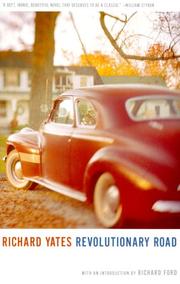
Revolutionary Road
2,085-word summary 9 min read 337 pages in the book
- First published
- 1961
- Publisher
- Vintage Books
- Pages
- 337
- ISBN
- 9780375708442
Reading options
What's inside (10 sections)
The first scene of Revolutionary Road is an amateur theatrical production, and it goes badly. April Wheeler is playing a woman in The Petrified Forest, and she is not good. She knows it. Her husband Frank knows it. The audience in the high school auditorium knows it, and the drive home afterward is a slow, polite disaster that turns into a fight on the side of the road. That fight is the whole novel in miniature: two people who believe they are exceptional, trapped in a performance that is not working, blaming each other for the silence in the room.
Richard Yates published the book in 1961, and it has the reputation of being one of the great American novels of the 1950s. It is a reputation I think it earns, though not for the reasons people usually give. It is not a novel about the suburbs being bad. It is a novel about two intelligent people who cannot bear to be ordinary, and who turn that fear into a war they conduct with good manners.
The Wheelers
Frank and April live in a white house on Revolutionary Hill Estates in Connecticut. They have two children, Jennifer and Michael, and a lawn Frank is trying to improve with a stone path. Frank works in the city at Knox Business Machines, a job he describes with elaborate contempt. April is a housewife who wanted to be an actress. They are both in their late twenties, both good-looking, both convinced that they were meant for something larger than what they have.
Their marriage runs on a shared story. They met in New York after the war, when April was working as a model and Frank was a veteran with vague ambitions. They had a good apartment, good parties, good conversations. Then April got pregnant, they moved to Connecticut, and the story became a compromise. Frank is not sure he minds the compromise. April is sure.
The novel is very precise about how that difference works. Frank needs to feel superior to his job, so he performs boredom while secretly wanting to succeed. April needs to believe her life was stolen from her, so she builds a plan to get it back. Neither of them can see the other clearly, because seeing the other clearly would mean admitting something about themselves.
Paris
April's plan is Paris. She will get a job as a secretary, and Frank will have the time and space to find out what he really wants to do. It is a good plan in the way that fantasies are good: specific enough to feel real, vague enough to hold any future. Frank agrees, and for a few weeks they are happy. They are nicer to each other. They are nicer to their children. The house feels possible again.
Yates lets the reader enjoy the plan too, which is what makes the rest of the book so painful. The Paris chapters are full of light. The Wheelers become the people they thought they were. They talk about books, about Europe, about the kind of life that does not involve commuter trains. Their neighbors are impressed and a little envious. It is a beautiful bubble, and you can feel it starting to leak.
Then April discovers she is pregnant again. Frank, who has been ambivalent all along, is secretly relieved. He does not say so. He starts to argue that the plan can wait, that the timing is bad, that they should be sensible. April hears the retreat and despises him for it. The pregnancy becomes the thing they cannot talk about, which means it becomes the thing that destroys them.
The affair
Frank begins an affair with Maureen Grube, a young woman at Knox. It is not a grand passion. It is a series of lunches and a hotel room and a lot of self-congratulation. Yates is merciless about the banality of it. Frank likes Maureen because she thinks he is important, and because the affair gives him a private life that April cannot touch. He tells himself he is a modern man. He is mostly a man who wants to be admired.
The affair also gives the novel one of its best comic sequences. Frank's office is a small ecosystem of typing pools and middle managers, and Yates writes it with the eye of someone who has been bored in an office. The scenes are funny and then sad, because you can see how easily Frank could disappear into that world and be happy. The tragedy is not that he is trapped. The tragedy is that he might not be.
April, meanwhile, starts an affair with Shep Campbell, the neighbor. Shep has been in love with her since the day they met. His wife, Milly, is Frank and April's closest friend, and the four of them have a friendship built on drinks and bridge and the unspoken agreement that nobody says the true thing. Shep's affair with April is brief and desperate. It is also, for Shep, the most important thing that has ever happened to him, which is its own kind of sadness.
The neighbors
The Campbells are the novel's other couple, and they exist to show what the Wheelers are not. Shep is a veteran who sells something or other and drinks too much. Milly is a housewife who wants to be liked. They have children, a house, a routine, and no illusions about being exceptional. Shep loves April from the moment he meets her, and his love is the closest thing to genuine feeling in the book. He sees her clearly, or thinks he does, and he is willing to risk his marriage for her.
Milly is treated more harshly than she deserves. She is silly and conventional, and the novel mostly uses her for comedy, but she is also the person who keeps the social world running. She organizes the dinners, remembers the birthdays, notices when someone is missing. When April dies, Milly turns the story into a party anecdote, and the novel judges her for it. It is a fair judgment, but it is not the whole story. Milly is surviving in the only way she knows.
The children, Jennifer and Michael, are almost invisible. That is deliberate. Frank and April are so absorbed in their own drama that they barely see them, and the novel's coldness toward the kids is a way of showing the cost. When Frank sends them to live with his brother after April's death, it is not a twist. It is the logical end of a household where the adults were always the real children.
John Givings
The novel's secret weapon is John Givings, the son of the Wheelers' real estate agent. John is a mathematician who has been in and out of mental institutions, and his mother brings him to the Wheelers' house for lunch because she thinks normal company will help. John is rude, brilliant, and completely without filters. He says the things the novel has been implying for two hundred pages.
He tells the Wheelers that their plan to move to Paris is a fantasy. He tells Frank that he is not as interesting as he thinks. He tells April that she is using the plan to punish her husband. He is not a reliable narrator or a wise fool exactly. He is a man whose illness has removed his social caution, and the effect is devastating. Everyone in the room is embarrassed, and everyone in the room knows he is right.
The Givings scenes are the best-written in the book. They are also the most theatrical. Yates came from a background in speechwriting and journalism, and he loved dialogue that crackles. John's speeches are a little too perfect, a little too much like a playwright's mouthpiece. But they land, and they give the novel a release valve that keeps it from becoming unbearable.
The end
The last hundred pages are a slow, controlled catastrophe. April decides to end the pregnancy herself. Frank, who has been trying to be the reasonable one, is horrified, and his horror is partly about the danger and partly about losing control of her. They have a final, terrible fight. April is calm in a way that frightens him. The next morning she is pleasant. She makes breakfast. She sends him to work.
The abortion goes wrong. Milly sees an ambulance. Shep drives Frank to the hospital, and April dies of blood loss. Frank's grief is not noble. He runs through the neighborhood at night, past the lit houses, and lets himself into his own dark home, where he can still feel her presence. It is one of the most desolate passages in American fiction.
The novel does not end there. Yates adds a coda set months later, after Frank has moved to the city, the children have gone to live with his brother in Pittsfield, and the house has been sold to a new couple. The coda is told mostly through Milly Campbell, who has turned April's death into a story she tells at parties. Shep listens and hates her for it, then goes outside and cries, then comes back in and is grateful that Milly is alive and loyal. The last chapter belongs to Helen Givings, who talks to her husband about the new neighbors while he ignores her. It is a cold, perfect ending. The suburbs close over the Wheelers and forget them.
What Yates does
Yates writes sentences that look plain and are not. He is a master of the small, revealing detail: the way Frank adjusts his hat, the way April lights a cigarette, the way a room feels after someone has said the wrong thing. His dialogue is sharp and often cruel. He is not a stylist in the ornamental sense, but he is in complete control of tone, and the tone of this book is a low, steady hum of dread.
He is also honest about money and work in a way that many novels of the period are not. Frank's job is not just a symbol of conformity. It is a real job with real tedium and real opportunities, and Frank's ambivalence about it is more interesting than simple rebellion would be. April's dependence on him is not romantic. It is economic, and the novel knows it.
The weakness is that Yates sometimes stacks the deck. John Givings exists to say the truth, and the neighbors exist to be smug, and the children are mostly absent, which lets the adults' self-absorption go unchallenged. April is vivid, but she is also a projection of Frank's fear and Yates's anger. The novel is harder on her than it needs to be, and softer on Frank than it admits.
Reading it now
Revolutionary Road is a book about a particular moment in American life, but its central anxiety is not dated. The fear of being ordinary, the belief that somewhere else would make you a better person, the way a couple can become a machine for confirming each other's worst suspicions: these are not 1950s problems. Yates wrote about them with a clarity that still stings.
It is not a comforting novel. It has no interest in teaching you how to live, and its ending offers no consolation beyond the fact that life goes on and people are mostly cowardly. But it is a great one. It takes two people who could have been happy and shows you, step by step, how they choose not to be. That is harder to do than it sounds, and Yates does it without a single false note.
The title is doing quiet work too. Revolutionary Road is the name of the development where the Wheelers live, and it is also a joke about the revolution they think they are making. They are not rebelling against anything. They are performing rebellion in a house with a mortgage, and the performance is what keeps them stuck. Yates never says this outright. He lets the address do it for him.
The novel has aged well because its subject is not really the 1950s. It is the fear that your life has already been decided, and that the person you married is the evidence. That fear is not historical. It is available to anyone, in any decade, who has ever looked at their kitchen table and wondered how they got there. Yates just found the clearest way to dramatize it.
FAQ
How does April die in Revolutionary Road?
She attempts to end her pregnancy herself at home, suffers severe blood loss, and dies in the hospital after an ambulance is called.
What is the point of the Paris plan?
It gives the Wheelers a way to believe their lives are not ordinary. April sees it as an escape and a chance for Frank to find himself, while Frank is drawn to the status it gives him.
Is Revolutionary Road a critique of the suburbs?
Partly. Yates described it as an indictment of 1950s conformity more broadly, and the novel is as hard on the Wheelers' self-regard as on their neighbors.
Similar books
The House of Mirth
Lily Bart, beautiful and penniless at twenty-nine, navigates New York's marriage market until a Dorset yacht scandal strips her of the only currency she has.
2,468-word summary · 11 min read
Ethan Frome
In snowy Starkfield, farmer Ethan Frome falls for his wife's young cousin Mattie, and one sled ride ends any hope of escape.
2,558-word summary · 11 min read
Madame Bovary
Emma Rouault marries Charles Bovary for romance, then seeks lovers and luxury until debts ruin them both.
2,400-word summary · 11 min read
The Great Gatsby
The Great Gatsby through Nick Carraway: Gatsby's parties, the green light, Daisy and Tom, and why Fitzgerald's 1925 novel ends as a judgment on the American…
2,501-word summary · 11 min read

Howards End
Forster's 1910 novel follows two families, a house in Hertfordshire, and a burned note, asking whether money and feeling can ever be connected.
2,187-word summary · 10 min read

Sophie's Choice
A young Southern writer in 1947 Brooklyn befriends a brilliant, unstable couple and slowly learns the story of the Polish Catholic woman at the center of their…
2,798-word summary · 12 min read
Naked Lunch
Burroughs's banned 1959 collage novel follows Bill Lee through addiction, Tangier, and the nightmare bureaucracy of the Interzone.
2,082-word summary · 9 min read
The Dharma Bums
Ray Smith rides freight trains, climbs Matterhorn Peak and argues about Zen with the poet Japhy Ryder in Kerouac's 1958 road novel.
2,729-word summary · 12 min read
We Were the Mulvaneys
After a rape following a school dance, the Mulvaneys, a family that believed it was blessed, comes apart over fifteen years. Narrated by the youngest son.
2,094-word summary · 9 min read
The Heart is a Lonely Hunter
A deaf man becomes the quiet center for lonely souls in a small Georgia mill town.
2,000-word summary · 9 min read
Lady Chatterley's Lover
A baronet's wife, starved in a marriage the war broke, takes the gamekeeper as her lover. Lawrence's banned 1928 novel of class and touch.
2,566-word summary · 11 min read
Tender Is the Night
Dick Diver marries his patient Nicole, and their Riviera marriage slowly breaks apart in Fitzgerald's 1934 novel of money, care, and drinking.
2,607-word summary · 12 min read
Middlemarch
Idealistic Dorothea marries dry scholar Casaubon while ambitious doctor Lydgate marries Rosamond, and a Midlands town watches both marriages strain.
2,883-word summary · 13 min read
Stoner
William Stoner trades farm life for literature, then endures a cold marriage and petty campus wars in John Williams's quiet classic.
2,282-word summary · 10 min read
The Virgin Suicides
Five Lisbon sisters die in 1970s Grosse Pointe as boys watch.
2,559-word summary · 11 min read
Anna Karenina
Anna leaves Karenin for Vronsky while Levin seeks faith and farming outside Moscow.
3,942-word summary · 18 min read
Wuthering Heights
Emily Bronte's Wuthering Heights retold: Heathcliff and Cathy on the moors, two houses, two generations.
2,056-word summary · 9 min read
Of Mice and Men
Steinbeck's Of Mice and Men retold: George and Lennie on a California ranch, the dream farm, and why mercy ends it.
2,237-word summary · 10 min read
To Kill a Mockingbird
To Kill a Mockingbird through the eyes of Scout Finch: Maycomb's slow days, Atticus's defense of Tom Robinson, the Boo Radley mystery, and what Lee's 1960…
2,308-word summary · 10 min read

The Crying of Lot 49
A California woman named executor of her ex-lover's estate follows a muted post horn into a possible centuries-old postal conspiracy, and Pynchon refuses to…
2,003-word summary · 9 min read
Silas Marner
A falsely accused weaver hoards gold in Raveloe until a stolen hoard and an abandoned child remake his narrow life.
2,699-word summary · 12 min read

Lisey's Story
Two years after her novelist husband dies, Lisey Landon follows a trail of clues into his childhood and the other world that made him a writer.
1,998-word summary · 9 min read

Less Than Zero
Clay returns to Los Angeles for Christmas and drifts through parties, drugs, and old friends, including one who is selling himself to survive.
1,926-word summary · 9 min read

James
Percival Everett retells Huckleberry Finn from Jim's side, giving him a library, a hidden school, and a voice the novel lets loose.
2,211-word summary · 10 min read

Fathers and Sons
Arkady brings the nihilist Bazarov home to his father's estate, and a generational argument turns into love, a duel, and an early death.
2,192-word summary · 10 min read

The Chosen
A shattered pair of glasses in a 1944 Brooklyn softball game starts a friendship between a Hasidic boy and his Orthodox neighbor, and their fathers pull them…
2,443-word summary · 11 min read
The Lottery
In Jackson's 1948 story, a village draws lots to keep the corn heavy, and the chosen person is stoned by her neighbors.
3,080-word summary · 14 min read
On Chesil Beach
Two newlyweds spend one terrible night on Chesil Beach in 1962, and the rest of their lives is decided by it.
2,456-word summary · 11 min read

Ivanhoe
A disinherited Saxon knight, a great tournament, a besieged castle and a trial by combat. Scott's most famous novel, set in England in 1194.
2,834-word summary · 13 min read

A Spool of Blue Thread
Four generations of the Whitshank family in Baltimore, and the silences, resentments and quiet love they hand down without ever saying so.
2,408-word summary · 11 min read