
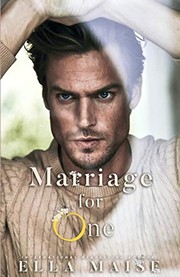
Marriage for One
2,032-word summary 9 min read 518 pages in the book
- First published
- 2019
- Publisher
- Independently published
- Pages
- 518
- ISBN
- 9781096681076
Reading options
What's inside (12 sections)
I have a weakness for marriage of convenience stories. The trope is ridiculous, and it works when the writer understands why it is ridiculous. Two people agree to pretend to be married, and then they spend four hundred pages failing to pretend. The pleasure is in the small betrayals of the arrangement: a hand held too long, a shared joke, a moment of jealousy that was not in the contract. Ella Maise understands this. Marriage for One is long, slow, and full of small betrayals.
Maise self-published the novel in 2019. The paperback runs 518 pages, and it is a standalone. It is set in New York, mostly in a coffee shop and a penthouse apartment, and it alternates between Rose Coleson's first-person narration and the slow reveal of Jack Hawthorne's motives. The book is not subtle. It is also very readable. I finished it in three days, which is fast for me, and I kept thinking about the coffee shop after I was done.
The will
Rose Coleson has spent years planning a coffee shop. She has the name, the menu, the staff, and the space. The space belongs to her uncle Gary, who raised her after her father died. Gary has always supported her dream. Then Gary and his wife die, and the will changes everything.
The will gives Rose the right to rent the space for two years. But if she marries, the building goes to her husband. The clause is bizarre, and the novel knows it. It is the kind of legal detail that exists to make the plot work, and Maise does not pretend otherwise. Rose's cousin Bryan is furious about the arrangement. Her cousin Jodi does not care. Rose's ex-fiancé, Joshua, has already dumped her by text, days after the funeral. She is alone, grieving, and about to lose the one thing she has been working toward.
Jack Hawthorne is the lawyer handling the estate. He is cold, composed, and almost impossibly handsome. He proposes a deal. He will marry Rose. She will get the coffee shop. He will get the building, and the appearance of being a settled family man, which will help his career. The arrangement is supposed to be temporary. It is supposed to be simple. It is neither.
The wedding
The wedding is a disaster. Rose cries in the car afterward, and Jack tells her that the marriage was a mistake. Then he leaves for London on a business trip. Rose assumes he wants a divorce. She does not move into his apartment. She goes back to the coffee shop and starts painting.
The early sections of the book are about two people who are married but not together. Jack sends money and instructions. Rose avoids him. Bryan shows up at the shop and harasses her. Jack appears, gets rid of Bryan, and helps her paint. Then he insists that she move into his apartment. The move is practical. It is also the first step in the real relationship.
The apartment is a classic romance setting: huge, cold, and waiting to be warmed up. Rose takes the guest room. Jack is distant. They have a late-night conversation on the terrace, and Rose learns about his strained relationship with his parents. He learns about her childhood. The scene is quiet, and it is one of the best in the book.
The coffee shop
Rose's coffee shop is called Around the Corner. Her employees are Sally and Owen. Sally is warm and nosy. Owen is a baker with a crush on Sally. The shop becomes the emotional center of the novel. It is where Rose is competent, where she is surrounded by people who like her, and where Jack gradually becomes a part of her life.
Jack comes by every evening to pick her up. He helps with furniture. He buys coffee for his office and refuses to let Rose give it away. He is trying to be useful without admitting that he wants to be there. Rose notices. She starts to look forward to his visits. She starts to miss him when he is not around.
The book takes its time with these small moments. That is both its strength and its weakness. The slow build is convincing. The pacing is also leisurely to the point of frustration. Readers who want a fast romance will find the first two hundred pages difficult.
Sally and Owen are more than comic relief. Sally is the friend who tells Rose the truth about her marriage, and Owen is the baker who makes the shop feel like a real workplace. Their relationship develops in the background, and it gives the novel a sense of a world beyond Rose and Jack. The coffee shop is not just a metaphor for Rose's independence. It is a small business with employees, customers, and a leaky ceiling. The details make the dream credible.
The dinner and the charity event
Jack asks Rose to accompany him to a dinner with his law partners and a client. Rose agrees. She has no idea what to wear, what to say, or how to be a wife. The dinner is awkward. Jack's ex, Samantha, is there, and she is rude to Rose. Jack tries to protect Rose without making a scene. The evening ends with them inventing a story about how they met.
The charity event is more important. Jack takes Rose to a fundraiser for foster children. Rose grew up in her uncle's house, and she knows what it feels like to be a child who is tolerated rather than loved. She befriends two children, Maddy and Sierra. Jack watches her with them, and something shifts. He sees her kindness, and he sees her pain.
Joshua is at the event with Jodi. Rose insists on staying. Jack kisses her in front of them, and Rose thinks it is for show. It might be. It might not be. The ambiguity is the point.
The health crisis
Rose has been having headaches and dizzy spells. She falls in Central Park. Jack carries her to work and insists that she see a doctor. The diagnosis is a cerebrospinal fluid leak. She needs surgery. The weeks before the surgery are filled with tests, fear, and Jack's quiet, stubborn care.
He stays with her during the MRI because she is claustrophobic. He cooks for her the night before the surgery. He waits at the hospital. He arranges for her to recover in his apartment. The health crisis is the point where the fake marriage becomes real, at least for Rose. She realizes that Jack is not just fulfilling a contract. He is terrified of losing her.
The surgery is successful, but the recovery is slow. Rose has to rest. She has to avoid stress. She has to let people take care of her, which is hard for her. Jack is there. He is still not good with words, but he is good with actions. The book is careful to show that care is not the same as love. It is a foundation. Love has to be built on top of it.
The betrayal
Joshua shows up at the coffee shop and tells Rose that Jack paid him to break up with her. The revelation is designed to destroy the relationship. Rose confronts Jack. He admits it. He says that Joshua was a con artist who had stolen money from vulnerable women. Jack paid him to leave Rose alone. He also paid Bryan to stop harassing her.
Rose is devastated. She is not upset that Jack protected her. She is upset that he lied about it. The marriage began with a contract, and the contract was always based on a lie. She moves out. Jack sends divorce papers. She refuses to sign.
The separation is the strongest section of the book. Rose has to decide whether she can trust Jack again. Jack has to decide whether he can be honest with her. The two of them are not good at talking. They are good at grand gestures, and the book knows it. The grand gestures are not enough. They have to learn to use words.
Jack's assistant, Cynthia, is a small but important character. She sees how Jack behaves when Rose is not around. She pushes him to tell the truth. She is not a plot device. She is a person who cares about her boss and is tired of watching him suffer in silence. Her presence makes Jack more human. It also makes the lie more complicated, because Cynthia has been part of it.
The reconciliation
Rose bakes an apple pie in Jack's kitchen and tells him that they are not getting divorced. She wants to move forward, not start over. Jack finally tells her the truth. He saw her at a Christmas party years earlier. He noticed her before she noticed him. He paid Joshua to leave her because he wanted to protect her, and because he wanted a chance to know her. The marriage was not just a business deal. It was a way to get close to her.
The confession is romantic and a little creepy. Jack's decision to manipulate Rose's life without her knowledge is not easily forgiven. The book acknowledges this, but it also lets Rose choose him. She decides that his intentions, while flawed, were not malicious. She decides that she wants to be with him. The ending is happy, and it is earned, but it is not uncomplicated.
The epilogue takes place a month later. Jack comes to the coffee shop to discuss their five-year plan. He makes a speech about how much he loves Rose and how he intends to be whoever she needs. It is a sweet ending, and it fits the book's tone.
What works
The best thing about Marriage for One is the slow accumulation of detail. Jack's gestures are small: picking Rose up, helping her paint, remembering how she takes her coffee. The book does not rely on a single grand declaration. It relies on a pattern. By the time Jack says he loves Rose, the reader believes it because the evidence has been piling up for hundreds of pages.
Rose is also a good narrator. She is funny, stubborn, and vulnerable. She does not lose her personality when she falls in love. She keeps her friends, her business, and her ambition. The book is as much about her building a life as it is about her finding a partner.
The novel is also good at the fantasy of being cared for. Rose has spent her life taking care of herself. Jack's quiet attention, the driver, the apartment, the way he insists on picking her up, is a fantasy of safety. The book knows that the fantasy is not the same as a healthy relationship, and it makes Jack earn his place by telling the truth. The truth is messy, but it is better than the arrangement.
Where it creaks
The book is too long. The middle section could be shortened by a hundred pages. The health crisis is emotionally effective, but it also feels like a plot device. The conflict with Joshua is resolved too easily. The epilogue is pure wish fulfillment.
The biggest issue is Jack's behavior. He lies to Rose, manipulates her ex, and pays off her cousin. The book frames these actions as protective, but they are also controlling. Rose forgives him because she loves him, and the book does not push her to ask harder questions. Readers who are uncomfortable with the ethics of the arrangement will stay uncomfortable.
Why it works anyway
Marriage for One works because it is honest about the fantasy. It knows that the marriage of convenience is a story about being chosen, and it gives Rose a man who chooses her in every small way. It also gives her a life of her own. The coffee shop is not a backdrop. It is a dream, and the book treats it with respect.
I enjoyed it. I rolled my eyes at it. I kept reading. That is the contract of a romance novel, and Maise fulfills it.
FAQ
Is Marriage for One a standalone?
Yes. It is a standalone romance, though Ella Maise has other books set in the same world.
What is the trope?
It is a marriage of convenience between Rose Coleson and Jack Hawthorne, who agree to marry so Rose can keep her uncle's building.
Does it have a happy ending?
Yes. Rose and Jack reconcile, and the epilogue shows them building a life together.
Similar books
Two by Two
Sparks's twentieth novel turns from first love to a marriage breaking up: Russell Green loses his wife and his job, then rebuilds his life around his…
2,192-word summary · 10 min read
One to Watch
A plus-size fashion blogger takes the lead role on a reality dating show to prove she belongs on television, and finds she might want what the cameras offer.
2,478-word summary · 11 min read

At First Sight
Jeremy and Lexie are married and expecting a baby when anonymous emails tell him the child may not be his.
2,317-word summary · 10 min read

2 States: The Story of My Marriage
A Punjabi boy from Delhi and a Tamil Brahmin girl from Chennai meet at IIM Ahmedabad, and turn a love marriage into a campaign to convince two families.
2,634-word summary · 12 min read
True Colors
Three Grey sisters split over love and duty after their father judges them.
2,596-word summary · 12 min read
The Marriage Bargain
A bookstore owner marries a billionaire friend's brother for a year to save home and company.
2,092-word summary · 9 min read
The Identicals
Twin sisters swap Nantucket and Martha Vineyard lives for a summer.
2,556-word summary · 11 min read
The Bookish Life of Nina Hill
Bookstore Nina gains a family and pub-quiz love in Los Angeles.
2,399-word summary · 11 min read
The Coincidence of Callie & Kayden
Callie saved Kayden in an alley and meets him again in college, where both must face assault and abuse to learn trust.
2,578-word summary · 11 min read
Love Redesigned
Rival designers Dahlia and Julian restore a Lake Wisteria Victorian while facing grief, family pressure, and old sparks.
2,248-word summary · 10 min read
Hello Stranger
Portrait artist Sadie loses face recognition after brain surgery and must finish a contest piece while falling for two men.
2,210-word summary · 10 min read
Heart of the Matter
Two Boston mothers collide after a burn injury puts a single mom in the orbit of another woman's surgeon husband.
2,585-word summary · 11 min read
Before We Were Strangers
Matt waits fifteen years to ask Grace why she left after one college night that shaped them both.
2,386-word summary · 11 min read
The Rosie Effect
Married in New York, Don Tillman turns Rosie's pregnancy into research and nearly loses her, until a crisis forces him to listen.
2,869-word summary · 13 min read
The Wedding
Wilson Lewis courts his own wife again with Noah's help as daughter Anna plans her wedding.
2,076-word summary · 9 min read
Landline
A TV writer left alone at Christmas finds her mom's old phone reaches her husband in 1998, before they married.
3,042-word summary · 14 min read
Freedom
A St. Paul couple and their grown children strain marriage, loyalty, and ideals in 2000s America.
2,678-word summary · 12 min read
King of Greed
Billionaire Dominic fights to win back Alessandra after work obsession breaks their ten year marriage.
2,548-word summary · 11 min read
Someone Else's Shoes
A rich wife loses everything and a tired mom gains red heels when gym bags swap in London.
1,951-word summary · 9 min read
The Pact
After Emily Gold dies from a gunshot, her boyfriend Chris Harte says it was a suicide pact and faces trial for murder.
2,873-word summary · 13 min read
Fifty Shades Freed
Married Ana and Christian face Hyde, Elena and a pregnancy neither planned.
3,213-word summary · 14 min read
To Love Jason Thorn
Childhood friends Olive and Jason reunite when the Hollywood star returns home, fake a romance for the cameras, and face old family wounds before trust turns…
2,506-word summary · 11 min read

What Happened to Goodbye
Mclean has reinvented herself in four towns since her parents divorced. In Lakeview she uses her real name, and for the first time staying put becomes a choice.
2,796-word summary · 12 min read

Size 12 Is Not Fat
Former teen pop star Heather Wells investigates two dorm elevator deaths while juggling her ex, her crush, and a size-12 wardrobe.
2,805-word summary · 12 min read
Austenland
A New York graphic designer obsessed with Mr. Darcy inherits a trip to a Jane Austen theme park, where the fantasy of Regency romance collides with the men…
2,030-word summary · 9 min read
Alone With You in the Ether
Two people in Chicago agree to six conversations, and the experiment becomes a love affair that is also a study of bipolar disorder, obsession, and the shape…
2,713-word summary · 12 min read

Little Earthquakes
Four Philadelphia women meet during pregnancy and discover that new motherhood is nothing like the plan, while friendship becomes the thing that holds them…
1,997-word summary · 9 min read

Dumplin'
Willowdean Dickson enters her town's beauty pageant as a protest and discovers that confidence is harder to keep once she lets someone close.
1,922-word summary · 9 min read
Lick
Evelyn wakes up married to the lead guitarist of Stage Dive after a Las Vegas birthday she cannot remember, and the annulment gets complicated.
1,989-word summary · 9 min read
The Bookshop on the Corner
A Birmingham librarian loses her job, buys a van, and moves to the Scottish Highlands to run a mobile bookshop. Warm and bookish, with uneven pacing.
2,557-word summary · 11 min read