
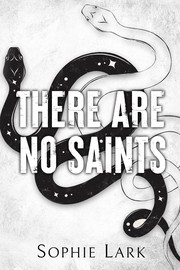
There Are No Saints
2,190-word summary 10 min read 360 pages in the book
- First published
- 2021
- Publisher
- Lark Publishing LLC
- Pages
- 360
- ISBN
- 9781958931028
- Series
- Sinners (#1)
Reading options
What's inside (10 sections)
I picked this up expecting the usual Lark setup, mafia families and a marriage arranged to stop a war, because that is where her Brutal Birthright books left me. This one goes somewhere else entirely: the San Francisco art scene, two rival artists, and a woman who paints for a living and cannot afford much of anything.
Sophie Lark self-published it in 2021. The edition I read is the illustrated paperback, 360 pages, issued by Lark Publishing LLC in October 2022. Bloom Books, the imprint behind Brutal Birthright, brought out a new trade paperback in 2023. It is book one of the Sinners duet, and the second half of the story is called There Is No Devil.
The label on the jacket is dark romance, which is accurate and undersells the rest. This is a serial killer romance, which means the man the heroine ends up with has murdered before and hid the evidence inside a sculpture.
The showcase and the sculpture
The book opens with Cole Blackwell reading about a girl found in the ruins of the old Sutro Baths on Ocean Beach. He knows the killer on sight. It is Alastor Shaw, his rival, and Cole is not remotely surprised, because the two of them are predators who happen to share a scene.
Then the story moves to a gallery showcase. Cole is the hot sculptor in San Francisco, rich, admired, working alone in a former chocolate factory on the sea cliffs above the city. Shaw is a loud, self-promoting painter with a cult following and a taste for ruining young women.
At the party, a curator named Jack Brisk spills merlot down the front of a stranger's white shift dress. The stranger is Mara Eldritch, broke, too thin, with a botanical tattoo running down one collarbone and smoked gouda in her hand. She does not cry and she does not apologize. She walks into the bathroom, ties the whole dress with the wine in burgundy, magenta and mulberry layers, and comes back out wearing the stain as the best work in the room.
Cole notices the craft. Shaw notices the girl. That misalignment drives most of the book.
He works alone in the studio with his own welding, gilding and cutting equipment, starting at ten in the morning and stopping at dinner, and he keeps no assistants. That solitary craft is the book's best argument for why he gets away with what he does: the work is genuinely excellent, and the art world rewards it.
The judges give the prize to Shaw, largely because Carl Danvers, a bitter critic nursing a grudge from a joke at a gala eight years back, will not give Cole anything. Danvers publishes a review praising Shaw's abandon and calling Cole's technique cold. Cole's answer is a garrote in his studio and a sculpture he calls Fragile Ego.
The bones are filed down, dipped in gold and mounted in an entirely new arrangement. It sells for 750,000 dollars to a newly minted tech billionaire. Shaw recognizes the material, of course, because Shaw knows what his rival is. The two of them share a moment of professional respect, and then Cole explains why he wins: it is because Shaw lacks discipline.
Cole's interior voice is the coldest thing in the novel. He reports no empathy and no guilt, only rage, revulsion and pleasure, and he compares killing to the feeling of making art. He does not hunt women, he says, because it would be too easy. That line does a lot of work, because it is the difference between him and Shaw. Shaw wants. Cole decides.
Mara and what she survived
Mara's chapters run at a different temperature. She shares a decaying Victorian with a few roommates, the important ones being Erin, her closest friend, and Joanna. She works several jobs and runs from one to the next, always late, and painting is the thing she actually does. Money is what stands between her and a studio of her own.
Shaw attacked her in the street after the showcase. Bound, gagged, put in the trunk of a car, cut and left in the woods to die. Cole found her that night, near where he had disposed of a body, and walked away. Shaw wanted him to. It was a message about who owns the territory.
Mara survived. She woke in a hospital where staff and police looked at the wounds on her wrists and decided that a woman does not cut herself that way without wanting to. Nobody believed her account.
Her childhood runs underneath everything. An alcoholic mother, a stepfather who hurt her, and art built as the alternative to a self she could not trust. Her flinch at certain words, her tolerance of being watched, her reflex to apologize for existing, all come from there.
Her days are a chain of service work. Waiting tables, cleaning up after other people's dogs, running between jobs with never enough minutes in the day. Cole watches that routine through a telescope and calls her existence tawdry and depressing, which is the most accurate description of how the arrangement is designed to feel.
A courtship built on surveillance
Here is where the book gets genuinely uncomfortable, and where my opinion of it started to split.
Cole does not let Mara go. He breaks into her room, rents the house directly behind hers for a month at eight hundred dollars a night, cuts a hole in his library window, blacks it over with paper and watches her balcony through a telescope. He arranges the discounted studio space she needs, in a building he owns. He gets her shortlisted for a grant. He enters her work in the New Voices show. Every step of her career is a step he planned.
The justification is that he is saving her from Shaw. The effect is that he has built a cage out of favors and called it a mentorship.
The confrontation comes at the panel visit to the studio. Mara recognizes him as the man in the woods. She accuses him of walking away while she was bleeding. Cole admits it, warns her that nobody will believe her, and talks her into the studio space anyway. That is the hinge of the book, and Cole is not redeemed by it. He is honest about what he did, which is worse.
There is real craft in the softer scenes too. He critiques her paintings with an artist's eye, sometimes accurately and sometimes to establish that he owns the conversation. He knows her schedule better than she does. Lark is good on those minutes, where two people are alone with a canvas and something else.
Jealousy, paint and a camera
The jealousy plot is where the book finds its engine. An art dealer named Simon Grundy interrupts them at the worst possible moment, and Cole responds by suggesting that Mara should be sharing herself with other men. She takes revenge by having sex with Logan, a friend with a tattoo gun, in her studio, with the security camera running, knowing Cole is watching through it. Then she hangs the painting from that session in his office.
Cole destroys a glass sculpture he loves. He corners Logan and takes his tattoo gun. The two of them end up tattooing each other, Mara inking two entwined snakes on his back while he covers her earlier snake with his own. It is absurd, it is hot, and it works as a scene.
Then Shaw turns up. At an Artists Guild party in Halloween costumes, Shaw sees Mara alive and cannot stop staring. Cole starts watching him, follows him to a building where a murdered woman has been staged, and narrowly avoids being framed for it. He decides to kill Mara to protect himself. Mara, meanwhile, has worked out that Shaw was her attacker all along.
The scene where she asks to go to his studio instead of his house is the most disturbing part of the novel and also the most interesting. She asks to be tied down. He does it. Her old fear of being controlled gets turned inside out, and she comes out of it on her own terms. Afterward he bathes her, feeds her, watches a movie with her. The whole book sits inside that scene: something that should read as horror turns into the first time she feels she is allowed to want something.
What the book is arguing
The argument underneath is about who gets to hold the leash. Cole's whole identity is control, and he says so out loud: whatever he does, he is always in control. Mara's whole identity is a person who has never been allowed to hold anything, including her own body. The romance works because it is a contest over that, and because Lark keeps the negotiation in plain dialogue rather than hiding it behind implication.
The serial killer plot is a thinner thread than the relationship, and it is where the book loses me. The Danvers murder gets almost no investigation. Shaw's killings stay opaque. The police, in the person of a homicide detective named Hawks, are skeptical and slow, and Mara cannot prove anything. Hawks even leans on the fact that the victims are artists, which is a cheap shot the book lets stand.
The ending is not an ending. Shaw is still out there. Erin's body is found in Mara's bed, drowned and arranged like the Ophelia in the Millais painting, and Mara identifies the pose for Hawks while he doubts her. Cole offers his house as protection, and Mara takes it, telling herself she has no choice.
What the work is worth
Art is how both of them talk, and the novel keeps returning to what a painting is worth to the person who makes it.
Mara's work is honest and unglamorous. She paints from her own life, and the piece that gets her noticed at the New Voices show is a life-size self-portrait. Cole's work is the opposite, technically immaculate and built out of another person's remains. He looks at a wall of his own pieces and thinks about price rather than meaning, and Lark writes that vanity with pleasure instead of as a warning.
The trouble starts when the two practices meet. Cole owns the building her studio sits in, chooses the show she enters, and is standing at the judging panel before she arrives. Every early win in her career is also his design. Mara can paint, and she can also see the pattern, which is why she turns angry instead of grateful.
His answer, when she accuses him of leaving her in the woods, is that nobody will believe her. He is right about the world, and he is the reason the world has no reason to believe her, and the book lets that sit there without tidying it.
What works and what drags
What works is the art world. Lark clearly knows how galleries behave: who curates, who reviews, who brokers, and how a prize is really decided. The wine dress, the gold bones, the sale of Fragile Ego, the Halloween party, the judging panel: this is the part of the book I still remember.
What drags is Cole. A character who stalks, garrotes and dismembers people, then bathes them and makes dinner, does not become safe through attention. The book wants him forgiven by Mara, and she does it, and the reader is left holding a disagreement the story treats as settled. The scene with the ropes works because Mara drives it. Take her consent away and the same scene says something entirely different.
The prose is tight, the chapters are short, the sex is explicit, and the violence is real. It is not a book for readers who want a hero, and the cover art does not help, because a jacket with a dangerous man on it does not tell you that the dangerous man is the villain of the story as often as he is the love interest.
Lark says in her note at the front that she wrote the book as therapy after struggling with her own mental health, and she ships an official soundtrack with it. Both feel like part of the text rather than decoration, because the book runs on music and on the pull of an old wound.
Who should read it
Give it to readers who like dark romance where the hero is genuinely dangerous, or to anyone curious about how a murder story written as a love story can hold together. Skip it if you need the man to be safe, if graphic violence or explicit scenes are a limit, or if you want the case closed by the last page.
Three hundred sixty pages of art world detail, one long scene of careful and heavy sex, and a sequel that starts where this stops. There Is No Devil continues directly from the arrangement Mara makes at the end of this one. I finished it in two sittings and wanted the second book immediately.
FAQ
When was There Are No Saints published?
Lark self-published it in 2021. The illustrated paperback from Lark Publishing LLC, dated October 2022, runs 360 pages.
Is it part of a series?
Yes. It is book one of the Sinners duet, and There Is No Devil continues the story from where this one stops.
Is it suitable for teens?
No. It is adult dark romance with explicit scenes, graphic violence and murder, for mature readers only.
Similar books
More from Sinners first, then related titles.
The Predator
Coder Morana Vitalio and mob enforcer Tristan Caine chase stolen software while a case of missing girls from twenty years back catches up with them both.
2,296-word summary · 10 min read
Brutal Prince
Aida's small fire forces a marriage to Callum Griffin to stop a Chicago mob war neither wants.
2,042-word summary · 9 min read
My Dark Romeo
A debutante ball kiss traps Dallas Townsend in a marriage to Romeo Costa, a man who wants her as leverage in a war against his father and her fiance.
2,530-word summary · 11 min read
The Casanova
Kate Landon's boss is also the pen pal she falls for online, hiding behind fake names, until family secrets and a trip to Paris get in the way.
2,274-word summary · 10 min read

Indigo Ridge
A new police chief in a Montana town meets the founding family's eldest son in a bar, and one night later a body turns up under their cliff.
2,763-word summary · 12 min read

The Kiss Thief
Promised to one man, taken by another, Francesca must choose in Chicago.
2,545-word summary · 11 min read
The Finish Line
Tobias King seeks forgiveness from Cecelia as the Ravenhood past closes in.
2,868-word summary · 13 min read

The Maddest Obsession
Sharp-tongued Gianna spars with secretive Christian Allister in this 2019 Made #2 mafia romance, where teasing hides danger and lies.
3,903-word summary · 17 min read
Corrupt
College student Rika Fane faces Michael Crist and his friends three years after Devil's Night put them in prison.
2,870-word summary · 13 min read

Her Soul to Take
A paranormal vlogger in a cult-run town summons a bound demon, and the only way to survive the god beneath the mine is to give him her soul.
2,089-word summary · 9 min read
The Ex Talk
Two rival public radio producers pretend to be exes for a dating show, then fall for each other while the lie grows.
2,389-word summary · 11 min read
Nightfall
Emory Scott wakes in Blackchurch, a remote house for the sons of the powerful, where the boy she once loved is imprisoned and the story she told about him…
2,339-word summary · 10 min read
Beneath This Man
Ava returns to Jesse after five days apart and finds his drinking, jealousy, and a hidden deception that changes what she can forgive.
2,341-word summary · 10 min read
Lover Unleashed
Paralyzed vampire warrior Payne and surgeon Manny Manello collide in an adult paranormal romance, as Xcor's Band of Bastards arrives in Caldwell for revenge.
2,374-word summary · 11 min read
Beautiful Stranger
After a betrayal, Sara Dillon moves to New York and starts a no-strings affair with a British stranger, only to find that control and intimacy are harder to…
2,015-word summary · 9 min read
Savage Bonds
Oli's deadly gift is out in the open, her Bond runs the show, and the Resistance is closer than ever in the second Bonds that Tie novel.
2,431-word summary · 11 min read
Wretched
The Wicked Witch of the West becomes a heroin chemist, and the DEA agent sent to destroy her family falls for the very woman he was assigned to ruin.
2,117-word summary · 9 min read

The Sinner
Sin, a Lord at Barrington, rigs his secret society's rules to claim Elli, the girl he has protected since killing her abuser, while the conspiracy around her…
2,059-word summary · 9 min read
Pestilence
Firefighter Sara Burns shoots the Horseman Pestilence and discovers he cannot die. Taken captive, she rides with him as his plague sweeps the world.
2,508-word summary · 11 min read

Pen Pal
A grieving widow receives letters from a man in prison who signs himself Dante, and the haunting in her house turns out to be the story of her own death.
2,066-word summary · 9 min read

Broken Prince
Reed loses Ella and ruins his name while rivals circle him.
2,356-word summary · 10 min read
Bound by Honor
An arranged mafia marriage between a Chicago girl and a New York heir turns to love.
2,586-word summary · 11 min read

The Darkest Temptation
Sheltered Mila flies to Moscow and falls for captor Ronan, a Russian enforcer seeking revenge.
2,023-word summary · 9 min read
My Killer Vacation
A teacher and a bounty hunter share a Cape Cod rental with a corpse and a growing attraction.
2,625-word summary · 12 min read
Kill Switch
Out of prison, Damon moves into Winter's house with keys and a plan, and old lies about that night crack open.
2,732-word summary · 12 min read
God of Malice
Rina Kent's God of Malice fully retold: Glyndon King, Killian Carson's fixation, secret societies, and the Devlin twist that resets everything.
2,849-word summary · 13 min read

Below Zero
Stranded at an Arctic station, NASA engineer Hannah is rescued by rival Ian, and a storm forces them to face old grudges and attraction.
2,555-word summary · 11 min read
Still Beating
Chained in a killer's basement, lifelong enemies Cora and Dean must rely on each other to survive, then face what survival cost.
2,880-word summary · 13 min read
Kulti
Pro soccer player Sal Casillas gets childhood idol Reiner Kulti as assistant coach, and a tense season turns into slow friendship.
2,544-word summary · 11 min read
Hideaway
Ex-con Kai hunts a hotel secret while Banks hides who she really is.
2,481-word summary · 11 min read