
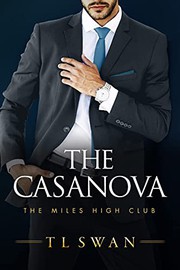
The Casanova
2,274-word summary 10 min read 512 pages in the book
- First published
- 2021
- Publisher
- Montlake
- Pages
- 512
- ISBN
- 9781542028073
- Series
- Miles High Club (#3)
Reading options
What's inside (10 sections)
The pitch sold me before the first page did. A woman joins a dating app under a fake name, starts a warm friendship with a stranger called Edgar, and only later discovers that Edgar is the boss she has spent seven years wanting to throttle. That is the engine of The Casanova, the third book in T. L. Swan's Miles High Club series, published by Montlake in a 512-page paperback in August 2021. I picked it up expecting a series instalment I would read for the brothers and the heat, the way I read The Stopover and The Takeover before it. What I got had more moving parts than that, including a third-act break that split readers down the middle.
Seven years of bad blood
Kate Landon runs the IT department at Miles Media's London office. Elliot Miles runs that office, and for most of the London and German operations besides. They have hated each other for roughly seven years, and the book opens with the two of them trading insults like people who have rehearsed it. Kate is IT manager and his mood is her weather. He asks for something unreasonable, she tells him exactly why it will not work, and both of them enjoy it more than they should.
Swan is good at this sparring, and it carries more weight here than it did in The Takeover, because Kate is not a pushover who eventually softens. She is a person with a reason for the wall she built.
Her parents died in a car accident. Kate handled it by going flat: no new relationships, no big feelings, sarcasm as body armour. Her flatmate Daniel, a fashion graduate with too many opinions, and her friend Rebecca decide she is a project. They build her a dating app profile under the name Pinkie Leroo, and Kate sabotages it on purpose, adding an ugly photo of a cat and a riddle, confident nobody will bother.
Somebody answers the riddle. His profile lists him as a garbologist who is also, in his own words, a professional fondler of something he will not name, and he is funny, and Kate is charmed. His username is Edgar Moffatt, and he lives on the other side of the world, which is the part that matters. Edgar is safe in a way a colleague could never be.
The night he watched the security cameras
Elliot is the head of the London office, and the chapter that turns him is embarrassingly small. Late at night, checking feeds for his brothers, he catches Kate dancing in a short red dress in front of a copy machine. That is all. A man on a screen, moving badly and happily, and something in him notices.
What he does with the noticing is the point of the book. Elliot has a reputation to protect. The tabloids have nicknamed him a Casanova, and he plays the part, dating women who want the money and the photographs. He also has a rule: no real relationships. Every girlfriend he has had has been ground down by cameras, by readers, by strangers who decided her life was public property. So he tells himself the women who stay are the ones who want the version of him that comes with press coverage.
The art collecting matters here, because it is the other obsession that shapes his choices. He owns twenty-seven of the thirty publicly known paintings by a reclusive artist nobody has identified, and he has paid a private investigator to find her. He refers to her as Harriet Boucher. He believes he will know his one true love on sight, that she will be extraordinary in a way he can feel before he can explain, and for years the hunt has been the shape of his loneliness.
Kate does not know any of this. She knows a man on a screen who is honest with her, and being honest with a stranger is the first thing Elliot has done for anyone in years.
Two usernames, one person
The cleverest thing Swan does here is let the reader watch information move in one direction. Kate learns that Edgar is Elliot and chooses to keep it. Elliot never learns that Pinkie is Kate, and he is therefore more honest with her than he has been with anyone, and Kate gets to see the inside of a man she is still pretending to despise.
That asymmetry is where the real intimacy lives. Office scenes are all surfaces: sarcasm, status, the endless small war over who gets to decide. The messaging scenes are where Elliot explains why he will not commit, why the press ruins everything, why he thinks he only wants Kate for her body. Kate reads the answers and cannot correct him, because correcting him means revealing herself.
Work gets stranger as he pays attention. He visits her office for the first time in seven years. He asks her to use his first name. Daniel styles Kate for a charity gala and she walks into the room in gold, and Elliot cannot take his eyes off her for the whole night. They kiss in a nightclub and she leaves him standing there, and the scene is played as comedy, which is how Kate uses it to stay in control.
The vulnerability that finally exposes him arrives sideways. Kate has endometriosis, and one day the pain is bad enough that she takes painkillers at the office and passes out on the floor. Elliot sees her on a monitor, drives her home, and stays until Daniel arrives. Later, as Edgar, he tells Pinkie about a coworker he has found unconscious and admits that he has a bit of a crush on her. He names her. Kate, reading the message in her own flat, understands that the man she is talking to is the man carrying her home.
An arrangement, and then the trouble
Elliot proposes a no-strings arrangement, which is exactly the kind of offer a man makes when he wants something and has decided not to want it. Kate says no more than once. She has learned that wanting people is how you end up grieving them, and her parents are the reason she knows it. But he is persuasive, and being wanted by a man who could have anyone is its own kind of argument.
The rules change on Christmas night, when he comes to her flat and explains the paparazzi situation for real. If they do this, they do it exclusively. Kate asks him to take it slowly, and he agrees, and the agreement holds.
What follows is the warmest stretch of the book. Elliot comes back early from New York for her. They have a first date, and then a week in the Canary Islands where nobody knows them, and Kate discovers something about herself she had not expected, which is that she likes being told what to do, and that what she has been missing in other relationships is a man who takes charge.
Then he buys her the ice cream her father used to bring her on special occasions, and Kate cries in front of him for the first time about her parents, and she understands that she is in love with him and that this is a terrible idea, because he is a man who runs from attachment.
The cold stretch, the estate, and the letters
Back in London, Elliot retreats. He is frightened by how much he feels, so he becomes the version of himself that works: cold, dismissive, unreachable. A tabloid photograph of him with another woman appears, and Kate reads it as proof of everything she already suspected. The reader knows it is a smokescreen, and Kate does not, and the frustration of that gap is the book's best tension.
The letters fix it. As Edgar, he confides to Pinkie that he pushed Kate away out of fear, and Kate reads those messages and feels hope come back. Two people carrying the same conversation in different directions, neither able to say the useful thing out loud.
There is a stretch of pure pleasure in the middle: the reconciliation, the art auction where they finally talk properly, and the country estate he has bought, called Enchanted, which comes with aggressive ducks, a goat named Billy, and a ram named Humphrey with opinions about visitors. Elliot arranges for female goats to arrive so that Billy can choose a mate, and Kate reads the gesture for what it is, a man who has more tenderness in him than his reputation allows. In New York for his birthday, his family walks in on them, and his mother Elizabeth takes Kate to lunch and tells her she is the first woman her son has ever brought home. Kate gives him a framed photograph with I love you, always, Kate, written on the back.
The Paris break and what it costs
Then the investigator calls. The artist is a young woman, and a meeting is arranged in France, and Elliot faces a choice that will be discussed in review threads for years. He loves Kate. He has also spent years believing the artist was his destiny.
Kate, who cannot reveal herself, advises him as Pinkie to follow his heart, which is the cruellest thing she does in the entire book, because she means it as encouragement and he takes it as permission to leave. They have a tender night first. Then he goes to France.
He meets the artist and feels nothing at all.
Kate, in the meantime, has resigned and flown to Oahu. She waitresses in Hawaii, does yoga, and starts painting again for the first time since she was a teenager. The letters keep coming, addressed to Pinkie Leroo, signed by Edgar Moffatt, garbologist extraordinaire of the Enchanted Kingdom, each one in a red envelope with a small bottle of his aftershave tucked inside. Kate reads every one and answers none of them, which is the correct response and also heartbreaking.
The last piece falls into place when Elliot visits Kate's brother Brad and recognizes Kate's sister Elanor in a family photograph as the woman he met in France. The paintings he has been chasing were Kate's own teenage work. Elanor had been selling them under the name Harriet Boucher, and when their parents died she cleared out the family house, donated almost everything, and destroyed the evidence of her own fraud. She had been trading on her sister's talent for years, and she was not in love with Elliot at all.
He understands that the pull he felt for the artist was never mystery. It was Kate.
What works, and what annoys
The trick of the two usernames is the best idea in the book, and Swan executes it well. The reader knows everything, Kate knows almost everything, and Elliot knows nothing, so the tension comes from watching a man be honest with a stranger while the woman he is honest with reads every word and cannot answer. The banter is sharp and fast, the workplace friction is real rather than decorative, and the family scenes keep the wider world alive.
The criticism has to start with length and repetition. Five hundred and twelve pages is a long way to travel from hostility to a wedding, and the book loops. Push, pull, near miss, wrong conclusion, repeated about three times before the plot finally moves. The letter sequence is the most graceful of these detours. The others are reheatings.
The Paris break is the other real argument. Elliot leaves for France to meet a painter he has never met, on the strength of a private investigator, while the woman he loves waits in London. Swan writes it as tragic obsession, and some readers will read it as a betrayal that no amount of grovelling repairs. Kate's own advice sends him there, which helps, and it does not help enough. The reconciliation is thorough, with a long grovel, a trip to Hawaii and a proposal, and it lands for me because the grovel includes real changes rather than jewellery, but I can see the case against it.
There is also a familiar trope doing quiet work: the woman who has been emotionally closed off since a trauma, and the man who teaches her to feel again. Kate's parents are handled with restraint, not sentimentality, and her endometriosis is treated as a medical fact that occasionally takes her out of the action. The therapy talk, such as it is, stays in the subtext of behavior.
The final section lands the ending on a joke, which tells you how well Swan knows her audience. The wedding happens at Enchanted with fifty guests, and the reception is disrupted by the rampage of a ram.
Who should read it
If you want a romance about two people who cannot stop arguing and cannot stop wanting each other, with explicit scenes and a working happy ending, this delivers. If you want the third brother after the first two, it does that too, with Christopher waiting in the next book of the series, The Do-Over.
If you want a plot that never doubles back, or a hero whose single mistake does not cost him a third of the book, look elsewhere. Swan writes the middle of this one on repeat and makes you earn the ending, but she also makes you care enough to want it, which is the harder trick. Kate carries more of the book than Elliot does, and she is the one I would remember if I forgot the rest.
FAQ
What is The Casanova about?
Kate Landon, IT manager at the family company Miles Media, and Elliot Miles, who runs its London office, have hated each other for years. A dating app puts them in touch as strangers, because Kate is Pinkie Leroo and he is Edgar Moffatt, and Kate only finds out much later that the man she is talking to is her boss.
Is The Casanova part of a series?
Yes. It is book three of the Miles High Club series, after The Stopover and The Takeover, and it follows Elliot Miles. The next book in the series, The Do-Over, follows his brother Christopher.
When was The Casanova published?
The 512-page paperback edition cited here came out from Montlake in August 2021, and a new printing followed in late 2025. The cover on this page is the verified Open Library image for that edition.
Similar books
More from Miles High Club first, then related titles.

The Stopover
A one night stopover fling turns awkward when she learns the arrogant stranger is her new billionaire boss. Banter, trips, and jealous rows follow in this…
3,242-word summary · 14 min read

The Takeover
An arrogant CEO and the sharp employee forced to staff his deal trade insults, trips and late nights across a long push-pull, until pride and jealousy force…
2,580-word summary · 11 min read

Beneath This Man
Ava returns to Jesse after five days apart and finds his drinking, jealousy, and a hidden deception that changes what she can forgive.
2,341-word summary · 10 min read
My Dark Romeo
A debutante ball kiss traps Dallas Townsend in a marriage to Romeo Costa, a man who wants her as leverage in a war against his father and her fiance.
2,530-word summary · 11 min read
There Are No Saints
Two rival artists circle a struggling San Francisco painter. Cole Blackwell wants her, Alastor Shaw wants her dead. Book one of the Sinners duet.
2,190-word summary · 10 min read

The Predator
Coder Morana Vitalio and mob enforcer Tristan Caine chase stolen software while a case of missing girls from twenty years back catches up with them both.
2,296-word summary · 10 min read

Broken Prince
Reed loses Ella and ruins his name while rivals circle him.
2,356-word summary · 10 min read
Reflected in You
Eva and Gideon deepen their obsessive love while facing past abuse and public exposure.
2,587-word summary · 11 min read
King of Wrath
Billionaire Dante Russo enters an arranged engagement with Vivian Lau and control slips into feeling.
2,975-word summary · 13 min read

Her Soul to Take
A paranormal vlogger in a cult-run town summons a bound demon, and the only way to survive the god beneath the mine is to give him her soul.
2,089-word summary · 9 min read

Lick
Evelyn wakes up married to the lead guitarist of Stage Dive after a Las Vegas birthday she cannot remember, and the annulment gets complicated.
1,989-word summary · 9 min read

Blood Bonds
Oleander is chained in a Resistance camp, and her five Bonds have to find her before Silas Davies finishes what he started in this third Bonds that Tie book.
2,018-word summary · 9 min read
Ricochet
Lily Calloway tries to stay celibate for ninety days while Loren is in rehab, leaning on Rose, Connor, and Ryke as therapy forces her to face her childhood.
2,575-word summary · 11 min read
Under Locke
Iris Taylor moves to Austin broke and wary, takes a front-desk job at a tattoo shop, and spends the book learning that Dex Locke’s blunt cruelty and unexpected…
2,591-word summary · 12 min read

The Ex Talk
Two rival public radio producers pretend to be exes for a dating show, then fall for each other while the lie grows.
2,389-word summary · 11 min read
One to Watch
A plus-size fashion blogger takes the lead role on a reality dating show to prove she belongs on television, and finds she might want what the cameras offer.
2,478-word summary · 11 min read

Indigo Ridge
A new police chief in a Montana town meets the founding family's eldest son in a bar, and one night later a body turns up under their cliff.
2,763-word summary · 12 min read
Beautiful Stranger
After a betrayal, Sara Dillon moves to New York and starts a no-strings affair with a British stranger, only to find that control and intimacy are harder to…
2,015-word summary · 9 min read

Rule
A tattoo artist still grieving his twin and the polished girl who has loved him since she was thirteen finally collide one drunken night in Denver.
2,014-word summary · 9 min read
Savage Bonds
Oli's deadly gift is out in the open, her Bond runs the show, and the Resistance is closer than ever in the second Bonds that Tie novel.
2,431-word summary · 11 min read
The Marriage Bargain
A bookstore owner marries a billionaire friend's brother for a year to save home and company.
2,092-word summary · 9 min read

The Kiss Thief
Promised to one man, taken by another, Francesca must choose in Chicago.
2,545-word summary · 11 min read
Losing It
Bliss plans a one-night stand, then finds her hookup is her professor.
2,195-word summary · 10 min read
This Man
Ava O Shea meets Jesse Ward while designing The Manor House, and their obsessive affair tests her work and limits.
2,209-word summary · 10 min read

The Coincidence of Callie & Kayden
Callie saved Kayden in an alley and meets him again in college, where both must face assault and abuse to learn trust.
2,578-word summary · 11 min read
Love Redesigned
Rival designers Dahlia and Julian restore a Lake Wisteria Victorian while facing grief, family pressure, and old sparks.
2,248-word summary · 10 min read
Gabriel's Rapture
A professor faces a hearing while Julia fights for her own name in Florence, testing love through distance and work.
2,480-word summary · 11 min read
Broken Bonds
Oleander returns after five years on the run to face the five men she is bonded to, in J. Bree's 2021 opener of resentment, training, and slow trust.
2,582-word summary · 11 min read
Captivated by You
Eva and Gideon hide a secret Caribbean marriage while planning a Monterey wedding as Gideon arrest, press threats, and Corinne strain test them in Crossfire…
3,016-word summary · 13 min read