
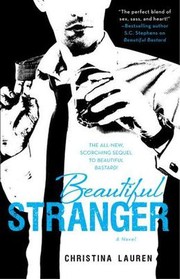
Beautiful Stranger
2,015-word summary 9 min read 352 pages in the book
- First published
- 2013
- Publisher
- Gallery Books
- Pages
- 352
- ISBN
- 9781476731537
- Series
- Beautiful Bastard (#2)
Reading options
What's inside (7 sections)
I read Beautiful Stranger after Beautiful Bastard, expecting another office romance with the same cast. It is a companion novel, not a direct sequel, and it has a different couple and a different problem. Sara Dillon is not Chloe Mills. She is quieter, more guarded, and more interested in control. Max Stella is not Bennett Ryan. He is British, charming, and much less angry. The result is a lighter book than its predecessor, and a more interesting one in some ways, even if it never quite figures out what to do with its own premise.
Sara's fresh start
Sara Dillon has just left Chicago and a fiancé named Andy who cheated on her. She has moved to New York to work in finance at Bennett's family firm, and she is living in a tiny East Village apartment that is nothing like the life she expected. The move is a reset. It is also an avoidance strategy. Sara has not processed the betrayal so much as outrun it.
On a night out with her friends Chloe and Julia, Sara decides to be someone else for a few hours. At a club, she meets a handsome British stranger. They have sex in a semi-public place, with the thrill of being seen. Sara does not give him her name. She leaves before the night can become a relationship. It is a deliberate act of freedom, and it is also a way of having intimacy without risk.
The stranger turns out to be Max Stella, a venture capitalist who works with Bennett and has a reputation for casual affairs. When they meet again, Sara is embarrassed and intrigued. Max is delighted. He wants to see her again. She does not want a boyfriend. What she proposes is a limited arrangement: one night a week, sex, no commitment, her terms. Max agrees, which is the first sign that he is more serious about her than he is willing to admit.
Max's world is one of expensive restaurants, borrowed apartments, and friends who talk about money the way other people talk about weather. He is not cruel about his privilege, but he is careless with it. The novel uses his wealth to smooth the path of the romance. He can take Sara to a fancy hotel, buy her a dress, and arrange a private room without thinking twice. That is part of the fantasy, and it is also a limitation. The practical problems that would make the relationship difficult in real life are mostly removed.
Bennett and Chloe are present as a married couple who have already been through their own messy story. Bennett is protective of Sara because she works for him, and Max is his friend. The overlap creates a small, insular social world where everyone knows everyone and the stakes are personal as well as romantic. It also gives the book some continuity with Beautiful Bastard, which is nice for returning readers.
The arrangement
The arrangement is the engine of the book, and it is also its central contradiction. Sara wants to control the terms of her own desire. After Andy's betrayal, she does not trust the story of a relationship, but she does trust her own body and her own choices. Max is happy to give her the control she asks for, at least at first. He plans encounters in places where they might be seen. He takes photographs. He lets her set the rules.
The photography is the most interesting part of the book. Sara enjoys being seen, but only when she has chosen it. Max's camera turns that choice into something permanent, and permanence is what frightens her. The photographs are consensual, but they also create a record that could be taken out of her hands. The novel knows this, and it uses a stolen bag and a newspaper story to make the fear concrete. The question is not whether Sara likes exhibitionism. The question is whether she can keep control of her own image once other people are involved.
The scenes between Sara and Max are playful and hot, and Christina Lauren is good at writing two people who are attracted to each other and also a little afraid of what the attraction means. The library scene and the empty apartment scene are the set pieces, and they work because the characters are negotiating rather than performing. Sara says what she wants. Max listens. That sounds simple, but it is rare in romance novels, and it is the reason the relationship is believable.
The rules matter. Sara is not experimenting because she has no boundaries. She is experimenting because she has spent years being told what a relationship should look like, and she wants to find out what she actually enjoys. Max is careful with her. He checks in, respects her limits, and does not use her desire against her. The book is clear that the arrangement is consensual, and that clarity is what makes the erotic scenes work. They are not about danger. They are about trust.
Sara's job is part of the story, though the novel does not make much of it. She works in finance at Bennett's firm, and she is good at it. The office gives her a separate identity from the one she had in Chicago, and it gives her a reason to stay in New York when the romance becomes complicated. I wish the book had spent more time on her work. It is the place where her competence is most visible, and it would have made her feel more like a whole person rather than a woman defined by her romantic history.
The feelings problem
The arrangement is supposed to stay casual. It does not. Max starts wanting more. Sara starts wanting more and resists it. Their meetings become more frequent, and the conversations between the sex scenes become longer and more personal. Max's reputation as a man who does not commit makes Sara doubt him, and her own history makes her doubt herself. The book is smart about the gap between what a person says they want and what they are ready to feel.
Andy contacts Sara. The call revives the old wound and makes her realize that she has not actually dealt with the betrayal. Max learns about Andy and gives Sara space instead of pushing. That restraint is the moment the relationship changes. Max is no longer only a charming stranger. He is a man who is willing to wait for her to decide what she wants.
Then the public attention arrives. A newspaper runs a photograph of Max with a mystery woman identified as Sara. Later, another story shows Max with other women. Sara reads the second story through the lens of Andy's betrayal. She withdraws and avoids Max's calls. Chloe supports her, and Bennett tells her to hear Max out. The conflict is not really about the photographs. It is about whether Sara can trust her own judgment after being made a fool of.
Andy's return is not a love triangle. It is a test of Sara's recovery. He wants to explain, or apologize, or see whether she is still available. Sara does not fall for it, but the encounter shakes her because it reminds her of the person she was before New York. The book is honest about how long betrayal stays in the body. Sara can move to a new city and start a new relationship, but she cannot outrun the reflex to expect the worst.
The resolution
The climax takes place at a fundraiser at Max's home. Sara confronts him about the newspaper story and her fears. Max explains, or tries to explain. The novel presents the rumors as false and his feelings as genuine. Sara sees photographs he has displayed in his home, and the images that once represented risk now represent continuity. He has kept them because they matter to him. She has been seeing them as evidence of exposure. The shift is a shift in interpretation, not in facts.
They reconcile. There is a kiss in front of their friends. Sara chooses intimacy without giving up the independence she came to New York to find. The ending is satisfying in the way romance endings are supposed to be, and it is also a little too easy. The conflicts that seemed serious, the stolen photographs, the public gossip, the ex-fiancé, are resolved in a few conversations. The book wants a happy ending more than it wants to sit with the difficulty of trust.
The stolen bag is the clearest example of a good idea that is not fully developed. Sara's private photographs are taken out of her control, and the novel treats the theft as a plot complication rather than a violation. The fear of exposure is real, but the consequences are limited to a tense conversation and a newspaper story. A more honest book would have let Sara sit with the fact that her image is out in the world, and would have let Max make a mistake that was not so easily forgiven. That book would be less fun. It might also be more memorable.
What works and what does not
Sara is the best thing about the novel. She is not a manic pixie dream girl or a shy virgin. She is a woman who has been hurt and is trying to rebuild her life on her own terms. Her insistence on control is not a flaw to be cured by the right man. It is a reasonable response to betrayal, and the book mostly respects it. Max is charming and funny, and his patience with Sara is attractive without being saintly. The supporting cast, especially Chloe and Bennett, adds continuity for readers of the first book.
The weakness is depth. The book is more interested in the fantasy of the arrangement than in the consequences. The exhibitionism is treated as a consensual game, which it is, but the novel does not spend much time on the risks. The stolen bag is a plot device, not a real exploration of what it would mean for Sara's private life to become public. The conflict between Sara and Max is resolved too quickly, and the ending feels earned by chemistry rather than by changed behavior.
The romance also leans on a familiar billionaire fantasy. Max is rich, British, and generous, and his wealth removes most of the practical obstacles that would make the relationship complicated. That is fine for the genre, but it means the book is less interesting when it tries to be serious. The stakes are emotional, not material.
The series structure is worth mentioning. Beautiful Bastard, Beautiful Stranger, and the later books are companion novels, not a single continuous story. Each couple gets a book, and the previous couples appear as supporting characters. That means you can start here without reading the first one, though you will miss some of the jokes and the context for Bennett and Chloe. The books are designed to be read quickly and enjoyed in order, and this one fits that model.
The title is a little misleading. Max is the stranger at the start, but the book is really about Sara becoming a stranger to her old self. She is not trying to become someone new for a man. She is trying to become someone she can live with. The romance is the catalyst, not the destination. That is a more interesting story than the cover suggests, and it is the reason the book has lasted longer than many of its contemporaries.
I would recommend Beautiful Stranger to readers who liked Beautiful Bastard and want a softer, funnier companion. It can be read on its own, though the cameos land better if you know the first book. It is not a deep novel, and it does not pretend to be. It is a romance about a woman learning that she can be seen and still be safe, and that is a story worth telling, even if the telling is uneven.
FAQ
Do I need to read Beautiful Bastard first?
No, but Chloe and Bennett appear, and the series is more fun in order.
Is Beautiful Stranger erotica?
It is a contemporary romance with explicit sex scenes.
What is the plot?
Sara moves to New York and begins a no-strings affair with Max, then has to decide whether she can trust him.
Similar books
More from Beautiful Bastard first, then related titles.
Beautiful Bastard
Chloe Mills battles her demanding boss Bennett Ryan in Chicago, until office rivalry turns into a secret relationship that tests both careers.
2,800-word summary · 12 min read
Entwined with You
Eva and Gideon marry in secret while a Corinne pregnancy claim, police questions, and reporter pressure test their bond in Crossfire book three.
2,971-word summary · 13 min read
The Ex Talk
Two rival public radio producers pretend to be exes for a dating show, then fall for each other while the lie grows.
2,389-word summary · 11 min read

Beneath This Man
Ava returns to Jesse after five days apart and finds his drinking, jealousy, and a hidden deception that changes what she can forgive.
2,341-word summary · 10 min read

There Are No Saints
Two rival artists circle a struggling San Francisco painter. Cole Blackwell wants her, Alastor Shaw wants her dead. Book one of the Sinners duet.
2,190-word summary · 10 min read

The Predator
Coder Morana Vitalio and mob enforcer Tristan Caine chase stolen software while a case of missing girls from twenty years back catches up with them both.
2,296-word summary · 10 min read
The Casanova
Kate Landon's boss is also the pen pal she falls for online, hiding behind fake names, until family secrets and a trip to Paris get in the way.
2,274-word summary · 10 min read

2 States: The Story of My Marriage
A Punjabi boy from Delhi and a Tamil Brahmin girl from Chennai meet at IIM Ahmedabad, and turn a love marriage into a campaign to convince two families.
2,634-word summary · 12 min read
Reflected in You
Eva and Gideon deepen their obsessive love while facing past abuse and public exposure.
2,587-word summary · 11 min read
Bared to You
Eva starts over in New York and falls for Gideon Cross, whose past mirrors her own trauma.
2,471-word summary · 11 min read
My Favorite Half-Night Stand
Millie, a criminology professor who has always been one of the guys, invents a secret dating profile and matches with her best friend Reid.
2,362-word summary · 10 min read
The Exception to the Rule
A typoed Valentine's email turns into yearly notes between two strangers who wonder if they should meet.
2,226-word summary · 10 min read

Her Soul to Take
A paranormal vlogger in a cult-run town summons a bound demon, and the only way to survive the god beneath the mine is to give him her soul.
2,089-word summary · 9 min read
Austenland
A New York graphic designer obsessed with Mr. Darcy inherits a trip to a Jane Austen theme park, where the fantasy of Regency romance collides with the men…
2,030-word summary · 9 min read

Lick
Evelyn wakes up married to the lead guitarist of Stage Dive after a Las Vegas birthday she cannot remember, and the annulment gets complicated.
1,989-word summary · 9 min read

The Bookshop on the Corner
A Birmingham librarian loses her job, buys a van, and moves to the Scottish Highlands to run a mobile bookshop. Warm and bookish, with uneven pacing.
2,557-word summary · 11 min read

Ricochet
Lily Calloway tries to stay celibate for ninety days while Loren is in rehab, leaning on Rose, Connor, and Ryke as therapy forces her to face her childhood.
2,575-word summary · 11 min read
My Dark Romeo
A debutante ball kiss traps Dallas Townsend in a marriage to Romeo Costa, a man who wants her as leverage in a war against his father and her fiance.
2,530-word summary · 11 min read
Under Locke
Iris Taylor moves to Austin broke and wary, takes a front-desk job at a tattoo shop, and spends the book learning that Dex Locke’s blunt cruelty and unexpected…
2,591-word summary · 12 min read
Fantasy Lover
A New Orleans sex therapist summons a cursed Spartan general from an ancient book and gets one month to break his spell.
2,315-word summary · 10 min read
Bet Me
A sharp actuary agrees to dinner with a charming serial bettor, then spends the next month pretending the wager does not matter.
2,710-word summary · 12 min read
Act Your Age, Eve Brown
Eve Brown crashes into a Lake District bed and breakfast, breaks the owner's arm, and talks her way into his kitchen. A grumpy-sunshine romance about work,…
2,474-word summary · 11 min read

Two by Two
Sparks's twentieth novel turns from first love to a marriage breaking up: Russell Green loses his wife and his job, then rebuilds his life around his…
2,192-word summary · 10 min read

One to Watch
A plus-size fashion blogger takes the lead role on a reality dating show to prove she belongs on television, and finds she might want what the cameras offer.
2,478-word summary · 11 min read
Lover Unleashed
Paralyzed vampire warrior Payne and surgeon Manny Manello collide in an adult paranormal romance, as Xcor's Band of Bastards arrives in Caldwell for revenge.
2,374-word summary · 11 min read
Angels' Blood
Nalini Singh's 2009 Guild Hunter opener sends vampire hunter Elena Deveraux after a murderous archangel in New York, while its most powerful ruler watches.
2,367-word summary · 11 min read
This Time Next Year
Two women give birth minutes apart on New Year's Day 1990, and one takes the other's lucky name. Thirty years on, their children meet again.
2,194-word summary · 10 min read

Indigo Ridge
A new police chief in a Montana town meets the founding family's eldest son in a bar, and one night later a body turns up under their cliff.
2,763-word summary · 12 min read

At First Sight
Jeremy and Lexie are married and expecting a baby when anonymous emails tell him the child may not be his.
2,317-word summary · 10 min read
True Believer
Jeremy Marsh, a science journalist who debunks paranormal claims, comes to a small North Carolina town and falls for a librarian who believes in things he…
2,125-word summary · 9 min read