
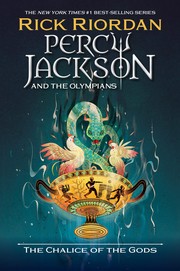
The Chalice of the Gods
2,106-word summary 9 min read 288 pages in the book
- First published
- 2023
- Publisher
- Disney Hyperion
- Pages
- 288
- ISBN
- 9781368098175
- Series
- Percy Jackson and the Olympians (#6)
Reading options
What's inside (9 sections)
I picked this up on a train to a job interview, and somewhere between Queens and the interview I stopped worrying about the interview. That is roughly the effect Rick Riordan had in mind with the first Percy Jackson book in more than a decade. The premise is simple enough to say out loud: Percy Jackson has to earn three letters of recommendation from three different gods before he can apply to college, and the gods, being gods, have made each letter conditional on a quest.
A college application written in quests
Percy opens the book in the hallway of Alternative High School, a converted elementary school in Queens where the drinking fountains are low and the lockers have been replaced by carrying your textbooks from class to class. He has lost his entire junior year to magical amnesia. He wants a normal senior year. He does not get one.
His guidance counselor is not a guidance counselor. She is Eudora, a Nereid, and she breaks the news while the floor dissolves into seawater and drops Percy into the Atlantic Ocean. The bad news is bureaucratic, which is where the joke lives. Poseidon explains it in his underwater palace, where a pair of blue whales are towing a marble column and a dolphin in a reflective safety vest gives Percy a high five. After the Second World War, Zeus, Poseidon and Hades made a pact not to sire any more demigod children, because the children of the Big Three are too powerful and too unpredictable. Percy was never supposed to exist, so he is technically ineligible for New Rome University. Zeus will consider the application only if Percy finishes three quests and collects three recommendation letters from three different gods before the winter solstice. Poseidon, who talks his brother down from twenty-five, prints a neon-yellow flyer with Percy's photo (taken in a bathroom mirror, toothbrush still in his mouth) and posts it on the Olympian quest board.
There is more here about paperwork as the natural enemy of a teenager than I expected, and it made me laugh more than it should have. The gods are running an internship program with no salary and no exit interview. Poseidon is a recognizable kind of father: affectionate, ashamed of his own distance, and not much use in a crisis unless you happen to be standing in the ocean.
The god in the smoothie bar
The reason Percy gets the job is Ganymede, the cupbearer of Zeus, who has been boarding the F train to Himbo Juice with a disguise that fools nobody. He is beautiful, self-conscious, and having the worst year of his immortal life, because his chalice has been stolen. It is the only cup worthy of Zeus, it grants immortality to any mortal who drinks from it, and without it Ganymede risks losing his job, his immortality, or both.
What makes Ganymede funny is that he never wanted the job. He complains that Ares wants nectar delivered to a battlefield and Aphrodite wants her usual with extra crushed ice to a sauna in Helsinki, and he calls the whole arrangement a gig economy. He is also, clearly, a young man who has been beautiful since ancient times and has never once been allowed to talk about how that feels.
He asks Percy for help for a reason that is not the least flattering thing about him. He says he cannot trust anyone else, because Percy has already turned down immortality once. That callback to the end of The Last Olympian is doing a lot of work here. Riordan is telling us that Percy has banked a kind of credibility, which is why a god in ripped black jeans and a nose ring can sit down next to him on the subway and get straight to the point.
Running around Manhattan
The investigation is built like a mystery and it moves at a good clip through real New York: Times Square, a farmers market at Lincoln Center, a river under Yonkers, Washington Square Park. Annabeth is on the case with a knife and a plan. Grover is there with his pan pipes. Percy keeps checking the clock, because he has classes and a swim team and a mother about to publish her first novel and a stepfather who teaches English and is, in the most understated way in American literature, the steadiest person in his life.
The suspects come from the Olympian household. Hebe, the goddess of youth, held the cupbearer job once and is sour about losing it. Iris, the goddess of the rainbow, has lost a job of her own to Hermes and wears the loss like a bruise. Both of them are, in their own way, also the wronged party in their particular story. That question runs underneath the whole book: who resents the situation more, the servant who lost the job or the boy who got it?
Clearing out Hebe and Iris
The Hebe chapter is the one I would hand to a skeptical reader. Percy, Annabeth and Grover walk into Hebe Jeebies, a nostalgia arcade in a warehouse in Times Square, and Hebe turns all three of them into eight-year-olds to make a point about how she must always be the youngest person in any room. Her sacred hens chase them through the arcade. Annabeth barricades them inside a play structure using a cafe table, then solves the problem by picking up a baby chick, which makes Hebe so upset that she regresses into infancy, at which point the three of them can talk to her like a reasonable adult.
It is a silly scene that works, and the reason it works is that the joke is mean. Hebe is not evil. She is someone who has been alive for an unimaginable stretch of time and cannot stop being young, and she takes it out on the mortal world by turning it into a place where nobody is allowed to get old. The horror and the comedy are the same joke, which is as close to good writing as this series gets.
Iris is harder. She agrees to help them find the thief, but only if they clean her herald's staff in the River Elisson, the purest water in creation, where horned serpents bathe. The river runs beneath Yonkers. The serpents are numerous and the instructions are specific: do not harm them.
Grover plays his pipes to distract the snakes. Annabeth works out the approach. Percy, who can breathe underwater and does not enjoy it, gets hurled to the riverbed by a river god named Elisson, who is furious about the pollution, and then does the one thing that shows what his father actually handed him. He gets angry and floods the cavern. The water clears. Elisson goes from trying to drown him to sitting on the bank drinking tea that Annabeth made for him.
Iris also charges them five dollars for a vial of pure nectar, paid by phone, because Iris is a small businesswoman and the author clearly likes that about her. The whole sequence is a good argument for reading Riordan for his scene-setting, which is where he has quietly become very strong: the arcade, the cavern of bathing snakes, the farmers market stall with the crystal pendants, all of it feels like a place rather than a set.
The old man in the playground
The thief is Geras, the god of old age, who goes by Gary, and he is found on a Monday morning in Washington Square Park by following three drops of nectar that separate the three friends and slow them to a crawl. Geras is about the size of a first grader, curved like a fishing hook, and he wants to wrestle Percy to the death for the cup. If Percy loses, he turns to dust. Hercules is the only other hero who has ever been offered the match.
Percy loses the fight, badly, pinned against a tetherball pole while Geras explains that Old Age is patient. What saves him is not strength. He hugs the god of old age and tells him he is fine with wrestling him for the rest of his life. Geras, who has not been hugged in millennia, hands over the cup.
This is the most sentimental thing in the book and I have mixed feelings about it. The joke lands. Geras resents the cup precisely because it lets people dodge the subject he exists to embody, and Percy is the one person equipped to argue that growing old with the people you love beats stopping at seventeen forever. But the story reaches its conclusion by having the hero embrace an abstraction, and Geras folds remarkably fast for a being who claims to have outlasted civilizations. It is a shortcut, and you can feel the machinery turning underneath the hug.
Brunch with the gods
Recovering the cup is only half the job. Ganymede needs it right away, because Zeus is hosting a brunch for his mother Rhea and the cup must be on the table. Percy cannot simply walk into Olympus. Grover arranges for a cloud nymph named Naomi to let him in through the side door. He hides under a pastry cart pushed by a dryad named Barbara, who wants an autograph and a selfie with Annabeth. Athena spots him, decides he is on a quest, and helps by asking Ganymede to take the cart back to the kitchen for clotted cream.
The Olympus scenes are the sharpest writing in the book. Zeus starts a story about his childhood that never ends. The gods hand demigods paper bags of leftover food, which is a humiliation dressed up as a treat. Percy leaves with a blank sheet of Arachnean silk from Ganymede: he has to write his own recommendation letter, and Ganymede's signature appears only if the letter turns out good enough. Percy, his mother Sally, his stepfather Paul and Annabeth then spend half an hour trying to compose it, and every suggestion is a joke about Annabeth's eyes or about Sally's book receiving its first one-star review for promoting paganism.
The ending is small on purpose. Poseidon telephones the school to say Percy will be late, which is more parental attention than he has ever shown, and Poseidon tells him that the thing that mattered was not saving the world but keeping a promise to a cupbearer he barely knew. Percy and Annabeth talk by Iris-message that night, and he tells her he thinks he might love her. Two more letters to go before the winter solstice.
What it is worth
Here is my objection. The college-application frame is a good idea, but the book treats the application as a running gag instead of a source of pressure. Percy is behind on his credits and worried about disappointing Annabeth, and that worry never gets tested. The stakes are entirely external: a god wants a cup back. The thing a real seventeen-year-old would be terrified of losing never appears on the page, and for a series that spent five books building Percy's fear of failure, that feels like a soft spot in the middle of the premise.
The other objection is that the mystery is soft. Two suspects, both cleared quickly, and a culprit whose motive is a grievance rather than a plan. The chase scenes are fun and the creature work is good, but by the end the plot is really just a delivery problem: move the cup from one place to another before a deadline.
What makes up for that is the friendship and the tone. Riordan writes Annabeth as genuinely the cleverest person in every room, which is rarer than it should be, and he writes Grover's anxiety as something he has earned rather than something to be mocked. The three of them are funnier here than in the original five books, partly because they are older and partly because Riordan has got much better at running a joke. The chapter titles, all in the first person and mostly complaints, do more work than they have any right to.
Read it for the jokes, the city, and the scene in Washington Square Park. Skip it if you need the Titan War to feel like a consequence, because this book has nothing to do with monsters. It is about a kid who has been fighting since he was twelve and is tired, and about what it costs to be used as a tool by the people who made you.
FAQ
Why does Percy need three recommendation letters to get into New Rome University?
Zeus, Poseidon and Hades made a pact after World War II not to have more demigod children, so Percy is technically ineligible for New Rome. Zeus will consider his application only if he completes three quests and gets a letter from three different gods before the winter solstice.
Who stole the chalice of the gods and why?
Geras, the god of old age, took it to punish Ganymede and to make a point about mortals being meant to age and die. Percy gets it back by wrestling Geras in Washington Square Park.
Does Percy drink from the chalice or become a god at the end of the book?
No. He refuses to drink from it and tells Geras he would rather live a whole life, including the bad parts. He still needs two more recommendation letters by the winter solstice when the book ends.
Similar books
More from Percy Jackson and the Olympians first, then related titles.

The Lightning Thief
Rick Riordan's The Lightning Thief retold: Percy Jackson, Camp Half-Blood, the stolen bolt, and the road trip to the Underworld.
2,581-word summary · 11 min read
The Sea of Monsters
Percy returns for a second summer as Camp Half-Blood loses its borders, Tyson is claimed as his brother, and the Golden Fleece waits past the Sea of Monsters.
2,056-word summary · 9 min read
The Titan's Curse
Percy joins a winter quest to save Annabeth and Artemis with Thalia, Grover, Bianca and Zoe, facing Atlas and Luke under a hard Oracle prophecy on Mount…
2,229-word summary · 10 min read
The Battle of the Labyrinth
Percy and Annabeth enter the shifting Labyrinth with Rachel Dare to stop Luke and Kronos from invading Camp Half-Blood.
2,924-word summary · 13 min read
The Last Olympian
Percy Jackson turns sixteen as Kronos marches on Manhattan, forcing Camp Half-Blood into a final stand for Olympus beside Annabeth as the old prophecy demands…
2,564-word summary · 11 min read
The Ship of the Dead
Magnus and his crew sail to the edges of the Norse worlds to stop Loki from launching Naglfar, the ship of the dead.
2,426-word summary · 11 min read
The Burning Maze
Apollo, still trapped in a mortal teenager's body, follows a dangerous prophecy through the Labyrinth with Meg and Grover as the Triumvirate's grip tightens.
2,248-word summary · 10 min read
The Serpent's Shadow
Carter and Sadie Kane have three days to bind Apophis by his shadow before the serpent rises and unmakes the world.
2,941-word summary · 13 min read

The Throne of Fire
Carter and Sadie Kane have five days to wake the sun god Ra before the serpent Apophis breaks free and eats the world.
2,867-word summary · 13 min read
The Red Pyramid
Siblings Carter and Sadie Kane wake the Egyptian gods and must stop Set from destroying the world.
2,682-word summary · 12 min read
The House of Hades
Percy and Annabeth cross Tartarus while the five close the Doors of Death before Gaea wakes.
2,910-word summary · 13 min read
The Son of Neptune
Amnesiac Percy wakes at Camp Jupiter and quests to Alaska with Hazel and Frank to free Thanatos.
2,107-word summary · 9 min read
The Thief
A boastful young thief is pulled from a prison to steal a legendary stone for the king's magus, and the story he tells about himself is not the whole story.
2,514-word summary · 11 min read
The Icebound Land
Captured and enslaved in Skandia, Will fights a drug that erases him while Halt and Horace cut a bloody road through Gallica to bring him home.
2,088-word summary · 9 min read
The Magician King
Quentin rules a peaceful Fillory until a golden key strands him on Earth, while Julia's brutal road from hedge witch to demigod rewrites the whole story.
2,431-word summary · 11 min read
The Demigod Files
Three Percy Jackson side quests plus camp maps, cabin guides, interviews, and god profiles set before the final battle.
2,498-word summary · 11 min read
The Hammer of Thor
Magnus and Sam chase Thor's stolen hammer to a giant wedding heist, with Alex Fierro joining Floor Nineteen as Loki bargains and Ragnarok stirs.
3,068-word summary · 14 min read
The Dark Prophecy
Mortal Apollo and Leo cross America to free the Oracle as Commodus hunts them.
2,368-word summary · 11 min read
The Sword of Summer
A homeless Boston teen learns he is a Norse god son and dies on day one stopping a fire giant.
2,116-word summary · 9 min read
The Hidden Oracle
Apollo lands as a teen in New York with no powers and must earn his way back with Meg and demigods.
1,933-word summary · 9 min read

The Blood of Olympus
Seven demigods stop Gaia waking while Reyna brings Athena statue.
2,196-word summary · 10 min read
The Mark of Athena
Seven demigods sail for Rome where Annabeth must follow the Mark to the Athena Parthenos alone.
2,031-word summary · 9 min read
The Lost Hero
Jason wakes with no memory while Piper and Leo learn they are demigods sent to free Hera.
2,734-word summary · 12 min read
Secrets of the Dragon Sanctuary
Kendra is replaced by a plant copy and held by the Society, while Seth steals a unicorn horn so the family can enter a dragon sanctuary.
2,590-word summary · 12 min read

Lioness Rampant
Alanna searches for the Dominion Jewel with the Shang Dragon, then returns to Tortall to face Duke Roger at Jonathan's coronation.
2,478-word summary · 11 min read
The Magician
Sophie and Josh flee to Paris with Nicholas Flamel, where John Dee, Machiavelli, and an awakened god close in on the missing pages of the Codex.
2,162-word summary · 10 min read

Lore
Lore Perseous, the last of a hunted bloodline, is pulled back into the Agon when a wounded Athena offers her revenge against the god who killed her family.
2,188-word summary · 10 min read

Princess Academy
Miri leaves her Mount Eskel quarry home for Princess Academy, where quarry songs, books, and a bandit siege shape her fight for fair trade, a school, and a…
2,441-word summary · 11 min read
The Alchemyst
Twins Sophie and Josh learn their boss is Flamel as Dee steals the Codex minus two pages.
2,085-word summary · 9 min read
Children of Blood and Bone
White haired Zelie chases magic return with princess Amari hunted by Inan.
2,027-word summary · 9 min read