
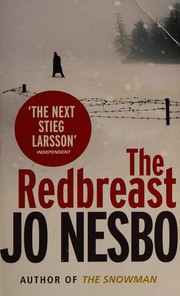
The Redbreast
2,453-word summary 11 min read 624 pages in the book
- First published
- 2000
- Publisher
- Vintage Books
- Pages
- 624
- ISBN
- 9780099546771
- Original title
- Rødstrupe
- Series
- Harry Hole (#3)
Reading options
What's inside (9 sections)
I came to The Redbreast late and from the wrong direction. I had already read the Snowman and a couple of the later Harry Hole books, so I knew the detective as a wreck with a method, and I wanted the origin story that everyone kept calling the best one. This is the third Harry Hole novel, first published in Norwegian in 2000 as Rødstrupe, and it reached English in Don Bartlett's translation. I read the Vintage Books edition, 624 pages, and for the first fifty or so I kept waiting for the plot to declare itself. Then the two timelines locked together and I stopped counting pages.
On paper it sounds like a standard thriller. A rare sniper rifle is smuggled into Norway, an old man starts killing the people he blames for a betrayal half a century old, and Harry Hole has to stop him before a public holiday turns into a bloodbath. What Nesbo actually does with that frame is odder and better. He uses a murder investigation to pry open a wound in Norwegian memory, the question of the volunteers who fought for Hitler on the Eastern Front and came home branded as traitors. It reads as a crime novel, but a large part of it is a war novel, and the two halves are not separate. They are the same story told from opposite ends.
A shot in the fog
The book opens on the first of November, 1999. A United States president is visiting Oslo for a peace conference, and Harry and his colleague Ellen Gjelten are posted at a toll barrier along the motorcade route. Harry sees a man in a toll booth holding what looks like a weapon, gets no signal that the figure is friendly, and fires. The man goes down. He turns out to be an American Secret Service agent.
The shooting should end Harry's career. Instead, the government decides it cannot afford a diplomatic scandal, and a senior foreign ministry official, Bernt Brandhaug, arranges a cover story. Harry is promoted to inspector and moved sideways into POT, the national security service, where the idea is to keep him busy and quiet. His new boss, Kurt Meirik, resents being handed a babysitting job. Harry resents the whole arrangement. He is a recovering alcoholic with a talent for making enemies in his own building, and a desk that is meant to bury him is the last thing he wants.
The posting does give him one useful thing: a reason to watch the neo-Nazis. A violent skinhead named Sverre Olsen has just walked free from an assault charge on a technicality, and Harry, who knows that world from an earlier case, starts paying attention to the people around him. Then a routine report from the forest district of Siljan catches his eye. Local officers recovered spent cartridges from a Märklin rifle, a powerful German weapon built for snipers, illegal in Norway, and rare enough that its presence can only mean someone paid a fortune to bring it in. Harry is a paper-pusher with a hunting complaint on his desk, and he treats it like the beginning of a murder.
Two winters
Halfway through the first section, the book drops the reader into 1942 without warning, and stays there long enough to matter. A small unit of Norwegian volunteers is dug into trenches near Leningrad, fighting for the Germans against the Soviets. They are cold, lice-ridden, and scared, and Nesbo makes the fear physical: the shelling, the frozen ground, the way a man can die between one breath and the next.
The unit's star is Daniel Gudeson, a legendary marksman and the natural leader the others orbit. On New Year's Eve a Russian sniper kills Daniel when he stands up to cheer midnight. His body is covered and left for the burial detail, and that same night another soldier, Sindre Fauke, vanishes, presumed to have defected to the Red Army. Then the strangest detail of the whole book arrives. Daniel's body reappears in the trench, as if it had never left. Years later, when the rifle starts firing, that detail stops being a ghost story and becomes a clue.
Later a grenade puts several of the men in a military hospital in the Vienna Woods. One of them, using the name Uriah, falls in love with a young nurse named Helena Lang. A jealous doctor named Brockhard, who also wants Helena, threatens to send Uriah back to certain death unless she gives in to him. The two lovers try to run, fail for want of travel papers, and are pulled apart. It is a small tragedy inside the larger war, and Nesbo lets it breathe. Only much later do you understand why he spent so much time on one nurse.
I did not enjoy the first half as much as I wanted to. The war chapters are vivid but they keep interrupting the investigation, and the present-day chapters keep interrupting the war. For a while the novel feels like two books stapled together. The payback comes when you realize how carefully the seam was placed.
The Prince, the rifle, and Ellen
Back in 1999, Harry and Ellen pull at the threads separately and then together. An arms dealer, and later a source in Johannesburg, tells them the rifle buyer was an elderly Norwegian who used the codename Uriah and mentioned a training camp called Sennheim, one of the places where Norwegian volunteers were prepared for the Eastern Front. The middleman who brokered the deal goes by a nickname: the Prince. Nobody knows who the Prince is, only that he moves between the neo-Nazis and the money and never shows his face.
The police angle keeps folding in on itself. Harry's old boss, Bjarne Møller, is decent and hamstrung. A colleague named Tom Waaler is efficient in a way that never quite feels clean. And through the veterans, Harry meets Rakel Fauke, the daughter of a former front fighter, and the two of them begin something careful and hesitant. Rakel is fighting a custody battle over her son Oleg, and she cannot afford complications. Harry, who collects complications, does not immediately understand how much of her life is being arranged behind her back.
Ellen is the best of the early book. She is smart, funny, and steady, and her partnership with Harry is not romantic, which is refreshing in a series that keeps threatening to turn every woman into a wound. She is also the one who gets too close. On a night shift with Waaler, she answers his ringing phone while he is away, pretends to be a machine, and hears Olsen demanding his commission for the shooter hired by the old man. In that moment she works out the Prince's identity. She tries to reach Harry, cannot, and is attacked and killed with a baseball bat on her way home. A combat cap is left at the scene to point the blame at the neo-Nazis.
That death hits the book like a dropped weight. I stopped reading it as a puzzle after that. Harry's grief is not tidy or noble. He drinks, he lashes out, he blames himself for missing her call, and none of it makes him easier to be around.
Grief and the paper trail
What saves Harry is the work. With a young officer named Halvorsen as his new partner, he starts building a picture out of fragments: cartridges in the forest, the poisoned oak in the Palace Gardens that someone killed to open a clean line of fire toward the royal balcony, the list of veterans who served together at Sennheim. He visits an old soldier named Sindre Fauke and listens to a story about the men he fought beside, including the gentle country boy the unit called the redbreast, a nickname for the little bird that shows its chest, and a name the man earned as a bayonet fighter.
Then the rifle speaks again. Brandhaug, the foreign ministry official who engineered Harry's promotion and who has been quietly coercing Rakel, is shot dead from a distance. Signe Juul, a former wartime nurse and the wife of a professor who studies the occupation, disappears from a home where the words GOD IS MY JUDGE have been scrawled on a mirror, and her body turns up at Akershus Fortress, the old execution site, staged as a traitor's death. Harry consults a psychologist, Ståle Aune, about what it means when a person has believed a lie so completely that passion becomes necessity.
The picture Harry assembles, and the picture the reader has been assembling, are not the same, which is the engine of the whole book. Nesbo lets us sit inside the killer's head in the war chapters and then hands us a wrong suspect in the present. Harry becomes convinced that the professor, Even Juul, obsessed with the legend of Daniel Gudeson, has developed a second personality and committed the murders, and when Even is found hanged, apparently a suicide and apparently trying to stop himself, the theory looks finished. It is the most confident Nesbo wants Harry to be, and it is wrong.
The memoir and the balcony
Harry's mistake is exposed on the morning of Constitution Day, the seventeenth of May. He wakes in Rakel's flat, wanders into the wrong bedroom, and sees a framed photograph of a woman's face. It is Helena Lang, the nurse from the Vienna hospital. Helena is Rakel's mother. Which means Sindre Fauke is not Sindre Fauke. The old soldier Harry has been interviewing, the man with the terminal diagnosis and the dying grudge, is Gudbrand Johansen, the quiet boy who idolized Daniel, killed the deserter Fauke with a bayonet, and swapped the two men's identity papers so that the dead man would be buried as Daniel and the survivor could vanish into a borrowed name.
Harry races to Fauke's flat and finds it emptied, along with a manuscript titled The Great Betrayal. In it the killer explains everything. He attacks the Norwegian royal family and the officials who fled to England in 1940 and then returned to brand the front fighters as traitors, and he sets out his plan to assassinate the Crown Prince on the Palace balcony during the holiday parade. The war chapters were never background. They were the killer's life, and the modern murders are his attempt to settle the account his country refused to acknowledge.
The ending plays out on the twenty-first floor of a hotel, in a suite overlooking the Palace, on a line of sight cleared by a poisoned tree. Harry arrives with seconds to spare and a gun he may not be able to use against a man who is part of the woman he loves. The old man is flickering between identities, and the thing that finally stops him is not a bullet. It is a name, Oleg, the grandson he has never been allowed to know. He lowers the rifle. He dies in hospital two days later, and Rakel and Oleg never learn who he was. To protect them, and to keep the near-assassination out of the papers, the whole case is buried, and Harry is promised his old job back, plus a quiet window to keep chasing the colleague he now suspects of ordering Ellen's death.
What works and what drags
I understand now why people call this the best one, even if I would not hand it to a first-time reader of the series. The ambition is real. Nesbo is doing something harder than a whodunit: he is arguing that a country's comfortable story about itself can be a kind of crime, and he makes that argument through plot rather than speeches. The historical figure of the front fighter, the man who is neither hero nor simple villain, is treated with more sympathy than most Norwegian fiction of the period bothered with, and the fact that the villain's grievance has a true root is what makes him frightening rather than cartoonish.
The cost of that ambition is length and drift. The book is long, and it wanders. Some of the neo-Nazi material creaks, particularly when it slides toward the generic skinhead menace of turn-of-the-century crime fiction. Rakel's custody subplot and Brandhaug's manipulation of her are necessary for the ending, but they read as a slower, lesser strand than either the war or the rifle. And the first hundred pages ask for patience that the book only pays back after you are already committed. I nearly put it down twice in the Siljan-to-Vienna stretch.
The structure also works against suspense in a deliberate way that not every reader will enjoy. Because we spend time inside the killer's past and inside the reader's greater knowledge, we are often ahead of Harry, and the pleasure is in watching him catch up rather than in being surprised. Twice Nesbo kills a character from inside her own point of view, and both times Harry arrives afterward to find a scene already cold. It is a confident choice. It can also feel like being told the answer before being asked the question.
Closing thoughts
What carried me through was Harry himself, in a version I had not seen before. He is not yet the ruin of the later books; he is a man sliding, and the slide is more interesting than the fall. His partnership with Ellen is the emotional center, and killing her off halfway through is the most honest thing the novel does, because it tells you the cost of this world without asking you to feel noble about it. Halvorsen, the rookie, is a good foil, eager and unbroken, and the way Harry takes him on is one of the few soft moves the character makes.
If you have read the series out of order the way I did, The Redbreast is where the whole thing is load-bearing. It sets up Harry's war with Tom Waaler, it plants Rakel and Oleg, and it establishes the historical conscience that the later books keep returning to. If you are new, know that it is slower and broader than its reputation suggests, and that its best passages are quiet ones: two men in a trench, a nurse in a corridor, an old man in a hotel suite with his finger on a trigger and a name he cannot quite say. In the Vintage Books edition, translated from the 2000 Rødstrupe, that is 624 pages of a flawed, serious book that is trying to be about more than who did it. For the most part, it earns the attempt.
FAQ
Is The Redbreast the first Harry Hole book?
No. It is the third novel in the series, first published in Norwegian in 2000 as Rødstrupe, although it was the first of the Harry Hole books to be published in English.
What is the illegal rifle in The Redbreast?
A rare and expensive Marklin sniper rifle, banned in Norway and smuggled in for an old man who used the codename Uriah, with the deal brokered by a figure known as the Prince.
Does The Redbreast work as a stand-alone novel?
Mostly, since the case is self-contained, but it introduces Harry's long-running enemy Tom Waaler and his relationship with Rakel and Oleg, so reading the series in order improves it.
Similar books
More from Harry Hole first, then related titles.
The Bat
Oslo detective Harry Hole aids Sydney police after a young Norwegian woman is murdered and finds a wider pattern. Grief, drink, and a lost partner shape the…
2,766-word summary · 12 min read
The Snowman
After the first snow, a mother vanishes and Harry Hole links her pink scarf to eleven missing women.
2,750-word summary · 12 min read

The Trespasser
A Dublin Murder Squad detective investigates a staged dinner-party killing and finds a cover-up that reaches into her own department.
2,051-word summary · 9 min read

Rules of Prey
Minneapolis detective Lucas Davenport hunts a killer who leaves a new rule at every scene and treats murder as a game of wits.
1,914-word summary · 9 min read

The Late Show
Exiled to the LAPD night shift after accusing her supervisor, Renée Ballard keeps two cases that were meant to be handed off at dawn: a brutal assault and a…
2,563-word summary · 11 min read

Bad Luck and Trouble
A deposit of $1,030 summons Jack Reacher back to his old army unit, which is being picked off one name at a time.
2,366-word summary · 11 min read

3rd Degree
The third Women's Murder Club novel follows a San Francisco terror cell and a three-day killing schedule, and it costs the club a member.
2,685-word summary · 12 min read
Razorblade Tears
Two ex-con fathers, one Black and one white, hunt their murdered sons' killers in a Richmond that never gave the boys a fair shake.
2,880-word summary · 13 min read
Broken Harbor
A family is found slaughtered in a half-built Dublin estate where no one broke in, and star detective Scorcher Kennedy must explain the holes in the walls.
2,308-word summary · 10 min read
Cruel & Unusual
Scarpetta links an execution to a boy's murder while someone steals bodies.
2,533-word summary · 11 min read
The Man in the Brown Suit
Anne Beddingfeld sees a Tube death in London and chases a paper clue to South Africa, diamonds, and the hidden Colonel.
2,292-word summary · 10 min read
Maisie Dobbs
A maid turned war nurse opens a London inquiry agency in 1929 and traces a quiet case to a refuge for shattered soldiers.
2,382-word summary · 11 min read

2nd Chance
Lindsay Boxer and the Women's Murder Club hunt the Chimera killer after a church shooting in San Francisco.
2,572-word summary · 11 min read
Troubled Blood
Strike and Robin take a year long cold case: doctor Margot Bamborough vanished in 1974, with a nurse hiding more.
2,211-word summary · 10 min read
Holly
Grieving detective Holly Gibney takes a missing-girl case in 2021 and traces it to two polite retired professors with a basement secret.
2,607-word summary · 12 min read
Faithful Place
Undercover Frank Mackey returns to Faithful Place when lost love Rosie suitcase is found.
2,161-word summary · 10 min read
End of Watch
A dying Bill Hodges and Holly Gibney face Brady Hartsfield again, as rigged game consoles push hurt teens toward suicide.
2,923-word summary · 13 min read
Finders Keepers
A boy finds a murdered writer's notebooks while the killer leaves prison hunting them and Hodges closes in.
2,157-word summary · 10 min read
The Likeness
A detective poses as her murdered double and moves in with four graduate students to find the killer.
2,751-word summary · 12 min read
Shutter Island
A U.S. marshal hunts a missing patient on a locked asylum island in 1954, where every clue turns back on him.
2,761-word summary · 12 min read
Career of Evil
A severed leg delivered to Robin forces Strike to face four men from his past as a London killer stalks, testing the agency and her wedding plans ahead.
2,887-word summary · 13 min read
The Silkworm
A missing novelist and a cruel manuscript pull Strike and Robin into London publishing.
3,583-word summary · 16 min read
Mr. Mercedes
Retired Hodges hunts Mercedes killer Brady Hartsfield concert plot.
2,281-word summary · 10 min read
Kiss the Girls
Cross hunts Casanova kidnapping women including niece Naomi.
2,397-word summary · 11 min read
1st to Die
Lindsay, Claire, Cindy and Jill hunt a honeymoon killer terrorizing San Francisco.
2,536-word summary · 11 min read

In the Woods
A detective investigates a girl's murder in the woods where his own friends vanished twenty years earlier.
2,773-word summary · 12 min read
Along Came a Spider
Detective Alex Cross hunts Gary Soneji after two children vanish from a Washington school and a Lindbergh echo grows.
2,523-word summary · 11 min read
The Cuckoo's Calling
Broke detective Strike and temp Robin investigate a supermodel's fatal fall in London.
2,006-word summary · 9 min read
Wolf Hour
In Minneapolis, suspended detective Bob Oz hunts sniper Tomas Gomez in 2016 while a Norwegian writer revisits the case in 2022 with secrets.
2,202-word summary · 10 min read

What She Knew
Rachel lets her eight-year-old son run ahead in a Bristol park, and the nine-day search turns her into a suspect in the public eye.
2,952-word summary · 13 min read