
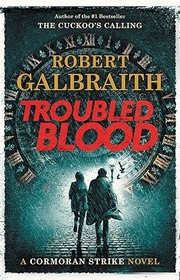
Troubled Blood
2,211-word summary 10 min read 944 pages in the book
- First published
- 2020
- Publisher
- Mulholland Books
- Pages
- 944
- ISBN
- 9780316703550
- Series
- Cormoran Strike (#5)
Reading options
What's inside (9 sections)
Troubled Blood is the fifth Cormoran Strike novel and the longest, at over 900 pages, and it earns most of that length through people work rather than padding. Private detectives Strike and Robin take a year long cold case. Doctor Margot Bamborough vanished in London in 1974. Her daughter Anna hires them to find truth after police chased a serial killer theory for decades.
Anna and the cold case
Anna Phipps, middle aged and steady, walks into the Denmark Street agency with her wife Kim and a box of old files. Mother Margot, a GP in Clerkenwell, left work on October 11, 1974 to meet a friend and never arrived. Police suspected Dennis Creed, jailed serial killer of women, but never found her. Anna wants closure before her own health scares grow. She offers a one year contract. Strike, limping more, and Robin, newly divorced, accept though swamped with other jobs.
The agency now has heft. Office manager Pat, chain smoking and blunt, plus contractors Sam Barclay, Saul Morris, and others. Strike and Robin juggle surveillance, interviews, and bills. Rowling shows small firm life well. Timesheets, train fares, sick days, clients who pay late. The cold case must fit around living cases of blackmail, theft, and cheating spouses that pay rent. That juggling creates realistic delay. Months pass chasing live witnesses who die, move, or refuse.
Margot herself emerges through records. Smart, outspoken, feminist GP who clashed with older male partners, cared for poor patients, noticed patterns others missed. Friends call her brave to a fault. Husband Roy, hematologist, remarried her former nanny Cynthia after. Daughter Anna was a child left with sitters. The 1974 setting matters. No mobiles, no DNA database, smoky pubs, doctors who drink at lunch, nurses who run practices. Rowling rebuilds it through menus, bus routes, and TV schedules without turning into costume show.
What hooked me is how Rowling makes a 40 year gap feel urgent. Anna ages while waiting. Strike's aunt Joan dies of cancer during the year. Robin's divorce drags. Time presses the living even as they dig among the dead. Every interview starts with how old are you now and what do you remember through illness and drink. Memory is evidence and suspect at once.
Creed, suspects, and legwork
Dennis Creed, in Broadmoor, is the obvious monster. Convicted of killing women and keeping trophies, he taunts police with hints about Margot. Strike visits and plays a tense game, trading cigarettes and silence to earn a scrap about another victim, Louise Tucker, whose remains lead to closure for her father. Creed is written without glamour. Fat, polite, watchful, quoting poetry to unnerve. He may have killed Margot or may enjoy letting others think so. Rowling keeps him possible but not certain for most of the book, which is disciplined at this length.
Suspects multiply usefully rather than as red herring stuffing. Roy Phipps, cold husband with a new wife who was the nanny. Joseph Brenner and Dinesh Gupta, older partners with egos and secrets. Janice Beattie, district nurse who seems kind and brings biscuits to interviews. Irene and Gloria, receptionists who saw last. Steve Douthwaite, patient Margot worried over. Paul Satchwell, artist ex who photographed Margot and loved her performatively. Gwilherm Athorn, ill man who confessed falsely. Nico Ricci, gangster with clubs and alibis.
Legwork chapters are the pleasure for series fans. Robin, skilled at getting women to talk, coaxes receptionists with tea and patience. Barclay goes undercover in pubs. Saul charms until he oversteps and is fired for harassing Robin, a subplot Rowling handles as workplace accountability rather than banter. Strike drives, limps, eats too much, thinks in maps. Interviews circle back months later when a detail clicks. A prescription pad, a taxi log, a star chart Margot cast as joke. Small paper holds big weight.
A fair note is that the middle sags around month eight with too many names. I kept a list of practice staff to track who did what in 1974. Rowling helps by dating chapters and recapping in agency meetings where Pat demands summaries. Those meetings, funny and brisk, keep the sprawl readable. Still, at 944 pages some readers will skim the other cases that fill gaps between Margot breaks. I skimmed a blackmail thread and missed little.
Strike and Robin in 2013 to 2014
The year runs August 2013 to October 2014, ending on Robin's thirtieth. Strike deals with aunt Joan dying in Cornwall, ex fiancee Charlotte threatening suicide for attention, half siblings pulling him toward rock star father events he despises. He drinks too much, skips physio for his amputated leg, works through pain. His love for Robin grows but he refuses to act, fearing ruin of the partnership that saved him after the army.
Robin deals with divorce from Matthew, who cheated and stalls papers until his mistress is pregnant and he needs freedom. She has PTSD from a past attack that flares on surveillance in dark alleys. She moves flats, leans on flatmate Max, works to prove she is partner not assistant. Her interviews shine because she listens as a woman who knows being dismissed. Older women tell her things they hid from male police in the seventies.
Their almost romance is handled with unusual patience for crime fiction. No kiss to spike sales, just missed calls, thoughtful birthday gifts versus generic ones, jealousy when others date. Strike remembers how Robin takes tea. Robin notices Strike's leg pain before he admits. Friends urge action. Work interrupts. The final Ritz champagne scene earns its warmth because they choose professionalism that slowly becomes care. Fans will swoon and still want more, which is the point heading into book six.
Joan's death chapters are among Rowling's best. Cornwall kitchen, hospice nurses, Ted's grief, Strike reading to his aunt. It grounds the procedural in mortality that mirrors Margot's case. Everyone loses mothers, aunts, time. Detectives cannot arrest death. They can sit vigil. Those pages made the cold case ache more. Find the body, give Anna a grave to visit as Strike got for Joan.
Office life and other cases
Pat the office manager steals every admin scene with cigarettes and sense. She tracks hours, bullies contractors into timesheets, mothers Robin with tea and sharp advice about men. Her past as a secretary who saw everything makes her a better detective than she admits. When Saul harasses Robin, Pat documents and pushes Strike to fire him despite staff shortage. That paperwork protects more than any punch. Small firms live or die on such backbone.
Other cases fill gaps without feeling like filler. A blackmailing ex, a stolen painting with insurance lies, a cheating spouse who turns dangerous. Each gives Barclay or Robin a showcase and pays the rent that lets Margot work continue unpaid after the contract ends. Strike insists on finishing though the client stops paying, not from nobility alone but from stubbornness about unsolved women. Money versus duty is the agency's constant math, and Rowling shows the ledger.
Cornwall interludes with Ted and Joan give rest between interviews. Pasties, cliff walks, hospice schedules. Strike, usually restless, sits still to read aloud. Those pauses let readers breathe before London returns with files. They also remind that detectives have families who die while they chase the long dead. Balance fails often. Phones ring during funerals. Leads arrive during eulogies. Work does not pause for grief, and grief does not pause for work.
Janice and the close
I will keep the solution outline light, but the shape is fair play. Margot noticed patients poisoned, including Douthwaite's lover and Janice's own son, and confronted Janice privately to protect the practice. Janice, a nurse who killed over decades for attention and control, silenced her and hid the body where practice waste and building works covered access. Creed did not kill Margot, though he killed others and enjoyed confusion. Clues were in prescription logs, holiday rotas, and a star chartMargot left as joke that marked where she feared to go.
Strike and Robin prove it through re-interview and exhumation logic rather than a chase. They find Margot's remains, force a confession by trapping Janice in lies about that night's visits, and watch police arrest with relief more than triumph. Publicity explodes. Reporters camp. The agency must hide. Anna gets burial and bills. Louise Tucker's father gets his daughter back from Creed's clue. Justice is partial and late, which feels honest for a 40 year case.
Controversy around Creed dressing as a woman to kill deserves note. Some critics called it transphobic given Rowling's public views. In text Creed is a cis male killer who disguises to access victims, not a trans character, alongside a dozen suspects. Rowling states he was based on real killers Brudos and Williams. Readers sensitive to the trope may still flinch at descriptions. The book does not debate gender care; it uses disguise as predation method. Know that going in and judge the mystery on its procedural merits while noting the cultural heat around it.
Length remains the honest flaw. At 944 pages the book could lose 150 of subplots and still satisfy. Charlotte's calls repeat. Agency admin drags. Yet the length also allows living with Strike and Robin for a year, which fans cherish. I finished tired and fond, like after a long visit with difficult friends. The final birthday gifts, chosen with attention rather than price, show growth. Strike learns to give care in detail. Robin learns to accept without owing. That is the series in miniature. Work done well, kindness practiced under pressure, truth found late but found.
How Rowling plants clues
Rowling plants the Janice solution in plain sight from the middle, which rereads reward. Prescription logs show Douthwaite's doses shifting without doctor orders. Rota sheets place Janice on visits she later forgets. A joke star chart Margot cast for fun marks a house Janice claimed never to enter. None of these glow on first pass among hundreds of names. On second look they line up with quiet clicks. The nurse who brings biscuits remembers too much about tea and too little about times. Kindness as camouflage is the oldest trick in these books and still works because Janice performs it well.
Creed's role as noise is deliberate craft. He writesSTAR? No, he writes letters with literary quotes, demands visits, hints at Margot to keep attention as his own murders fade from papers. Strike wastes weeks proving Creed lies about key dates, time that feels wasted until it clears fog. By eliminating the loud monster, the quiet one emerges. Rowling uses the serial killer trope to critique true crime hunger itself. Readers, like detectives, chase the famous beast while the ordinary nurse refills prescriptions unnoticed. That misdirection is fair because clues to Janice never vanish. They sit in files while eyes look at Broadmoor.
The year structure helps hide and reveal. Chapters dated month by month force slow accumulation rather than binge solving. Witnesses die, move, or remember late. A receptionist agrees to talk only after retirement. A patient speaks only after his wife dies. Time does detective work that brilliance cannot rush. Strike's bad leg worsens in winter, Robin's divorce finalizes in spring, Joan dies in summer. Seasons mark both lives and case. When the end comes in October on Robin's birthday, the date feels earned as harvest after long tending rather than twist pulled from sleeve.
Margot as person, not victim
Margot Bamborough could have been a photo on a box, but Rowling insists on a full woman through files and friends. A GP who chose a poor practice over Harley Street money, who prescribed contraception without lecture, who noticed a nurse's overmedication when male partners signed without reading. Friends recall her laughing loudly in pubs, arguing about feminism with patients, wearing bright scarves to cheer wards. Oonagh, her old friend, remembers planned meeting the day she vanished and blames herself for being late. That guilt, carried forty years, mirrors Anna's. Women blaming themselves for another woman's murder is a theme Rowling threads without speechifying.
Husband Roy and nanny turned wife Cynthia add uncomfortable domestic detail. Roy, hematologist with cold hands and colder manner, loved Margot in his way while resenting her spotlight. Cynthia, young nanny who married the widower in effect, raised Anna with care that Anna both thanks and questions. Was Cynthia complicit or merely convenient. Interviews show her defensive about dates and oddly precise about a kettle. Rowling lets readers suspect her through three quarters before clearing with pity. She is a woman who took a chance at security and lives with whispers. Not a killer, but not innocent of ambition.
Practice politics explain why Margot died. Older partners Brenner and Gupta ran a cozy surgery where nurses handled repeat prescriptions with little oversight. Margot, new and idealistic, audited charts and asked why Douthwaite received sedatives he did not need. Janice, trusted district nurse, diverted blame with efficiency born of years. Male partners dismissed Margot as difficult. Receptionists feared for jobs if they backed her. The murder motive grows from professional diligence, not passion. A doctor doing her job too well threatens a system built on not looking. That indictment of medical hierarchy lands harder than any serial killer scare because it implicates routine.
FAQ
When was Troubled Blood published?
Sphere published the UK first on September 15, 2020. The US Mulholland edition runs 944 pages and is Strike book five.
Is Troubled Blood part of a series?
Yes. It is Cormoran Strike book five, after Lethal White, before The Ink Black Heart.
Who disappeared?
Margot Bamborough, a London GP missing since October 1974, suspected taken by serial killer Dennis Creed.
Similar books
More from Cormoran Strike first, then related titles.
The Cuckoo's Calling
Broke detective Strike and temp Robin investigate a supermodel's fatal fall in London.
2,006-word summary · 9 min read
The Silkworm
A missing novelist and a cruel manuscript pull Strike and Robin into London publishing.
3,583-word summary · 16 min read
Career of Evil
A severed leg delivered to Robin forces Strike to face four men from his past as a London killer stalks, testing the agency and her wedding plans ahead.
2,887-word summary · 13 min read
Lethal White
When troubled Billy reports a buried child, Strike and Robin untangle blackmail around minister Chiswell in a long London case that strains their partnership.
3,063-word summary · 14 min read

Rules of Prey
Minneapolis detective Lucas Davenport hunts a killer who leaves a new rule at every scene and treats murder as a game of wits.
1,914-word summary · 9 min read

3rd Degree
The third Women's Murder Club novel follows a San Francisco terror cell and a three-day killing schedule, and it costs the club a member.
2,685-word summary · 12 min read

2nd Chance
Lindsay Boxer and the Women's Murder Club hunt the Chimera killer after a church shooting in San Francisco.
2,572-word summary · 11 min read
Holly
Grieving detective Holly Gibney takes a missing-girl case in 2021 and traces it to two polite retired professors with a basement secret.
2,607-word summary · 12 min read
End of Watch
A dying Bill Hodges and Holly Gibney face Brady Hartsfield again, as rigged game consoles push hurt teens toward suicide.
2,923-word summary · 13 min read
Finders Keepers
A boy finds a murdered writer's notebooks while the killer leaves prison hunting them and Hodges closes in.
2,157-word summary · 10 min read

Mr. Mercedes
Retired Hodges hunts Mercedes killer Brady Hartsfield concert plot.
2,281-word summary · 10 min read
1st to Die
Lindsay, Claire, Cindy and Jill hunt a honeymoon killer terrorizing San Francisco.
2,536-word summary · 11 min read

Along Came a Spider
Detective Alex Cross hunts Gary Soneji after two children vanish from a Washington school and a Lindbergh echo grows.
2,523-word summary · 11 min read

What She Knew
Rachel lets her eight-year-old son run ahead in a Bristol park, and the nine-day search turns her into a suspect in the public eye.
2,952-word summary · 13 min read

The Beach House
A young valet is beaten to death at a Hamptons party, and his law-student brother spends a year building a case against the family that covered it up.
2,049-word summary · 9 min read

Six Years
A professor who promised to forget the woman he loved sees her husband's obituary and discovers that the wedding, the marriage, and the woman herself may never…
2,076-word summary · 9 min read
The Trespasser
A Dublin Murder Squad detective investigates a staged dinner-party killing and finds a cover-up that reaches into her own department.
2,051-word summary · 9 min read
The Late Show
Exiled to the LAPD night shift after accusing her supervisor, Renée Ballard keeps two cases that were meant to be handed off at dawn: a brutal assault and a…
2,563-word summary · 11 min read

4th of July
Lindsay Boxer shoots two armed teenagers in self-defense, faces a wrongful-death trial, and spends her leave chasing a string of throat-slashing murders in…
2,192-word summary · 10 min read

61 Hours
A bus crash strands Jack Reacher in a snowbound South Dakota town where a drug gang, a corrupt police force, and a single witness are on a collision course.
2,227-word summary · 10 min read

Still Missing
A realtor is abducted at a Vancouver Island open house and held for more than a year. Told through therapy sessions, the novel follows her escape and the hunt…
2,466-word summary · 11 min read

Bad Luck and Trouble
A deposit of $1,030 summons Jack Reacher back to his old army unit, which is being picked off one name at a time.
2,366-word summary · 11 min read

Worth Dying For
Reacher stops for one night in rural Nebraska and finds a family that runs the county, a missing girl and a shipment worth killing for.
2,021-word summary · 9 min read

Say You're Sorry
A widowed prosecutor defends the teenager accused of killing her babysitter, uncovering a small town's secrets and a killer hiding in plain sight.
2,116-word summary · 9 min read

Echo Burning
Reacher hitches a ride with a Texas woman who wants her abusive husband killed, then has to prove she did not murder him when he comes home.
2,209-word summary · 10 min read

Girl, Forgotten
A rookie US marshal guards a judge with a stalker and ends up reopening the 1982 prom-night murder of the judge's pregnant daughter.
2,111-word summary · 9 min read

The Woods
Twenty years after two teenagers were murdered and two vanished at summer camp, prosecutor Paul Copeland identifies a fresh corpse as one of the missing.
2,490-word summary · 11 min read
The Redbreast
Harry Hole chases an ageing sniper through modern Oslo while two Norwegian volunteers on the Eastern Front carry a fifty-year-old betrayal toward a royal…
2,453-word summary · 11 min read

The Boy from the Woods
Wilde, found feral in a New Jersey forest in 1986, hunts for a missing teenager while a senator's secrets tear a wealthy town apart.
2,270-word summary · 10 min read
Broken Harbor
A family is found slaughtered in a half-built Dublin estate where no one broke in, and star detective Scorcher Kennedy must explain the holes in the walls.
2,308-word summary · 10 min read