
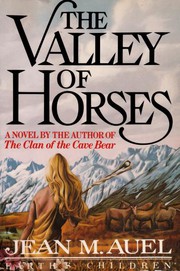
The Valley of Horses
2,311-word summary 10 min read 502 pages in the book
- First published
- 1982
- Publisher
- Crown Publishers
- Pages
- 502
- ISBN
- 9780517544891
- Series
- Earth's Children (#2)
Reading options
What's inside (9 sections)
Ayla walks north for half a year with almost nothing. She has a fur wrap, a sling, a knife, and a death curse on her head. The Clan she grew up with has cast her out, and the man who became her enemy made sure everyone understood that she was not to be spoken to, fed, or remembered. She is nineteen or twenty. She has a son, and she had to leave him behind because he belonged to the Clan and she did not.
That is where The Valley of Horses begins, and it is a brutal place to start a novel that will spend so much of its time on horseback rides and cave lion cubs. Auel does not soften the exile. Ayla is alone in a way that most loneliness books only pretend to understand. She has no language partner, no family, no tribe, no map. She has survived because the Clan taught her how to survive, and now she is walking away from the only people who ever taught her anything.
I read The Clan of the Cave Bear years ago and remembered it mostly as a book about a girl who could not stop being different. The sequel is about what happens when being different stops being a problem and becomes a life. It is longer, slower, and stranger than the first book. It is also more ambitious.
The valley
Ayla finds the valley by accident, or by instinct. It is a deep cut in the steppes, sheltered from the wind, with a cave, a stream, and enough plants and animals to last a winter. She explores it carefully. She checks the cave for bears. She learns where the sun rises and where the game moves. She builds a hearth, stores food, and prepares hides.
Auel is very good at this part. The book is often criticized for its length, and the criticism is fair, but the survival passages earn their space. Ayla does not simply "survive." She solves problems. She figures out how to keep meat from spoiling. She experiments with plants. She makes tools from bone and stone. She learns to start a fire by striking flint against iron pyrite, which is presented as a discovery rather than a given. The reader watches her think.
The valley is also a character. It has a rhythm. Spring brings new grass and foals. Summer brings berries and fish. Autumn is a race to store enough food. Winter is a test. Auel returns to the same places in different seasons, and the repetition builds a sense of home. By the time Jondalar arrives, the reader knows the valley as well as Ayla does. That matters, because the book is about the difference between a place that keeps you alive and a place that makes you want to stay.
Ayla's isolation is the engine of the first half. She talks to herself. She talks to the animals. She has dreams about her mother, a woman she barely remembers, and about a man with a beard who might be her father. She does not know what the Others look like. She has been told they are dangerous, animal-like, and without proper customs. She has also been told that she is one of them. The contradiction sits in her chest all winter.
Whinney and Baby
The two relationships that define the book are with a horse and a lion. Ayla kills a mare in a hunt, then discovers the mare had a foal. She takes the foal back to the cave, feeds her, and names her Whinney, after the sound she makes. Later, she finds an injured cave lion cub and nurses him back to health. She names him Baby.
The names are childish, and that is the point. Ayla has never had pets. She has never had the luxury of naming something for affection rather than utility. Whinney and Baby are not livestock. They are company. The book is honest about the work they require. Whinney needs to be fed, groomed, and trained. Baby needs meat and space and a great deal of patience. Ayla does not tame them with magic. She earns their trust slowly, with food and touch and consistency.
The horse changes how Ayla moves through the world. Once she can ride Whinney, the valley gets bigger. She can hunt farther, carry more, and escape faster. The book presents this as a practical breakthrough, but it is also an emotional one. Ayla has spent her life walking behind men. On Whinney, she is level with the horizon.
Baby is the more dangerous relationship. He is a predator, and Auel never lets the reader forget it. He is affectionate with Ayla, but he is not a dog. He kills. He has a mate. He will eventually have cubs of his own. The book's most important choice is to let Baby remain wild. Ayla does not turn him into a pet. She loves him and lets him go, and the letting go is what makes the love real.
The animal scenes are the best writing in the book. Auel is patient with them. She describes the way Whinney's ears move, the weight of Baby's paw, the smell of wet fur. The prose is not lyrical, but it is precise. The animals feel like animals, not humans in fur suits. That is harder than it looks.
The journey of the brothers
The other half of the novel follows Jondalar and his younger brother Thonolan. They are Zelandonii, from the Ninth Cave, and they are on a Great Journey, a traditional rite of passage that takes young men far from home. Jondalar is tall, blond, and skilled with flint. Thonolan is impulsive, funny, and eager to see everything. They are half-brothers, and they love each other in the way brothers do, which is to say they argue constantly and would die for each other.
Their journey is a tour of Ice Age Europe. They meet the Sharamudoi, a river people who build boats and hunt sturgeon. They meet the Mamutoi, the mammoth hunters who will matter in the next book. They learn languages, share food, and sleep with women. Auel uses the journey to show how many different ways there are to be human. The Zelandonii are not the center of the world. They are one tribe among many.
Thonolan falls in love with a Sharamudoi woman named Jetamio. He marries her and settles for a while. She becomes pregnant. For a few chapters, it looks like the journey will end there, with Thonolan becoming a river man and Jondalar going home alone. Then Jetamio dies in childbirth, and the baby dies with her. Thonolan stops caring whether he lives or dies. He pushes on, takes stupid risks, and picks fights with animals he should avoid.
Jondalar stays with him because he cannot leave him. That is the whole relationship in one sentence. Jondalar is the responsible one, the careful one, the one who keeps the fire going. He is also the one who has never been in love, or has been in love badly, and does not know what to do with the feeling when it arrives. Auel gives him a past with a woman named Zolena that left him cautious. She gives him a present with a Sharamudoi woman he does not love. By the time he meets Ayla, he is a man who has been trained to distrust his own desires.
The lion in the grass
The two storylines collide in the valley. Jondalar and Thonolan are traveling through, and Baby, now fully grown and living wild with a mate, attacks them. Thonolan is killed. Jondalar is badly mauled. Ayla finds him, drives Baby off, and carries him back to the cave.
The scene is not romantic. Jondalar is delirious, bleeding, and terrified. Ayla is a stranger who speaks a language he does not know. She strips him, cleans his wounds, sets his leg, and feeds him. He wakes up in a cave with a woman who looks like a flathead, which is the word his people use for the Clan. He has been taught that the Clan are animals. He has also been taught that animals do not make fire or heal wounds. The contradiction is the beginning of his education.
Ayla does not know what to make of him either. He is taller than the men of the Clan. He has a beard. He has blue eyes. He is one of the Others, the people she has been looking for, and he is also a stranger who might hurt her. She keeps her distance at first. She gives him food and medicine and watches him sleep. The book takes its time with this. Trust is built in small increments.
The language barrier is the best part of the middle section. Ayla and Jondalar create a pidgin of Clan signs, Zelandonii words, and gestures. They point. They repeat. They laugh at their own mistakes. Auel is good at showing how communication works before grammar. The scenes are funny and tender, and they make the later conversations feel earned.
Learning to be together
Once Jondalar can speak, he starts to teach Ayla Zelandonii. He tells her about his people, their caves, their Mother festival, their ideas about death and birth. She tells him about the Clan, and he listens, which is more than most of his people would do. He begins to understand that the Clan are not animals. He also begins to understand that Ayla is not a flathead, no matter how she was raised.
The romance builds slowly. Ayla is curious about sex, but she has been raised with Clan customs that treat it as a matter of mating and dominance. Jondalar is attracted to her, but he is also afraid. He has a history of wanting women he cannot have, and he does not want to repeat it. He pulls away. She is hurt. They misunderstand each other in ways that are painfully ordinary.
Auel is frank about desire. The book has several explicit scenes, and they are written with a mixture of awe and instruction that can feel dated. Ayla's first orgasm is treated as a discovery on the scale of fire. Jondalar's hesitance is treated as a psychological wound that only the right woman can heal. Some readers find this moving. Some find it purple. Both reactions are reasonable.
The emotional climax is not a battle. It is a decision. Jondalar has to choose whether to stay in the valley with Ayla or continue his journey home. Ayla has to choose whether to leave the valley, the animals, and the life she built. They choose each other. They leave together, heading toward the Mamutoi, and the book ends on the edge of the next story.
What works and what does not
The Valley of Horses is a long book. It is 500 pages in the original edition, and it feels like it. The survival chapters are absorbing, but they are also repetitive. Ayla hunts, gathers, stores food, and observes the seasons. The pattern repeats. Auel loves research, and she wants the reader to know how much she has done. Sometimes that is a pleasure. Sometimes it is a lecture.
The "Ayla invents everything" problem starts here. She domesticates a horse. She trains a lion. She discovers a new way to make fire. She develops a travois. She figures out how to ride. She is a genius at every practical skill she attempts, and the book rarely gives her a failure that costs her more than a day. This becomes more noticeable as the series goes on. In this book, it is still tolerable, because she is surviving alone and the stakes are clear.
The parallel structure is also uneven. Jondalar and Thonolan's journey is interesting, but it takes a long time to connect to Ayla's story. Some readers will find the cut between the two threads jarring. Others will appreciate the contrast between Ayla's solitude and the brothers' crowded, social world. The book is doing something deliberate: it is showing two kinds of loneliness. Jondalar is surrounded by people and still alone. Ayla is alone and has learned to fill the silence with animals.
The prose is plain. Auel writes long paragraphs and short chapters, and she is not afraid of exposition. The dialogue is sometimes stiff, especially when characters are explaining their customs. But the descriptions of landscape and animals are strong, and the emotional beats land when they need to. The ending is satisfying because it has been earned by three hundred pages of quiet work.
Who should read it
Read this if you read The Clan of the Cave Bear and wanted to know what happened to Ayla after the exile. Read it if you like survival fiction with a strong sense of place. Read it if you are interested in the Ice Age and do not mind a novel that doubles as a speculative anthropology lesson.
Do not read it if you need a fast plot. Do not read it if explicit sex scenes bother you. Do not read it if you are looking for a realistic Neanderthal novel, because the Clan are filtered through Ayla's memory and Jondalar's prejudice, and the book is more interested in her future than in their past.
What remains is a strange, generous book. It believes that a woman alone can build a life, that animals can be family, and that two people from different worlds can learn to speak to each other. It takes its time. It repeats itself. It loves its own research a little too much. But it also has a scene where a girl rides a horse across a valley she has made her own, and that image stays.
FAQ
Do I need to read The Clan of the Cave Bear first?
Yes. The Valley of Horses begins right after Ayla's exile, and the first book explains the Clan, Broud, and her son.
How old is Ayla in The Valley of Horses?
She is in her late teens and lives alone in the valley for roughly three years before Jondalar arrives.
Is The Valley of Horses historically accurate?
It is a novel built on Ice Age archaeology and speculation. The animals, tools, and travel routes are researched, but the dialogue and customs are invented.
Similar books
More from Earth's Children first, then related titles.
The Clan of the Cave Bear
A Cro-Magnon girl orphaned by disaster grows up with a Neanderthal clan, learning their medicine and customs while testing their limits.
3,684-word summary · 16 min read

Ivanhoe
A disinherited Saxon knight, a great tournament, a besieged castle and a trial by combat. Scott's most famous novel, set in England in 1194.
2,834-word summary · 13 min read
Fable
Abandoned on a lawless island at fourteen, Fable spends four years diving for gems to buy passage off it, straight into the cutthroat trade of the Narrows.
2,320-word summary · 10 min read
Written in My Own Heart's Blood
1778 war splits Jamies and Claires across rebellion and time as Brianna hunts a kidnapped son.
2,008-word summary · 9 min read
One Thousand White Women: The Journals of May Dodd
May Dodd journals joining Cheyenne as a bride in an 1875 government swap, learning prairie life and loss.
2,036-word summary · 9 min read
Daughter of Fortune
Eliza Sommers flees Chile for California gold rush San Francisco, disguised and searching for her lover, finding freedom with Tao Chi'en.
2,009-word summary · 9 min read
The Scarlet Pimpernel
A foppish baronet rescues aristocrats from the guillotine while his French wife hunts the hero she scorns.
2,980-word summary · 13 min read
The Gentleman's Guide to Vice and Virtue
Bisexual heir Monty flees across Europe with his crush Percy and sister Felicity after stealing a dangerous box.
2,724-word summary · 12 min read
A Breath of Snow and Ashes
Jamie and Claire Fraser face the coming Revolution on Fraser's Ridge, torn between Crown oaths and rebel neighbors as old enemies return.
2,362-word summary · 10 min read
The Things We Cannot Say
A Florida mother travels to Poland to answer her silent grandmother's plea, uncovering a wartime love story and a decades-old identity swap.
2,365-word summary · 11 min read
The Fiery Cross
Jamie musters militia for Tryon while Brianna and Roger wed on the Ridge, ending at Alamance with a hanging that steals Rogers voice.
2,719-word summary · 12 min read
Cold Mountain
Wounded deserter Inman walks home to Ada as the Civil War ends, while she learns to keep a mountain farm in North Carolina with tough Ruby.
2,314-word summary · 10 min read
Drums of Autumn
Brianna crosses stones to save parents, finding love, assault fallout, and a home to build.
2,003-word summary · 9 min read
Voyager
Claire returns through the stones in 1968 after learning Jamie survived Culloden.
2,901-word summary · 13 min read
Robinson Crusoe
Shipwrecked near South America, Crusoe spends 28 years farming, building, praying, and facing who he becomes alone.
2,520-word summary · 11 min read
Dragonfly in Amber
Claire 1968 recalls Jacobite Paris with Jamie to stop Culloden.
2,530-word summary · 11 min read
Hatchet
A plane crash leaves thirteen-year-old Brian alone in the Canadian wild with only a hatchet.
2,770-word summary · 12 min read
Watership Down
Hazel leads a small band of rabbits from a doomed warren to Watership Down, where survival means facing snares, farms and General Woundwort.
2,550-word summary · 11 min read
The Tattooist of Auschwitz
Heather Morris retells the years of Lale Sokolov as tattooist at Auschwitz Birkenau, his love for Gita Furman, and the food trades and quiet risks that kept…
2,442-word summary · 11 min read
The Stationery Shop
Two teenagers fall in love in a Tehran stationery shop in 1953, are separated by the coup and a family deception, and meet again sixty years later.
2,024-word summary · 9 min read

The Long Winter
Dakota Territory, 1880: seven months of blizzards cut a town off from the railroad, and a family survives on twisted hay, ground wheat, and a dangerous wheat…
2,210-word summary · 10 min read

The Japanese Lover
A Polish refugee and the son of a Japanese gardener fall in love in San Francisco in 1939, then keep the affair secret for nearly seventy years.
2,286-word summary · 10 min read

Anatomy: A Love Story
In 1817 Edinburgh, a noblewoman who wants to be a surgeon disguises herself to study anatomy and falls for the grave robber who supplies her with bodies.
2,031-word summary · 9 min read

Vow of Thieves
Kazi and Jase return to Tor's Watch to find it occupied, and their marriage is tested by captivity, betrayal, and a war for the town of Hell's Mouth.
2,059-word summary · 9 min read

The Shadow Sister
Star D'Apliese steps out of her sister's shadow and follows a bookshop clue into the Edwardian life of Flora MacNichol, a woman who gave up love for duty.
2,260-word summary · 10 min read
The Power of One
A boy in apartheid South Africa decides to become welterweight champion of the world, and the novel follows every mentor, fight, and loss that gets him there.
2,145-word summary · 10 min read
The Icebound Land
Captured and enslaved in Skandia, Will fights a drug that erases him while Halt and Horace cut a bloody road through Gallica to bring him home.
2,088-word summary · 9 min read
The Beach
A young backpacker follows a dead man's map to a hidden island community, then discovers what the people there are willing to do to keep it secret.
2,067-word summary · 9 min read

Archenemies
Nova steals for the Anarchists while Adrian hides his Sentinel identity, and a serum that erases prodigy powers puts them both at risk.
2,485-word summary · 11 min read
Carve the Mark
On a planet divided between conquered and conqueror, the tyrant's sister and a kidnapped oracle's son discover that their gifts make them useful to everyone…
2,340-word summary · 10 min read