
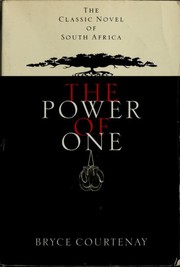
The Power of One
2,145-word summary 10 min read 518 pages in the book
- First published
- 1989
- Publisher
- Ballantine Books
- Pages
- 518
- ISBN
- 9780345410054
Reading options
What's inside (9 sections)
A friend gave me this book in my twenties with the warning that it would either make me want to box or make me want to move to South Africa. Neither happened, but I understand the impulse. Bryce Courtenay's first novel is a big, shameless, propulsive story about a boy who decides he is going to be the welterweight champion of the world and then spends five hundred pages making that sound reasonable. It is not a subtle book. It is not a careful book. It is the kind of book that gets read in one long weekend and then argued about for years.
Published in 1989, The Power of One arrived when Courtenay was in his fifties, after a career in advertising. You can feel that background in the way the novel sells its own emotions. Every chapter has a hook, every setback has a lesson, and every minor character seems to arrive carrying a piece of wisdom the hero will need later. That can be exhausting. It can also be exactly what you want from a novel about a kid with nothing who talks his way into a better life.
The Boy Called Pisskop
The story begins in South Africa in 1939, with a five-year-old English-speaking boy whose mother has a nervous breakdown. He is raised for a while by a Zulu nanny, Mary Mandoma, and then sent to a boarding school where he is the youngest and smallest student. The other boys call him Pisskop, which means piss-head, because he wets the bed. They also call him rooinek, a slur for English South Africans that goes back to the Boer War.
The school is run by an Afrikaans woman with a whip and a taste for humiliation. The worst of the boys is an older child known only as the Judge, a Nazi sympathizer who has decided that the boy represents everything he hates. The Judge and his friends beat him, starve him, and make him do their homework. When the boy brings a pet chicken, Granpa Chook, back to school, the Judge kills it and forces him to eat part of it. It is a horrible sequence, and Courtenay does not soften it.
What saves the boy is not a teacher or a social worker. It is a Zulu medicine man named Inkosi-Inkosikazi, who is brought in to cure the bedwetting. The cure works, but the more important thing is what he teaches the boy: a private place in his mind with three waterfalls and ten stepping stones, where he can go when the world is too much. The boy also learns a phrase that becomes the book's title, the power of one, the idea that one person can change a situation if he refuses to be afraid.
The Train and the Teacher
On the train to Barberton, where his mother has gone to live after leaving the institution, the boy meets Hoppie Groenewald, a boxer and a talker. Hoppie lets him hold his gloves, takes him to a fight, and gives him the line that the novel repeats for the next four hundred pages: first with your head, then with your heart. It is good advice for boxing and better advice for living, and the boy takes it literally. By the time the train pulls in, he has decided to become the welterweight champion of the world.
Barberton gives him two more teachers. The first is Doc, a German professor of music and botany who has been interned as an enemy alien. Doc lives in the prison but is allowed to tend his cactus garden, and he teaches the boy piano, German, and a kind of disciplined curiosity. The second is Geel Piet, a prisoner who runs the boxing squad and teaches him how to move, how to feint, and how to take a punch. Geel Piet is a small, funny, damaged man, and his murder by a warder is one of the novel's real gut punches.
The prison chapters are where the book becomes something more than a boys' adventure. The boy runs errands for the prisoners, carries letters, smuggles tobacco, and becomes a mascot they call the Tadpole Angel. He sees the machinery of apartheid up close, though he does not yet have the language for it. He also sees that the people inside the prison are more generous to him than the people outside who are supposed to care for him. That inversion is the moral center of the novel.
Johannesburg and the Business of Winning
At twelve, the boy wins a scholarship to the Prince of Wales School in Johannesburg. There he meets Morrie Levy, the son of a Jewish millionaire, who becomes his manager, his business partner, and his closest friend. Together they run small scams, sell things to other boys, and build a reputation. Morrie is the brains, the boy is the muscle, and their friendship is one of the few relationships in the book that feels equal.
Boxing becomes the organizing principle of his life. He trains with Solly Goldman, a legendary coach, and starts winning. He faces Gideon Mandoma, the son of his old nanny, in a fight that carries more weight than any title. He excels at rugby and academics. He is, for a while, a stranger to failure. Then Doc dies, and the Rhodes scholarship he was counting on goes to someone else, and the neat ladder he has been climbing falls apart.
This is the part of the book that works best for me. Success in The Power of One is not a straight line, and the setbacks are not just plot obstacles. Doc's death takes away the adult who saw him as a whole person rather than a project. The lost scholarship takes away the plan. What is left is a young man who has been trained to fight but has not yet decided what he is fighting for.
The Mines and the Judge
He goes to Northern Rhodesia to work in the copper mines, partly to build up his body for the welterweight division and partly to get away from everything he knows. The mine is another education. He works as a grizzly man, one of the most dangerous jobs underground, and he meets Rasputin, a Georgian miner who becomes a friend and then a sacrifice. When an accident traps them, Rasputin saves the boy and dies in the process, leaving him enough money to go to Oxford.
Before he leaves, he runs into the Judge again. The Judge is now a broken, violent man working with explosives, and he tries to kill him. The fight that follows is the novel's climax, and it is deliberately mythic. The boy uses everything he has learned, from Geel Piet's footwork to Hoppie's advice, and he wins. Then he carves a Union Jack and his initials over the swastika on the Judge's arm. It is a childish gesture, and the book knows it. That is part of the point.
The ending is not really an ending. He is still young, still ambitious, and still carrying the people who died for him. The novel closes with him walking into the night, which is the kind of image Courtenay loves. It works because the book has earned a certain amount of swagger. It has also earned a certain amount of skepticism.
The Film and the Reputation
The 1992 film version is worth mentioning because it shows what the novel loses when it is compressed. Directed by John G. Avildsen, who had already made Rocky and The Karate Kid, the film keeps the boxing, the prison, and the friendship with Doc, but it flattens the South African politics into background color. Morgan Freeman plays Geel Piet, which is good casting, and the movie is watchable. It is also much smaller than the book.
In Australia, the novel became a kind of institution. It was voted onto lists of favorite books, taught in schools, and passed around families. Courtenay went on to write many more novels, most of them historical epics with the same love of unlikely heroes and long odds. None of them had quite the same grip. The Power of One is the one people remember, partly because it was first and partly because it arrived at the right moment, when a generation of Australian readers was ready for a big story about a small boy who refuses to stay small.
That reputation can be a burden. Readers who come to it expecting a masterpiece will find the coincidences and the sentimentality hard to forgive. Readers who come to it expecting a yarn will have a good time. The book is best approached as a yarn with ambitions, not as a novel of ideas. It wants to move you, and it usually does, even when you can see the machinery.
What the Book Gets Wrong
The Power of One has been criticized since it was published for being formula fiction, and the criticism is fair. The plot runs on coincidence. The right mentor appears whenever the hero needs one. The villains are grotesques, especially the Judge, who has no interior life beyond cruelty. The women are mostly saints or obstacles. The politics of apartheid are present as weather rather than as a system with beneficiaries, and the novel is more interested in individual triumph than in collective change.
There is also the matter of the "power of one" itself. The phrase sounds inspiring, but the book's version of it is essentially meritocratic: a gifted boy works hard, finds the right coaches, and rises. It does not ask what happens to the children who do not have a Doc or a Geel Piet. It does not ask whether the system that produced the Judge can be reformed by one good boxer. Courtenay is telling a story about survival and self-invention, not a story about justice, and the two are not the same.
The women in the novel get a raw deal. Mary Mandoma is warm and wise and then disappears. Peekay's mother is a nervous invalid who becomes a born-again Christian and a source of embarrassment. Maria, the girl he loves, exists mainly to give him something tender to lose. The book is written from the perspective of a boy who sees women as caretakers or symbols, and while that may be psychologically true to the character, the novel never steps outside that view to give them a life of their own.
The prose can also be clumsy. Courtenay repeats his lessons, sometimes within a few pages. He tells you what a scene means before he lets you feel it. The novel is long, and the middle section in Johannesburg drags. If you are allergic to inspirational fiction, this book will set off every alarm you have.
There is one more problem, and it is the ending. Peekay beats the Judge in a bar fight and carves his initials into the man's arm. It is satisfying in the way that revenge always is, but it is also a fantasy of individual violence solving a problem that the novel has spent hundreds of pages describing as structural. The Judge is not apartheid. He is a bully with a swastika. Beating him does not change the country, and the book does not pretend that it does, but the scene still lets the reader feel as if the account has been settled.
Why It Still Works
And yet. The Power of One has sold millions of copies for a reason. It is a book about a child who is told, in every possible way, that he does not matter, and who decides to matter anyway. That is a fantasy, but it is a durable one. Courtenay writes action well. The boxing scenes are clear and exciting. The prison sequences have real tension. The friendship between the boy and Morrie is funny and warm.
The book is also a portrait of a particular place and time that is hard to find elsewhere in popular fiction. The South Africa of the novel is a world of boarding schools, small towns, mines, and prisons, all organized by race and language. Courtenay does not explain the country to outsiders. He assumes you can keep up. That confidence gives the book texture, even when the politics are underdeveloped.
I would not call The Power of One a great novel. I would call it a great read, the kind of book that makes a long train journey feel short. It is at its best when it forgets to be inspiring and simply shows you a boy in a bad situation learning something useful from an unlikely adult. First with your head, then with your heart. It is a slogan, but it is also a decent way to live.
FAQ
Is The Power of One based on Bryce Courtenay's life?
Partly. Courtenay drew on his own South African childhood and his love of boxing, but Peekay is a fictional character and the plot is heavily heightened.
What does the power of one mean in the book?
It is the idea that one determined person can change a situation. Peekay uses it to survive school and to build a boxing career, and the novel treats it as a personal creed rather than a political program.
Is The Power of One suitable for younger readers?
It contains graphic bullying, violence, and sexual content, so it is usually read by older teenagers and adults rather than children.
Similar books
Maniac Magee
Orphaned Jeffrey Magee runs to Two Mills, becomes a playground legend, and tests a town split by race while hunting for a real home.
2,219-word summary · 10 min read

Fever 1793
Philadelphia, 1793: fourteen year old Mattie Cook nurses family, buries neighbors, and keeps a coffeehouse through yellow fever.
2,259-word summary · 10 min read
The Clan of the Cave Bear
A Cro-Magnon girl orphaned by disaster grows up with a Neanderthal clan, learning their medicine and customs while testing their limits.
3,684-word summary · 16 min read

Lilac Girls
Three women meet across World War II: a New York volunteer, a Polish courier turned prisoner, and a German camp doctor.
2,731-word summary · 12 min read
City of Girls
City of Girls retold: a Vassar dropout, a shabby theater, one scandal, and a love like no other.
2,823-word summary · 13 min read
The Kite Runner
Khaled Hosseini's The Kite Runner retold: Amir and Hassan in Kabul, the alley, the escape to America, and the return to find Sohrab.
2,584-word summary · 11 min read
The Orphan's Tale
A Dutch teenager rescues a Jewish baby from a death train and joins a German circus, where a Jewish aerialist teaches her to fly.
2,943-word summary · 13 min read

The Long Winter
Dakota Territory, 1880: seven months of blizzards cut a town off from the railroad, and a family survives on twisted hay, ground wheat, and a dangerous wheat…
2,210-word summary · 10 min read
Take My Hand
In 1973 Montgomery, a young nurse discovers that two sisters were sterilized without consent, and spends the rest of her life living with what she could not…
2,126-word summary · 9 min read
Brown Girl Dreaming
Jacqueline Woodson retells her childhood in verse, moving from Ohio to South Carolina to Brooklyn while the civil rights movement reshapes the world around her.
2,727-word summary · 12 min read
Anya's Ghost
A lonely Russian immigrant falls into a well, befriends the ghost trapped there, and discovers that the ghost's help comes with a dangerous price.
2,001-word summary · 9 min read

Little Town on the Prairie
In the spring after the Long Winter, fifteen-year-old Laura sews shirts, studies for a teaching certificate, and helps send her blind sister Mary to college.
2,071-word summary · 9 min read

Dumplin'
Willowdean Dickson enters her town's beauty pageant as a protest and discovers that confidence is harder to keep once she lets someone close.
1,922-word summary · 9 min read
Five Point Someone: What Not to Do at IIT
Three friends at IIT drift to a five-point GPA, mock the system, and break into a professor's office for an exam paper.
2,458-word summary · 11 min read
Wilder Girls
At a quarantined boarding school off Maine, three girls with strange mutations search for a missing friend and learn what the adults have hidden.
2,594-word summary · 12 min read
The Valley of Horses
Exiled from the Clan, Ayla survives alone in a hidden valley, tames a horse and a cave lion, and nurses a wounded stranger back to life.
2,311-word summary · 10 min read
A Long Walk to Water
Two eleven-year-olds in southern Sudan, twenty-three years apart: a Dinka boy fleeing war and a Nuer girl walking hours for water, until their stories meet at…
2,217-word summary · 10 min read
The House of the Scorpion
A clone raised in a drug lord's poppy fields learns what he was made for and chooses what to do with the life he was given.
2,527-word summary · 11 min read
The Troop
A Boy Scout troop on a Canadian island takes in a stranger who cannot stop eating, and the worm inside him turns a camping trip into a war.
2,457-word summary · 11 min read

Wide Sargasso Sea
Jean Rhys gives the first Mrs. Rochester a Caribbean childhood, a marriage built on money and suspicion, and a voice that Charlotte Bronte left in the attic.
2,021-word summary · 9 min read
The Second Summer of the Sisterhood
Four friends share the traveling pants through a summer of grandmothers, first loves, and mothers who are learning to let go.
2,209-word summary · 10 min read
The Blind Side: Evolution of a Game
Michael Lewis traces how the left tackle became a premium position and tells the story of Michael Oher, a homeless Memphis teenager whose size and speed made…
2,038-word summary · 9 min read
On the Come Up
Bri Jackson, a sixteen-year-old rapper in Garden Heights, chases a record deal while a viral song turns her into a symbol she never wanted to be.
2,034-word summary · 9 min read
Aristotle and Dante Dive into the Waters of the World
Ari and Dante return for senior year in El Paso, navigating first love, AIDS, family grief, and the cost of being openly gay in 1987 Texas.
2,188-word summary · 10 min read
A Painted House
In 1952 Arkansas, seven-year-old Luke Chandler picks cotton with his family and learns how quickly poverty, violence, and adult secrets can end a childhood.
2,060-word summary · 9 min read
The House of Eve
Two Black women in 1950s Philadelphia and Washington, one a pregnant teenager and one a doctor's wife who cannot carry a child, are pulled together by a…
2,270-word summary · 10 min read
Harriet the Spy
Eleven year old Harriet Welsch fills notebooks with honest, often cruel observations about her neighbors, until her classmates read one and turn her spy route…
2,510-word summary · 11 min read

Someone Like You
Halley and her best friend Scarlett face a summer of grief, a surprise pregnancy, and Halley's dangerous first romance in Sarah Dessen's 1998 young adult novel.
2,218-word summary · 10 min read
Paper Girls, Volume 1
Four paper girls in 1988 Ohio chase a stolen walkie-talkie into a basement and stumble into a time war, flying dinosaurs, and an older version of themselves.
2,235-word summary · 10 min read
Luster
Edie, twenty-three and adrift in New York, falls into an affair with an older white archivist in an open marriage, and into the orbit of his wife and adopted…
2,049-word summary · 9 min read