
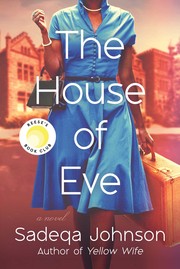
The House of Eve
2,270-word summary 10 min read 384 pages in the book
- First published
- 2023
- Publisher
- Simon & Schuster
- Pages
- 384
- ISBN
- 9781982197360
Reading options
What's inside (9 sections)
Most novels about adoption keep the birth mother offstage, a name on a form or a silhouette in a doorway, and the story belongs to the family that gets the child. The House of Eve does the opposite. Sadeqa Johnson gives the birth mother half the book, a first-person voice, a name, a dream and a price list, and by the time the adoption happens the reader knows exactly what it cost. That is the whole engine of the novel, and it runs hot from the first chapter.
The book opens with two epigraphs: a line from Toni Morrison and a line from Clarissa Pinkola Estes that ends, "Sometimes there are no words to help one's courage. Sometimes you just have to jump." That second line is the novel in miniature. Everyone here is jumping off a ledge of some kind, and Johnson is far less interested in whether they land than in what the jump says about the society that built the ledge.
Ruby Pearsall, October 1948
Ruby Pearsall is fifteen and lives in Philadelphia, and her plan for her life could fit on an index card. She is in the We Rise program, a local initiative for Black students that offers rigorous academic coaching and, for the ones who meet the standard, a scholarship to Cheyney University. Ruby needs that scholarship the way other people need air, because college is the only door she can see out of generational poverty. Her specific dream is optometry. Her grandmother lost her sight, and Ruby has spent years watching what blindness costs a woman who has no money, so she wants to be the person who catches vision problems early.
Her mother, Inez, is the first obstacle. Inez does not support the program, does not come to the meetings, and treats Ruby's ambition like a personal insult. Ruby's mentor in We Rise, Mrs. Thomas, keeps her steady through the paperwork and the practice tests, and their scenes together are the book at its warmest. Then the house detonates. Inez's boyfriend, Leap, forces a kiss on Ruby, and when Inez finds out, she blames her daughter and throws her out. Ruby lands at the door of her Aunt Marie, who takes her in but not without warnings about what poverty does to women who make romantic mistakes. It is a brutal opening act, and Johnson writes it without sentiment. Ruby is smart, careful and completely without protectors, which makes what happens next feel less like melodrama and more like arithmetic.
Shimmy Shapiro
Ruby falls in love with a Jewish boy from the neighborhood named Shimmy Shapiro, and the novel treats the relationship as both tender and dangerous. Interracial couples in 1948 Philadelphia are not simply disapproved of; they are targets. Ruby knows this and says so. Shimmy, who is kind, generous and largely innocent about the specific weight of anti-Black racism in America, does not fully grasp it, and the gap between Ruby's caution and Shimmy's optimism is one of the most honest things in the book. He is not a villain. He is a boy who has never had to calculate the odds the way she has.
They sleep together, and Ruby gets pregnant. Shimmy wants to marry her, immediately and sincerely, and for about a page the reader can see the alternate novel where that works. Then his mother enters the story. Mrs. Shapiro sits on the We Rise board, which means she controls the thing Ruby has spent years earning, and she makes the offer that the entire book exists to examine: give up the baby for adoption, and the scholarship is safe. Ruby tells Shimmy that his mother will never accept them, and that the life he is imagining cannot survive the world they live in. Against his wishes, she takes the deal, because she has done the math that he refuses to do. A baby, a marriage, a Jewish family that does not want her, and no degree adds up to a life she can already see in her aunt's face. So she goes to the House of Magdalene.
Eleanor Quarles in Washington
The other half of the novel belongs to Eleanor Quarles, and the structural choice to tell her story in third person while Ruby's runs in first is the book's smartest move. Ruby narrates from inside her own skin. Eleanor is observed, mostly by herself, from a slight distance, which suits a woman who has taught herself to present well and feel carefully.
Eleanor is a student at Howard University in Washington, DC, from a modest family with warmth in it, and she falls in love with William Pride, a medical student whose family is Black Washington royalty. The Prides are wealthy, established, and pale, and Rose Pride, William's mother, runs the household's social order with an iron glove. Rose does not object to Eleanor personally as much as to Eleanor's entire category. She has a light-skinned heiress in mind for her son. The dinner scene where Eleanor meets the family, and sees what she later describes as a room filled with white-faced Negroes, lays out the novel's secondary theme with a wink and a knife: colorism inside Black society, and the way class polishes it into something that looks like manners.
Eleanor does not back down, and neither does William, who marries her against his mother's wishes. The marriage is happy and then it is grief-stricken. Eleanor gets pregnant, and miscarries. A year later she gets pregnant again, and miscarries again. Her doctor delivers the sentence that makes the plot turn: another pregnancy would be dangerous for her. So the Prides, who have love and money and a name, and none of what they actually want, decide to adopt. Their mentor-shaped figures include Mrs. Porter, who steadies Eleanor the way Mrs. Thomas steadies Ruby, and the parallel mentorship works because Johnson keeps it quiet. Both women in this novel are being raised, in a sense, by women who are not their mothers, which is its own comment on the families these women came from.
The House of Magdalene
The House of Magdalene is the novel's title engine, the place where its two rivers meet. It is a home for unwed mothers where girls are hidden, counseled, shamed and delivered, and where their babies are adopted out. Mother Margaret runs it with a surface of Christian kindness and a spine of institutional pragmatism, and the house has only four spots for Black mothers, which gives the room a waiting list and gives Mother Margaret the upper hand. Ruby's chapters inside the home are the hardest reading in the book. The shaming room, the chores, the other girls' stories, the nuns who wrap ordinary fear in Scripture, the constant messaging that the baby inside her is evidence of sin and that the only way forward was to forget. That last phrase belongs to Mother Margaret, and Ruby repeats it later with a bitterness the reader has earned.
Meanwhile, the Prides are waiting for a baby, and the machinery clanks. The baby the house intended for them is born with an eye condition, which the adoption apparatus reads as defective, and the child is dispatched to an orphanage. A slot opens. Mother Margaret does what institutions do when paying customers are inconvenienced: she induces Ruby's labor early, before her body is ready, to deliver a replacement. The scene is as frightening as it sounds. Ruby drifts in and out, feels instruments, hears people speaking about her rather than to her, and hates everyone in the room, including, for one honest minute, the boy who got her here. The nurses wrap her daughter in a green blanket and hesitate when she asks the baby's sex, which tells Ruby everything about how the transaction is being managed.
She names the baby Grace. She nurses her for five days, and the nurses warn her against getting attached, which is like warning a drowning person against water. Ruby looks at her daughter and sees Inez in her, and Shimmy, and herself. She runs the alternatives through her mind and remembers Aunt Marie's warnings, and the shame of the home, and the fact that a girl with a baby in 1948 has one future and a girl with a degree has another. Then Grace is taken to Eleanor and William, and Ruby goes home with stitches and no baby, and the novel refuses to tidy the moment. There is no villain in the room. There is a system built out of everyone's good reasons, and a girl who paid for it.
What Comes After
The last quarter of the book is about what the two women build on top of that day. Ruby keeps away from Shimmy, even though he wants to try again, because she understands that loving him would cost her everything she fought for. She takes her scholarship, does the work, and becomes an optometrist, a woman who fixes sight for a living, which Johnson cannot resist as a metaphor and does not need to. Eleanor raises Grace with William, and the novel lets that home be a good one. The update on Rose is the quiet surprise: mother-in-law and daughter-in-law come to an understanding, and the book lets Eleanor have a mother figure after all. The two epigraphs circle back here. Morrison's monsters are revealed to be mostly institutions. The Estes line about jumping belongs to everyone who lived through that era of American history without going under.
The novel's final chapter is the only scene in the entire book in which Ruby and Eleanor meet in person, and Johnson stages it years later, briefly, with the reader knowing everything and the characters knowing only what they know. I will not spoil the mechanics of the encounter, because the scene is the point. For some readers it will feel like the perfect restraint, the two women circling each other at last without any reunion sermon. For others it will feel like a door closing one chapter too early. I understand both reactions and lean toward the first. The book has already said what it needs to say about what these women owe each other, and the answer is complicated, which is why the meeting is short.
The History Behind the House
Johnson has said the novel grew out of reading about maternity homes, and the details she uses are drawn from a well-documented system. In the middle of the twentieth century, hospitals, churches and private agencies ran homes where pregnant girls were hidden away, sometimes under new names to protect the families who sent them there, and delivered under heavy social pressure to surrender. Closed adoptions sealed the records, which meant that for decades afterward many adoptees could not learn who their birth parents were, and birth mothers had no reliable way to search. Race shaped the system at every step. Black unwed mothers had fewer beds, which is why the House of Magdalene has exactly four, and fewer agencies willing to help them after a birth, which is why so many mothers in those years ended up keeping children they could not afford. Adoptions across racial lines were rare and heavily stigmatized. The Prides, for all their money, are only able to adopt because a Black child was available, and the novel is honest about what happens when a powerful family's longing meets an institution's ledger.
The title carries part of the critique too. Eve is the woman blamed for the fall, the first person punished for wanting knowledge and a life of her own, and the House of Magdalene is where that old story gets taught to teenage girls as policy. Ruby wants a degree. Eleanor wants a family. The book arranges for one woman's dream to cost the other woman nearly everything, and it refuses to let either of them be the villain. The system is the villain, and systems do not apologize.
The Verdict
The House of Eve has an engineered spine, and you can see the engineering. The alternating chapters are evenly weighted, the parallels are deliberate, and Mother Margaret's decision to induce a birth to satisfy adopters is a plot device that creaks when you press on it. Some readers will find the prose plain and the emotional beats telegraphed. I did not mind, because the research underneath the machinery is doing real work. The stocking counter where Ruby and Aunt Marie are insulted, the color line inside Black Washington society, the home for unwed mothers with four Black beds and a waiting list, the way a scholarship could function as hush money: none of that is invention, and Johnson writes it with the flat authority of a woman who has read the files.
What lingers is Ruby. The novel's best chapters are her first-person ones, partly because Johnson's voice for her is so unadorned and specific, and partly because the book trusts her to be smart without making her likable on schedule. She is hard on Shimmy, hard on her mother, hard on the imaginary girl she might have been. She is also a teenager, and grieving, and running on nerve, and the ending gives her a life that feels earned rather than awarded. If you read Yellow Wife and wanted Johnson's eye turned toward the twentieth century, this is the book. Bring tissues and a clear afternoon, because the middle hundred pages do not let up, and the green blanket will stay with you longer than any of the history dates.
FAQ
Is The House of Eve based on a true story?
It is fiction, but Sadeqa Johnson drew on the real history of midcentury homes for unwed mothers and the shame and coercion that surrounded them.
How are Ruby and Eleanor connected?
Ruby gives birth at the House of Magdalene, and Mother Margaret arranges for her baby to be adopted by Eleanor and William Pride. The two women meet in person only in the novel's last chapter.
Is The House of Eve part of a series?
No. It is a standalone novel, though it shares the midcentury Black historical setting of Johnson's earlier book Yellow Wife.
Similar books
Mrs. Everything
Two Jewish sisters in Detroit grow up, apart and together, across seven decades of American life, from the 1950s to the 2016 election.
2,362-word summary · 10 min read

Violeta
A woman born in 1920 writes her life story to her grandson, from one pandemic to another, through wealth, ruin, passion, and dictatorship in South America.
2,555-word summary · 11 min read
Take My Hand
In 1973 Montgomery, a young nurse discovers that two sisters were sterilized without consent, and spends the rest of her life living with what she could not…
2,126-word summary · 9 min read
The Power of One
A boy in apartheid South Africa decides to become welterweight champion of the world, and the novel follows every mentor, fight, and loss that gets him there.
2,145-word summary · 10 min read
The Only Woman in the Room
A novel about Hedy Lamarr's escape from an arms-dealer husband, her Hollywood career, and the frequency-hopping patent the Navy ignored.
2,067-word summary · 9 min read
Little Earthquakes
Four Philadelphia women meet during pregnancy and discover that new motherhood is nothing like the plan, while friendship becomes the thing that holds them…
1,997-word summary · 9 min read
Last Night at the Telegraph Club
The 2021 National Book Award winner follows Lily Hu, a Chinese American teenager in 1954 San Francisco, as she falls for Kath and learns what it costs to be…
2,336-word summary · 10 min read
Euphoria
Three anthropologists in 1930s New Guinea turn fieldwork into a love triangle, and a real history breathes behind them.
2,048-word summary · 9 min read

Wide Sargasso Sea
Jean Rhys gives the first Mrs. Rochester a Caribbean childhood, a marriage built on money and suspicion, and a voice that Charlotte Bronte left in the attic.
2,021-word summary · 9 min read
Where We Belong
Marian's orderly New York life cracks when the daughter she gave up for adoption arrives, and the search for the father forces her to tell the truth.
2,056-word summary · 9 min read
A Painted House
In 1952 Arkansas, seven-year-old Luke Chandler picks cotton with his family and learns how quickly poverty, violence, and adult secrets can end a childhood.
2,060-word summary · 9 min read
The Lost Girls of Paris
In 1946, a war widow finds an abandoned suitcase in Grand Central holding photographs of twelve women who vanished in the war, and follows their story back to…
2,668-word summary · 12 min read
The Water Dancer
An enslaved man with a strange power for travel fights to free himself and rescue those he loves.
2,910-word summary · 13 min read
The Book of Lost Friends
Three women trace Lost Friends ads from 1875 to find stolen sons.
2,368-word summary · 11 min read
Song of Solomon
Milkman Dead leaves Michigan to hunt for family gold and finds instead the old song of his ancestor Solomon.
2,465-word summary · 11 min read
Roll of Thunder, Hear My Cry
In Depression-era Mississippi, nine-year-old Cassie Logan learns what her Black family's land costs and why they keep it.
2,273-word summary · 10 min read
The Frozen River
Midwife Martha Ballard pens a frozen man's wounds in 1789 Maine while standing men demand forgetting.
2,043-word summary · 9 min read
The Personal Librarian
Belle da Costa Greene builds J.P. Morgan's library into a world treasure while hiding that she is Black in a white world.
2,155-word summary · 10 min read
The Henna Artist
In 1950s Jaipur, a henna artist to rich women rebuilds her life until the sister she never knew arrives.
2,104-word summary · 9 min read
Our Missing Hearts
In a fearful future America, twelve-year-old Bird crosses the country to find the poet mother who left him.
2,434-word summary · 11 min read
The Heaven and Earth Grocery Store
In a 1930s company town, Black and Jewish neighbors hide a deaf boy from the state and pay for it for years.
2,038-word summary · 9 min read
The Lincoln Highway
Emmett and Billy plan California in 1954, but two escapees steal their car and drag them east to New York.
2,954-word summary · 13 min read
Snow Flower and the Secret Fan
Footbound Lily and Snow Flower share laotong bond through 19th century Hunan hardship.
2,557-word summary · 11 min read
Small Great Things
A Black nurse faces trial after a white supremacist couple bans her from their baby.
2,221-word summary · 10 min read
My Brilliant Friend
Elena and Lila grow up in 1950s Naples bound by rivalry and love.
2,584-word summary · 11 min read
Orphan Train
Foster teen Molly helps 91-year-old Vivian clear her attic and uncovers a hidden orphan-train childhood.
2,488-word summary · 11 min read
Everything I Never Told You
In 1977 Ohio, sixteen-year-old Lydia Lee is found dead in a lake, forcing her interracial family to face the secret pressures around race, school and duty that…
2,711-word summary · 12 min read
Before We Were Yours
Avery uncovers her family's link to stolen orphans while Rill fights to keep her siblings together in 1939.
2,020-word summary · 9 min read
Little Fires Everywhere
In planned Shaker Heights, Elena Richardson rents to drifting artist Mia Warren, and a custody fight over baby May Ling splits friends and teens.
1,911-word summary · 8 min read
The Stationery Shop
Two teenagers fall in love in a Tehran stationery shop in 1953, are separated by the coup and a family deception, and meet again sixty years later.
2,024-word summary · 9 min read