
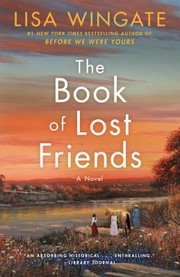
The Book of Lost Friends
2,368-word summary 11 min read 416 pages in the book
- First published
- 2020
- Publisher
- Ballantine Books
- Pages
- 416
- ISBN
- 9781984819895
Reading options
What's inside (8 sections)
I came to The Book of Lost Friends because Before We Were Yours had stayed with me, and I wanted to see what Lisa Wingate would do with another buried piece of American history. The Book of Lost Friends was published by Ballantine Books in 2020, a 416 page novel with ISBN 9781984819895. Google Books lists the edition under Random House Publishing Group, which makes sense because Ballantine is an imprint inside that group. I read it over a slow weekend, expecting a straight road story, and found something closer to two school lessons folded into one book, one set in 1875 and one in 1987, both set around the same small Louisiana town.
The hook is real. After the Civil War, newly freed people placed Lost Friends advertisements in Southern newspapers, especially in the Southwestern Christian Advocate, a Methodist paper. They were looking for children, parents, husbands, wives, brothers and sisters sold away under slavery. Those notices were read aloud in churches. Wingate prints real examples between chapters. That device gives the novel its spine. Even when the fictional plot wobbles, those short notices pull you back to what is at stake.
Hannie Gossett is the heart of the older story. She is eighteen in 1875, born into slavery on the Gossett place at Goswood Grove near Augustine, Louisiana. By the time we meet her, slavery has ended but freedom is thin. She works as a sharecropper on land her family never owned, tied by debt and habit to white people who once held her. Her mother and eight siblings were sold away before the end of slavery. She carries small keepsakes and scraps of memory, and a habit of counting family the way other people count money. She is cautious, observant, good with horses and work, and slow to trust promises.
Lavinia Gossett is the heir to that same ruined place. She grew up pampered and is now nearly broke. The plantation house is falling down. The family name still opens a few doors in Augustine, but there is no cash behind it. Juneau Jane is Lavinia's Creole half sister, free born, the daughter of the old master by another woman. That tie makes her both family and outsider. White neighbors do not fully accept her. Black neighbors do not fully trust her. Lavinia does not know how to treat her. Hannie watches both of them with a mix of loyalty and wariness that took years to form.
The three set out for Texas. That is the engine for the 1875 chapters. For Lavinia and Juneau Jane, the trip is about money and papers. Their father left loose ends, and there may be an inheritance or a claim worth chasing in Texas if they can get there and prove who they are. For Hannie, the trip starts as an order. She is sent along to help and to serve. Then it turns into something else. Moving west means moving along the same roads and through the same towns where freed people are posting and answering Lost Friends notices. Every stop brings a chance that someone saw her mother, or a brother, or knows a name.
Work and debt at Goswood Grove
The early chapters stay close to Goswood Grove and Augustine. Wingate is good at showing how slavery was replaced by arrangements that looked different on paper and felt close to the same in daily life. Hannie works hard. What she earns goes back out for seed, tools, food, and rent. The books are kept by other people. The explanations are short. If you ask too many questions, you are called ungrateful. Lavinia, for her part, is not cruel in the cartoon way. She is ignorant and tired and scared of falling further. She was raised to expect help and deference. Now she needs Hannie more than Hannie needs her, and she hates knowing it.
Juneau Jane lives in the gap between those two positions. She can read rooms quickly. She knows how to dress and speak so white clerks will deal with her, and she knows when to leave before trouble starts. She has her own reasons for wanting Texas. She wants proof of who her father was and what he owed her mother. She also wants distance from Augustine, where everyone knows her story and uses it against her. Hannie respects her toughness without fully trusting her plans. Lavinia leans on her while resenting the need.
Augustine itself feels stuck. It is a Mississippi River town with live oaks, empty stores, and long memories. In 1875, Reconstruction is unwinding. Federal soldiers still appear in some places, but their power is fading. Black families try to buy land, open schools, and keep churches going. Every small gain can be undone by a night visit or a new fee.
Benny's half of the book echoes that stuck feeling from the other end. Benedetta Silva, called Benny, is a first year teacher in 1987. She took a subsidized post in Augustine to pay down student debt. She arrives with lesson plans that do not fit the room. Her students are poor, many are Black, and almost all of them have learned not to expect much from outsiders who come for a year and leave.
The Texas road and who it tests
The journey chapters move in short hops. The women travel by wagon and on foot, with a mule, through swamps and pine woods toward Texas. They run into mud, hunger, broken wheels, fever, and men who make a living off travelers. Some are soldiers who never stopped fighting the war. Some are night riders who claim to keep order and mostly spread fear. Some are ordinary farmers who will sell food at high prices and look the other way if trouble follows.
Wingate structures these episodes as tests that reveal character. Hannie learns to speak up. At first she hangs back and lets Lavinia do the talking because that is safer for a Black girl in 1875 Louisiana. Then Lavinia's manners stop working. Hannie starts making choices, where to stop, whom to pay, when to leave at night rather than wait for morning.
There are kindnesses too. A Black church feeds them for a night. An older couple warns them about a bridge where travelers get robbed. These scenes show the network that made survival possible. News traveled through churches, kitchens, and rail stops. A name in a paper in New Orleans could be read aloud in a church in Texas the next month.
The inheritance plot stays murky for a long stretch. Lavinia carries papers she barely understands. Juneau Jane carries anger she does not always name. Hannie carries names and dates she repeats so she will not forget them.
I liked that Wingate lets Hannie be practical about hope. She knows many of the people she seeks may be dead. She knows names change and records lie. Still, she asks. She saves string, beads, and small tokens that tie back to her mother and sisters.
Lost Friends notices and why they matter
The historical core deserves a section of its own. The Lost Friends ads were short, plain, and devastating. A woman looks for her son sold at age six in Natchez. A man looks for his wife taken to Texas. A sister looks for three brothers sent to different buyers. They give names, ages, places, sellers, and scars when they can. They often end with a request to write to the paper or to a minister. Wingate reprints a selection of real ones. They are not long. They do not need to be.
What struck me is how the ads relied on community reading. Many freed people could not read or could not afford the paper. Ministers and teachers read the notices aloud after services. Listeners memorized names. Travelers carried clippings. That chain explains why Hannie keeps stopping at churches and asking after names. It was not random. It was the system people used when courthouses would not help them.
The novel also shows the limits of that system. Ads went unanswered. Names were common. Children sold young did not remember birth names. Hannie runs into all of this. Someone thinks he knew her brother but means another boy with the same first name.
I appreciated that Wingate does not use the real ads as decoration. She lets them set the moral scale. Her fictional search is one thread among thousands. Hannie is not special because her loss was worse. She is one of many, which makes her persistence feel larger rather than smaller. When Benny's students read these ads in 1987, more than a century later, they react the way I did. The language is simple. The losses are specific.
Augustine in 1987 and a teacher out of depth
Benny Silva's chapters start with culture shock. Augustine in 1987 is poor, proud, and tired of being studied. The school is underfunded. The roof leaks. The books are old. The students work after school, care for siblings, and deal with parents who drink or drift. Benny tries group work and journal prompts she learned in college. Some kids stare. Some test her with jokes. A few push back hard because they have seen young teachers quit by Christmas.
Her best scenes are the ones where she stops performing and starts listening. She visits homes. She learns which kids are hungry, which ones read well but hide it, which ones carry family stories they never wrote down. She finds an ally in Nathan Gossett, a local man tied to the old Gossett family. He is guarded at first. Benny has to earn access by showing she will stay past the hard part.
The school project that anchors this half is simple. Benny asks students to research local history through family stories and documents. At first it flops. Then one student finds a name that matches a story at home. Another brings a Bible with birth pages. Another remembers a grandmother talking about Lost Friends. The class starts to see Augustine not as a dead town but as a place where their own people survived hard things. Test scores are not the point here, though Wingate nods to them. The point is attention. Someone from outside finally treats their families as sources worth citing.
There is also town politics. Asking about the old plantation house makes some white families nervous. The Goswood house stands empty, full of papers and furniture under sheets. What Benny finds there links back to Hannie, Lavinia, and Juneau Jane in ways that change how the town tells its own story.
Wingate is careful not to make Benny a savior. She shares a story before she has permission. She pushes a shy student to speak too soon. Nathan and the older women in town correct her, sometimes bluntly. To her credit, she adjusts.
What the hidden book changes
Without giving away every turn, the link between 1875 and 1987 runs through writing. Hannie learns to value written names as tools. In a world where Black testimony was often ignored, a name in a ledger, a letter kept in a trunk, or a notice saved in a Bible could prove a tie that white memory denied. Someone in the past kept such records at risk. Someone else hid them. Benny's job in the present is to find them, read them correctly, and get them to the people they belong to, especially descendants still living around Augustine.
That hunt gives the last third its drive. Benny and Nathan compare handwriting, track land transfers, and match family stories to paper. Students help by bringing in oral histories that fill gaps where paper stops. The two lines meet in a way that feels earned even if a couple of coincidences stretch belief.
Hannie's personal search stays open for most of the book, which felt honest. She finds traces, not full answers. Lavinia and Juneau Jane get clearer resolutions about money and identity, though not the ones they expected. Texas does not fix them. It clarifies what they can and cannot claim from each other.
The closing chapters bring both timelines to rest without pretending the past is closed. Benny's class puts on a small public showing of what they found. Hannie's line, in the past, makes a choice about where home is.
What works, what drags, who should read it
The strengths are clear. Hannie's voice carries the book. She is steady without being simple, religious without being preachy, and brave in a way that includes fear. The Lost Friends material is handled with care and gives the novel weight beyond its plot. Augustine feels lived in, in both centuries, with food, weather, bugs, mud, church fans, and school bells doing quiet work. The classroom chapters ring true about teaching in poor schools, from bad copies to bright moments when a kid connects a lesson to home.
The weaknesses are real too. The middle sags. The Texas road has one ambush too many, and Lavinia repeats the same lesson about listening several times. A few reveals depend on papers surviving in unlikely shape. Readers who want tight mystery plotting may get restless.
Content notes help set expectations. There is racial violence, threats on the road, harsh language from white characters in 1875, hunger, illness, child separation, and poverty in 1987 that includes neglect. It suits readers who liked Before We Were Yours, historical fiction with dual timelines, and family research plots.
For me, the takeaway sits in something Benny tells her class in different words across the year. Stories change how people see each other, and real history helps more than slogans. Hannie lived that a century earlier by asking names and writing them down. Benny learns it by handing the microphone to kids whose families were never in the textbook. I closed the 416 pages feeling that Wingate had honored the real advertisers by giving one fictional seeker a full road to walk, and by showing that the road did not end in Texas. It runs through Augustine still, whenever someone reads an old notice aloud and a student hears a name that sounds like home.
FAQ
When was The Book of Lost Friends published?
Ballantine Books published it in 2020. The hardcover runs 416 pages and the ISBN is 9781984819895.
What are the Lost Friends ads in the novel?
They were real postwar notices in papers like the Southwestern Christian Advocate, where freed people sought relatives sold away under slavery.
Is it part of a series?
No, it stands alone, though readers of Before We Were Yours will find a similar dual timeline and research plot.
Similar books
Big Lies in a Small Town
A 22-year-old woman leaves prison to restore a 1940 mural, and Edenton, North Carolina, starts talking.
2,187-word summary · 10 min read

Song of Solomon
Milkman Dead leaves Michigan to hunt for family gold and finds instead the old song of his ancestor Solomon.
2,465-word summary · 11 min read
The House at Riverton
In 1999, ninety eight year old maid Grace Bradley tapes the truth about a 1924 shooting at Riverton Manor, poet Robbie Hunter, two sisters and a lie held for…
2,433-word summary · 11 min read
Roll of Thunder, Hear My Cry
In Depression-era Mississippi, nine-year-old Cassie Logan learns what her Black family's land costs and why they keep it.
2,273-word summary · 10 min read

The Seven Sisters
Maia follows Pa Salt clue from Geneva to Rio and Christ the Redeemer.
2,210-word summary · 10 min read
Ordinary Grace
In 1961 Minnesota, thirteen-year-old Frank Drum faces a summer of deaths that tests his minister family and forces him to weigh truth, guilt, and mercy.
2,948-word summary · 13 min read

The Heaven and Earth Grocery Store
In a 1930s company town, Black and Jewish neighbors hide a deaf boy from the state and pay for it for years.
2,038-word summary · 9 min read
Everything I Never Told You
In 1977 Ohio, sixteen-year-old Lydia Lee is found dead in a lake, forcing her interracial family to face the secret pressures around race, school and duty that…
2,711-word summary · 12 min read
Before We Were Yours
Avery uncovers her family's link to stolen orphans while Rill fights to keep her siblings together in 1939.
2,020-word summary · 9 min read

The Long Winter
Dakota Territory, 1880: seven months of blizzards cut a town off from the railroad, and a family survives on twisted hay, ground wheat, and a dangerous wheat…
2,210-word summary · 10 min read

The Japanese Lover
A Polish refugee and the son of a Japanese gardener fall in love in San Francisco in 1939, then keep the affair secret for nearly seventy years.
2,286-word summary · 10 min read
The Art Forger
A disgraced Boston painter agrees to copy a Degas stolen from the Gardner Museum, then begins to suspect the original she is copying is itself a forgery.
2,117-word summary · 9 min read

Take My Hand
In 1973 Montgomery, a young nurse discovers that two sisters were sterilized without consent, and spends the rest of her life living with what she could not…
2,126-word summary · 9 min read
Brown Girl Dreaming
Jacqueline Woodson retells her childhood in verse, moving from Ohio to South Carolina to Brooklyn while the civil rights movement reshapes the world around her.
2,727-word summary · 12 min read

Anatomy: A Love Story
In 1817 Edinburgh, a noblewoman who wants to be a surgeon disguises herself to study anatomy and falls for the grave robber who supplies her with bodies.
2,031-word summary · 9 min read

The Shadow Sister
Star D'Apliese steps out of her sister's shadow and follows a bookshop clue into the Edwardian life of Flora MacNichol, a woman who gave up love for duty.
2,260-word summary · 10 min read
The Power of One
A boy in apartheid South Africa decides to become welterweight champion of the world, and the novel follows every mentor, fight, and loss that gets him there.
2,145-word summary · 10 min read

Little Town on the Prairie
In the spring after the Long Winter, fifteen-year-old Laura sews shirts, studies for a teaching certificate, and helps send her blind sister Mary to college.
2,071-word summary · 9 min read

Ace of Spades
Two Black seniors at an elite academy are celebrated by day and hunted by an anonymous texter in this YA thriller about institutional racism.
2,066-word summary · 9 min read

Mrs. Everything
Two Jewish sisters in Detroit grow up, apart and together, across seven decades of American life, from the 1950s to the 2016 election.
2,362-word summary · 10 min read

The Black Dahlia
James Ellroy builds a fiction around the real Black Dahlia murder, following two Los Angeles cops whose partnership and obsessions destroy them.
2,533-word summary · 11 min read
Only Time Will Tell
A Bristol dockworker's son wins a scholarship, falls in love with the daughter of the family that owns the shipyard, and learns that his father's death was not…
2,082-word summary · 9 min read

The Girls in the Garden
Clare moves her daughters to a gated London garden where the community feels safe; at the midsummer party, twelve-year-old Pip finds her sister bleeding in the…
1,973-word summary · 9 min read
Once Upon a River
A wounded man stumbles into a riverside inn carrying what appears to be a drowned child who is not quite dead, and the story braids the guesses of everyone who…
2,173-word summary · 10 min read

The Echo of Old Books
Barbara Davis's 2023 novel sends a rare-book dealer in 1984 New Hampshire hunting for the authors of two unpublished volumes that tell opposite sides of one…
2,491-word summary · 11 min read
Last Night at the Telegraph Club
The 2021 National Book Award winner follows Lily Hu, a Chinese American teenager in 1954 San Francisco, as she falls for Kath and learns what it costs to be…
2,336-word summary · 10 min read

Wide Sargasso Sea
Jean Rhys gives the first Mrs. Rochester a Caribbean childhood, a marriage built on money and suspicion, and a voice that Charlotte Bronte left in the attic.
2,021-word summary · 9 min read

What the Wind Knows
Annie scatters her grandfather's ashes on Lough Gill and is pulled into 1921 Ireland, where she becomes the missing Anne Gallagher and falls for Dr. Thomas…
2,056-word summary · 9 min read

This Is How You Lose Her
Yunior cycles through love affairs and betrayals in nine linked stories, tracing the damage he does and the family history behind it.
2,195-word summary · 10 min read
The Tuscan Child
After her father's death, Joanna follows a returned letter to Tuscany and uncovers his wartime love, a hidden painting and a village secret. A dual-timeline…
2,095-word summary · 9 min read