
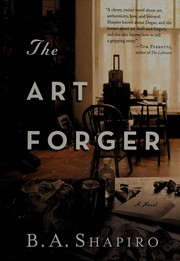
Reading options
What's inside (9 sections)
On the morning of March 18, 1990, two men dressed as Boston police officers walked into the Isabella Stewart Gardner Museum, tied up the guards, and left with thirteen works of art. They took a Vermeer, several Rembrandts, a Manet, and five drawings by Degas. Nobody has been arrested. The frames are still hanging empty on the walls. Barbara Shapiro takes that unsolved crime and asks a question that is very good for a novel: what if one of the paintings came back, and what if the person who got it was not sure it was real?
Her answer is Claire Roth, a painter in her early thirties who is talented, angry, and broke. Claire makes her living reproducing famous paintings for an online company, which is a polite way of saying she paints copies for people who want a Vermeer over the sofa. She is good at it. She is also radioactive. Three years earlier, during her last months of graduate school, she had an affair with her teacher, the painter Isaac Cullion, and painted a canvas that he exhibited under his own name. The painting made his career. When Claire tried to claim it, a panel of experts decided she was lying. The art world labeled her a pretender, and the label stuck.
That backstory matters because it sets up the ethical trap. Claire knows what it feels like to be erased. She also knows how easy it is to make a convincing copy. When Aiden Markel walks into her studio with an offer, she is exactly vulnerable enough to say yes.
The offer
Markel owns a well-known gallery and was a friend of Isaac's. He has seen Claire's reproductions and he wants a specific one: a perfect copy of Degas's After the Bath, one of the works stolen from the Gardner. He says he has the original. He says a foreign buyer has paid for it, and that he intends to give the buyer Claire's copy while returning the real painting to the museum anonymously. The copy will be sold as the original. The original will go home. Nobody gets hurt, except the buyer, who is rich and probably deserves it.
In exchange, Markel offers Claire a solo show at his gallery and a large sum of money. The show is the thing she cannot refuse. It is the difference between being a copyist and being an artist again. She says yes, and then she spends the rest of the novel dealing with what that yes means.
Shapiro is good at the seduction of this bargain. Markel is charming, well connected, and genuinely interested in her work. Their relationship becomes romantic, and the novel lets you feel the pull of being seen by someone powerful. Claire is not stupid. She knows she is being used. She decides that she can use him back, and that the painting is a way to buy her career. It is a very human calculation, and it makes her a more interesting protagonist than a simple victim would be.
The heist
The real robbery is worth knowing about, because the novel leans on it. In the early hours of March 18, 1990, two men in police uniforms entered the Gardner, told the guards they were responding to a disturbance, and then bound them with duct tape. The guards were found in the basement hours later. The thieves took thirteen works, including Vermeer's The Concert, three Rembrandts, a Manet, and five Degas drawings and watercolors. The frames were left on the walls. The museum, following Isabella Gardner's will, has never replaced them. The empty frames are still there.
Nobody has been charged. The investigation has produced suspects, theories, and dead ends, but no paintings. The heist has become a kind of national joke and a national wound, and it has spawned documentaries, books, and at least one very good novel. Shapiro does not try to solve it. She uses it as a stage. The question is not who robbed the Gardner. The question is what happens when a painting comes back and nobody can agree on whether it is real.
That is a smart choice. The novel is not a procedural. It is a story about authenticity, and the heist gives it a perfect symbol: a museum full of empty frames, waiting for objects that may never return. Claire spends the book filling one of those frames with a fake, and the museum hangs it without noticing. The joke is on the experts, and also on the reader, who has been rooting for her.
The copy
The middle of the book is about craft, and it is the best part. Claire studies the Degas, mixes pigments, builds layers, fakes the craquelure, ages the canvas. Shapiro clearly enjoys the technical details, and the reader does too. There is something pleasurable about watching a skilled person do a difficult thing, even when the thing is forgery. The novel makes the case that copying is not the opposite of art. It is a form of attention. To reproduce a painting well, you have to understand every decision the original artist made.
Claire's attention starts to catch something. The painting Markel brings her does not quite behave like a Degas. The central nude is posed in a way Degas rarely used. The shadows around her are weak. The brushwork is a little too careful in places and a little too loose in others. Claire begins to suspect that the painting she is copying is itself a forgery, and that the museum may have been hanging a fake for decades.
That suspicion gives the book its second engine. The first is whether Claire will get away with the copy. The second is what actually happened to the painting, and who made it. Shapiro interleaves the present with letters from Isabella Stewart Gardner to her niece Amelia, written in the late nineteenth century. The letters reveal a friendship between Isabella and Degas that was closer and more complicated than the historical record admits, and they suggest that the nude in the painting might be Isabella herself. The letters are a lovely device. They give the novel a second voice and a historical texture that the contemporary chapters sometimes lack.
The scandal
Claire's copy is discovered in a shipment of blue jeans heading from San Francisco to India. The painting is so good that the Gardner Museum authenticates it as the stolen original and puts it back on the wall. Markel is arrested. Claire is left holding the other end of the crime, with a solo show to prepare and a growing fear that she will be exposed as a forger or, worse, as an accomplice.
The investigation that follows is where the novel becomes a thriller. Claire tracks down Sandra, a relative of Isabella's, and through her learns about Virgil Rendell, a Boston painter who worked in the same circles as Degas and who may have painted the copy that hung in the museum. The trail leads to a secret room in Sandra's house, where the real painting has been kept, and to the truth about what Isabella did with it and why.
The solution is elaborate and satisfying in the way that art mysteries are supposed to be. The painting in the museum was a copy made to hide a scandalous nude of Isabella. The real Degas was hidden. Markel knew more than he admitted. Claire's forgery accidentally restored the wrong painting to the wall, which is a delicious irony. The novel's final image is of the original going back to the Gardner, where it belongs, while the people who tried to own it are exposed.
What the book gets right
The Art Forger is at its best when it is about looking. Shapiro writes about paintings the way good food writers write about meals, with attention to texture and process. The passages on mixing pigments, on the smell of turpentine, on the way a canvas tells you its age, are vivid and specific. The novel also understands the economics of the art world: the way reputation is made by collectors and critics, the way a single scandal can end a career, the way museums depend on donors who want to be flattered.
Claire is a strong character because she is not innocent. She makes a bad choice for understandable reasons, and then she keeps making choices that are slightly worse. Her anger at Isaac is real and justified, but it has also become a story she tells about herself. The book is smart about how grievance can become an identity, and how hard it is to put down.
The Isabella letters are the most charming thing in the novel. They give Shapiro a chance to write in a different register, more formal and more arch, and they make the historical mystery feel alive. The reveal that the nude might be Isabella is a good twist, not because it is shocking but because it reframes everything the reader has seen.
Where it wobbles
The romance with Markel is the weakest thread. He is handsome, powerful, and mysterious, and the novel never quite decides whether he is a villain or a romantic lead. The ambiguity could be interesting, but it mostly reads as indecision. Claire's attraction to him is asserted more than dramatized, and the sex scenes are oddly perfunctory for a book that is otherwise so attentive to sensation.
The thriller plotting also strains. The copy being discovered in a jeans shipment is a great coincidence. The museum authenticating a forgery as the original is a bigger one, and the novel does not do enough to make it plausible. Real authentication is a slow, contentious process, and the book treats it as a single dramatic beat. Readers who know the Gardner case may also find the timeline compressed in ways that feel convenient.
There is also a lot of exposition. Shapiro has done her research, and she wants you to know it. Characters explain the art market, the heist, the history of the museum, and the techniques of forgery, sometimes at length. The novel is never dull, but it is often informative in a way that slows the story down. A tighter edit would have helped.
The verdict
The Art Forger is a smart, entertaining novel about a world that is obsessed with authenticity and built on copies. It asks whether a perfect copy is worth less than a mediocre original, and it does not give an easy answer. Claire's forgery is both a crime and a tribute. The museum's real painting is both a masterpiece and a hiding place. Everyone in the book is trying to own something that cannot really be owned.
It is also a love letter to Boston and to the Gardner, a strange, beautiful museum that was designed by a woman who wanted to arrange art the way she wanted and did not care what the experts thought. Shapiro captures that stubbornness. Her novel is at its best when it is inside the studio, with the smell of oil paint and the radio on, and at its weakest when it is explaining the plot. But the good parts are very good, and the central question stays with you: if you cannot tell the difference, does it matter which one is real?
The answer the novel gives is yes, but not for the reasons the experts would give. The difference is not in the brushstrokes. It is in the history. A painting is real because of the hands that made it and the life that surrounded them, and a copy, however perfect, is a copy of a surface. Claire understands that better than anyone, which is why her forgery is both an act of love and an act of theft. She is not trying to fool the museum. She is trying to get inside the painting.
That is the most interesting thing about her, and the novel knows it. The art world in this book is full of people who talk about authenticity and then buy whatever is convenient. Claire is the only character who actually cares about the object, and her care is what makes her dangerous. She would rather make a beautiful fake than a mediocre original, and the book refuses to decide whether that is a virtue or a crime.
If you like novels about process, this is a good one. If you like novels about ideas, it is even better. It is not a perfect book, and its coincidences are hard to forgive, but it has a real subject and a real heroine, and it treats both with intelligence.
FAQ
Is The Art Forger based on a true story?
It is built around the real 1990 robbery at the Isabella Stewart Gardner Museum, which remains unsolved, but Claire Roth, Aiden Markel, and the forgery plot are fictional.
What painting does Claire forge?
She copies Edgar Degas's After the Bath, one of the works taken in the Gardner heist. The novel imagines that the painting Markel gives her to copy is itself a forgery.
Does The Art Forger have a happy ending?
It ends with the original painting returned to the Gardner, Markel exposed, and Claire's career revived by her solo show, though the resolution relies on several convenient discoveries.
Similar books

What She Knew
Rachel lets her eight-year-old son run ahead in a Bristol park, and the nine-day search turns her into a suspect in the public eye.
2,952-word summary · 13 min read

The Beach House
A young valet is beaten to death at a Hamptons party, and his law-student brother spends a year building a case against the family that covered it up.
2,049-word summary · 9 min read

Six Years
A professor who promised to forget the woman he loved sees her husband's obituary and discovers that the wedding, the marriage, and the woman herself may never…
2,076-word summary · 9 min read

Rules of Prey
Minneapolis detective Lucas Davenport hunts a killer who leaves a new rule at every scene and treats murder as a game of wits.
1,914-word summary · 9 min read
The Black Dahlia
James Ellroy builds a fiction around the real Black Dahlia murder, following two Los Angeles cops whose partnership and obsessions destroy them.
2,533-word summary · 11 min read

4th of July
Lindsay Boxer shoots two armed teenagers in self-defense, faces a wrongful-death trial, and spends her leave chasing a string of throat-slashing murders in…
2,192-word summary · 10 min read

61 Hours
A bus crash strands Jack Reacher in a snowbound South Dakota town where a drug gang, a corrupt police force, and a single witness are on a collision course.
2,227-word summary · 10 min read

Still Missing
A realtor is abducted at a Vancouver Island open house and held for more than a year. Told through therapy sessions, the novel follows her escape and the hunt…
2,466-word summary · 11 min read
Big Lies in a Small Town
A 22-year-old woman leaves prison to restore a 1940 mural, and Edenton, North Carolina, starts talking.
2,187-word summary · 10 min read

Bad Luck and Trouble
A deposit of $1,030 summons Jack Reacher back to his old army unit, which is being picked off one name at a time.
2,366-word summary · 11 min read

3rd Degree
The third Women's Murder Club novel follows a San Francisco terror cell and a three-day killing schedule, and it costs the club a member.
2,685-word summary · 12 min read

Worth Dying For
Reacher stops for one night in rural Nebraska and finds a family that runs the county, a missing girl and a shipment worth killing for.
2,021-word summary · 9 min read

Say You're Sorry
A widowed prosecutor defends the teenager accused of killing her babysitter, uncovering a small town's secrets and a killer hiding in plain sight.
2,116-word summary · 9 min read

Echo Burning
Reacher hitches a ride with a Texas woman who wants her abusive husband killed, then has to prove she did not murder him when he comes home.
2,209-word summary · 10 min read
The Clockmaker's Daughter
A London archivist finds a Victorian satchel holding a photograph, a sketchbook and a letter, then follows them to Birchwood Manor, where a young woman died in…
2,886-word summary · 13 min read

Girl, Forgotten
A rookie US marshal guards a judge with a stalker and ends up reopening the 1982 prom-night murder of the judge's pregnant daughter.
2,111-word summary · 9 min read
Death Comes to Pemberley
P.D. James drops a murder onto the Pemberley estate and sends Wickham to trial, reading Austen's most famous marriage through the machinery of Georgian justice.
2,318-word summary · 10 min read

The Woods
Twenty years after two teenagers were murdered and two vanished at summer camp, prosecutor Paul Copeland identifies a fresh corpse as one of the missing.
2,490-word summary · 11 min read
The Witch Elm
Toby Hennessy has always been lucky, until a beating leaves his memory full of holes and a skull turns up in the garden of the family home. A stand-alone novel…
2,021-word summary · 9 min read
The Redbreast
Harry Hole chases an ageing sniper through modern Oslo while two Norwegian volunteers on the Eastern Front carry a fifty-year-old betrayal toward a royal…
2,453-word summary · 11 min read

The Boy from the Woods
Wilde, found feral in a New Jersey forest in 1986, hunts for a missing teenager while a senator's secrets tear a wealthy town apart.
2,270-word summary · 10 min read
Without Fail
Reacher is asked to test vice presidential security by planning to kill.
2,084-word summary · 9 min read
Things We Do in the Dark
A comedian kills her husband, then a podcaster digs up her teen murder past.
2,427-word summary · 11 min read
The Widow
A widow of a suspected criminal faces reporters and police while hiding what her marriage really cost.
2,599-word summary · 12 min read
The Racketeer
A jailed lawyer trades a judge murder secret for freedom and revenge.
2,434-word summary · 11 min read
The Night Swim
A true crime podcaster covers a rape trial while probing an old drowning in a small town.
2,260-word summary · 10 min read
The Judge's List
Lacy Stoltz hunts a sitting judge who murders off his list.
2,513-word summary · 11 min read
The Innocent
A government hitman refuses one kill and must protect a teenage girl at the center of a cover-up.
2,403-word summary · 11 min read
The Girl Who Was Taken
A survivor returns alone while a reporter digs for her lost sister.
2,261-word summary · 10 min read

The Club
A luxury island resort for the rich turns deadly when secrets, staff and guests collide.
2,386-word summary · 11 min read