
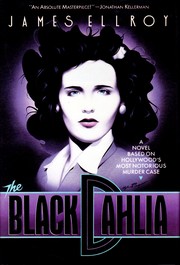
The Black Dahlia
2,533-word summary 11 min read 325 pages in the book
- First published
- 1987
- Publisher
- Mysterious Press
- Pages
- 325
- ISBN
- 9780892962068
- Series
- L.A. Quartet (#1)
Reading options
What's inside (9 sections)
I came to this novel after too many true-crime accounts of Elizabeth Short, which is probably the wrong order. The real case is a cloud of interviews, rumor, bad police work, and photographs of a dead girl. James Ellroy gives that cloud a shape. His 1987 novel, the first of the L.A. Quartet, is a fiction built on the murder, with two invented cops at the center and a fictional family standing in for the killer. The book is convincing enough to make readers forget the difference.
Ellroy's Los Angeles is 1946 and 1947, full of returned soldiers, cheap bars, fixed fights, and men who are not sure what to do with themselves. Dwight "Bucky" Bleichert and Lee Blanchard are patrolmen and former boxers. Bucky is the cool counterpuncher. Lee is the brawler, all heat. The department stages a rematch between them to sell a police bond issue. Bucky is supposed to lose, and he does, but only after nearly knocking Lee out. The fight makes them famous and gets Bucky transferred to Warrants, where Lee already works. They become partners.
Fire and Ice
That opening is one of the best things in the book. Ellroy writes the fight with real ring knowledge, the feints, the clinches, the way a clean punch can change a man's balance. He also writes the aftermath, the two men joking in the locker room, the press clippings, the sense that they have been handed a story about themselves. The partnership that follows is the novel's warm center. Bucky and Lee eat at Lee's house, argue about cases, and fall into the rhythm of men who trust each other without saying so. A few months later they kill four men in a shootout in Leimert Park and become the department's favorite story.
Lee lives with Kay Lake, a woman he met when he arrested her former boyfriend, Bobby De Witt, for a 1939 armored-car robbery. Kay is smart and guarded, tired in a way that makes her seem older than she is. She and Lee are not lovers, though they live together. That arrangement pays off late, when Kay explains that Lee planned the robbery himself and framed De Witt, then fell in love with the woman he had wronged. The house they share is a fairy tale built on a lie. Bucky wants Kay almost from the first dinner. She wants him too, but neither of them says it while Lee is there.
Lee is also carrying an older wound. His younger sister, Laurie, disappeared when he was fourteen and was never found. He became a policeman because he wanted a world with order in it. That detail explains almost everything he does later. Bucky has his own damage: a German-American father with Bund ties, a boxing career that went nowhere, a habit of watching other people's happiness from the doorway. The two men know exactly where the other one is weak.
The body at 39th and Norton
On January 15, 1947, a woman walking her daughter to school finds Elizabeth Short's body in a vacant lot at 39th and Norton. She has been cut in half at the waist, drained, and arranged. Her face is ruined. The newspapers call her the Black Dahlia. Bucky and Lee catch the call, and Ellroy gives the scene the weight it needs without turning it into a spectacle. The description is exact, and the exactness is the point. This is a city that will look at a mutilated girl and see a headline.
The case becomes an obsession for Lee. Betty Short's death touches the old wound left by Laurie, and Lee begins to work the case in a way that is not healthy. He stops sleeping. He snaps at Kay. He goes to a bar connected to the investigation and causes a scene that gets him pulled off the case. Bucky watches his partner come apart and does not know how to stop it.
The investigation is a tour of Los Angeles at its least glamorous. Bucky and Lee visit rooming houses, lesbian bars, studio hangouts, and the offices of men who sell dirty movies. A woman named Lorna Martilkova describes a stag film with Betty and a Mexican man, and says the film was made in Tijuana. That lead sends the police south of the border and gives the case a convenient foreign suspect. It is also a lie, planted to cover the fact that the film was shot in one of Emmett Sprague's empty houses. The novel lets the reader believe the lie for a long time.
Lee's obsession breaks him. He goes after Bobby De Witt, recently released from prison, and then disappears. His car is found near the border. The department decides not to make a fuss. Bucky is left with a missing partner, a stalled case, and Kay, who is suddenly alone.
The house on Muirfield Road
The trail leads Bucky to the Spragues. Emmett Sprague is a Scottish-born contractor who helped build Hollywoodland and made a fortune on cheap houses and expensive ground. He is charming and violent in the way of men who treat success as proof of virtue. His wife, Ramona, is thin and medicated, given to long stares. Their daughter Madeleine is beautiful and bored, with a reckless streak. She wears black like Betty Short and knows it. Their other daughter, Martha, is a quiet art student, the only person in the house who is not performing.
Bucky interviews Madeleine and then, against every instinct he has, begins an affair with her. He moves between the mansion and his own shabby apartment. The sex scenes are not erotic. They are transactions, and Ellroy writes them with a cold eye. Madeleine calls him "Bucky" and "sweet" and tells him things about her family that may or may not be true. She is playing a role, and Bucky knows it, and he keeps going back.
The Sprague sections are where the novel becomes a family horror story. Emmett and Madeleine have a relationship that is not quite father and daughter. Ramona is jealous of Madeleine in a way that does not make sense until later. Martha draws disturbing pictures and is treated like a servant. The house is full of expensive art and bad feeling. Bucky, the cop, becomes a guest, then a participant, then something closer to a prisoner. He is sleeping with a girl who may be connected to the murder. His judgment is gone.
Ellroy uses these chapters to build the case's hidden architecture. Betty Short looked like Madeleine. That resemblance is the engine of the plot and the novel's cruelest idea. A woman is killed because she reminds another woman of a daughter she cannot keep. The murder becomes a family matter, a punishment, a pageant. The Spragues are a closed system of money, sex, and resentment, and Betty walked into it by accident.
The shack in Hollywoodland
Bucky eventually finds the place where Betty was killed. It is a shack in the Hollywoodland hills, one of Emmett's abandoned properties, with a mattress, a baseball bat, and a shelf of jars. The jars hold preserved organs. There are notebooks filled with handwriting, a copy of Gray's Anatomy, and a copy of Victor Hugo's The Man Who Laughs. The killer read a nineteenth-century novel about men who disfigure children for profit and used it as a script.
The shack is also where Bucky finds Georgie Tilden, the scarred handyman who was Emmett's old friend and hired man, and Madeleine's real father. Georgie is the physical killer, but he is not the whole story. Ramona is the one who wanted Betty dead. She went to the shack, took the bat, and did the worst of it while Georgie watched and helped. Betty looked like Madeleine, and Madeleine was the daughter Ramona had with Georgie, the one Emmett had raised as his own. The murder was a way to destroy the girl who had taken Georgie's attention and to punish the family that had made Ramona invisible.
Bucky kills Georgie. It is not a clean arrest or a justified shooting. It is a fight in a room full of specimen jars, and Bucky comes out of it with bites on his face and blood on his hands. The novel does not let him off. He has crossed a line, and the rest of the book is about what that crossing costs him. He tells himself he did it for Betty, but he also did it because he wanted to hurt someone. The distinction is the novel's moral center.
Ensenada
While Bucky is falling apart in Los Angeles, Lee is already dead. Bucky goes to Ensenada and finds a private detective named Milton Dolphine, who tells him that a rich Mexican woman hired him to find Lee. The woman was not Mexican. She was Madeleine Sprague in disguise, wearing heavy makeup and a false accent, and she wanted Lee found so she could kill him. Lee was buried outside town, near a bluff, under a marker the locals kept lit with burning crosses. Bucky has the body exhumed. The cause of death is an axe.
The Mexican-woman disguise is one of the novel's boldest inventions, and one of its silliest. It works because Madeleine is an actress in her own life, a girl who has been playing Betty Short for months. It strains belief, since Bucky is supposed to be a good detective. Ellroy wants the reader to feel the pull of the performance, the way a story can be more convincing than evidence. He mostly gets away with it.
Kay fills in the rest. She tells Bucky that Lee planned the Boulevard-Citizens robbery, framed Bobby De Witt, and had been living with the guilt ever since. She also tells him that Lee knew who killed Betty Short and had blackmailed Emmett Sprague for $100,000. Madeleine followed him to Mexico and killed him to get the money back. Kay's confession is the novel's emotional hinge. It turns Lee from a martyr into a man with a secret.
Bucky and Kay marry after Lee is gone. The marriage is tender for a while, then it sours. Bucky resumes his affair with Madeleine. Madeleine is arrested for Lee's murder, but her confession is a fiction designed to keep the Dahlia case out of the papers. She is sent to a state hospital. The Spragues leak stories about Bucky to a scandal magazine, and he is fired from the LAPD for moral turpitude. Kay leaves Los Angeles. Ramona is never charged. The case remains open.
The last mask
The final confrontation is the best-written scene in the book. Bucky finds Madeleine in a motel room, dressed as Betty Short, talking to a soldier in Betty's voice. She is not merely pretending. She has built a personality out of a dead woman, and the performance frightens him. He listens as she tells the soldier about her childhood and a policeman who tried to hurt her. Then she slips into a Mexican accent and describes killing Lee with an axe. Bucky breaks in. Madeleine says Betty was the only thing that was real to her, and that she had to tell people about her.
That scene is where the novel's themes come together. Madeleine has been turned into an image by her father, her mother, and the men who desire her. Betty Short was turned into an image by the newspapers. The two women become interchangeable, and the novel suggests that this is what Los Angeles does to women. The novel sometimes uses that idea to excuse its own fascination with the bodies it describes.
Bucky lets Ramona go. He does it because arresting her would destroy Martha, the only innocent person in the family, and because he is not sure he has the right to decide. He also does it because he is tired. The novel does not present this as a noble choice. It is a compromise, and it leaves him with nothing. Months later, Kay writes from Cambridge to say she is pregnant. He flies to Boston to find her. The last page leaves him on the plane, working out what he will say.
What the novel does and what it costs
The Black Dahlia is a great crime novel and a troubling one. Ellroy's prose is the main reason to read it. He writes short, hard sentences that sound like they were typed on a manual machine in a smoke-filled room. He has an ear for period slang and an eye for the details that make a scene stick: the way a bar smells, the way a man's face looks after a fight, the exact color of a cheap dress. The plotting is ambitious, and the first two hundred pages move like a train.
The partnership is the best thing in the book. Lee is more than a foil for Bucky. He is a man with his own guilt, his own failed career, and his own idea of what a good life would look like. Kay is also a strong character, though the novel treats her as a prize for much of the book. Her final letters are sad and funny and very human. The scene where she tells Bucky the truth about Lee is the moment the novel earns its length.
The costs are real. The book is brutal toward women, and not only because the murder is brutal. The camera lingers on mutilation, on breasts, on the violated body of a real woman who never agreed to become a character in someone else's novel. Ellroy writes as if he is aware of this, but awareness is not restraint. Some readers will find the novel's gaze pornographic. I think that objection is fair. The book is also full of racial slurs and casual homophobia, which is accurate to the period and exhausting to read. A reader who wants a clean procedural or a likable hero should stay away.
The conspiracy is overstuffed. By the end, the solution involves an illegitimate daughter, a scarred handyman, a fake Mexican accent, a stolen bank robbery, a blackmail scheme, a stag film, and a dead policeman who knew too much. Together they feel like a machine built to produce a surprise. The novel's insistence that everything connects is both its pleasure and its problem.
The central invention is ethically questionable. Elizabeth Short was a real person. Her murder is unsolved. Ellroy gives her a fictional killer, a fictional motive, and a fictional family, and he does it with such conviction that some readers come away thinking they have read the answer. The novel borrows a real wound and puts a shape on it. Whether that is art or exploitation is a question each reader has to answer.
What keeps me coming back is not the solution. It is the mood, the partnership, and the way Ellroy writes men who are trying to be good and failing in ordinary ways. The last page leaves Bucky on a plane to Boston, and leaves Betty Short in the vacant lot, where she still is.
FAQ
Is The Black Dahlia based on a true story?
It is built on the real 1947 murder of Elizabeth Short, but the detectives, the Sprague family, and the solution are fictional. The real case remains unsolved.
Is The Black Dahlia the first book in the L.A. Quartet?
Yes. It was published in 1987 and is the first of four novels, followed by The Big Nowhere, L.A. Confidential, and White Jazz.
How graphic is The Black Dahlia?
The novel describes the mutilation of Elizabeth Short's body and includes several explicit sex scenes. Readers sensitive to sexual violence should approach it with caution.
Similar books
More from L.A. Quartet first, then related titles.
The Big Sleep
Marlowe takes a blackmail job for the Sternwoods and finds murder and daughters money cannot save.
2,243-word summary · 10 min read
The Art Forger
A disgraced Boston painter agrees to copy a Degas stolen from the Gardner Museum, then begins to suspect the original she is copying is itself a forgery.
2,117-word summary · 9 min read
Death Comes to Pemberley
P.D. James drops a murder onto the Pemberley estate and sends Wickham to trial, reading Austen's most famous marriage through the machinery of Georgian justice.
2,318-word summary · 10 min read
The Redbreast
Harry Hole chases an ageing sniper through modern Oslo while two Norwegian volunteers on the Eastern Front carry a fifty-year-old betrayal toward a royal…
2,453-word summary · 11 min read
The Maltese Falcon
Sam Spade hunts a jeweled bird through lies after his partner is killed.
2,529-word summary · 11 min read
Fingersmith
A thief plots to cheat an heiress, then the scheme flips twice in Victorian London.
2,532-word summary · 11 min read
Maisie Dobbs
A maid turned war nurse opens a London inquiry agency in 1929 and traces a quiet case to a refuge for shattered soldiers.
2,382-word summary · 11 min read
The Black Echo
Harry Bosch links a fellow veteran's death to a tunnel bank robbery and a dangerous FBI investigation in Los Angeles.
2,133-word summary · 9 min read
Shutter Island
A U.S. marshal hunts a missing patient on a locked asylum island in 1954, where every clue turns back on him.
2,761-word summary · 12 min read
The Lincoln Lawyer
Mickey Haller defends a rich assault suspect from his Lincoln while doubting his innocence.
2,317-word summary · 10 min read
Dark Places
Libby Day, sole survivor of family murders, is paid to rethink her testimony.
1,910-word summary · 8 min read

What She Knew
Rachel lets her eight-year-old son run ahead in a Bristol park, and the nine-day search turns her into a suspect in the public eye.
2,952-word summary · 13 min read

The Beach House
A young valet is beaten to death at a Hamptons party, and his law-student brother spends a year building a case against the family that covered it up.
2,049-word summary · 9 min read

Six Years
A professor who promised to forget the woman he loved sees her husband's obituary and discovers that the wedding, the marriage, and the woman herself may never…
2,076-word summary · 9 min read
How the Light Gets In
Gamache investigates the murder of the last Ouellet quintuplet while the Sûreté he served is dismantled from inside by the man who took his protégé.
2,279-word summary · 10 min read
Bury Your Dead
Recovering from a failed raid that killed his officers, Gamache investigates a murder in a Quebec City library while Beauvoir reopens a case in Three Pines.
2,022-word summary · 9 min read

Anatomy: A Love Story
In 1817 Edinburgh, a noblewoman who wants to be a surgeon disguises herself to study anatomy and falls for the grave robber who supplies her with bodies.
2,031-word summary · 9 min read

The Trespasser
A Dublin Murder Squad detective investigates a staged dinner-party killing and finds a cover-up that reaches into her own department.
2,051-word summary · 9 min read

Rules of Prey
Minneapolis detective Lucas Davenport hunts a killer who leaves a new rule at every scene and treats murder as a game of wits.
1,914-word summary · 9 min read

The Late Show
Exiled to the LAPD night shift after accusing her supervisor, Renée Ballard keeps two cases that were meant to be handed off at dawn: a brutal assault and a…
2,563-word summary · 11 min read
Only Time Will Tell
A Bristol dockworker's son wins a scholarship, falls in love with the daughter of the family that owns the shipyard, and learns that his father's death was not…
2,082-word summary · 9 min read
Night Film
A disgraced journalist investigates the death of a reclusive horror director's daughter, following a red coat through hospitals, secret clubs, and a family…
2,690-word summary · 12 min read
Finger Lickin' Fifteen
Lula sees a celebrity chef decapitated and talks Stephanie into entering a barbecue contest to lure the killers, while Ranger hires her to find a security leak…
2,248-word summary · 10 min read

4th of July
Lindsay Boxer shoots two armed teenagers in self-defense, faces a wrongful-death trial, and spends her leave chasing a string of throat-slashing murders in…
2,192-word summary · 10 min read
The Camel Club
Four Washington misfits witness a murder on Roosevelt Island and stumble into a conspiracy that reaches the Oval Office, with a hostage president and a nuclear…
2,354-word summary · 10 min read

61 Hours
A bus crash strands Jack Reacher in a snowbound South Dakota town where a drug gang, a corrupt police force, and a single witness are on a collision course.
2,227-word summary · 10 min read
Once Upon a River
A wounded man stumbles into a riverside inn carrying what appears to be a drowned child who is not quite dead, and the story braids the guesses of everyone who…
2,173-word summary · 10 min read
The Echo of Old Books
Barbara Davis's 2023 novel sends a rare-book dealer in 1984 New Hampshire hunting for the authors of two unpublished volumes that tell opposite sides of one…
2,491-word summary · 11 min read
The Last Mile
Melvin Mars is hours from execution for his parents' murder when another man confesses, and FBI cold case detective Amos Decker goes looking for the trap.
2,746-word summary · 12 min read

Still Missing
A realtor is abducted at a Vancouver Island open house and held for more than a year. Told through therapy sessions, the novel follows her escape and the hunt…
2,466-word summary · 11 min read