
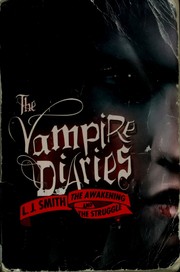
The Awakening / The Struggle
2,660-word summary 12 min read 502 pages in the book
- First published
- 1991
- Publisher
- HarperTeen
- Pages
- 502
- ISBN
- 9780061140976
- Series
- The Vampire Diaries (#1)
Reading options
What's inside (9 sections)
The first line of The Struggle is a name shouted into wind: "Damon!" Elena Gilbert stands in the cemetery in a thin sweater, hair whipping her face, oak leaves skating over the headstones. She has come to demand that her boyfriend's brother tell her where Stefan is. Damon is behind her before she hears him. She slaps him. He offers her immortality.
That is the whole series in one scene: a teenage girl with more nerve than sense, a beautiful monster who talks about Power like it is a country club membership, and a town full of graves.
I read the two novels in the HarperTeen omnibus, 502 pages, first published separately in 1991 and bound together later. The omnibus looks fat only because the type is generous and the chapters are tiny. It goes down in two evenings, which is part of its charm and part of the problem. Smith is not building a cathedral. She is keeping you turning pages.
The girl who has everything
Elena Gilbert is seventeen, blond, and the undisputed queen of Robert E. Lee High School in Fell's Church, Virginia. She lives with her Aunt Judith and her four-year-old sister, Margaret, because her parents died in a car crash three years earlier. The tragedy is mentioned, mourned, and then mostly used as a reason for Elena to be sad between bouts of scheming. Elena keeps a diary, and the diary is where she admits that she wants things because wanting them is what she does.
She has a boyfriend at the start, Matt Honeycutt, and she breaks up with him early because a new boy has arrived. Matt stays decent for the whole book, which is more than most of the cast manages. Her friends are Bonnie McCullough, small and red-haired and psychic in a way she does not fully control, and Meredith Sulez, dark-eyed and dry and the only person who consistently talks sense. Caroline Forbes is the rival, beautiful and ambitious and increasingly willing to use whatever she can find to take Elena down a peg.
Then Stefan Salvatore enrolls. He is beautiful the way a knife is beautiful, wears dark glasses indoors, drives a Porsche, and refuses to look at Elena. That refusal is the hook. Elena has never been ignored before, and she reacts the way a cat reacts to a closed door: she decides she must get through it.
The pursuit takes up the first half of The Awakening and is a little exhausting. She gets his schedule and makes a blood oath with Bonnie and Meredith in the cemetery, pricking their thumbs with a cloisonné pin and swearing to do whatever Elena asks about Stefan. Bonnie warns her that blood oaths are dangerous. Meredith does it anyway. That scene is one of the best in the book: the girls are serious and ridiculous at once, and the ruined church on the hill is watching them.
A town with a graveyard in it
Fell's Church is a good name for a vampire town. It has an old graveyard full of Civil War dead, a ruined church with a belfry still standing, a bridge, and enough woods to hide a body. The crow that follows Elena is a nice touch once you know who the crow is. The weather turns when Damon is angry. The town feels cold and slightly wrong, and that atmosphere does more work than the exposition.
The old church matters more than the school does. It is where the girls swear their oath, where Tyler Smallwood takes Elena on the night of the homecoming dance, and where Vickie Bennett is attacked. The cemetery is the other important place. Both sit on the hill above Wickery Bridge, and by the end of the second book you will know why the bridge matters.
The school never feels real, and the teachers are mostly there to die.
The brother in the dark
Stefan is a vampire. He was born in Renaissance Florence and fell in love with Katherine von Swartzschild (renamed Katherine Pierce on television), a German girl who was already a vampire. Katherine was beautiful and capricious and looked exactly like Elena. She gave Stefan and his older brother, Damon, lapis lazuli rings that let them walk in sunlight, and told them she wanted all three to live together forever. Neither brother would share. They demanded she choose. She walked into the sun instead, leaving a dress and some ashes, and the brothers fought a duel with swords and killed each other. Because her blood was in their veins, they rose as vampires.
That backstory arrives in a lump, through Stefan's memories and a long confession on the roof of his boarding house. It is silly and melodramatic, and it works because Smith commits to it. Two brothers killing each other over a girl who has already chosen is the engine of the series. Damon has spent centuries blaming Stefan; Stefan has spent centuries feeling guilty. Neither has learned anything.
The present-day plot is a series of attacks. A homeless man is drained under the bridge. Vickie Bennett, a girl from Tyler's crowd, is found raving about eyes in the dark after something happens in the ruined church. Stefan has blackouts and wakes afraid that he is the one doing it. The truth is that Damon is in town, stronger, and using his Powers to fog Stefan's mind. Damon killed Mr. Tanner, the history teacher, at the school's Halloween haunted house, partly to frame Stefan and partly for fun.
The Halloween set piece is where the book clicks. Mr. Tanner is dressed as the Bloody Corpse, covered in fake blood, lying in a coffin with a knife beside him. Bonnie brings visitors through, and he does not sit up. He is dead for real. Tyler, drunk and stupid and carrying a grudge, turns the crowd into a mob and points at Stefan. Stefan runs. Elena follows him to the boarding house and finds him on the widow's walk with blood on his mouth and a dead mourning dove at his feet. She falls through the railing. He catches her in midair.
The girl falling and the monster catching her is the novel's whole romantic argument. It is also where Smith finally lets Stefan explain himself: the rings, the Powers, the animal blood, the brother. Elena takes it well, well enough to offer him her blood, and he drinks from her for the first time. It is written as a sex scene with the serial numbers filed off, which is probably why teenagers liked it so much in 1991.
Then Damon wins the first round. Stefan confronts him in the woods, and Damon drains him and leaves him in a well. The Awakening ends with Stefan missing, the town convinced he is a murderer, and Bonnie in a trance. She speaks in Stefan's voice: dark, cold, water up to his neck, thirsty. Then she warns Elena not to go to the bridge. Death is waiting there.
The second book starts with a slap
The Struggle picks up the next morning, with that cemetery scene. Damon tells Elena he killed Stefan. He makes it snow. The snow is a display of strength, and a neat image for how the series treats him.
The search for Stefan is the best sustained sequence in either book. Bonnie, Meredith, and Matt follow Bonnie's impressions to the old Francher farmhouse, where Stefan is trapped in a covered well. They haul him out with a rope. Elena cuts her finger and puts it to his lips, and he drinks from her throat. It is a rescue and a violation and a love scene at once, and Smith does not pause to sort out the ethics. Stefan recovers enough to travel with Matt to get vervain, an herb that protects the mind from vampire influence. Elena stays behind, a mistake, because Damon has already been in her dreams.
The middle of The Struggle is a different kind of horror story. Someone is leaving notes made from pages of Elena's stolen diary. Caroline has it, and she and Tyler plan to read it aloud at the Founders' Day ceremony. It is full of private thoughts about Stefan, some of them readable as evidence that he is dangerous. Elena spends most of the book trying to get it back. She and Bonnie and Meredith break into Caroline's house and fail. Elena ends up on the roof, where Damon offers a deal: he will help her if she gives him her blood and spends an hour with him, willingly. She agrees, and does not tell Stefan.
That secret is the engine of the second book, and it is where the love triangle becomes something uglier. Damon does not court Elena so much as corner her. He invades her dreams. He threatens her little sister. He comes to Thanksgiving dinner because Robert, Aunt Judith's fiancé, invites him in, and then he tries to enter Elena's bedroom at night. He cannot, because her room and the living room are the only parts of the old house left, and he was never invited into that older dwelling. So he stands in the hall, snarling, and puts his hand on Margaret's door. Elena gives in and lets him drink from her, and she drinks from him. The book presents this as a bargain to protect her family, which is true, and also as a dark romantic thrill, which is where it gets uncomfortable.
Thanksgiving shows what the books do well and badly. The dinner is tense and funny and sad. Aunt Judith fusses. Margaret is four and has no idea what is going on. Bonnie goes into a trance at the table and says, "Your death is waiting, Elena." Then Damon arrives with a bottle of wine and a smile. It is a great scene, and also one in which a man with centuries of power stalks a seventeen-year-old girl while the prose falls half in love with him.
Founders' Day
The last movement is Founders' Day. Elena is chosen as the Spirit of Fell's Church, which means riding in a buggy beside the mayor and his wife in the parade. Caroline is the Spirit of Fidelity. It is pageantry about the town's founding, with schoolchildren dressed as colonists and Civil War soldiers. All those people and all that noise make it a good place for a public humiliation.
Caroline gets up to read and discovers that Damon has switched the diary for her own. She opens it, sees her handwriting, and runs off the stage. It is a cruel, efficient revenge, and Elena did not plan it. Damon did it for her, which is somehow worse. Then the engagement comes out. Stefan has proposed with Katherine's ring. Elena accepts, and when Aunt Judith and Robert forbid it, she stands in the courtyard and announces that she will marry him anyway.
That is the last thing she does as a human being. She borrows Matt's car and drives toward the boarding house. The storm comes down, and it is not weather. It is a shape like a great bird made of mist, and it hates her. She remembers that running water stops vampires, so she heads for Wickery Bridge. The bridge is icy, the car skids, hits the guardrail, and goes into the river. Stefan pulls her body out, but she has been under too long. Bonnie and Meredith watch him try to revive her. He gives up.
The bridge
What happens next is why people remember it. Stefan loses it. He goes to the Quonset hut where Tyler and his friends are hiding, drains most of them, nearly kills Caroline, and then turns into a falcon and goes after Damon. The brothers fight in a clearing. Stefan breaks his arm. He is winning, or at least not losing, and then Elena wakes up.
She is cold, covered in ice. She smells a squirrel and wants to chase it. She hears the fight in her mind and follows it, and the last line is her stepping into the clearing, thinking about the brother with the black eyes and the secret smile. She does not know what she is yet. The reader does. It is a nasty, effective ending, and a promise that the next book must deal with the heroine becoming the thing she was running from.
The series is named after diaries, but these books give us one, Elena's, and use it as a plot object. It is stolen, quoted, hidden, swapped, and used as a weapon. The private voice in it is the best writing in the book, because Elena is more honest on the page than she is out loud. But it disappears for long stretches, and the title starts to feel like marketing.
What holds up, and what does not
The books are addictive the way soap operas are addictive. Smith writes short chapters and ends most on a hook. The atmosphere is genuinely good: the ruined church, the old graveyard, the snow, the crow, the well, the bridge. Bonnie's trances are eerie without being overexplained. The physical details are strong. Blood is warm and copper-tasting. Cold gets into your bones. Hunger is a thing in your stomach. For a 1991 YA novel, it is surprisingly willing to let its heroine be hungry and wrong.
The problems are just as obvious. Elena is hard to like for most of the first book. She is vain, manipulative, and casually cruel, and the narration often seems to admire the qualities it should question. The romance with Stefan is instalove: a handful of conversations, one kiss, and then she is ready to die for him. Damon is more interesting, but the book's interest in him is the problem. He threatens a child, feeds on Elena without her consent, and invades her dreams, and the prose keeps calling him beautiful. A modern reader is likely to want a restraining order, not a love triangle.
The worldbuilding is thin. The rules arrive when the plot needs them: lapis lazuli for sunlight, running water as a barrier, the invitation rule, the Powers that do whatever the scene requires. Fell's Church is a backdrop, not a place. The prose is dated in ways that are sometimes charming and sometimes clunky. There is a lot of head-hopping, a lot of italicized emphasis, and a lot of exposition from characters who have no reason to explain themselves except that the reader needs to know.
None of that stops the pages from turning. Both novels are short, propulsive, and full of scenes that stick: the blood oath, the roof, the well, the Thanksgiving dinner, the parade, the bridge, the falcon. They are not good in the way a careful novel is good. They are good the way a campfire story is good, if the campfire is in a graveyard and everyone is too old to be there.
I would give this to a reader who wants a fast vampire soap with a real sense of place and does not mind a heroine who is sometimes the worst person in the room. I would not give it to anyone who needs the love interest to be safe, the gender politics to be current, or the magic system to hold still under examination. It is a period piece, and best enjoyed as one.
The ending of The Struggle is the best argument for continuing. Elena is a vampire, Stefan is bleeding in the snow, Damon is the one she is walking toward, and nobody knows what happens next. That is a great cliffhanger, and the moment the series stops being about a girl choosing between two boys and becomes about a girl becoming one of the monsters. The books do not always earn that turn, but they know how to sell it.
FAQ
Do I need to read The Awakening before The Struggle?
Yes. This omnibus collects both novels in order, and The Struggle picks up the morning after The Awakening ends.
Is the book the same as the TV show?
No. The novels were published in 1991 and differ substantially from the CW series, especially in character fates and the role of Katherine.
How does The Struggle end?
Elena drowns in Wickery Bridge, is revived as a vampire, and walks toward Damon while Stefan lies injured in the snow.
Similar books
More from The Vampire Diaries first, then related titles.
Origins
Stefan's diary of 1864 and 1888: how he and Damon fell for Katherine, became vampires, and went looking for a killer in London.
2,056-word summary · 9 min read
At Grave's End
Cat and Bones face Max, a zombie-raising ancient vampire, and a prophecy that ties their marriage to Patra's death in the third Night Huntress novel.
2,061-word summary · 9 min read
Lover Unleashed
Paralyzed vampire warrior Payne and surgeon Manny Manello collide in an adult paranormal romance, as Xcor's Band of Bastards arrives in Caldwell for revenge.
2,374-word summary · 11 min read
Angels' Blood
Nalini Singh's 2009 Guild Hunter opener sends vampire hunter Elena Deveraux after a murderous archangel in New York, while its most powerful ruler watches.
2,367-word summary · 11 min read

Dumplin'
Willowdean Dickson enters her town's beauty pageant as a protest and discovers that confidence is harder to keep once she lets someone close.
1,922-word summary · 9 min read

Masquerade
After Cordelia's death, Schuyler flies to Venice to find her exiled grandfather, then returns to the Blue Bloods as they prepare for a masked ball and a hidden…
2,543-word summary · 11 min read

I Kissed Shara Wheeler
Shara Wheeler kisses her rival Chloe Green at prom and disappears, leaving a scavenger hunt that forces Chloe to rethink everything she knew about her.
2,083-word summary · 9 min read
Born at Midnight
Kylie Galen is sent to a camp for troubled teens and discovers it is a haven for vampires, werewolves, and witches, and that she may be something stranger…
2,310-word summary · 10 min read
Paranormalcy
A teenage agent who can see through glamour falls for a shape-shifter and learns the agency she works for is hiding her true nature.
2,041-word summary · 9 min read

Blue Moon
Ever Bloom tries to save her immortal boyfriend, Damen, from a mysterious illness while a new student named Roman quietly takes control of her school and her…
1,998-word summary · 9 min read
The Evolution of Mara Dyer
Back in Miami after the asylum collapse, Mara Dyer is treated at Horizons while Jude, who should be dead, stalks her. Noah stays close as the experiments…
2,577-word summary · 11 min read
Glass Houses
Claire Danvers moves off campus to escape a bully and lands in a house where the roommates know Morganville's real secret: the town belongs to vampires.
2,345-word summary · 10 min read

The Indigo Spell
Sydney Sage hunts an aging witch, learns forbidden magic, and finally admits she loves Adrian, while the Alchemist tattoo on her cheek may be controlling her.
2,604-word summary · 12 min read
Deadlocked
A dead woman on Eric's lawn starts a murder investigation, a vampire queen wants Eric as her consort, and the fairies in Sookie's life close in.
2,885-word summary · 13 min read
Beautiful Chaos
Ethan Wate is losing himself piece by piece as the broken Order of Things demands a sacrifice, and the answer may be the last person anyone expected.
2,068-word summary · 9 min read
The Upside of Falling
Two teens fake-date for a summer dare and end up facing grief, family secrets, and first love.
2,274-word summary · 10 min read
Lover Enshrined
Phury's celibacy, addiction, and duty collide when Cormia enters his life, in J.R. Ward's sixth Black Dagger Brotherhood novel of war, ritual, and mating built…
2,630-word summary · 12 min read

Vampire Knight, Vol. 1
Guardian Yuki protects Day students from secret vampire Night Class while Zero hates what he may become.
2,106-word summary · 9 min read
Dead Reckoning
Sookie confronts the firebombing of Merlotte's, Sandra Pelt's revenge, and a vampire power struggle while questioning her future with Eric.
2,391-word summary · 11 min read
Lover Unbound
Scarred genius Vishous falls for human surgeon Jane after a Lesser attack pulls her into his hidden war.
2,786-word summary · 12 min read
Lover Revealed
Human cop Butch loves Marissa from afar until Lessers take him and the Brotherhood fights to bring him home.
2,592-word summary · 12 min read
Blue Bloods
At an elite Manhattan school, Schuyler Van Alen learns she is a forbidden half-vampire as someone starts killing her kind.
2,725-word summary · 12 min read
Beautiful Darkness
After Macon's death, Lena pulls away and Ethan follows her into the Tunnels toward a dangerous choice.
2,647-word summary · 12 min read
Burned
Zoey's soul hides in the Otherworld while Stark must die to fetch her and Stevie Rae burns secrets.
2,074-word summary · 9 min read
Lover Awakened
Scarred Brother Zsadist stands guard over Bella after Lessers take her in Caldwell. Book three of the Black Dagger Brotherhood pairs rescue with slow trust and…
2,468-word summary · 11 min read
From Dead to Worse
Sookie mediates a Were war and vampire takeover while learning about her fairy blood.
2,533-word summary · 11 min read