
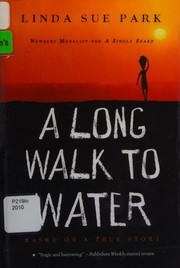
A Long Walk to Water
2,217-word summary 10 min read 122 pages in the book
- First published
- 2010
- Publisher
- Clarion Books
- Pages
- 122
- ISBN
- 9780547251271
Reading options
What's inside (8 sections)
I finished A Long Walk to Water in about ninety minutes and then sat with it for a while. It is a short book, 122 pages in the Clarion edition, with chapters that often run two or three pages. Linda Sue Park published it in 2010, and it has become one of those school novels that gets handed to a whole grade at once. I understand why. It is clean, fast, and built around a true story that is hard to shake.
The book runs two timelines at once. In 1985, an eleven-year-old Dinka boy named Salva Dut is sitting in a classroom in southern Sudan when gunfire starts. In 2008, an eleven-year-old Nuer girl named Nya is walking to a pond to fetch water for her family. The chapters alternate, and each one is labeled with a place and a year. For a while the two stories seem to have nothing to do with each other except geography and the fact that both children are eleven. Then the last chapters bring them together, and the whole design clicks.
That design is the book's greatest strength and also the thing that keeps it from being a richer novel. But I am getting ahead of myself.
Salva hears the guns
The first Salva chapter is almost unbearably efficient. He is in school, bored, listening to the teacher drone, thinking about the walk home. Then there is a sound like firecrackers, and the teacher is shouting at the boys to run into the bush, not back to the village. Salva runs. He keeps running. By the time he stops, he is separated from his parents and his brothers and sisters, and he has no idea whether any of them are alive.
He hides in a barn with an old woman for a few nights. She feeds him what she has and then tells him he has to go, because there is no more food and the soldiers are coming. That is the last adult kindness he gets for a long time. He joins a stream of people walking away from the fighting, and eventually he falls in with a group from his own village, Loun-Ariik. No one knows where his family has gone.
The walking sections are the heart of the book. Salva crosses a huge stretch of southern Sudan on foot, with little food and almost no clean water. He meets a boy named Marial, another Dinka child who has lost his family, and for a while they keep each other going. He meets a man named Buksa, who knows where to find a beehive and gives the group honey and beeswax to eat. Then, much later, he hears someone calling his name and discovers that his uncle Jewiir is with the group. Jewiir is a former soldier, he has a gun, and he takes charge. He tells Salva they will make it, and he teaches him to think about the next step instead of the whole distance.
Then Marial disappears in the night. Jewiir says it was probably a lion. Salva has to keep walking the next morning anyway. That is the pattern of the book: a loss, a short chapter, and then more walking.
The group reaches the Nile and crosses on boats made of reeds to an island where fishermen live. For a few days there is more food than Salva has seen in months. Then they cross the Akobo desert, three days of heat and almost no water. Partway through, they pass men who are dying of thirst, and some of the adults in Salva's group give away their own water to save them. Salva does not understand it at first. He is a child, and he is thinking about survival. The adults are thinking about something larger.
On the far side of the desert, armed men stop the group, take their food and supplies, and kill Uncle Jewiir in front of Salva. The book identifies the killers as Nuer fighters, and the killing is the emotional center of the Salva timeline. Everything before it has been endurance. This is the moment where endurance turns into grief, and where Salva has to decide whether to keep going. He does. He walks into Ethiopia and into a refugee camp, where he stays for six years.
Nya walks to the pond
Nya's chapters are much quieter, and at first they feel almost like a nature documentary. She wakes early. She takes a plastic container and walks to the pond. She waits in line with other women and girls. She fills the container, balances it on her head, and walks home. Then she does it again in the afternoon. The round trip takes half a day, which means that fetching water is not a chore she does after her other work. It is her work. It is most of her life.
The pond water is not clean. Nya knows this. Everyone knows this. But there is no other water, so they drink it, and the children get sick. Nya's five-year-old sister Akeer comes down with diarrhea and gets weaker and weaker. Their mother and Nya carry her to a clinic several days away, where medicine saves her. The nurse tells them the water is the problem and that they should boil it. Nya's mother knows that boiling water takes firewood, and firewood is scarce, and the whole calculation is impossible. That scene does more to explain the village's situation than a page of statistics could.
Nya's older brother Dep hunts with their father and asks the same question Nya does: how could water ever come out of this dry ground? During the dry season the family moves to a camp by a lake and digs in the mud for water. It is a life organized around a resource that is always running out.
Then men arrive. They talk to the village chief. The villagers clear a patch of ground in the middle of the village. Nya is told to carry rocks and water for the workers, which she does, with her mother carrying the baby on her back and hauling rocks too. A drilling rig appears. For a long time nothing happens except noise and mud. Nya does not fully understand what is being built, and Park keeps the reader in her limited point of view, so the well is a mystery until the water actually comes out.
The river of boys
The middle of Salva's story is the part that stays with me. After six years in Ethiopia, the government there falls, and the new government forces the refugees out. Salva and thousands of others are pushed toward the Gilo River, which is swollen and fast and full of crocodiles. People drown. People are shot. Salva survives, and then he joins the long walk to Kenya.
This is where he becomes a leader almost by accident. He is older now, maybe seventeen, and there are more than a thousand boys in the group, most of them younger than he is. He organizes them. He finds water. He keeps them moving. The journey takes about a year and a half, and by the end he has brought a huge number of boys to the Kakuma refugee camp.
Park does not make a hero speech out of this. She just shows him doing the next thing, and then the next. That restraint works better than a big inspirational scene would. Salva is not brave in a cinematic way. He is stubborn, and he is used to loss, and he has learned from his uncle that leadership means carrying other people's fear without putting yours on them.
In the camp, an aid worker named Michael teaches him English. Salva is in his late teens by then, and he has spent most of his life in camps. Then comes the news that a few thousand Sudanese refugees will be resettled in the United States. Salva's name is on the list. He flies to Rochester, New York, and is taken in by the Moore family.
Rochester, and the email
The Rochester chapters could have been a different book. Salva learns English properly, gets a job, and starts to build a life in a place with reliable water and heat and traffic lights. He is grateful and also displaced. The book does not spend much time on the loneliness, but you feel it in the gaps.
Then a cousin he has never met sends an email. Salva's father is alive, in a hospital in Sudan. Salva travels back in 2003 and finds him. His father is ill, and the illness is related to drinking contaminated water over years. Salva learns that his mother and sisters are alive and that two of his brothers died in the war. He cannot go back to his village because the war is still dangerous. He returns to the United States with a plan.
That plan becomes Water for South Sudan, the organization Salva founded to drill wells in villages that have none. The book is careful to show that this is not a simple rescue. It takes years, money, equipment, local workers, and negotiations with chiefs and families. The first well is not a magic wand. It is a piece of infrastructure, and infrastructure is slow.
The well at the school
Nya's timeline catches up here. The drilling rig finally hits water. The villagers celebrate, and Nya drinks clean water for the first time in her life without walking half a day to get it. Then the village builds a school next to the well, and Nya's father tells her she can go. That detail is the real ending of her story. The well does not just save her time. It changes what her time can be used for.
In the final chapter, Nya introduces herself to the man who designed the well and thanks him. He smiles and tells her his name is Salva. The two timelines meet in that handshake, and the reader realizes that the boy who walked out of Sudan in 1985 is the man who came back to build the well. It is a designed ending, and it works. I saw it coming from about the halfway point, and I still felt it.
Park's author's note explains what is true and what is not. Salva's story is real, and the book follows it closely. Nya is a composite, built from the experiences of girls Park met and read about. That distinction matters, and the book is honest about it. It also means the two halves are not quite the same kind of story. One is a biography compressed into a child's point of view. The other is a representative figure constructed to show a daily reality.
What the short chapters cost
The book is often described as inspiring, and it is, but that word can hide what it actually does. It is a book about water and war that has been trimmed down until it can be read by a ten-year-old in a week. That trimming is a skill. It is also a limitation.
Nya's chapters are thin. She is observant and patient, but she does not have much interior life on the page, and her story exists mostly to set up the final reveal. The well is the point, and she is the person standing next to it. Park gives her a few moments of fear for Akeer and a few of curiosity about the drill, but not enough to make her as memorable as Salva.
The war is also kept at a distance. We see guns and soldiers and a killed uncle, but we do not learn much about who is fighting whom or why. The Dinka and Nuer conflict, the northern government, the rebel army, the role of oil and religion: almost none of it is explained. For a middle grade reader, that may be appropriate. For an adult, it leaves the story feeling weightless in places, as if the violence is weather rather than politics.
The prose is deliberately plain, and most of the time that is right for the audience. Occasionally it tips into summary where a scene would be stronger. The middle of Salva's journey, in particular, becomes a list of hardships: walked, was hungry, was thirsty, kept going. The repetition is truthful, but it is still repetition. And the ending, with its perfectly timed meeting and its new school, is tidier than the real world usually allows.
None of that ruined the book for me. It is a very good introduction to a subject that most readers will know nothing about, and it trusts children to handle loss without melodrama. The chapters are short enough to give a reluctant reader momentum, and the alternating structure gives the book a pulse. I would hand it to a sixth grader without hesitation. I would also tell an adult reader to pair it with something longer, because this is a doorway, not the whole house. The story of Salva Dut is real, and the well is real, and the book earns its final image. It just does not give Nya enough room to be as real as he is.
FAQ
Is A Long Walk to Water based on a true story?
Salva Dut's story is true and the book follows his life closely, while Nya is a composite character based on the experiences of girls in southern Sudan. Park explains the distinction in her author's note.
What age is A Long Walk to Water for?
It is usually read in grades five through eight, roughly ages ten to thirteen. The short chapters and plain prose make it accessible, though it deals with war, thirst, and the death of a child.
How do Salva and Nya connect?
Nya's village is where Salva's organization drills a well. In the last chapter she thanks the man who designed it and learns his name is Salva.
Similar books

Schindler's List
Womanizing profiteer Schindler spends a fortune typing over a thousand Jews onto factory lists.
2,048-word summary · 9 min read
Salt to the Sea
Four refugee teens cross frozen Prussia toward a doomed ship that history barely remembers.
2,094-word summary · 9 min read
Cold Mountain
Wounded deserter Inman walks home to Ada as the Civil War ends, while she learns to keep a mountain farm in North Carolina with tough Ruby.
2,314-word summary · 10 min read
Between Shades of Gray
In 1941, fifteen-year-old Lina is deported from Lithuania to Siberia and uses her drawings to survive and send word to her father.
2,263-word summary · 10 min read
Beneath a Scarlet Sky
Pino Lella guides Jews over Alps then drives for Nazis in Milan.
2,271-word summary · 10 min read
The Orphan's Tale
A Dutch teenager rescues a Jewish baby from a death train and joins a German circus, where a Jewish aerialist teaches her to fly.
2,943-word summary · 13 min read

The Long Winter
Dakota Territory, 1880: seven months of blizzards cut a town off from the railroad, and a family survives on twisted hay, ground wheat, and a dangerous wheat…
2,210-word summary · 10 min read
The Power of One
A boy in apartheid South Africa decides to become welterweight champion of the world, and the novel follows every mentor, fight, and loss that gets him there.
2,145-word summary · 10 min read

The Icebound Land
Captured and enslaved in Skandia, Will fights a drug that erases him while Halt and Horace cut a bloody road through Gallica to bring him home.
2,088-word summary · 9 min read
The Valley of Horses
Exiled from the Clan, Ayla survives alone in a hidden valley, tames a horse and a cave lion, and nurses a wounded stranger back to life.
2,311-word summary · 10 min read

Sophie's Choice
A young Southern writer in 1947 Brooklyn befriends a brilliant, unstable couple and slowly learns the story of the Polish Catholic woman at the center of their…
2,798-word summary · 12 min read

The Girl with Seven Names: A North Korean Defector's Story
Hyeonseo Lee crossed the frozen Yalu River at seventeen, spent years hidden in China, escaped to South Korea, and later returned to rescue her family.
2,404-word summary · 11 min read
Lone Survivor: The Eyewitness Account of Operation Redwing and the Lost Heroes of SEAL Team 10
Marcus Luttrell's account of the 2005 SEAL mission in Afghanistan that killed three of his team and left him alone.
2,144-word summary · 10 min read
The Silence of the Girls
Briseis, queen of Lyrnessus, is captured by Achilles and narrates the Trojan War from inside the Greek camp, where women are prizes and survival is its own…
2,098-word summary · 9 min read

The Last of the Mohicans
During the French and Indian War, Hawkeye and two Mohican warriors try to save two British sisters from a Huron chief whose revenge will end the Mohican line.
2,017-word summary · 9 min read

Doctor Zhivago
A doctor and poet lives through revolution, war, and love in Pasternak's novel of private life under the pressure of Russian history.
2,213-word summary · 10 min read

Exodus
Leon Uris's sweeping 1958 novel follows Jewish refugees, Haganah fighters, and Holocaust survivors from Cyprus to the founding of Israel and the 1948 war.
2,529-word summary · 11 min read
The War That Saved My Life
Ten-year-old Ada has never left her London flat, hidden away because of her clubfoot. Wartime evacuation sends her to Kent, where a reluctant guardian and a…
2,252-word summary · 10 min read
The Last Kingdom
Kidnapped by Danish raiders as a boy and raised in their halls, Uhtred of Bebbanburg must choose what he is when the fight for England begins.
1,997-word summary · 9 min read

A Long Petal of the Sea
A pregnant widow and her brother-in-law marry for passage on a ship of Spanish exiles bound for Chile, then spend decades building and losing homes together.
2,016-word summary · 9 min read
The Red Badge of Courage
Henry Fleming runs at Chancellorsville, then returns to stand.
2,486-word summary · 11 min read

Esperanza Rising
Esperanza trades ranch life for farm labor camps in California.
2,338-word summary · 10 min read

Edge of Eternity
Five families cross civil rights, Cold War and Berlin Wall to the eighties.
2,489-word summary · 11 min read
Bud, Not Buddy
A ten year old orphan in the Depression walks to find a jazzman he thinks is his father.
2,568-word summary · 11 min read

Cryptonomicon
Codebreakers in World War II and hackers in the 1990s chase gold, ciphers, and a secret data haven.
2,280-word summary · 10 min read

The Island of Missing Trees
A talking fig links 1970s Cyprus lovers Kostas and Defne with their grieving London daughter Ada years later.
3,172-word summary · 14 min read
Code Name Verity
In 1943 France, captured agent Verity writes a confession for von Linden to buy time. Her pilot friend Maddie survives the crash and searches for her by…
2,690-word summary · 12 min read

The Sympathizer
Double agent captain spies in Saigon fall and LA exile while confessing to commandant.
2,169-word summary · 10 min read
The Island of Sea Women
On Jeju island, haenyeo divers Young-sook and Mi-ja share decades of friendship strained by war and massacre.
2,204-word summary · 10 min read

The English Patient
In a ruined Italian villa in 1945, a burned man, a nurse, a thief, and a sapper trade pasts shaped by desert love and war.
2,006-word summary · 9 min read