
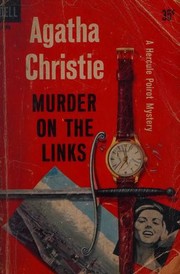
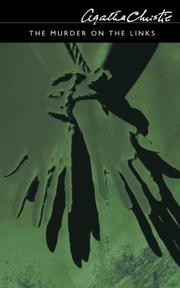
The Murder on the Links
2,055-word summary 9 min read 288 pages in the book
- First published
- 1923
- Publisher
- The Bodley Head
- Pages
- 288
- ISBN
- 9780062986320
- Series
- Hercule Poirot (#2)
Reading options
What's inside (10 sections)
The Murder on the Links is the second Hercule Poirot novel and the one where Agatha Christie teaches herself how to build a mystery with a corpse that keeps changing shape. It was first serialized in Grand Magazine from December 1922 under the title "The Girl with the Anxious Eyes," then published as a book in 1923, by Dodd, Mead in New York in March and by The Bodley Head in London in May. It runs 288 pages in the modern HarperCollins paperback. Poirot is two books old here, Hastings is still narrating, and the formula is not yet furniture. That is exactly why I like it.
The summons
The book opens with a letter. Poirot and Hastings, back in London, receive an urgent plea from a millionaire named Paul Renauld, who lives in Merlinville-sur-Mer, a resort town on the northern coast of France. He does not say what he wants. He only says come. They take the boat and the train and arrive to learn that they are a day late in the worst way: Renauld has been found stabbed in the back and left in a freshly dug open grave beside the local golf course.
The timing matters. A letter that arrives before a murder is one of the oldest engines in detective fiction, and Christie uses it here cleanly. Poirot accepts the summons partly out of professional curiosity and partly, I think, because a Belgian detective in a French seaside town in 1923 is an outsider twice over, and Christie likes him slightly wrong-footed. He is also, notoriously, a peacock about his appearance, and the local police waste no time enjoying that.
The widow, Eloise Renauld, tells a story about masked men, a 2 a.m. break-in, and her own binding. She collapses on seeing the body. The scene is staged for the reader as much as for the police, which is the fun of a Christie second novel: everyone in the villa has an alibi that is also a performance.
Giraud
The investigating officer from the Paris Sûreté is a man named Giraud, and Giraud exists to lose. He is all physical evidence, all footprints and tobacco ash, and he holds the Belgian in open contempt. Poirot, insulted and delighted, wagers him five hundred francs that he will solve the case first. The bet is the book's little comic engine, and it pays off in a final scene that Giraud does not enjoy.
What Christie does with the rivalry is more interesting than a simple rivalry, though. Giraud is not stupid, and the physical clues do matter. Poirot wins because he reads the clues as psychology instead of as a chain. There is a piece of lead piping near the body and a set of footprints through the flower beds, and the tramp who left the footprints ends up dead of an epileptic seizure, stabbed afterward with the same knife that killed Renauld. The physical story is a mess of contradictions, and Poirot's insight is that the mess is the message: someone built this scene on purpose.
There is also, and this is the part that ages best, the smell of an old case. Poirot learns that twenty-two years earlier, in Paris, a man named Georges Conneau and his lover, Madame Beroldy, conspired to murder her husband, and that the lover disappeared and the woman vanished. When he finds a photograph, it proves that the Renaulds' neighbor, Madame Daubreuil, is the notorious Madame Beroldy. Poirot's thesis, stated more than once, is that human nature does not change. A murderer who got away with it once will do it again, in the same hand, twenty-two years on.
The clues
Let me lay out the physical evidence the way the book does, because watching it misfire is the pleasure of the middle chapters. The body is found in a grave beside the golf course, stabbed in the back, which suggests a coward's crime or a staged one. A length of lead piping lies nearby, unaccounted for. There are footprints in the flower beds, and the servant situation is odd: the villa has only three female staff on hand, because Renauld had sent his son Jack and his chauffeur out of town the day before he died. A stranger was seen near the property. And 200,000 francs had recently been deposited by the neighbor, Madame Daubreuil, which is the kind of fact that looks like blackmail before it looks like anything else.
Then a tramp is found dead with the same knife, and the medico-legal detail that saves the book from being tidy: he died of an epileptic seizure first. He was stabbed after death. Corpses do not bleed much, and the book, to its credit, lets the evidence say so. Everything the local investigation found is real evidence of something, and none of it is evidence of murder, because the crime scene has been assembled from the leftovers of a different plan.
Watching Poirot sort this is the closest the early novels get to watching him think out loud. He does not announce deductions. He asks about gloves, about a photograph, about why a man would bury a body he did not kill. The wager with Giraud hangs over the middle of the book like a barometer, and the final accounting, when it comes, is one of the most satisfying scenes Christie wrote in the twenties. Giraud's method is not discredited. It is simply given a lower ceiling.
Cinderella
Hastings, meanwhile, meets a young woman at the crime scene who will not give her name. She calls herself Cinderella, she has the kind of nerve Hastings finds irresistible, and she asks to see the body. Then the murder weapon disappears. Hastings, who has spent his narration being wrong in a courteous way, is completely gone over her by about chapter four. The reader knows this is a Christie romance, which means the girl is never quite who she says either, and the payoff is a twin sister and a boat to South America.
I should say something in defense of Hastings, because he is usually written off as Poirot's dullard. His function in The Murder on the Links is not to be right about the mystery. It is to be the story's emotional register, a man who wants the world to make moral sense, while Poirot assembles the world out of mechanical sense. The gap between those two readings is where the plot hides its tricks.
Jack and the confession
The evidence points to Jack Renauld, the victim's son, especially after Poirot reveals that Paul Renauld had just changed his will to disinherit him. Giraud arrests Jack, and the case looks closed enough for the papers. Then Bella Duveen, a stage performer in love with Jack, walks into the police station and confesses. She and Jack had each come upon the body that night, each assumed the other had done it, and each stayed silent to protect the other. Two confessions to one murder is a classic knot, and Christie resolves it with an efficiency I did not expect from an early novel.
The knottier question is why the dead man was killed and left in a grave that he had, in a sense, dug himself. The answer is the book's best invention. Paul Renauld was Georges Conneau, living under a false name and being blackmailed by his old accomplice, Madame Daubreuil, who had found him and wanted money. Then a tramp died of natural causes on the grounds, and Conneau, fresh out of options, saw an exit: disfigure the tramp's face, bury him in a grave dug in advance, and let the world conclude that Paul Renauld had been murdered. A fake death would release him from the blackmailer forever.
It did not work because someone followed him out to the grave.
Marthe
The killer is Marthe Daubreuil, the neighbor's daughter, who wants to marry Jack and wants Jack to inherit. She watched the fake burial from the dark, and when the opportunity stood up with a shovel in its hands, she used the knife that was already part of the planned scene. Someone else's staged murder became Marthe's real one. The double exposure is pure Christie: the elaborately faked crime concealing a much simpler one, a pattern she would reuse and refine across her career.
Poirot proves it the way I wish every mystery would end, by setting a trap out of human nature. He arranges for Madame Renauld to announce that Jack will be disinherited after all, which gives the killer a reason to come back and try again. Marthe breaks into the house to kill the mother. The struggle that ends her life involves Dulcie Duveen, the twin of the girl Hastings called Cinderella, and yes, by then Hastings has proposed to one of them and married the idea of the other, and the resolution is tidier than it should be, but it is 1923 and the war generation deserved a happy ending now and then.
Hastings and the shape of the series
There is another reason to read the second book of a famous series, which is to catch the author deciding what is load-bearing. By the time she wrote this one, Christie knew she had a detective worth keeping, and she was experimenting with what to do about his chronicler. Hastings is a device, but a charming one, and the twin-sister twist that ends his story here reads as a deliberate clearing of the decks. Christie later said she miscalculated, and brought him back. That back-and-forth is visible on the page, and it is part of the fun for series readers. You are watching a franchise invent itself.
The same is true of the mechanics. The locked room here is a grave. The impossible crime is a man who was buried before he was killed, or killed before he was buried, depending on which body you mean. Christie would spend her career hunting variations on this single pleasure, and The Murder on the Links is her second and rougher attempt, which makes it the ideal place to see the trick before it becomes the trademark. If you have read a dozen Poirots, the machinery here will feel like a sketchbook. If you have read none, it will feel like a magic trick.
What the book is owed
Contemporary reviews were warm in a way that should encourage anyone put off by Christie's reputation as a genre-machine. The Times Literary Supplement called it an enthralling mystery of an unusual kind. The New York Times called it a remarkably good detective story. The Observer noted that Poirot was a pleasant contrast to his lurid competitors, which is a compliment about exactly the quality that makes the books last: the murders are grotesque, the detective's manners are not.
Christie herself later said she wrote it in a high-flown, fanciful style, and you can feel that in places. The French setting is painted with a broad brush. The romance is a fairy tale. One reviewer, the crime novelist Robert Barnard, complained that the solution is the kind you forget the moment it is revealed, which feels harsh but not insane. The Murder on the Links is not Murder on the Orient Express. It is a young writer discovering that fair-play clues and emotional smoke screens are the same technology aimed in different directions.
And there is a structural thing to notice about it, which is the book's real value to a reader of the series. This is where the series grows its habits: the investigating rival, the bet, the fake-out solution, the couple whose romance is entangled with the crime, and the investigator who wins by understanding people rather than clues. Hastings marries Dulcie and gets parcelled off toward South America, less a character decision than a maintenance decision, and Christie later admitted as much. Poirot, meanwhile, arrives fully formed. You read this one to watch a master blueprint being drawn, and it is a good, quick, devious mystery in its own right, with the best last line of any of the early Poirot novels, which I will not spoil except to say that it belongs to a wager.
FAQ
Who is the murderer in The Murder on the Links?
Marthe Daubreuil, the daughter of the neighbor blackmailing Paul Renauld, kills him while he stages his own fake death.
Is The Murder on the Links the first Hercule Poirot novel?
No. It is the second, published in 1923 after The Mysterious Affair at Styles, and it is narrated by Captain Hastings.
Why was this novel originally called The Girl with the Anxious Eyes?
It was serialized in Grand Magazine in 1922 and 1923 under that title before book publication as The Murder on the Links.
Similar books
More from Hercule Poirot first, then related titles.
The Mysterious Affair at Styles
Hastings reunites with refugee Poirot at Styles Court after Emily Inglethorp is poisoned in her locked room.
2,856-word summary · 13 min read
The Murder of Roger Ackroyd
Retired Poirot probes a locked study murder in King's Abbot, told by the village doctor.
3,582-word summary · 16 min read
Murder on the Orient Express
Poirot is trapped by snow with thirteen strangers after an American is found stabbed in his berth.
2,004-word summary · 9 min read
The ABC Murders
Poirot and Hastings chase a killer who leaves an ABC railway guide near victims in Andover, Bexhill, and Churston. A salesman looks guilty, but publicity hides…
3,302-word summary · 15 min read
Death on the Nile
Poirot takes a Nile cruise where a young heiress is shot dead in her cabin.
4,077-word summary · 18 min read

One, Two, Buckle My Shoe
Poirot links a dentist murder to a missing banker and stolen millions.
2,549-word summary · 11 min read
The Body in the Library
A strange girl found dead in a library pulls Miss Marple into lies about dance halls and film.
2,017-word summary · 9 min read
The Memoirs of Sherlock Holmes
Doyle's second Holmes collection gathers twelve Strand stories, including the early case of the Gloria Scott and the confrontation with Moriarty at Reichenbach…
2,390-word summary · 11 min read
The Maltese Falcon
Sam Spade hunts a jeweled bird through lies after his partner is killed.
2,529-word summary · 11 min read
The Sign of Four
Mary Morstan's pearls lead Holmes and Watson from foggy London to Agra treasure and a Thames chase.
2,114-word summary · 9 min read
The Adventures of Sherlock Holmes
Twelve Strand cases from Irene Adler to the Copper Beeches, with Holmes at his sharpest and strangest.
3,579-word summary · 16 min read
The Hound of the Baskervilles
Holmes Watson probe spectral hound killing Baskervilles on Dartmoor.
2,596-word summary · 12 min read
A Study in Scarlet
Watson meets Holmes in Baker Street, a Brixton body bears the word Rache, and a Utah revenge tale explains it.
2,208-word summary · 10 min read
At Bertram's Hotel
Miss Marple finds a luxury hotel fronting robbery and murder.
2,550-word summary · 11 min read
The Man in the Brown Suit
Anne Beddingfeld sees a Tube death in London and chases a paper clue to South Africa, diamonds, and the hidden Colonel.
2,292-word summary · 10 min read
The Murder at the Vicarage
Vicar Leonard Clement narrates the shooting of Colonel Protheroe while Miss Marple watches St Mary Mead.
2,926-word summary · 13 min read
And Then There Were None
And Then There Were None retold: ten to Soldier Island, rhyme deaths, no one left to tell.
2,137-word summary · 9 min read

How the Light Gets In
Gamache investigates the murder of the last Ouellet quintuplet while the Sûreté he served is dismantled from inside by the man who took his protégé.
2,279-word summary · 10 min read
Bury Your Dead
Recovering from a failed raid that killed his officers, Gamache investigates a murder in a Quebec City library while Beauvoir reopens a case in Three Pines.
2,022-word summary · 9 min read

The Trespasser
A Dublin Murder Squad detective investigates a staged dinner-party killing and finds a cover-up that reaches into her own department.
2,051-word summary · 9 min read

Rules of Prey
Minneapolis detective Lucas Davenport hunts a killer who leaves a new rule at every scene and treats murder as a game of wits.
1,914-word summary · 9 min read

The Late Show
Exiled to the LAPD night shift after accusing her supervisor, Renée Ballard keeps two cases that were meant to be handed off at dawn: a brutal assault and a…
2,563-word summary · 11 min read
Finger Lickin' Fifteen
Lula sees a celebrity chef decapitated and talks Stephanie into entering a barbecue contest to lure the killers, while Ranger hires her to find a security leak…
2,248-word summary · 10 min read
The Moonstone
A cursed yellow diamond vanishes on the night of a birthday party, and eight witnesses tell what they saw.
2,603-word summary · 12 min read
Fearless Fourteen
Bounty hunter Stephanie Plum babysits a teenager, guards a fading singer, and hunts nine stolen million dollars under her boyfriend's basement.
2,466-word summary · 11 min read

3rd Degree
The third Women's Murder Club novel follows a San Francisco terror cell and a three-day killing schedule, and it costs the club a member.
2,685-word summary · 12 min read
Lean Mean Thirteen
Stephanie Plum's ex-husband disappears after she attacks him, leaving her suspected of murder and chasing a forty-million-dollar secret through Trenton.
2,100-word summary · 9 min read

The Redbreast
Harry Hole chases an ageing sniper through modern Oslo while two Norwegian volunteers on the Eastern Front carry a fifty-year-old betrayal toward a royal…
2,453-word summary · 11 min read

The Caves of Steel
Detective Elijah Baley must solve a Spacer's murder in a domed New York, partnered with R. Daneel Olivaw, a humaniform robot built in the victim's image.
2,445-word summary · 11 min read
Broken Harbor
A family is found slaughtered in a half-built Dublin estate where no one broke in, and star detective Scorcher Kennedy must explain the holes in the walls.
2,308-word summary · 10 min read