
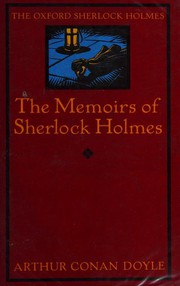
The Memoirs of Sherlock Holmes
2,390-word summary 11 min read 321 pages in the book
- First published
- 1894
- Publisher
- George Newnes
- Pages
- 321
- ISBN
- 9780192123091
- Series
- Sherlock Holmes (#4)
Reading options
What's inside (9 sections)
I read The Memoirs of Sherlock Holmes immediately after The Adventures, which is the way the book wants to be read. The first collection establishes the formula. The second one starts to test it. Arthur Conan Doyle's twelve stories appeared in The Strand Magazine between December 1892 and December 1893, with Sidney Paget's illustrations, and George Newnes brought them out in book form at the end of 1893 with an 1894 imprint. The edition I read runs 321 pages. In the site's Sherlock Holmes order it is the fourth book, after A Study in Scarlet, The Sign of Four, and The Adventures, and before The Hound of the Baskervilles.
One publishing detail matters. The first British edition left out "The Adventure of the Cardboard Box" because its plot turned on adultery, which was considered unsuitable for the family magazine market. Most modern editions put it back, so the count is twelve rather than eleven. That missing story is a small lesson in how Victorian publishing worked. The Strand was a family magazine, and Holmes was a product for households. Doyle could write about murder, blackmail, and betrayal, but he had to be careful about sex. The Cardboard Box crossed a line, and the book changed shape because of it.
The Horse, the Dog, and the Ears
"Silver Blaze" is the collection's opening story and one of its best. A famous racehorse, Silver Blaze, disappears from Colonel Ross's stables at King's Pyland before an important race. The trainer, John Straker, is found dead on the moor, his head smashed by a heavy blow. The police assume a stranger did it. Holmes looks at the stable dog, which did nothing in the night. That silence tells him the intruder was someone the dog knew. The horse, meanwhile, is not stolen in the ordinary sense. Straker had taken it out to injure it, hoping to fix a bet, and the horse killed him with a kick. Holmes finds the animal and restores it in time for the race. The solution is elegant because it turns on a non-event. The dog did nothing. That is the clue.
"The Adventure of the Cardboard Box" is the story the first edition omitted, and it is the grimmest piece in the book. A parcel arrives at the home of Miss Susan Cushing in Croydon. Inside are two severed ears, one male and one female, packed with salt. Holmes reads the ears, the address, and the postmark, and works back to a sailor named Jim Browner, whose jealousy had already destroyed his marriage. The killings were domestic and brutal, and the package was a last act of spite. The story is not a puzzle in the cozy sense. It is a study in rage, and the details are ugly enough that the editor's discomfort makes sense. Modern readers who want the complete collection should make sure their edition includes it.
Faces, Clerks, and Hidden Children
"The Yellow Face" is the story that surprised me most. Grant Munro comes to Holmes because his wife, Effie, has been visiting a cottage in Norbury and lying about it. She had a previous life in America, and Munro suspects another man. Holmes expects the usual triangle. What he finds is a child, Effie's daughter from her first marriage, who is of mixed race. Effie has hidden the girl because she is afraid of what her husband will think, and the face at the window belongs to the child. Munro, to his credit, accepts the girl. Holmes's reaction is the real surprise. He is gentle about it, and Watson notices. The story is a small rebuke to the era's assumptions, though it also carries the assumptions of its own time in the way the child is described. It is the most humane story in the collection, and one of the few where Holmes's sympathy matters as much as his logic.
"The Stockbroker's Clerk" is lighter and more mechanical. A young clerk named Hall Pycroft is offered a job at a salary far above what he is worth, on strange conditions, by a firm that seems to have no real business. He is told to travel and wait, and the waiting is the point. Holmes sees that the job is a way to keep the clerk out of London while someone uses his name and his record in a fraud against a stockbroking house. The story is a lesson in how confidence men work: they do not need to forge a man's face if they can borrow his ordinary life. It is not one of Doyle's famous cases, but it is a clean example of Holmes thinking about institutions rather than corpses. The solution depends on a coincidence, and the villains are thin, but the mechanics are satisfying.
Two Cases Holmes Tells Himself
"The Gloria Scott" and "The Musgrave Ritual" are the stories where Doyle hands the narration to Holmes. That change matters. Watson's voice is the reader's friend, a little slow, honest, and easily impressed. Holmes's voice is colder and more technical. He tells "The Gloria Scott" as his first case, the one that happened before he was famous. An old university friend, Victor Trevor, invites him home, and a cryptic message about a former convict named Hudson frightens Trevor's father to death. The message points back to the convict ship Gloria Scott, and the father's respectable life turns out to rest on a mutiny and a fortune taken from the dead. Holmes solves the code, but he cannot save the man. It is a young man's case, full of coincidence and melodrama, and that is part of its charm.
"The Musgrave Ritual" is better. Reginald Musgrave, an old acquaintance, asks Holmes about his butler Brunton, who disappeared after becoming obsessed with the family's old ritual. The ritual is a set of questions and answers about the sun, an oak, and a shadow, and it sounds like nonsense until Holmes treats it as a set of measurements. The butler had worked out that it pointed to a hiding place under the house. He and a maid, Rachel Howells, went looking for the treasure. Brunton was trapped in the cellar, and the maid, who had reason to hate him, may have left him there. The treasure is the crown of Charles I, hidden after the king's execution. The story is a nice blend of family history, greed, and engineering. It also shows Holmes's pleasure in old paper. He is happiest when a ritual turns out to be a map.
Country Houses and Old Soldiers
"The Reigate Squire" begins with Holmes ill and worn out, recuperating in the country. A local landowner has been murdered, and the case looks like a burglary gone wrong. A torn note is found in the dead man's hand, and Holmes notices that the handwriting matches a note written by one of the neighboring family. The murder turns on a lawsuit, a forged document, and a quarrel between two households. Holmes solves it from his sickbed, which is the story's appeal. He is not chasing anyone across a moor. He is lying under a blanket, asking for a glass of water, and outthinking everyone in the room. The solution is clever, though the culprit is obvious once the handwriting is mentioned. It is a good example of Doyle's habit of building a story around a single physical clue.
"The Crooked Man" is stranger and sadder. Colonel James Barclay is found dead in his home, and his wife is the obvious suspect. The marriage was unhappy, and the dead man had a temper. Holmes looks at the room and finds evidence of a third presence, a deformed man from the colonel's past. The man is Henry Wood, a soldier who was betrayed by Barclay in India and left to be tortured. He has come back, and the shock of seeing him killed the colonel. The story is a colonial ghost story in miniature. The past does not stay in India. It walks into an English drawing room and stands there. The solution is melodramatic, but the image of the crooked man is hard to forget.
Doctors, Patients, and a Greek Interpreter
"The Resident Patient" is one of the weaker stories for me. Dr. Percy Trevelyan is a young physician who was set up in practice by a mysterious patient named Blessington. Blessington takes a share of the fees and lives in the house, and he is terrified that someone is watching him. He is right. His past as a member of a criminal gang has caught up with him, and the men who come to the house are not patients. Holmes arranges a watch, but the gang gets to Blessington anyway. The story has a good atmosphere of a house turned into a trap, and the relationship between the doctor and his patron is unusual. The solution, though, depends on a long confession and a coincidence, and the villains are not memorable. It is the kind of story that fills a collection rather than defining it.
"The Greek Interpreter" introduces Mycroft Holmes, and that alone makes it worth reading. Watson is astonished to learn that Holmes has a brother, and even more astonished to learn that Mycroft is smarter. Mycroft is a government man who spends his days at the Diogenes Club, a place for men who do not want to talk. He is lazy in body and immense in mind. The case begins with a Greek interpreter, Mr. Melas, who is hired to translate for a Greek man being held in a house. The man is a prisoner, his sister is being pressured, and the criminals are trying to get control of a family fortune. Holmes and Watson rescue the prisoner, but not in time to save him from the damage that has already been done. Mycroft's presence adds a new layer to the Holmes myth: the detective is not a unique mind but a family trait, and the British government has one of its own.
A Stolen Treaty and the Falls
"The Naval Treaty" is one of the longest stories in the collection and one of the most entertaining. Percy Phelps, a clerk at the Foreign Office, was working late on a secret treaty between Britain and another power. He left the room for a moment, and when he came back the treaty was gone. The scandal threatens his career and the country. Holmes reads the room, the window, and the garden, and works out that the thief was someone in the household. The treaty is recovered from a rose garden, where it has been hidden in a way that only someone who knew the house could manage. The story has a strong sense of professional anxiety. Phelps is not a hero. He is a man who made one careless mistake and has been living with the consequences. Holmes's calm is a comfort, but the story also shows how fragile a respectable life can be.
Then there is "The Final Problem." Holmes comes to Watson with a warning. Professor Moriarty, the criminal mastermind, has finally been identified, and Holmes has enough evidence to bring down his network. Moriarty visits him at Baker Street and warns him to withdraw. Holmes does not. He asks Watson to accompany him to the Continent, and they travel across Europe to Switzerland, with Moriarty's men behind them. At the Reichenbach Falls, Holmes sends Watson back to the hotel on an errand. When Watson returns, Holmes is gone. There are footprints at the edge, a note, and no body. Watson concludes that Holmes and Moriarty went over together.
The story is famous because Doyle meant it. He was tired of Holmes and wanted to write other things, and killing the detective was his escape. The public reaction was enormous. Readers wrote letters and mourned a fictional man as if he had been a real friend. Doyle eventually brought Holmes back, first in The Hound of the Baskervilles, which is set before the falls, and then in The Return of Sherlock Holmes, where the detective explains that he survived. The Memoirs is therefore a hinge. It is the book where Doyle tries to end the myth, and the myth refuses to end.
What the Collection Does and Where It Strains
Read as a whole, The Memoirs is uneven. "Silver Blaze," "The Yellow Face," "The Musgrave Ritual," "The Naval Treaty," and "The Final Problem" are strong. "The Resident Patient" and "The Stockbroker's Clerk" feel like filler. The method repeats: a client arrives, a small detail is overlooked by the police, Holmes sees it, and a confession follows. Some solutions depend on coincidence, and some of the science is stage science. Loyalty and secrecy run through the book: Watson follows Holmes to Switzerland without knowing the plan, and the clients who hide the truth from him are usually the ones in the most danger. The empire is always in the background, usually as a place where Englishmen went and did something they would rather forget. India supplies a betrayed soldier, America a secret marriage and a hidden child, Australia a convict ship. Doyle is not examining that history. He is using it for atmosphere.
The collection's importance is still enormous. It gives Holmes a brother, a turn at narration, an origin story, and an ending. It shows Doyle experimenting with voice, and it shows the character becoming a myth in real time. "The Final Problem" is one of the most famous endings in detective fiction, and the fact that it had to be undone is part of its power. The story works because it takes the character seriously enough to kill him. The return works because readers could not let him stay dead. The Memoirs is the book where both of those things become clear.
What stays with me is the way Doyle can make a small omission carry a whole story. The dog that did nothing is more memorable than the horse that won. That is the trick of the collection: the absence is the clue, and the ending is the absence of the man himself. Watson comes back to an empty ledge above the water, and the reader fills the space. Doyle did not need to show the fall. He only needed to leave the footprints.
FAQ
Is The Memoirs of Sherlock Holmes a novel?
No. It is a collection of twelve short stories that first appeared in The Strand Magazine between December 1892 and December 1893.
Why does the first British edition leave out The Cardboard Box?
George Newnes omitted it because the plot depends on adultery, which was considered unsuitable for a family magazine. Most modern editions restore the story.
Does Sherlock Holmes die in The Final Problem?
He appears to die at Reichenbach Falls, and Doyle intended the story as an ending. Public demand led him to bring Holmes back in later books.
Similar books
More from Sherlock Holmes first, then related titles.
A Study in Scarlet
Watson meets Holmes in Baker Street, a Brixton body bears the word Rache, and a Utah revenge tale explains it.
2,208-word summary · 10 min read
The Sign of Four
Mary Morstan's pearls lead Holmes and Watson from foggy London to Agra treasure and a Thames chase.
2,114-word summary · 9 min read
The Adventures of Sherlock Holmes
Twelve Strand cases from Irene Adler to the Copper Beeches, with Holmes at his sharpest and strangest.
3,579-word summary · 16 min read
The Hound of the Baskervilles
Holmes Watson probe spectral hound killing Baskervilles on Dartmoor.
2,596-word summary · 12 min read
The Moonstone
A cursed yellow diamond vanishes on the night of a birthday party, and eight witnesses tell what they saw.
2,603-word summary · 12 min read
The Murder on the Links
Poirot arrives in France too late to save his client, who is found stabbed in a grave and was not the man he claimed to be. Christie's second Poirot novel.
2,055-word summary · 9 min read
The Maltese Falcon
Sam Spade hunts a jeweled bird through lies after his partner is killed.
2,529-word summary · 11 min read
The Body in the Library
A strange girl found dead in a library pulls Miss Marple into lies about dance halls and film.
2,017-word summary · 9 min read
The Murder of Roger Ackroyd
Retired Poirot probes a locked study murder in King's Abbot, told by the village doctor.
3,582-word summary · 16 min read
The Mysterious Affair at Styles
Hastings reunites with refugee Poirot at Styles Court after Emily Inglethorp is poisoned in her locked room.
2,856-word summary · 13 min read
How the Light Gets In
Gamache investigates the murder of the last Ouellet quintuplet while the Sûreté he served is dismantled from inside by the man who took his protégé.
2,279-word summary · 10 min read
Bury Your Dead
Recovering from a failed raid that killed his officers, Gamache investigates a murder in a Quebec City library while Beauvoir reopens a case in Three Pines.
2,022-word summary · 9 min read

The Trespasser
A Dublin Murder Squad detective investigates a staged dinner-party killing and finds a cover-up that reaches into her own department.
2,051-word summary · 9 min read

Rules of Prey
Minneapolis detective Lucas Davenport hunts a killer who leaves a new rule at every scene and treats murder as a game of wits.
1,914-word summary · 9 min read

The Late Show
Exiled to the LAPD night shift after accusing her supervisor, Renée Ballard keeps two cases that were meant to be handed off at dawn: a brutal assault and a…
2,563-word summary · 11 min read
Finger Lickin' Fifteen
Lula sees a celebrity chef decapitated and talks Stephanie into entering a barbecue contest to lure the killers, while Ranger hires her to find a security leak…
2,248-word summary · 10 min read
Fearless Fourteen
Bounty hunter Stephanie Plum babysits a teenager, guards a fading singer, and hunts nine stolen million dollars under her boyfriend's basement.
2,466-word summary · 11 min read

3rd Degree
The third Women's Murder Club novel follows a San Francisco terror cell and a three-day killing schedule, and it costs the club a member.
2,685-word summary · 12 min read
Lean Mean Thirteen
Stephanie Plum's ex-husband disappears after she attacks him, leaving her suspected of murder and chasing a forty-million-dollar secret through Trenton.
2,100-word summary · 9 min read
The Redbreast
Harry Hole chases an ageing sniper through modern Oslo while two Norwegian volunteers on the Eastern Front carry a fifty-year-old betrayal toward a royal…
2,453-word summary · 11 min read

The Caves of Steel
Detective Elijah Baley must solve a Spacer's murder in a domed New York, partnered with R. Daneel Olivaw, a humaniform robot built in the victim's image.
2,445-word summary · 11 min read

Broken Harbor
A family is found slaughtered in a half-built Dublin estate where no one broke in, and star detective Scorcher Kennedy must explain the holes in the walls.
2,308-word summary · 10 min read

One, Two, Buckle My Shoe
Poirot links a dentist murder to a missing banker and stolen millions.
2,549-word summary · 11 min read
Fingersmith
A thief plots to cheat an heiress, then the scheme flips twice in Victorian London.
2,532-word summary · 11 min read
Cruel & Unusual
Scarpetta links an execution to a boy's murder while someone steals bodies.
2,533-word summary · 11 min read
Case Histories
A Cambridge PI takes three cold cases that tangle with his own loss.
2,465-word summary · 11 min read
Bleak House
Jarndyce and Jarndyce grinds through Chancery while Esther finds her family.
2,480-word summary · 11 min read
At Bertram's Hotel
Miss Marple finds a luxury hotel fronting robbery and murder.
2,550-word summary · 11 min read
The Man in the Brown Suit
Anne Beddingfeld sees a Tube death in London and chases a paper clue to South Africa, diamonds, and the hidden Colonel.
2,292-word summary · 10 min read
Maisie Dobbs
A maid turned war nurse opens a London inquiry agency in 1929 and traces a quiet case to a refuge for shattered soldiers.
2,382-word summary · 11 min read