
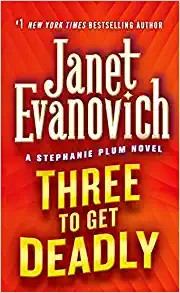
Three to Get Deadly
1,981-word summary 9 min read 396 pages in the book
- First published
- 1997
- Publisher
- St. Martin's Press
- Pages
- 396
- ISBN
- 9780312966096
- Series
- Stephanie Plum (#3)
Reading options
What's inside (5 sections)
I read One for the Money on a plane and laughed enough that the person next to me asked what book it was, so I kept going. Three to Get Deadly is the third Stephanie Plum novel, first published in 1997, St Martin's Press mass market edition running 396 pages in the copy I cite, ISBN 9780312966096, though many readers know the 288 page hardcover rhythm. Stephanie is still broke in Trenton, still bounty hunting for cousin Vinnie, still torn between Joe Morelli and Ranger, still blowing up cars. This one involves a candy store owner who goes missing with army money, a very patient drug dealer, and Lula in a wedding dress. It is sillier and darker in turns than book two, and it shows Evanovich settling into the series formula.
Stephanie Plum lost her lingerie buyer job in book one, took bounty hunting to pay rent, and has not looked back except to complain. At the start of book three she is behind on rent again, her car is embarrassing, her hamster Rex is still running in his wheel, her parents still want her married, Grandma Mazur still wants to see bodies at viewings. Vinnie gives her a file that looks easy. Moses Bedemier, aka Uncle Mo, beloved candy store owner in the Burg, missed court on a weapons charge and vanished. Bring him in, collect a small bond, eat free chocolate. Of course it is not easy. Mo was holding money for a dangerous man and everyone wants it.
Uncle Mo and the Burg
Uncle Mo matters because the Burg, the tight Trentonn neighborhood where Stephanie grew up, protects its own. Mo gives kids free candy, extends credit, remembers birthdays. That he would hold a gun charge for someone shocks people. Stephanie starts by asking polite questions and gets polite walls. No one saw anything. No one knows Mo's friends. Lula, former sex worker turned file clerk turned aspiring bounty hunter, comes along and gets more honest answers by being herself. A scene where Lula orders ice cream while interviewing a terrified clerk tells you how she works. She makes people laugh until they talk.
Morelli is now a cop again after book one troubles, trying to be legitimate while still bending rules for Stephanie. Their relationship is at the stage where they sleep together, argue about her safety, make up, repeat. Ranger, the Special Forces turned security expert with a mysterious company, trains her, gives her guns she loses, bails her out without asking for thanks he would accept. The love triangle here is less about choice and more about Stephanie refusing to choose while both men refuse to leave. Some readers tire of it by book three. I still find it funny because Evanovich lets Stephanie be annoyed by both. She likes Morelli's steadiness and Ranger's competence and resents being managed by either.
The Burg details carry the early chapters. Catholic churches, bars with sticky floors, bakeries that extend credit, old ladies who see everything from windows. Stephanie's parents' house, with her father's silence and mother's shopping, is a sitcom set that never wears out for me. A dinner scene where Grandma Mazur asks if Mo killed anyone and whether there will be a viewing had me laughing out loud. That humor balances the drug plot that gets serious fast.
The missing money belongs to a dealer who does not joke. He sends men to watch Stephanie, to break into her apartment, to take her car apart. Stephanie, who still locks her door but leaves windows open for Rex's air, is an easy target. She loses a car to fire, another to theft, gets a new one that is worse. The running car gag, which could feel repetitive by book three, still works because each loss is staged differently. One burns while she watches with Lula eating popcorn. One is stripped in an hour outside a courthouse. The insurance man knows her by voice.
Lula, Connie, and the office
Lula is the reason to read this volume. In book one she was comic relief. Here she wants to be a bounty hunter, buys a wedding dress to catch a skip at a wedding, practices apprehensions on Stephanie's couch. Her stakeout fashion, her food metaphors for stakeouts, her willingness to walk into bars Stephanie fears, all give the book energy when the money plot gets talky. A chapter where Lula tries to fit into a bridesmaid dress to infiltrate a reception is worth the price alone. She gets stuck, rips it, goes anyway, catches the guy by sitting on him. I cheered.
Connie, Vinnie's office manager, holds the office with sarcasm and files. She tells Stephanie which bonds are worth it, which skips are dangerous, when Vinnie is lying about the fee. Their friendship is all business talk and shared eye rolls, which feels true to workplaces. Vinnie himself is weaselly, cheap, lecherous, and occasionally brave when his office is threatened. Evanovich does not redeem him. She lets him be useful once and then back to hiding behind Connie's desk.
The investigation moves through candy store ledgers, army surplus connections, and a kid who saw a truck. Stephanie is not a good detective in the classic sense. She forgets to check locks, loses her gun, interviews without notes. She succeeds by showing up repeatedly and by being liked. People tell her things because she listens and because she is from the Burg. Morelli and Ranger succeed by skill. Stephanie succeeds by persistence and by having Lula. That division keeps the series from feeling like a superhero story. She is ordinary trying hard.
For pacing, the middle has two searches in a row that find nothing. A storage unit empty, a garage empty, a basement with old candy molds. I skimmed one because the pattern, drive, joke, empty, car trouble, was clear. Then a scene where Stephanie finds Mo hiding and must decide whether to turn him in immediately snaps it back. Mo's reason for running, protecting kids who would be hurt if he talked, reframes him from sweet old man to someone making hard choices. Stephanie's choice about what to report shows growth from book one. She still wants the fee, but she wants to do it without getting him killed.
Danger that actually lands
The dealer plot turns serious in the last third. Men follow Lula home. Stephanie is grabbed in a parking lot and warned with a gun she can feel through her coat. Morelli tells her to drop the case and means it. Ranger gives her a panic button and a lecture without humor. Evanovich balances tone by keeping jokes in dialogue while letting action have consequences. No one Stephanie loves dies here, but it feels possible in a way book two did not always. A shooting at a soda shop breaks glass near a child. That image stayed with me more than any explosion.
Without spoiling the recovery, the money is found in a place that makes sense for a candy man who thinks in terms of treats and tins. The handoff goes wrong in a way that requires all three, Stephanie, Morelli, Ranger, plus Lula doing something brave and stupid. The final confrontation is short and messy, not a mastermind speech. Someone panics, someone runs, Stephanie tackles badly and wins by luck and weight. That messiness is the series charm. She is not Reacher. She is a woman from New Jersey with pepper spray and friends.
The romance does not resolve, which will annoy if you want picking. Morelli asks for more. Ranger offers less with more intensity. Stephanie chooses work and rent. A late scene where Morelli cooks for her and she falls asleep on his couch from exhaustion is tender without promising. I liked that Evanovich does not force a decision in book three of a long series. The triangle is the engine, not the destination yet.
For criticism, the book leans on fat jokes and Burg stereotypes that have aged poorly. Lula's weight is commented on too often as punchline rather than fact. Grandma Mazur's gun obsession repeats. A dealer henchman is written as dumb in ways that feel lazy. Also, Stephanie's incompetence with guns, losing them, forgetting safeties, is funny until you remember real guns kill. Evanovich plays it for laughs in 1997 in a way a 2026 reader may flinch at. I did twice.
Still, at under 400 pages in mass market it flies. Short chapters, dialogue heavy, cliffhangers about cars rather than lives until late. I read it in two sittings on a weekend and immediately wanted book four. That is what a series third should do. Deepen the town, test the heroine a little harder, let the sidekick shine, leave the romance simmering.
For who this is for. If you liked One for the Money, keep going. This is funnier than Two for the Dough and a touch darker. If you are new, start at book one. You need Vinnie's office rules, Rex, Grandma, Morelli and Ranger introductions for this to land. If you want gritty crime, look elsewhere. Bodies here bleed but jokes keep coming. I closed it thinking about Uncle Mo's free candy and about how Stephanie, who started hunting for rent, now hunts because people call her when they are scared. That shift from money to trust is why the series lasts.
One more element that holds up is Trenton as a small town inside a city. The Burg watches. Windows open when a car backfires. Old men at the bar know who missed court before Connie files it. Stephanie cannot go undercover because everyone knows her father and her grandmother's church pew. That lack of anonymity, which would sink a hardboiled detective, fuels comedy and plot here. She gets tips while buying milk. She gets warned off while getting her hair done. Lula, who is from outside but learned the streets, translates. Morelli, who grew up there too, uses the same network with a badge. Ranger, the outsider, buys information the Burg will not give freely. Each of them moves through the same blocks differently, which keeps even empty searches entertaining. You learn the alleys by who will talk in them.
The money itself deserves attention because Evanovich treats it practically. How much is the bond. What percent does Vinnie take. What does gas cost for a week of surveillance. Stephanie counts in a notebook with rounded numbers and dread. When Mo's cash appears, she does not dream of keeping it long, though the thought flashes. She thinks about rent, about her parents' roof, about Lula's car repairs. Crime money in this series is never glamorous. It is rent and groceries with risk attached. That grounding is why the stakes feel real even when the action is cartoonish. A thousand dollars means heat for winter. Losing it means shame at Sunday dinner. Those are the real punishments driving Stephanie to chase men with guns while carrying pepper spray she keeps forgetting to replace.
Morelli and Ranger as contrasting teachers deserve a beat too. Morelli teaches procedure even when he breaks it. Check the back door. Call for backup. File the paper so a case holds. He gets angry when Stephanie skips steps because he has seen skips get people killed. Ranger teaches improvisation. How to enter a room. How to read hands. How to leave a scene fast. He gives her tools without lectures, then watches to see if she practices. Stephanie learns from both and fully follows neither, which is why she stays herself. A scene where she uses Morelli's rule to get a warrant detail right and Ranger's trick to get out of a locked garage in the same night shows growth without transformation. She is still Stephanie, losing guns and finding people. She is just a little harder to scare off.
FAQ
Who is Uncle Mo?
Moses Bedemier, beloved Burg candy owner who missed court on a weapons charge. He held cash for a dealer to protect kids and ran.
When was Three to Get Deadly published?
It was first published in 1997. The St Martin's Press mass market cited runs 396 pages with ISBN 9780312966096.
Where does it sit in Stephanie Plum?
Yes. It is book 3 in Stephanie Plum, after One for the Money and Two for the Dough. Start at book one for office rules and romance.
Similar books
More from Stephanie Plum first, then related titles.

One for the Money
Janet Evanovich's One for the Money fully retold: Stephanie Plum's first bounty hunt, Morelli on a murder charge, Ranger, Lula, Ramirez, and why Trenton still…
2,339-word summary · 10 min read
Two for the Dough
Janet Evanovich's Two for the Dough retold: Stephanie Plum's second hunt, a missing gun dealer, Morelli and Ranger, and why Trenton still charms.
3,677-word summary · 16 min read
Four to Score
Stephanie hunts waitress Maxine Nowicki through coded clues, firebombs, and counterfeit cash while living with Morelli in Trenton.
2,870-word summary · 13 min read
High Five
Stephanie hunts missing Fred with Ranger's help while Morelli sulks and Grandma shops for funerals and husbands.
2,228-word summary · 10 min read

Hot Six
Stephanie Plum hunts a missing bail jumper tied to Ranger's mentor while Morelli, Lula, and Grandma Mazur stir Trenton chaos.
2,035-word summary · 9 min read
Seven Up
Stephanie hunts old mobster Eddie DeChooch, finds a body, a missing heart, and trouble from Morelli to Ranger.
2,798-word summary · 12 min read
Hard Eight
Janet Evanovich's Hard Eight fully retold: a missing mother and child, Abruzzi's medal hunt, Valerie's rescue, and Ranger crossing a line.
2,961-word summary · 13 min read
To the Nines
Janet Evanovich's ninth Stephanie Plum case retold: a missing skip, threats in Trenton, and a rescue run to Las Vegas.
2,839-word summary · 13 min read

Ten Big Ones
Stephanie witnesses a gang robbery dressed as a devil, and the Comstock Street Slayers put her on a list of people to kill.
2,062-word summary · 9 min read
Eleven on Top
Stephanie quits bounty hunting for normal jobs, but a killer and a wedding keep pulling her back.
2,508-word summary · 11 min read
Twelve Sharp
Stephanie Plum is stalked by a woman claiming to be Ranger's wife, and when Ranger's daughter is kidnapped, Stephanie becomes both bait and target.
2,064-word summary · 9 min read
Lean Mean Thirteen
Stephanie Plum's ex-husband disappears after she attacks him, leaving her suspected of murder and chasing a forty-million-dollar secret through Trenton.
2,100-word summary · 9 min read
Fearless Fourteen
Bounty hunter Stephanie Plum babysits a teenager, guards a fading singer, and hunts nine stolen million dollars under her boyfriend's basement.
2,466-word summary · 11 min read
Finger Lickin' Fifteen
Lula sees a celebrity chef decapitated and talks Stephanie into entering a barbecue contest to lure the killers, while Ranger hires her to find a security leak…
2,248-word summary · 10 min read

Say You're Sorry
A widowed prosecutor defends the teenager accused of killing her babysitter, uncovering a small town's secrets and a killer hiding in plain sight.
2,116-word summary · 9 min read
Men at Arms
The City Watch gets new recruits and a murder case when the Disc's only handgun turns up in Ankh-Morpork, in the fifteenth Discworld novel.
2,216-word summary · 10 min read
Naked in Death
In 2058 New York, Lt. Eve Dallas hunts the killer of a senator's granddaughter and collides with suspect Roarke.
2,470-word summary · 11 min read
Finlay Donovan Is Killing It
A broke single mom novelist is mistaken for a hitwoman over lunch and takes the job. Funny crime caper, first in the series.
2,538-word summary · 11 min read

What She Knew
Rachel lets her eight-year-old son run ahead in a Bristol park, and the nine-day search turns her into a suspect in the public eye.
2,952-word summary · 13 min read

The Beach House
A young valet is beaten to death at a Hamptons party, and his law-student brother spends a year building a case against the family that covered it up.
2,049-word summary · 9 min read
The Art Forger
A disgraced Boston painter agrees to copy a Degas stolen from the Gardner Museum, then begins to suspect the original she is copying is itself a forgery.
2,117-word summary · 9 min read

Size 12 Is Not Fat
Former teen pop star Heather Wells investigates two dorm elevator deaths while juggling her ex, her crush, and a size-12 wardrobe.
2,805-word summary · 12 min read

Six Years
A professor who promised to forget the woman he loved sees her husband's obituary and discovers that the wedding, the marriage, and the woman herself may never…
2,076-word summary · 9 min read

How the Light Gets In
Gamache investigates the murder of the last Ouellet quintuplet while the Sûreté he served is dismantled from inside by the man who took his protégé.
2,279-word summary · 10 min read
First Grave on the Right
Charley Davidson is a private investigator in Albuquerque and the grim reaper. When three murdered lawyers come back as ghosts, her two jobs collide.
2,770-word summary · 12 min read

Bury Your Dead
Recovering from a failed raid that killed his officers, Gamache investigates a murder in a Quebec City library while Beauvoir reopens a case in Three Pines.
2,022-word summary · 9 min read

Anatomy: A Love Story
In 1817 Edinburgh, a noblewoman who wants to be a surgeon disguises herself to study anatomy and falls for the grave robber who supplies her with bodies.
2,031-word summary · 9 min read

The Trespasser
A Dublin Murder Squad detective investigates a staged dinner-party killing and finds a cover-up that reaches into her own department.
2,051-word summary · 9 min read

Rules of Prey
Minneapolis detective Lucas Davenport hunts a killer who leaves a new rule at every scene and treats murder as a game of wits.
1,914-word summary · 9 min read
The Unmaking of June Farrow
A woman in a North Carolina flower-farming family walks through a red door into 1951, where she must solve her mother's disappearance and decide whether to…
2,701-word summary · 12 min read