
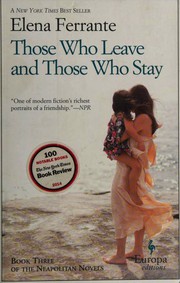
Those Who Leave and Those Who Stay
2,034-word summary 9 min read 400 pages in the book
- First published
- 2013
- Publisher
- Europa Editions
- Pages
- 400
- ISBN
- 9781609452339
- Original title
- Storia di chi fugge e di chi resta
- Series
- Neapolitan Novels (#3)
Reading options
What's inside (12 sections)
- Naples versus Florence as moral stages
- Lila stays and grinds
- Telefonate as lifelines
- Origin, destiny, and dissolving boundaries
- What surpasses and what strains
- Children as witnesses and weights
- Writing itself as battleground
- Translation as second authorship
- Rereading rewards planted ironies
- Who should stay or leave
- Key takeaways
- FAQ
I continued to Those Who Leave and Those Who Stay because book two left Elena and Lila splitting paths. Elena Ferrante published it in Italian in 2013 as Storia di chi fugge e di chi resta, with Ann Goldstein's English translation from Europa Editions in 2014. My reading follows the 400 page paperback. Elena publishes and marries into Florence intellect while Lila labors in Naples, and the 1970s test both. It is the quartet's most political volume and its most ferocious about friendship.
Elena leaves the neighborhood through books. Degree from Pisa. First novel published. Marriage to Pietro Airota, upper class professor who offers libraries and salons along with condescension she only slowly names. Two daughters follow. Florence life brings learned interlocutors, richly furnished rooms, and the particular loneliness of being admitted but not belonging. Her writing stalls under domesticity and doubt. Who is she without Lila's fire to strike against. That question shadows every salon scene.
Naples versus Florence as moral stages
The two cities function as opposite tests rather than mere settings. Naples demands endurance through confrontations that arrive daily and physically. Factory foremen. Former husbands. Neighborhood judgment. Florence offers subtler trials through salons where condescension wears perfume. Elena navigates both when visiting home, code switching between dialect and literary Italian with exhaustion that bilingual readers will recognize intimately. Each city exposes what the other hides. Naples shows bodies. Florence shows books. Ferrante loves both and trusts neither fully. That even handedness keeps the novel from becoming escape narrative or hometown elegy. Places test. People choose daily.
Pietro's family circle deserves attention as anthropology of Italian intelligentsia. Dinners where communism is discussed by people with maids. Children praised for spontaneity on schedule. Elena performs belonging while noting every slight she can not answer without seeming ungrateful. Those chapters will resonate with anyone who married across class lines. Love crosses. Habitus remains. Her mother in law's gifts arrive with strings. Her father in law's library welcomes conditionally. Navigating that maze while nursing babies and missing deadlines explains Elena's stalls better than writer's block clichés. Context blocks. Not talent.
Lila stays and grinds
Lila stays in Naples through worse and harder. Escaped from abusive marriage to Stefano, living platonically with Enzo Scanno from the neighborhood plus her young son, working factory floors that chew fingers and pride. Her chapters carry the book's working class fury. Assembly lines. Foremen's hands. Union meetings where men talk over the woman who reads fastest. Lila, brilliant without credentials, learns computing as it emerges and outthinks degreed men who dismiss her. Those victories taste like iron because each costs health and sleep she can not spare.
Her bond with Enzo deserves emphasis as the book's quietest love story. Not romance but partnership. Shared rooms. Shared child minding. Shared night study of machines. He respects her mind without competing, protects without possessing. After Stefano's violence, that plain decency heals more than passion could. Ferrante writes their domesticity with documentary tenderness. Who cooks. Who watches the boy. Who walks whom home from late shifts. Those logistics carry more erotic charge than love scenes elsewhere because safety itself is arousing after fear. Peace as aphrodisiac. Rare and true.
The late 1960s and 1970s setting does more than backdrop. Feminism, class struggle, and sexual politics remake Italy around both women at different speeds. Elena marches, debates, and publishes into the movement's upper rooms. Lila lives its factory floor version with strikes and injuries. Their arguments about strategy, grades of freedom available to educated versus laboring women, cut deeper than any marital quarrel. Ferrante refuses to rank their feminisms. Both cost. Both partially fail. That even handedness infuriates readers wanting heroines to agree. Real friendships argue across class lines that love can not erase. This one does, brilliantly.
Telefonate as lifelines
The phone calls between Elena and Lila deserve formal praise as the book's signature device and emotional infrastructure. Expensive, crackling, and constant, they transmit envy, news, and love across cities with an intimacy letters can not match. Lila calls to provoke as much as to share. Elena answers despite vows to focus on husband and pages. Those conversations, rendered with he said she said spareness, detonate like chapters three times their length. A tone conveys what paragraphs would dilute. Jealousy hums through wires. The reader hears it too.
What the calls cost matters as much as what they carry. Husbands resent the bills and the hours. Children interrupt. Writing stalls. Yet neither woman hangs up first. That refusal defines friendship stronger than convenience. Ferrante understands that maintenance, not intensity, sustains bonds across decades. Call weekly. Fight monthly. Forgive yearly. Those rhythms outlast affairs and careers. The novel's middle sags never because a call always threatens to upend fragile balances both built. Pick up. Everything shifts.
Origin, destiny, and dissolving boundaries
The book's Italian title speaks of fleeing and remaining as twin fates, and Ferrante braids them until they blur. Elena, who left, finds Naples inside her sentences and marriage. Lila, who stayed, reaches Elena through phone calls that shape chapters. Their famous dissolving boundaries episodes, moments where reality's edges melt into dread, afflict both under stress. Those passages, strange and physical, divide literalist readers from psychological ones. Either way they register truth about female friendship under patriarchy. Selves leak into each other. Where do I end, the books ask across 1600 pages. Here the leak quickens.
Motherhood threads through with unsparing honesty about ambivalence. Elena loves her daughters and resents the career pause they enforce. Lila mothers fiercely while refusing martyrdom scripts. Both watch their own mothers' fates as warnings. The neighborhood teaches that maternity devours women whole. The 1970s promises choices that prove partial on delivery. Childcare still falls to mothers. Husbands help as favor, not duty. Those frustrations boil into scenes of startling frankness about regretting hours if not children. Ferrante writes what many feel and few print. That candor explains devotion that outlasts plot quibbles.
Men in this volume mostly fail usefully. Pietro loves Elena's mind and expects gratitude that curdles into control. Stefano's shadow lingers over Lila's freedom. Enzo excepted as decent constant. Even good men extract. The book's feminism lives less in speeches than in accumulated evidence of who washes dishes after political dinners. Nobody male, mostly. Those dishes pile into argument stronger than manifestos. Look at sinks to judge revolutions. Ferrante does, and invites readers to count at home.
What surpasses and what strains
What surpasses, as PW noted in 2014, is storytelling that outdoes even the first two volumes' rapture. The narrative propulsion never stalls across 400 pages despite heavy politics. Factory chapters read like thrillers. Salon chapters like comedies of manners with knives. Phone calls between Elena and Lila detonate like action scenes. That pacing inside literary fiction explains bestseller status for demanding work. Page turner and stylist rarely share bodies. Here they do. Goldstein's translation deserves part of the credit, rendering Neapolitan grit and academic polish in distinct, flowing English.
What strains is middle density for readers craving Lila's fire in every scene. Elena's Florence domesticity, deliberately airless, can feel slow beside factory urgency. Pietro's family talk circles. Academic parties blur. Those stretches serve theme, showing what leaving costs in boredom as well as gain, but they test patience. The book also assumes volumes one and two fresh in mind. Newcomers will drown in names and callbacks. Start at My Brilliant Friend or do not start. This is book three in blood and bone.
Length at 400 pages suits the decade it covers. No bloat, though one factory strike could trim. The ending pushes toward the final volume with Lila vanishing premise that frames the whole quartet. Readers finishing will immediately need The Story of the Lost Child. That pull is intentional and irresistible. Friendship as mystery that outlasts politics. Find out who disappeared. And why the writer must tell.
Children as witnesses and weights
Dede, Elsa, and Gennaro function as more than background to adult dramas by embodying futures both women fight over. Elena's daughters grow up between Florence comfort and Naples visits that confuse their class coordinates. They love grandparents who frighten their mother. Those divided loyalties reproduce Elena's own split at smaller scale. Ferrante writes children observing adult hypocrisies with devastating accuracy. Why does mama whisper on phone. Why does aunt Lila scare and thrill. Kids ask directly what adults circle. Their questions puncture pretense usefully. Answer carefully or lose them early.
Gennaro's path through Lila's factory years and computing rise shows working class childhood with brilliant mother and absent structures. He is loved fiercely and parented erratically between shifts. His adolescence in later pages hints at troubles that the final volume will harvest. Readers should note him carefully here. Neglected boys become key men in Ferrante's long game. What he absorbs from Enzo's steadiness versus Stefano's shadow shapes Naples' next generation. The book plants those seeds without harvesting. Watch them sprout in Lost Child. Roots shown here run deep.
Writing itself as battleground
Elena's authorship struggles deserve meta attention because Ferrante writes a writer blocked by life she also lives. Novel drafts stall between feedings. Reviews praise and wound in same week. Husband reads manuscripts with professorial corrections that help prose and hurt confidence. Those dynamics will resonate with anyone creating inside domesticity. Art needs rooms of one's own that motherhood rarely locks. Elena steals hours before dawn with fury that fuels pages. Readers see sausage made from sleeplessness and spite. Unglamorous. Accurate. Inspiring precisely because it refuses romantic garret myths. Write tired. Publish anyway.
Lila's relationship to Elena's books adds the book's sharpest irony. She reads drafts first, criticizes brutally, and recognizes herself refracted without consent. Is she muse or material. Both resent the roles. Their fights over representation echo real debates about writing loved ones into fiction. Ferrante, anonymous herself, stages this with special authority. Who owns shared past. The one who lived it loudest or wrote it best. No answer satisfies both. The novels themselves are the disputed territory. Read them as peace treaty that both sign and suspect. Ink binds and chafes.
Translation as second authorship
Ann Goldstein's English deserves credit woven through any praise of Ferrante because these sentences sing in translation that reads seamless. Neapolitan grit and academic polish both land without footnotes cluttering. Readers rarely notice translators when work succeeds, which is injustice worth correcting here. Goldstein's decades with Ferrante show in rhythms that feel native rather than ferried. The phone calls crackle. Factory floors reek. Salon chatter clinks. All in English that never reminds of Italian underneath except where dialect words season deliberately. Great translation disappears into story. Thank it anyway.
Rereading rewards planted ironies
Details that pass quietly first time detonate on reread once trajectories are known. A casual insult at a wedding. A book dedication worded oddly. A phone answered too fast. Ferrante plants such ironies with a gardener's patience across all four volumes, and this middle book holds the densest beds. Second reads reveal Lila engineering outcomes credited to luck and Elena missing cues obvious in hindsight. That dramatic irony never feels cheap because characters act on partial knowledge realistically. They can not see patterns readers assemble across decades. Reread to watch blindness operate. Then forgive your own.
Who should stay or leave
Give Those Who Leave and Those Who Stay to Ferrante readers current through book two, to book clubs that enjoy feminism and class argued through lives, to literary fiction lovers who want propulsion with depth. Do not start here. Read My Brilliant Friend first or the names will bury you. Pair it with the HBO adaptation for faces, then return to prose for interiority only pages give.
At 400 pages I read it in four nights, marking phone call pages. Elena starts publishing into Florence salons and ends doubting every room but Lila's voice, while Lila starts factory floors and ends computing futures men can not see. That cross, leaver stalled and stayer surging, is why the volume electrifies past politics. Leave or stay, the bond binds. The rest is weather. The final volume awaits with disappearances that reframe everything built here. Answer when it calls.
FAQ
When was Those Who Leave published?
Published in Italian in 2013 as Storia di chi fugge e di chi resta; Europa Editions published Ann Goldstein's English translation in 2014. It runs 400 pages and the ISBN is 9781609452339.
Is it part of a series?
Yes. It is book three of the Neapolitan Novels, between The Story of a New Name and The Story of the Lost Child.
What is the original title?
Storia di chi fugge e di chi resta, translated by Ann Goldstein.
Similar books
More from Neapolitan Novels first, then related titles.
My Brilliant Friend
Elena and Lila grow up in 1950s Naples bound by rivalry and love.
2,584-word summary · 11 min read
The Story of a New Name
Married Lila and student Elena grow apart and collide again across shops, Ischia, and Pisa.
2,523-word summary · 11 min read
The Story of the Lost Child
Elena and Lila age through motherhood, quakes, and a vanishing.
2,500-word summary · 11 min read

We Are Okay
Marin fled San Francisco after her grandfather vanished and stopped answering anyone. When Mabel visits her college dorm, she has to say what happened.
2,253-word summary · 10 min read

The Birth of Venus
A Florentine merchant's daughter trains as an artist, marries a man who hides a secret, and survives Savonarola's bonfire of the vanities.
2,404-word summary · 11 min read
The School for Good Mothers
A mother sent to a reform school fights to keep her daughter under cold surveillance and strict rules.
2,114-word summary · 9 min read
Summer Sisters
Vix and Caitlin share Martha's Vineyard summers from age twelve into adulthood, through first love, grief, marriage, and a disappearance that still haunts Vix.
3,633-word summary · 16 min read

The Bean Trees
Taylor Greer flees Kentucky, inherits Cherokee toddler Turtle, and roots with Tucson strays.
2,082-word summary · 9 min read

The Elegance of the Hedgehog
A Paris concierge hides her brilliant mind while a gifted girl plans her death, until a new tenant sees through them both.
2,248-word summary · 10 min read
Little Earthquakes
Four Philadelphia women meet during pregnancy and discover that new motherhood is nothing like the plan, while friendship becomes the thing that holds them…
1,997-word summary · 9 min read

Howards End
Forster's 1910 novel follows two families, a house in Hertfordshire, and a burned note, asking whether money and feeling can ever be connected.
2,187-word summary · 10 min read

Hard Luck
Rowley has a girlfriend, so Greg turns to a Magic 8 Ball, a family Easter hunt and the school yearbook for answers.
2,586-word summary · 11 min read

Fathers and Sons
Arkady brings the nihilist Bazarov home to his father's estate, and a generational argument turns into love, a duel, and an early death.
2,192-word summary · 10 min read

Unaccustomed Earth
Lahiri’s second story collection follows Bengali families in America and abroad, tracing the quiet distances between parents and children, spouses, and the…
2,333-word summary · 10 min read
The Age of Miracles
A California girl grows up while the Earth's rotation slows, and ordinary adolescence continues alongside slow catastrophe.
2,417-word summary · 11 min read

Peace Like a River
An asthmatic boy in the early 1960s narrates his family's search for his older brother, who is accused of two killings and has escaped custody.
1,969-word summary · 9 min read

The Chosen
A shattered pair of glasses in a 1944 Brooklyn softball game starts a friendship between a Hasidic boy and his Orthodox neighbor, and their fathers pull them…
2,443-word summary · 11 min read
One to Watch
A plus-size fashion blogger takes the lead role on a reality dating show to prove she belongs on television, and finds she might want what the cameras offer.
2,478-word summary · 11 min read
Her Body and Other Parties: Stories
Eight stories where bodies, medicine and old fairy tales get taken apart, with a green ribbon running through the whole book.
2,997-word summary · 13 min read

Big Swiss
A transcriptionist for a sex coach falls for one of his clients, the tall Swiss gynecologist she calls Big Swiss, in a funny novel about work and secrets.
2,523-word summary · 11 min read

A Spool of Blue Thread
Four generations of the Whitshank family in Baltimore, and the silences, resentments and quiet love they hand down without ever saying so.
2,408-word summary · 11 min read

Wide Sargasso Sea
Jean Rhys gives the first Mrs. Rochester a Caribbean childhood, a marriage built on money and suspicion, and a voice that Charlotte Bronte left in the attic.
2,021-word summary · 9 min read
This Is How You Lose Her
Yunior cycles through love affairs and betrayals in nine linked stories, tracing the damage he does and the family history behind it.
2,195-word summary · 10 min read
The Silence of the Girls
Briseis, queen of Lyrnessus, is captured by Achilles and narrates the Trojan War from inside the Greek camp, where women are prizes and survival is its own…
2,098-word summary · 9 min read
The Second Summer of the Sisterhood
Four friends share the traveling pants through a summer of grandmothers, first loves, and mothers who are learning to let go.
2,209-word summary · 10 min read
I Who Have Never Known Men
Forty women in a cage, one child who remembers nothing, and a nearly empty world above the bunker. Harpman's quiet, unexplained dystopia.
2,025-word summary · 9 min read

Flight Behavior
Dellarobia Turnbow is stuck in a Tennessee farm marriage until a valley full of monarch butterflies, and the scientist who comes to study them, force her to…
2,051-word summary · 9 min read

Aristotle and Dante Dive into the Waters of the World
Ari and Dante return for senior year in El Paso, navigating first love, AIDS, family grief, and the cost of being openly gay in 1987 Texas.
2,188-word summary · 10 min read
And Every Morning the Way Home Gets Longer and Longer
An elderly grandfather, his son, and his grandson share memories and fears as the old man's mind begins to fade, in a short novel about grief and love.
2,078-word summary · 9 min read

The Tiger's Wife
A young doctor in a war-scarred Balkan country chases the stories her grandfather left behind, including a deathless man and a deaf girl who loved an escaped…
2,232-word summary · 10 min read