
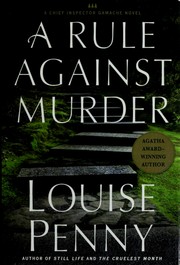
A Rule Against Murder
2,201-word summary 10 min read 322 pages in the book
- First published
- 2008
- Publisher
- Minotaur Books
- Pages
- 322
- ISBN
- 9780312377021
- Series
- Chief Inspector Armand Gamache (#4)
Reading options
What's inside (9 sections)
Most people come to this one after three visits to Three Pines and assume the fourth will be more of the same. It is not, and that is the point. Louise Penny took her inspector out of the village for the fourth Gamache novel and dropped him into a robber baron's lodge on a lake with a family that could curdle milk, then let the claustrophobia do the work. The book first appeared in 2008 as The Murder Stone from Headline, and reached American readers a year later as A Rule Against Murder from Minotaur Books. Same novel, more or less the same cover promise, 322 pages. Readers who only know the series from adaptations sometimes think these are two books. They are not.
I went in expecting comfort food and got something closer to a stage play with wasps under the floorboards. What follows is the whole thing, ending included, so if you want the puzzle intact, stop after this paragraph and come back when you have finished.
An Anniversary at the Manoir
Armand Gamache and his wife Reine-Marie book the Manoir Bellechasse to celebrate thirty-five years of marriage. The place is a former robber baron's lodge on the shore of Lac Massawippi, all dark wood and old money and a garden that looks better in photographs than in person. They arrive expecting quiet. They find the Finney family reunion.
Irene Finney is the matriarch, a woman who has turned dismissiveness into an art form. Her four adult children have been summoned to unveil a statue of her late first husband, Charles Morrow, who built the family fortune and has been dead long enough that everyone has an opinion about him. Peter Morrow is one of the four, and the Gamaches already know him and his wife Clara from Three Pines, which gives the reader two friendly faces in a hostile room. The others are Thomas, who has money problems and a talent for needling; Julia, once married to the imprisoned financier David Martin and visibly on edge; and Marianna, brittle and short-tempered, there with her young child whom everyone calls Bean.
The family call Clara "Claire" all weekend, which is the kind of thing Penny is very good at, a small act of erasure that tells you everything about who these people are. Dinner is miserable. Thomas taunts Julia about being the subject of a cruel message scrawled in a bathroom years ago. Julia smashes her coffee cup, denounces her siblings, says outright that she knows "Daddy's secret," and storms out. Gamache follows her and sees that her fear is real, not merely anger. A storm rolls in and shakes the lodge all night.
The Statue and the Body
In the morning one of the gardeners screams. The statue of Charles Morrow has toppled from its plinth, and beneath it lies Julia Morrow, crushed. Everyone assumes the storm did it. Gamache does not. He notices bees and ants working the base of the plinth, and the beginnings of a detail that will crack the case later: there is dry dirt under Julia, which means she was killed before the rain arrived. The pedestal itself is unmarked, which is impossible if a statue simply fell on her.
He cancels the anniversary and calls in Inspector Jean-Guy Beauvoir and Agent Isabelle Lacoste. The roads are closed, the phone lines are unreliable, and the guest list is trapped. A locked circle, in the oldest tradition of the genre, with a maître d' named Pierre Patenaude running the dining room and a chef named Véronique Langlois running the kitchen. Beauvoir keeps squinting at Véronique, certain he has seen her before, which becomes one of the book's softer subplots.
The suspects pile up with every chapter. Thomas and his wife Sandra are drowning in debt and have been leaning on Irene for money. Marianna is defensive about Bean and about her life in general. Peter admits he hated his sister and is honest about the ways she cut him down. Irene is chillingly calm. Her second husband Bert Finney, who married into this family and stayed, watches everyone with a patience that seems mismatched with his bluster. Even the staff carry secrets. A waiter named Elliot Byrne had been flirting with Julia and writing her notes. Pierre patrols the grounds and the dining room with a proprietary air that reads as grief and might be something worse.
Meanwhile Penny threads in Gamache's own unfinished business. His son Daniel wants to name a baby after Gamache's father, Honoré, and Gamache is not at peace with it. His father was a conscientious objector during the war, which cost him dearly, and he never fully explained his change of heart about the war afterward. The inspector's discomfort with the memory runs alongside the case and quietly rhymes with the family's refusal to look honestly at their own dead patriarch.
Sugar, and How the Statue Fell
The break comes during a Canada Day visit to Three Pines, which is where the two-books rumor starts, because this section feels like a homecoming. Gamache watches ants swarm a puddle of spilled soda by the statue's plinth and puts it together. Someone laid a bed of sugar under the statue's base, slid the heavy thing into place on it, and then the rain did the rest, washing the evidence away while the sugar's friction held just long enough. That means the killer had physical access to the lodge's grounds and equipment, someone trusted on the property rather than a family member improvising. Pierre, who had been watching all of them with that proprietary air, knew exactly how the staff kept the grounds and how much a statue weighs.
His motive is old and ugly. Pierre's father had been ruined by the early fraud of David Martin, Julia's estranged husband. Watching the Morrows and Finneys arrange their money and their silences, Pierre developed a hatred that landed on Julia as a representative of everything the family was and everything his family was not. The rule against murder, in Penny's title, is also a rule against using a family as a bomb that you throw at someone else.
Confronted, Pierre does not go quietly. He tries to frame Elliot first, then panics, takes Bean, and climbs onto the lodge's copper roof. Gamache, who is afraid of heights, follows him up. There is a genuinely tense sequence in which Bean kicks free, Gamache catches the child, slips, and Pierre, of all people, grabs him and hauls both of them to safety. The killer saves the inspector and the child, then confesses. Penny lets that contradiction stand rather than resolving it, which is the sort of choice that makes the series better than its premise.
The Secret After All
The last chapters answer Julia's stormy boast. The secret she knew was not a crime or a hidden heir. Charles Morrow knew which of his children had written the malicious bathroom message about her, and it was Peter, and the father's response was to love him anyway. Bert Finney, asked plainly, delivers the answer like a man setting down a heavy box. The revelation lands as both cruel and generous, an admission that forgiveness can be a form of truth, and it lands mainly on Clara and Peter, who now have to live with each other knowing.
The denouement also unbuttons several smaller puzzles. Bert reveals he was a prisoner of war in Burma, which reframes his flintiness. Irene's coldness gets a physical explanation in neuralgia, a pain condition that explains a face without excusing a life. Chef Véronique turns out to have been Soeur Marie Angèle, a famous television nun who left the habit and the cameras. Gamache reconciles with Daniel, and the baby will be a girl named Zora, a decision the inspector can finally bless.
The House as a Character
The Manoir Bellechasse is the best supporting actor in the book. Penny gives it a history as a robber baron's lodge, then dresses it in old wood, indifferent plumbing, and a garden that has been allowed to go slightly wild. The staff move through it with the particular pride of people who keep a beautiful thing running for guests who do not notice. The rain makes the walls sweat. The telephone lines fail. By the time the body is found, the lodge has become a sealed box, and the reader feels the seal.
That matters because the Finneys behave differently in a sealed box. At home, they could leave. At the Manoir, they have to sit in the same dining room and pass the same butter. The reunion is a family ritual that has been performed for decades, and the murder turns it into a trap. Penny uses the setting to strip away the distractions that usually let rich families avoid each other: separate houses, separate cars, separate lives. What is left is a table.
The contrast with Three Pines is deliberate. Three Pines is a village where people know each other and mostly choose kindness. The Manoir is a place where people know each other and mostly choose manners. Both are closed circles. Only one of them has a bistro where you can say what you actually mean. When Gamache and Reine-Marie sneak away for Canada Day, the book visibly relaxes, and so does the reader, which is exactly how Penny makes the point.
The Family as a Machine
The Finneys are unpleasant, and their unpleasantness is organized into a machine for distributing blame. Irene presides. Thomas needles. Marianna defends. Peter retreats into his art and his wife. Julia, the one who left and came back, is the pressure valve, and when she threatens to say the family secret out loud, the machine has to decide what to do with her. The murder is not the first violence in the family. It is the first one that leaves a body on the lawn.
That is why the final revelation about Charles Morrow lands so hard. The patriarch everyone has been arguing about turns out to have known exactly who his children were, including the cruel one, and to have loved them anyway. It is a strange kind of grace, and it does not make the family healthy. It makes them human. Penny is very good at that move, letting a monstrous clan have one moment of recognizable tenderness so the reader cannot dismiss them entirely.
What I Loved and What Drags
The gorgeous thing here is the control. A house, a lake, a list of suspects, and a murder weapon that has to be assembled out of physics and hospitality. The bee-and-ants clue is fair play, planted early, and the sugar slide is the kind of trick that would feel cheap in a lesser book and feels earned in this one because Penny made us watch Pierre working the grounds for two hundred pages.
What drags is the family itself. The Finneys are meant to be insufferable, and they are, but there are stretches where their nastiness is repetitive rather than escalating, and the middle innings lean on petty snobbery more than I needed. The not-Claire running joke stops being funny before it stops being used. Readers who love Three Pines for its warmth may miss Myrna, Ruth, and the bistro, because this book rations them until the Canada Day section, and the rationing is deliberate but felt.
The other fair criticism is that the puzzle's solution depends on a character we have not had enough time to suspect. Pierre is present, he is watchful, he is professionally convenient, and in retrospect the clues are honest, but the emotional weight of the reveal rests almost entirely on the final chapters rather than on anything we watched him risk earlier. Compare that to the awkward, human killer in Still Life and the difference is instructive.
None of that stops the book from being the most atmospheric of the first four. Penny set out to write a book away from home, in a closed circle, under a hammering rain, and she got exactly that, plus a title that doubles as a moral: there is a rule against murder, and there is also a rule against letting old money decide who is allowed to be human. Gamache follows both. As always, the meals are good, the interrogations are better, and Beauvoir is allowed to be wrong without being humiliated, which is more than most series give their seconds.
If you are reading the Gamache books in order, start with Still Life, because the value of this one comes partly from knowing how it feels to leave the village and dread the phone call home. If you only ever read one, read this one at the end of a warm month and keep a cardigan nearby. The Manoir is cold, and so are some of the people. But the inspector's marriage sits at the center of it like a fire in the next room, and in a series full of cats, bistro tables, and quiet decency, sometimes that is enough to get you through a bad weekend with bad money.
FAQ
Is A Rule Against Murder part of the Gamache series?
Yes. It is Chief Inspector Armand Gamache book four, after Still Life, A Fatal Grace and The Cruelest Month, and it takes place away from Three Pines at the Manoir Bellechasse.
Is The Murder Stone a different book?
No. The Murder Stone is the UK and Canadian title of the same novel, published in 2008. A Rule Against Murder is the American title from Minotaur Books, published in 2009.
Who killed Julia Morrow?
The gardener Pierre Patenaude. He slid the statue onto a bed of sugar that the rain later washed away, to strike at the Morrow family that had ruined his father through David Martin's fraud.
Similar books
More from Chief Inspector Armand Gamache first, then related titles.

Still Life
A beloved teacher found with an arrow in Three Pines looks like hunting accident until Gamache looks closer.
1,996-word summary · 9 min read
A Fatal Grace
Gamache returns to Three Pines for Christmas where hated CC de Poitiers is electrocuted on a frozen lake.
2,339-word summary · 10 min read
The Cruelest Month
Gamache returns to Three Pines where a seance ends in murder.
2,529-word summary · 11 min read

Bury Your Dead
Recovering from a failed raid that killed his officers, Gamache investigates a murder in a Quebec City library while Beauvoir reopens a case in Three Pines.
2,022-word summary · 9 min read
How the Light Gets In
Gamache investigates the murder of the last Ouellet quintuplet while the Sûreté he served is dismantled from inside by the man who took his protégé.
2,279-word summary · 10 min read

The Trespasser
A Dublin Murder Squad detective investigates a staged dinner-party killing and finds a cover-up that reaches into her own department.
2,051-word summary · 9 min read

Rules of Prey
Minneapolis detective Lucas Davenport hunts a killer who leaves a new rule at every scene and treats murder as a game of wits.
1,914-word summary · 9 min read

The Late Show
Exiled to the LAPD night shift after accusing her supervisor, Renée Ballard keeps two cases that were meant to be handed off at dawn: a brutal assault and a…
2,563-word summary · 11 min read
The Last Mile
Melvin Mars is hours from execution for his parents' murder when another man confesses, and FBI cold case detective Amos Decker goes looking for the trap.
2,746-word summary · 12 min read

Worth Dying For
Reacher stops for one night in rural Nebraska and finds a family that runs the county, a missing girl and a shipment worth killing for.
2,021-word summary · 9 min read

Say You're Sorry
A widowed prosecutor defends the teenager accused of killing her babysitter, uncovering a small town's secrets and a killer hiding in plain sight.
2,116-word summary · 9 min read

The Survivors
Kieran Elliott returns to Evelyn Bay twelve years after a storm killed his brother, and a young woman's murder forces the town to face what it has concealed.
2,571-word summary · 11 min read

Men at Arms
The City Watch gets new recruits and a murder case when the Disc's only handgun turns up in Ankh-Morpork, in the fifteenth Discworld novel.
2,216-word summary · 10 min read
Triptych
A GBI agent with dyslexia hunts a rapist while two Atlanta cops hide pasts.
2,576-word summary · 11 min read
Blindsighted
Sara and Jeffrey hunt a killer staging women in small-town Georgia.
2,400-word summary · 11 min read
At Bertram's Hotel
Miss Marple finds a luxury hotel fronting robbery and murder.
2,550-word summary · 11 min read
The Bat
Oslo detective Harry Hole aids Sydney police after a young Norwegian woman is murdered and finds a wider pattern. Grief, drink, and a lost partner shape the…
2,766-word summary · 12 min read
Memory Man
Amos Decker, a detective who cannot forget, hunts the link between his family murder and a school shooting.
2,931-word summary · 13 min read
The Truth About the Harry Quebert Affair
A blocked writer tries to clear his mentor Harry Quebert after a girl missing since 1975 is found buried with his famous manuscript.
2,192-word summary · 10 min read
Naked in Death
In 2058 New York, Lt. Eve Dallas hunts the killer of a senator's granddaughter and collides with suspect Roarke.
2,470-word summary · 11 min read

All Good People Here
A journalist returns home to care for her uncle and reopens a 20 year old child murder tied to a new abduction.
2,006-word summary · 9 min read
The Maid
Hotel maid Molly Gray finds a dead guest and must use her eye for detail to clear herself.
2,031-word summary · 9 min read

What She Knew
Rachel lets her eight-year-old son run ahead in a Bristol park, and the nine-day search turns her into a suspect in the public eye.
2,952-word summary · 13 min read

The Beach House
A young valet is beaten to death at a Hamptons party, and his law-student brother spends a year building a case against the family that covered it up.
2,049-word summary · 9 min read
The Art Forger
A disgraced Boston painter agrees to copy a Degas stolen from the Gardner Museum, then begins to suspect the original she is copying is itself a forgery.
2,117-word summary · 9 min read

Six Years
A professor who promised to forget the woman he loved sees her husband's obituary and discovers that the wedding, the marriage, and the woman herself may never…
2,076-word summary · 9 min read
The Unmaking of June Farrow
A woman in a North Carolina flower-farming family walks through a red door into 1951, where she must solve her mother's disappearance and decide whether to…
2,701-word summary · 12 min read

The Black Dahlia
James Ellroy builds a fiction around the real Black Dahlia murder, following two Los Angeles cops whose partnership and obsessions destroy them.
2,533-word summary · 11 min read
Once There Were Wolves
A biologist reintroduces fourteen wolves to the Scottish Highlands while protecting her traumatized twin sister, then finds a body in the snow that could…
2,682-word summary · 12 min read
Finger Lickin' Fifteen
Lula sees a celebrity chef decapitated and talks Stephanie into entering a barbecue contest to lure the killers, while Ranger hires her to find a security leak…
2,248-word summary · 10 min read