
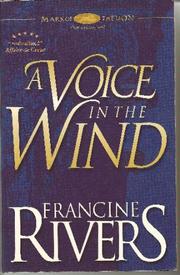
A Voice in the Wind
2,322-word summary 10 min read 514 pages in the book
- First published
- 1993
- Publisher
- Tyndale House
- Pages
- 514
- ISBN
- 9780842377508
- Series
- Mark of the Lion (#1)
Reading options
What's inside (13 sections)
I am not a regular reader of Christian fiction, and I picked up A Voice in the Wind because I wanted a novel set in Rome during the first century. I expected a historical romance with a thin plot and a lot of sermons. What I found was a book with a real story, a vivid setting, and a heroine whose faith is tested in ways that are genuinely frightening. It is not a subtle novel. It is, at times, a very preachy one. But it has a pulse, and the arena scene at the end is as harrowing as anything in historical fiction.
Tyndale House published the novel in 1993. The edition I used runs 514 pages and carries the ISBN 9780842377508. It is the first book in the Mark of the Lion series, followed by An Echo in the Darkness and As Sure as the Dawn. Francine Rivers was already a successful romance novelist before she became a Christian writer, and this book marked a turn in her career. It sold well, found a large audience in churches, and became a staple of Christian book clubs. It is not a literary novel in the usual sense, but it is an effective one.
Jerusalem and Rome
The novel opens in Jerusalem in 70 AD, during the Roman siege. Hadassah is a young Jewish woman whose family has converted to Christianity. The Roman army is closing in. The city is starving. The temple is about to fall. Hadassah's family is killed, and she is captured and sold into slavery.
The journey to Rome is brutal. Hadassah is stripped of her name, her family, and her faith community. She is bought by the Valerian family, a wealthy merchant household, and assigned to be the personal servant of Julia, the teenage daughter. Hadassah is intelligent, gentle, and deeply devout. She is also terrified. She has been taught that her faith is a matter of life and death, and she is now surrounded by people who worship a pantheon of gods and an emperor who claims to be divine.
The Rome of the novel is a city of contrasts. The rich live in villas with fountains, mosaics, and servants. The poor live in crowded apartment blocks. The games are a public religion of violence. The sexual economy is predatory. Rivers is good at showing how luxury and cruelty coexist. The Valerian household is comfortable, but it is built on slavery, and the novel does not let the reader forget it.
Hadassah
Hadassah is the moral center of the book. She is not a warrior or a revolutionary. She is a servant who tries to live out her faith in a world that has no respect for it. Her courage is quiet. She cleans, cooks, nurses, and listens. She does not preach unless she is asked. When she is asked, she speaks clearly, even when the answer could get her killed.
The novel's best scenes are the ones in which Hadassah's faith collides with Roman power. She refuses to participate in a household ritual. She prays for her enemies. She protects Julia from a beating and is badly injured herself. She tells the truth about her beliefs when lying would be safer. Rivers does not make her a superhero. Hadassah is afraid, and her fear makes her bravery believable.
Hadassah's relationship with Julia is the novel's central relationship. Julia is everything Hadassah is not: rich, spoiled, impulsive, and hungry for pleasure. Hadassah serves her, loves her, and watches her destroy herself. The dynamic is complicated by class and power. Hadassah cannot tell Julia what to do. She can only model a different way of living, and Julia is not ready to see it.
The Valerian household
Decimus Valerian is the father, a merchant who has made a fortune through trade. He is pragmatic, generous, and tired. Phoebe is his wife, a kind woman who becomes curious about Hadassah's faith. Marcus is the older son, educated in Athens, restless, and searching for something he cannot name. Julia is the daughter, beautiful and willful, accustomed to getting what she wants.
The household is not a happy family. Decimus and Phoebe are worried about their children. Marcus is drifting. Julia is out of control. The parents try to manage her with money and marriage, which only makes things worse. The novel is good at showing how affluence can hide neglect. The Valerians have everything except the ability to say no to their daughter.
Decimus's death is one of the book's most moving sequences. He is dying, and he asks Hadassah to tell him about her God. She explains her faith simply, without pressure. He asks to be baptized. She has no time for a formal ritual, so she tells him that belief and grace are enough. He dies holding her hand and Marcus's hand. The scene is sentimental, but it works. It shows what the novel believes: that faith is a relationship, not a performance.
Julia's descent
Julia is the novel's villain, and she is a memorable one. She is not evil from the beginning. She is a neglected rich girl who has learned that beauty and charm can get her anything. Her mother is distant. Her father is indulgent. Her brother is critical. She has no one who will tell her the truth.
Her first marriage is to Claudius, an older, wealthy man. She resents him. She goes to a gladiator school without permission, and he dies in a fall from his horse while chasing her. She inherits his estate and returns home. Then she meets Calabah, a wealthy widow who encourages her to pursue pleasure and independence. Calabah is the serpent in the garden. She introduces Julia to Caius, a charming gambler, and persuades Julia to marry him.
Caius is abusive. He gambles away her money, beats her, and treats her as a possession. Julia becomes pregnant and does not want the child. Calabah arranges for an abortion, and Julia orders Hadassah to dispose of the remains. The scene is horrifying, and Rivers does not soften it. Later, Julia poisons Caius with Calabah's help. He dies slowly. Julia is free, but she is not healed.
Julia's story is a study in how privilege without love becomes self-destruction. She is not a sympathetic character, but she is understandable. She has been taught that her value is in her beauty and her ability to attract men. When those things fail, she has nothing. The novel does not excuse her, but it shows the machinery that made her.
Marcus
Marcus is the romantic lead, and he is a more interesting character than the cover suggests. He is intelligent, skeptical, and genuinely attracted to Hadassah's faith. He does not understand it. He wants to possess it, and he wants to possess her. His love is real, but it is also entitled. He is used to buying what he wants, and he cannot buy Hadassah.
Their conversations about faith are the novel's theological core. Marcus argues like a Roman philosopher. He asks why a good God would allow suffering. He points to the hypocrisy of Christians. He is not a fool, and Hadassah does not treat him as one. She answers with patience and with her own life. The novel does not give him a sudden conversion. He moves slowly, and the sequel continues his journey.
Hadassah loves Marcus, but she will not marry him unless he shares her faith. That refusal is the book's romantic crisis. Modern readers may find it frustrating. Hadassah's position is not that Marcus is a bad man. It is that a marriage between two people with different ultimate commitments will pull her away from the thing that gives her life meaning. The novel takes that seriously, even when it hurts.
Atretes
Atretes is the third major storyline. He is a Germanic chieftain captured by the Romans and forced to become a gladiator. He is proud, angry, and physically powerful. He hates Rome, and he hates the crowds who cheer for him. His only reason to stay alive is the hope of freedom and revenge.
Julia becomes obsessed with him. Their affair is passionate and destructive. She becomes pregnant with his child, but she marries Primus, a man she believes will let her keep her independence. Atretes wins his freedom in the arena, buys a house, and plans to marry Julia. When he learns she has married Primus, he rejects her, burns down the house, and retreats into the mountains.
Atretes is not a Christian, and his story is not resolved in this book. He is the protagonist of the third novel, As Sure as the Dawn. In this volume, he functions as a contrast to Marcus. Both men are proud and powerful. Both are humbled by a woman they cannot control. Atretes responds with rage. Marcus responds with questions. The difference is the beginning of their separate journeys.
The arena
The final section is the most powerful. Julia, jealous of Hadassah's influence on Marcus, arranges for her to be arrested. At a gathering hosted by a man who hates Jews, Hadassah is ordered to make a sacrifice to the emperor. She refuses. She is beaten, imprisoned, and sentenced to face the lions.
Marcus realizes what Julia has done and rejects her. He goes to the arena, hoping to save Hadassah, but he is too late. The novel ends with Hadassah in the arena, facing the lions with calm. The sequel, An Echo in the Darkness, reveals what happens next. The ending is a cliffhanger, and it is a cruel one. It is also unforgettable.
The arena scene is where the novel's themes come together. Hadassah's faith is no longer an abstraction. It is a choice she makes with her body. The crowd wants blood. The empire wants obedience. Hadassah gives neither. Rivers writes the scene with restraint. She does not turn it into a spectacle. The horror is in the ordinariness of the violence.
Faith and suffering
The novel's central question is why a good God allows good people to suffer. Hadassah does not get an answer. She gets a presence. Her faith is not a promise that she will be safe. It is a promise that she will not be alone. That distinction is the book's theological heart.
Rivers is writing for a Christian audience, and she does not hide it. The novel is full of prayers, conversions, and moral lessons. Some of the dialogue sounds like a sermon. Some of the characters exist mainly to represent a theological position. Readers who are not religious may find this off-putting. Readers who are may find it moving. I found it uneven. The best scenes are the ones where faith is shown through action rather than explained through speech.
The novel is also about forgiveness. Hadassah forgives Julia again and again. She forgives Marcus for his arrogance. She forgives the Romans for destroying her family. That forgiveness is not presented as weakness. It is presented as a kind of strength that the Roman world cannot understand. The book argues that mercy is more powerful than revenge. That argument is tested in the arena, and it is not resolved easily.
What works and what does not
The historical setting is vivid. Rivers has done her research. The food, clothing, architecture, and social customs of first-century Rome feel authentic. The gladiator scenes are exciting and brutal. The household scenes are intimate. The novel moves between the private and the public without losing its footing.
Hadassah is a strong protagonist. She is not a modern woman in a Roman costume. She is a woman of her time who finds a way to live with integrity. Her courage is gradual and believable. The reader watches her grow from a frightened girl into a woman who can face lions.
The plot is well constructed. The three storylines, Hadassah, Julia, and Atretes, intersect at the right moments. The pacing is steady. The ending is a genuine cliffhanger. The book makes you want to read the next one.
What does not work
The villains are one-dimensional. Julia is selfish from beginning to end. Calabah is a cartoon temptress. Caius is a cardboard abuser. The novel does not give them the complexity it gives its heroes. That makes the moral universe simple, which is comforting but not challenging.
The prose can be preachy. Characters explain their beliefs in long speeches. The narrator sometimes tells the reader what to feel. The novel would be stronger if it trusted the scenes more and the sermons less.
The romance is frustrating. Hadassah and Marcus love each other, but they cannot be together because of their faith. That conflict is real, but the novel stretches it out. Readers who want a satisfying romance will have to wait for the sequel.
Who it is for
This is a book for readers who enjoy historical fiction with a strong faith element. It is for fans of Rome, gladiators, and early Christianity. It is also for readers who want a story about a woman who survives terrible things without losing her humanity.
It is not a book for readers who dislike didactic fiction. The sermons are frequent, and the theology is simple. It is also not a book for readers who want a balanced portrait of Roman society. The Romans are mostly decadent and cruel. The Christians are mostly humble and good. That is the novel's moral framework, and it does not apologize for it.
I am glad I read it. It is not a perfect novel, but it is a powerful one. Hadassah stayed with me after I finished. The arena scene is one of those endings that makes you sit still for a minute. I will probably read the sequel, if only to find out what happens to her. That is the mark of a story that works.
FAQ
Is A Voice in the Wind the first book in a series?
Yes. It is book one in the Mark of the Lion series, followed by An Echo in the Darkness.
Does Hadassah die at the end of A Voice in the Wind?
The novel ends with her facing the lions, and the sequel reveals what happens next.
Is A Voice in the Wind based on real history?
It is set during the Roman siege of Jerusalem in 70 AD and uses real places and events, but the main characters are fictional.
Similar books
More from Mark of the Lion first, then related titles.
Redeeming Love
Sold into prostitution as a child, Angel trusts no one in 1850s California until farmer Michael Hosea loves her as Hosea loved Gomer.
2,457-word summary · 11 min read

The Stationery Shop
Two teenagers fall in love in a Tehran stationery shop in 1953, are separated by the coup and a family deception, and meet again sixty years later.
2,024-word summary · 9 min read

The Japanese Lover
A Polish refugee and the son of a Japanese gardener fall in love in San Francisco in 1939, then keep the affair secret for nearly seventy years.
2,286-word summary · 10 min read

Anatomy: A Love Story
In 1817 Edinburgh, a noblewoman who wants to be a surgeon disguises herself to study anatomy and falls for the grave robber who supplies her with bodies.
2,031-word summary · 9 min read

The Shadow Sister
Star D'Apliese steps out of her sister's shadow and follows a bookshop clue into the Edwardian life of Flora MacNichol, a woman who gave up love for duty.
2,260-word summary · 10 min read
The Valley of Horses
Exiled from the Clan, Ayla survives alone in a hidden valley, tames a horse and a cave lion, and nurses a wounded stranger back to life.
2,311-word summary · 10 min read
The Agony and the Ecstasy
Irving Stone turns Michelangelo's seventy years of carving, painting, and arguing with popes into a novel about the cost of making something that outlives you.
2,260-word summary · 10 min read

Love Does
A lawyer and activist tells stories of saying yes, showing up, and loving people through ordinary, often ridiculous actions.
2,411-word summary · 11 min read

Origins
Stefan's diary of 1864 and 1888: how he and Damon fell for Katherine, became vampires, and went looking for a killer in London.
2,056-word summary · 9 min read
Last Night at the Telegraph Club
The 2021 National Book Award winner follows Lily Hu, a Chinese American teenager in 1954 San Francisco, as she falls for Kath and learns what it costs to be…
2,336-word summary · 10 min read

Ivanhoe
A disinherited Saxon knight, a great tournament, a besieged castle and a trial by combat. Scott's most famous novel, set in England in 1194.
2,834-word summary · 13 min read
Euphoria
Three anthropologists in 1930s New Guinea turn fieldwork into a love triangle, and a real history breathes behind them.
2,048-word summary · 9 min read
What the Wind Knows
Annie scatters her grandfather's ashes on Lough Gill and is pulled into 1921 Ireland, where she becomes the missing Anne Gallagher and falls for Dr. Thomas…
2,056-word summary · 9 min read
The Tuscan Child
After her father's death, Joanna follows a returned letter to Tuscany and uncovers his wartime love, a hidden painting and a village secret. A dual-timeline…
2,095-word summary · 9 min read
The Birth of Venus
A Florentine merchant's daughter trains as an artist, marries a man who hides a secret, and survives Savonarola's bonfire of the vanities.
2,404-word summary · 11 min read

Loving Frank
Mamah Borthwick Cheney leaves her family for Frank Lloyd Wright, and their affair becomes a public scandal that ends in tragedy at Taliesin.
2,034-word summary · 9 min read

Doctor Zhivago
A doctor and poet lives through revolution, war, and love in Pasternak's novel of private life under the pressure of Russian history.
2,213-word summary · 10 min read
The Storm Sister
Ally D'Aplièse loses her father and her lover within weeks, then follows a brass frog and a Norwegian biography into Anna Landvik's music and the world of…
2,376-word summary · 11 min read
90 Minutes in Heaven: A True Story of Death and Life
A pastor declared dead at a 1989 crash scene describes ninety minutes he says he spent in Heaven, then thirteen months of surgeries, depression, and recovery.
2,246-word summary · 10 min read
The Keeper of Happy Endings
Barbara Davis's 2021 standalone braids a Paris dressmaker's wartime losses with a grieving Boston artist who unlocks her family's secrets through an old row…
2,437-word summary · 11 min read
Captive Prince
Betrayed by his half-brother and sold to the enemy kingdom as a pleasure slave, Prince Damianos must survive in the court of Vere without revealing who he…
2,063-word summary · 9 min read
The Water Dancer
An enslaved man with a strange power for travel fights to free himself and rescue those he loves.
2,910-word summary · 13 min read
Grave Mercy
Convent assassin Ismae spares Gavriel and hunts traitors in Brittany.
2,357-word summary · 10 min read
Chain of Gold
Cordelia and James hunt demons in Edwardian London while hearts tangle.
2,364-word summary · 11 min read
Anne's House of Dreams
Newlyweds Anne and Gilbert start in a seaside house with kind neighbors.
2,465-word summary · 11 min read
The Rules of Magic
Franny, Jet, and Vincent Owens test strict family rules and a love curse in 1960s Manhattan and Massachusetts in Alice Hoffman's warm prequel about love, loss,…
2,686-word summary · 12 min read
The House at Riverton
In 1999, ninety eight year old maid Grace Bradley tapes the truth about a 1924 shooting at Riverton Manor, poet Robbie Hunter, two sisters and a lie held for…
2,433-word summary · 11 min read
The Evening and the Morning
Edgar, Ragna, and Aldred build a bridge town that becomes Kingsbridge around 997, facing Viking raids, harsh law, and a scheming bishop in Follett's prequel.
2,833-word summary · 13 min read
Written in My Own Heart's Blood
1778 war splits Jamies and Claires across rebellion and time as Brianna hunts a kidnapped son.
2,008-word summary · 9 min read

The Last Letter from Your Lover
A 1960s wife with lost memory and a modern journalist chase the same lost love letters across forty years.
2,506-word summary · 11 min read