
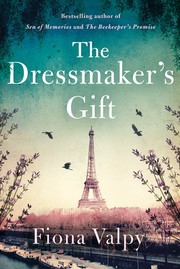
The Dressmaker's Gift
2,277-word summary 10 min read 287 pages in the book
- First published
- 2019
- Publisher
- Lake Union Publishing
- Pages
- 287
- ISBN
- 9781542005135
Reading options
What's inside (9 sections)
The photograph on Rue Cardinale
I picked this up for the setting: a dressmaking shop in occupied Paris, three women who sew by day and do something far more dangerous in the hours they cannot account for. What surprised me was how much of the book turns on small, ordinary objects, a photograph, an address, a dress folded away in tissue paper. Fiona Valpy lived in France for seven years, and her familiarity with the city shows up in the streets and the buildings long before it shows up in the plot.
Harriet is the way in. In 2017 she is a recent business graduate, rootless in Paris, interning at a fashion PR agency. Her mother killed herself when Harriet was still young, and her father never told her much about the French side of the family. She is not exactly a woman setting out to solve a mystery. She is someone who cannot bear being cut off from her own past. Then she finds an old photograph, dated 1941, of three young women standing outside a building on Rue Cardinale. One of them is her grandmother Claire, whom she never met.
Harriet's day job gives the book one of its quieter ironies. At the fashion PR agency she is paid to help make clothes look like desire, all images and launch parties and carefully managed attention. Upstairs in her apartment she is surrounded by the remains of a trade that was about survival. Valpy lets the two versions of the fashion business sit next to each other without commenting on the contrast, which is more effective than a lecture would have been.
The building in the photograph is the building where Harriet now works, and she lives in an upstairs apartment in it. That is the first of several coincidences the novel asks you to swallow, and it is by far the largest. Harriet's flatmate Simone turns out to be the granddaughter of one of the other women in the picture. Once Simone understands what Harriet has found, she begins filling in the story. From there the book moves back and forth between 1940 and 2017, with Harriet assembling her grandmother's life the way you might piece together a garment from scraps left in a sewing basket.
Three women above the shop
In 1940 the three women in the photograph are seamstresses. They share a cramped apartment above the dressmaker's shop on Rue Cardinale, and they have come to Paris from different places: Mireille from the Pyrenees, Claire from Brittany, Vivienne from Lille. Valpy gives each of them a way of standing and a way of holding her tongue, so that even before the secrets are named you can tell they are carrying different weights.
They become close in the way people do when there is no one else available. They work together, eat together, and cover for one another. The shop matters more than scenery. The hems and fittings give them a reason to be together and a reason to be overlooked, and the novel is strongest when it stays close to that work: the feel of cloth, the performance of ordinary life carrying on while the city outside is being remade. Dressmaking becomes a kind of camouflage. A woman with a needle in her hand does not look like someone carrying a message across Paris.
Their origins matter more than the novel sometimes lets on. Mireille has come down from the Pyrenees carrying a history of violence that the others can only guess at. Claire has left Brittany for Paris and found something in the city she was not looking for. Vivienne arrived from Lille, further north and closer to the fighting, and she brings a caution that reads like habit rather than personality. Valpy is interested in how these three women became friends across such different starting points, and she is honest about how little they actually know about one another at first.
Mireille is the one most clearly marked by the war. She is described as war-scarred, and she is already involved with the Resistance when we meet her. Claire is the one who drifts into danger through her heart rather than through politics. Vivienne is the one whose involvement is kept hidden from both her friends, and Valpy withholds that thread on purpose, letting the reader feel that there is a fourth person in the room whose name nobody says out loud.
Claire and Ernst
Claire's relationship with a German officer named Ernst is the part of the book that made me uneasy in a productive way. Valpy does not write him as a mustache-twirling villain, and she does not write Claire as a fool. She writes an affair: the attention, the gifts, the way a young woman far from home can mistake being noticed for being safe. Claire knows what he is. She knows what her friends would think. That knowledge is precisely what makes the relationship dangerous and what makes it interesting.
The liaison cannot stay private. Mireille, who has been working with the Resistance all along, eventually draws Claire in. The work the women do is mostly courier work and helping people find a way out of occupied France, and Valpy is careful about the scale of it. These are not people planting bombs or storming headquarters. They carry things, they pass information, and they shelter strangers for a night. The danger comes from the accumulation of small decisions, each one defensible on its own.
What the book gets right here is the way fear reorganizes a life. The women learn which staircases to avoid, which neighbors to trust, which questions to answer with a shrug. Their friendship is built out of these practical adaptations rather than out of declarations of loyalty. When one of them is late coming home, the others know better than to ask where she has been. That silence is the real texture of the novel, and it is more convincing than any speech about courage.
There is an awkwardness to the friendship that I appreciated. These women are not a seamless unit. Claire's relationship with Ernst puts her at a distance from Mireille, whose resistance work makes the German uniform a daily fact rather than a romantic complication. Claire is drawn into the work partly to close that distance, and partly because she cannot bear to be the one who does nothing. Valpy does not make that into a clean conversion. Claire remains torn, and the book lets her want incompatible things for a long time before anything resolves.
Vivienne's secret and the camp
Vivienne's thread is the one Valpy saves. She is involved in sabotage, and the extent of it stays vague for a long time, partly because her friends genuinely do not know and partly because the novel wants the reveal to land late. When it comes, it comes hard. Vivienne is captured, and Claire is caught up in the same net. Both women end up in Dachau.
The camp chapters are the most difficult reading in the book, and they are also the most firmly written. Valpy describes the furnaces and the gas chambers directly. She does not look away, and she does not dress the place up with a metaphor that would let the reader keep a comfortable distance. What struck me was how little there is to say in these pages beyond the physical facts. The seamstresses who spent their days judging the fall of a skirt are now reduced to bodies in a system built to erase them. The book does not need to underline that.
Claire survives. So does Mireille, who is not with them in the camp. Vivienne's fate is treated more obliquely, and the novel's later references to her are carried through what she left behind rather than through her own presence. That choice is frustrating in one way and honest in another. Valpy seems to understand that the people who come home from such places are not the only people the story belongs to.
This is also where the title starts to make sense. The gift is not a jewel or a pattern for a dress. It is the thing that gets passed forward when there is no one left to explain why any of it happened.
What Harriet pieces together
Back in 2017, Harriet's investigation is tangled up with her own state of mind. She has spent her life assuming that her mother's suicide was a fact about her mother alone. As she learns what Claire went through, the book introduces the idea of inherited trauma, the notion that the fear of one generation can take up residence in the next. Harriet starts to wonder whether she has been living inside a story that began before she was born.
Felicity, Harriet's mother, is the hinge between the two timelines. She is the child Claire had after the war, and her death is the wound Harriet has spent her life treating as a private fact about herself. Once Harriet understands what her grandmother survived, she starts asking whether the despair that killed her mother belonged to her mother at all. Valpy notes somewhere in the book that people can recover from inherited trauma, and that small sentence matters. Without it the novel would be handing Harriet a diagnosis and no way out of it.
The contemporary chapters also bring in terrorism. Harriet and Simone live through a shooting at a satirical newspaper and an attack on a concert crowd, events that echo the fear of the 1940 sections without the novel having to draw the parallel for you. Valpy is not subtle about it. The point is that the feeling of being unsafe in your own city does not belong to one decade.
The family relationships are revealed in pieces, and they are worth holding onto because the book depends on them. Monsieur Leroux, the man Claire marries after the war, is really Larry, and he is Vivienne's brother. Claire and Larry have a daughter, Felicity. Felicity has Harriet. That makes Vivienne Harriet's great aunt, and it also explains the name: we learn that Vivienne's own name was Harriet, and that the child born decades later was named for her. Simone is the granddaughter of one of the three women in the photograph, which is how she comes to know enough to tell Harriet anything at all.
I had to reread a few pages to keep the relationships straight, and I think Valpy knows she is asking a lot. The reveal is delivered as a set of connections rather than as a scene, and it arrives late enough that some of the emotional weight has to be carried by the reader. Still, the logic holds. Every secret the seamstresses kept was kept for someone else, and the person standing in the shop in 2017 is the person those secrets were meant to protect.
The dress at the end
Mireille and Claire both make it through the war and marry the men they loved in it, Mireille to Philippe and Claire to Larry. The last movement of the book belongs to Harriet, who finally has a family history instead of a hole where one should be. Mireille gives her a dress that Claire made. It is a small object, but it carries the weight of the whole story: the skill that kept the three women together, the friendship that outlasted the war, and the grandmother Harriet never got to know.
That gesture is the book's best idea. A dress is something you wear close to the body, and it is also something that can be handed to someone else. Valpy does not make a speech about it. She lets the object do the work, which is exactly what the seamstresses would have done.
What works and what does not
The coincidences are heavy. Harriet landing in the very building where her grandmother lived, with a flatmate who happens to be the granddaughter of another woman in the photograph, asks a great deal of coincidence. The inherited trauma thread is asserted more than it is examined. Harriet thinks about it often, but the novel never quite trusts the reader to sit with the idea, so it keeps naming it. Some of the dialogue in the 2017 chapters exists mainly to deliver facts, and I could feel the machinery turning on those pages.
The 1940 chapters are a different proposition. Valpy is good at the daily arithmetic of occupation, the papers, the curfews, the small humiliations, the way a wrong word at a counter could end a life. She is also good at the friendship, which is neither sentimental nor easy. These three women like one another, but they also lie to one another constantly, and the book never pretends that keeping a secret is the same as being faithful.
The Dachau section will stay with me longer than the puzzle-box plotting. There is a plainness to it that the rest of the novel does not always manage. When the narrative stops trying to arrange things into a satisfying shape and simply reports what happened in that place, it becomes the book it keeps promising to be.
I would hand this to someone who likes their historical fiction with a dual timeline and a strong sense of place, and I would warn them that the present-day half is the weaker one. The best pages here are the ones where nothing much is happening except three women at work, a needle moving through cloth, and the sound of a city trying to carry on outside the window.
FAQ
Is The Dressmaker's Gift based on a true story?
No. It is a work of historical fiction set in occupied Paris and in Paris in 2017. Valpy drew on seven years of living in France, but Harriet, Claire, Mireille, and Vivienne are invented characters.
Does the book have a dual timeline?
Yes. It alternates between 1940, when the three seamstresses live above the shop on Rue Cardinale, and 2017, when Claire's granddaughter Harriet pieces their story together from an old photograph.
Is there a romance in The Dressmaker's Gift?
Yes, though it brings danger rather than comfort. Claire's relationship with a German officer pulls her into Resistance work, and Mireille and Claire both marry men they loved during the war once it ends.
Similar books
The Lost Girls of Paris
In 1946, a war widow finds an abandoned suitcase in Grand Central holding photographs of twelve women who vanished in the war, and follows their story back to…
2,668-word summary · 12 min read
The Paris Library
Odile lands her dream job at the American Library in Paris as war closes in, then hides that past in Montana until teen Lily draws it out.
2,813-word summary · 13 min read

At the Water's Edge
A Philadelphia socialite follows her husband and his friend to wartime Scotland to hunt the Loch Ness monster, and finds herself instead: a novel of friendship…
2,906-word summary · 13 min read
Manhattan Beach
A Brooklyn girl works the Navy Yard and dives for warships while chasing the gangster who may know why her father vanished.
2,251-word summary · 10 min read
The Orphan's Tale
A Dutch teenager rescues a Jewish baby from a death train and joins a German circus, where a Jewish aerialist teaches her to fly.
2,943-word summary · 13 min read
The Only Woman in the Room
A novel about Hedy Lamarr's escape from an arms-dealer husband, her Hollywood career, and the frequency-hopping patent the Navy ignored.
2,067-word summary · 9 min read
The Tuscan Child
After her father's death, Joanna follows a returned letter to Tuscany and uncovers his wartime love, a hidden painting and a village secret. A dual-timeline…
2,095-word summary · 9 min read
Those Who Save Us
A Minnesota professor hunts her mother's hidden wartime past in Weimar, where survival came wrapped in an SS officer's protection. A dual timeline about…
2,345-word summary · 10 min read
The Keeper of Happy Endings
Barbara Davis's 2021 standalone braids a Paris dressmaker's wartime losses with a grieving Boston artist who unlocks her family's secrets through an old row…
2,437-word summary · 11 min read
Code Name Verity
In 1943 France, captured agent Verity writes a confession for von Linden to buy time. Her pilot friend Maddie survives the crash and searches for her by…
2,690-word summary · 12 min read
The Secret Keeper
A girl watches her mother kill a stranger in 1961; fifty years later she digs into her mother wartime London past.
2,262-word summary · 10 min read

The Book of Lost Names
A young forger in occupied France helps Jewish children flee with new names while keeping a secret book of the truth.
2,097-word summary · 9 min read
The Rose Code
Three Bletchley Park women reunite in 1947 to expose a wartime traitor in Quinn's codebreaking novel.
3,219-word summary · 14 min read
Lilac Girls
Three women meet across World War II: a New York volunteer, a Polish courier turned prisoner, and a German camp doctor.
2,731-word summary · 12 min read
The Three Musketeers
Young dArtagnan joins Athos, Porthos and Aramis to recover the queens diamonds and face Milady.
2,569-word summary · 11 min read
Snow Flower and the Secret Fan
Footbound Lily and Snow Flower share laotong bond through 19th century Hunan hardship.
2,557-word summary · 11 min read
My Brilliant Friend
Elena and Lila grow up in 1950s Naples bound by rivalry and love.
2,584-word summary · 11 min read
The Nightingale
Nightingale retold: Vianne and Isabelle in occupied France, hide children, run routes, trials.
1,950-word summary · 9 min read

The Wilderness
Four Black women move through twenty years of friendship in Angela Flournoy's discontinuous, widely praised second novel.
2,141-word summary · 10 min read
The Teacher of Nomad Land
In 1941 Iran, an orphaned boy straps a chalkboard to his back and sets off to teach nomads, hoping to keep his little sister with him.
2,534-word summary · 11 min read
The Last Bookshop in London
A woman who has never cared for reading takes a job in a dusty London bookshop as the Blitz begins, and finds her place in it.
2,264-word summary · 10 min read
The Forest of Vanishing Stars
A girl raised in the Polish wilderness uses her survival skills to hide Jewish refugees, until a secret from her own past catches up.
2,250-word summary · 10 min read
The Paris Express
Emma Donoghue turns the real 1895 Montparnasse rail disaster into a crowded historical thriller, following a bomb-carrying anarchist and a carriage of…
2,785-word summary · 12 min read

The Kitchen God's Wife
Amy Tan's second novel pairs a San Jose speech therapist with her Chinese mother, whose account of war, an abusive husband, and a narrow escape comes out in a…
2,896-word summary · 13 min read
The Distant Hours
A letter posted in 1941 reaches Edith Burchill in 1992 and draws her to Milderhurst Castle, where three elderly sisters still guard the secret of a stormy…
2,261-word summary · 10 min read

The Buffalo Hunter Hunter
A 1912 diary found in a Montana parsonage recounts a Blackfeet man's unraveling after a dying creature's blood turns him undead, in a novel of history and…
2,731-word summary · 12 min read
The Beekeeper's Apprentice
In 1915 a bookish fifteen-year-old American girl stumbles across a retired Sherlock Holmes keeping bees on the Sussex Downs, and talks him into taking her on…
2,215-word summary · 10 min read

The Art of Hearing Heartbeats
When a New York lawyer vanishes, his daughter follows an old love letter to Burma, where a stranger narrates the story of the father she never knew.
2,950-word summary · 13 min read
The Antidote
In a Dust Bowl town where a woman stores her neighbors' unwanted memories inside her own body, a storm blows the bank away and leaves a tangle of debts and…
2,707-word summary · 12 min read

Good Dirt
A stoneware jar made by an enslaved potter links a prominent Black New England family across a hundred and fifty years of prosperity, grief and buried history.
2,069-word summary · 9 min read