
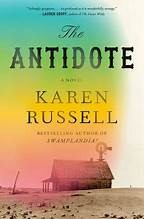
The Antidote
2,707-word summary 12 min read 432 pages in the book
- First published
- 2025
- Publisher
- Knopf
- Pages
- 432
- ISBN
- 9780593802250
Reading options
What's inside (10 sections)
I came to this book knowing almost nothing about it beyond the fact that Karen Russell had spent years writing it and that it had been shortlisted for a National Book Award. What I found was a novel far stranger and more ambitious than its title suggests, a book about a dust storm and a town and a woman who keeps other people's memories inside her own body. It was published by Knopf on 11 March 2025, runs to 432 pages, and takes place during the worst years of the Dust Bowl. By the end I was impressed by what Russell attempts and a little frustrated by how many of her ideas refuse to settle. That combination, I think, is the honest response to this book.
Black Sunday and the town of Uz
The novel opens on Black Sunday in 1935, the day a colossal dust storm swallowed a stretch of the plains. Russell sets her story in a fictional Nebraska town called Uz. The name is deliberate. It echoes the book of Job, where Uz is the place where suffering lands, and this town is built to be a place where suffering lands too. The storm rolls in and covers everything, and the ordinary business of farming and living comes to a halt. It is a strong opening because it does two jobs at once. It gives you a physical event, a wall of dust blotting out the sun, and it tells you, through the name of the place, that the book means to ask why bad things happen and what people owe one another when they do.
One detail in that opening stayed with me. Every farm in Uz is ruined except one. The farm belonging to Harp Oletsky, a Polish wheat farmer, comes through the storm untouched, his crop flourishing while everyone else's fails. In a lesser novel this would be a tidy miracle, a sign of favor or a quirky bit of local color. Here it is presented as something stranger and less comfortable. The untouched field is an anomaly the town cannot explain, and it sits near the center of the book as a kind of quiet accusation. Why this farm and not the others? Russell never fully answers that question, and the refusal to answer is part of the design.
The dust itself is more than scenery. It is the force that sets every other story in motion, the thing that scatters people and ruins crops and, crucially, blows away the memory bank at the heart of the novel. I liked that Russell treats the storm as both a real weather event and a metaphor she trusts us to work out for ourselves. There is no paragraph that explains what the dust stands for. It simply arrives, and the consequences unfold. That restraint is one of the book's best habits, and it is a shame the later chapters do not always keep it.
Toni, the Vault, and the memory bank
At the center of the book is Antonina Rossi, whom everyone calls Toni. She is an Italian immigrant and a survivor of the Milford Home for Unwed Mothers, an institution whose name carries its own quiet cruelty. In Uz she has made a life for herself as the town's prairie witch. The local word for what she does is Vault. People come to her with memories they cannot bear to keep, and she takes those memories off their hands and stores them in her own body. This is the book's central invention, and Russell treats it with a matter-of-factness that makes it work. Toni is not a mystical figure wrapped in fog. She is a working woman with a job, and the job happens to be impossible.
Then the storm blows the whole bank clean away. The memories are gone, scattered with the dust, and Toni is left effectively bankrupt. She has taken on a debt she can no longer repay. What makes this terrifying is not any supernatural rule but a plain social one. Her customers will come back to withdraw what they deposited. They will want their burdens returned, and she will have nothing to give them. The fear of that reckoning drives much of the first half of the novel. I found it a genuinely fresh way to think about guilt and obligation, and about the way a person can be held responsible for pain they agreed to carry.
Toni's body as a storehouse is a fine idea, and Russell pushes it further than I expected. If memories live in flesh, then forgetting is not a clean act of will but a physical loss, something that happens to you. That distinction matters in a book about a country that has chosen to forget things on purpose. Toni's predicament is a small, intimate version of a much larger national habit. She cannot return what she has lost, and so she must decide what to do with the people who trusted her. The best passages in the book are the ones that keep this scale small, that stay with one woman facing a problem she cannot honestly solve.
Dell and the Counterfeiters
Toni does not face the problem alone. Her teenage niece, Asphodel Oletsky, everyone calls her Dell, becomes her apprentice. Dell is a fierce basketball player, and her ferocity is not decorative. Her mother, Harp's daughter, was murdered by the man the town calls the Lucky Rabbit's Foot Killer. That loss sits behind Dell's hardness and her willingness to act when adults hesitate. She is the one who proposes the solution that gives the middle of the book its energy. Since the original memories are gone, Dell writes invented ones. She makes up counterfeits, fake memories crafted to look enough like the real thing to satisfy a customer who comes asking.
The two of them call themselves the Counterfeiters. I enjoyed this section of the novel most. There is something wonderful and slightly awful about the scheme. Dell is not a criminal in any glamorous sense. She is a grieving girl trying to protect her aunt, and the lies she writes are acts of care as much as fraud. Russell lets the moral ambiguity sit there without cleaning it up. Are the invented memories crueler than the truth, kinder, or simply different? The book never hands down a verdict, and the uncertainty is more interesting than any verdict would have been.
The basketball detail gives Dell a life outside the magical machinery. She is a person with a body and a temper and a sport she is good at, and that makes her more than a plot device. I wanted more of her on the court, honestly. Russell has said the character was partly imagined as someone who could hold her own in a physical contest, and the few moments of sports in the book crackle with a directness the quieter magical passages lack. When Dell is moving through the world as an athlete, the prose seems to loosen up and trust itself.
The aunt and niece relationship is the warmest thread running through the novel. Toni carries the weight of her role and the shame of her past. Dell carries grief and a young person's certainty that she can fix things. They need each other, and the book understands that the bond between them is practical before it is sentimental. They are partners in a scheme, accomplices, family. That combination gives their scenes a texture I believed.
The son Toni never stopped looking for
Running quietly alongside the memory plot is Toni's private search. She was told that the son she bore died at birth, and she has never accepted it. For years she has been leaving clues, small signals meant to guide him back to her if he is alive and looking. This thread gives the novel its aching emotional undercurrent. It also explains a great deal about why Toni does what she does. A woman who has been separated from her child, and who was made to believe the separation was permanent, has a particular relationship to other people's memories. She knows what it means to have something taken and be told it never existed.
I found this the most affecting part of the book. The idea of leaving breadcrumbs for a child you were told was dead is almost unbearable, and Russell writes it without milking it. Toni's hope is not presented as a quirk of character. It is the thing that has kept her going, the private engine beneath her public role as the Vault. When the memory bank is destroyed, her search becomes more urgent, because the very faculty she relies on has been damaged.
It is also here that the book begins to show the weakness that Amy Merrick identified in her review for the Englewood Review of Books. Merrick argued that too many weighty themes stay underdeveloped and that a complex deus ex machina climax leaves important threads dangling. I felt the force of that criticism most sharply around Toni's son. The search is set up with such care that its resolution, when it arrives, felt rushed to me. Russell has built so many interlocking mechanisms that the ending has to move like clockwork to close them all, and the human feeling gets squeezed out in the process.
Cleo Allfrey and the camera that sees too much
The third major figure is Cleo Allfrey, a Black government photographer working for the New Deal's Resettlement Administration. She arrives in Uz with a camera that seems to capture the past and possible futures. This is Russell at her most boldly magical. The camera does more than take pictures. It makes time visible, showing what has been and what might be. In the hands of a government agency it becomes a way of documenting a region in collapse, and in Cleo's hands it becomes something harder to control.
Cleo quits after her boss punches holes in her negatives. That act of destruction is one of the sharpest moments in the book for me. Someone in authority cannot bear what the photographs show, so he destroys the record rather than face it. Cleo then sets up a darkroom in Harp's root cellar, working in the dark beneath the one farm the storm spared. The image of a photographer developing pictures underground, while the dust blows above, is the kind of picture Russell knows how to make. It ties together several of the book's threads in a single space: the untouched farm, the official record, the act of looking, and the refusal to look.
Cleo's presence also shifts the novel's concern from personal memory to public history. If Toni holds what individuals want to forget, Cleo records what a government would rather not have on file. The two women are doing related jobs. One absorbs memory into a body, the other fixes it on film, and both find their work destroyed by forces that prefer forgetting. I wish Russell had spent more time with Cleo. She is the character who connects the book's intimate losses to its political argument, and she often feels like she is passing through a story that belongs to other people.
What the book says about forgetting
The deepest subject of The Antidote is America's deliberate forgetting of Native dispossession. This is not a subtext I am reading into it. Russell has been clear that the novel is a reckoning with the way the country has chosen not to remember what was taken and who it was taken from. The Dust Bowl itself becomes part of that story. The land is not a blank stage on which white settlers suffer. It is a place with a history that predates the people who call it Uz, and the novel keeps pressing on that point even when the plot is doing something else.
This is where the title earns itself. An antidote is something that counteracts a poison, and the poison here is forgetting, the practiced national habit of looking away. The counterfeit memories Dell writes are a kind of antidote too, though a compromised one. The photographs Cleo takes are another, and the holes punched in her negatives show how vigorously the poison works. Russell is interested in all the forms a remedy can take, and in how easily a remedy can become another lie. The book is at its best when it holds those two things together.
I should say that the historical material is not delivered as a lecture. It arrives through the landscape, through what the camera sees, through the names of places and the absence of people who should be there. That approach suits a novel of magical realism, which is a form built to make the unseen visible. When the book works, you feel the weight of what has been erased without being told to feel it. The name Uz does a lot of work here, linking a specific American moment to an older story about suffering and the questions people ask of God when it arrives.
The parts that do not fully land
I want to be fair about the weaknesses, because they are real. This is a large novel with many large ideas, and not all of them get the space they need. Merrick's complaint about underdeveloped themes matches my own reading. The book takes on the Dust Bowl, motherhood, immigration, racial violence, the theft of land, the reliability of memory, and the power of photographs. That is a great deal for 432 pages, and some of these subjects appear, make an impression, and then recede before they have been thought through. Cleo's storyline in particular feels shorter than it deserves.
The climax is the other problem. Russell builds an elaborate structure of deposits and counterfeits and clues and photographs, and the ending has to bring all of it home at once. The result is clever in a way that feels mechanical. Threads connect, but the connecting feels engineered rather than lived. I was aware of the author's hand arranging matters, and that awareness cooled a story that had been warm. A deus ex machina is not automatically a fault, but when the machinery is this visible, the emotional payoff thins out.
There is also a question of tone. The book moves between the grim realities of the Dust Bowl and the playful invention of the memory bank, and the shifts are not always smooth. At times the whimsy of the magical elements sits uneasily beside the historical suffering. I do not think this is a failure so much as a risk Russell chose to take, and I can see readers loving exactly what bothers me here. The danger of a book this inventive is that the invention can become a performance. I felt that happening in a few scenes, though never for long.
Who this book is for
I would hand this to a reader who likes a novel with a big imagination and the patience to sit with difficult history. It is a book that asks a lot and gives a lot in return, and its best passages are as good as anything Russell has written. The picture of Toni storing her neighbors' pain in her own body, of Dell writing lies to keep that body whole, and of Cleo developing photographs in a root cellar beneath a miraculous field will stay with me. Those images are the book's true achievement.
I would be more careful with a reader who wants a tight plot and a clean resolution. The ending ties things up, but it ties them up in a way that can feel more like a puzzle solved than a life understood. And the themes compete with one another in a way that leaves some of them underfed. Still, I finished the novel glad I had read it. It is a strange, serious, occasionally wonderful book about how people carry what they cannot put down, and about a country that has made an art of pretending there is nothing to carry. The title promises an antidote. What Russell offers is closer to a diagnosis, offered with enough skill that the diagnosis itself is worth the time.
FAQ
What is the memory bank in The Antidote?
Toni Rossi, the town's prairie witch known as the Vault, takes her neighbors' unwanted memories and stores them inside her own body. The dust storm blows the whole bank away, leaving her unable to return what her customers deposited.
Is The Antidote based on real history?
It is a work of fiction set during the Dust Bowl in the made-up Nebraska town of Uz, and its opening draws on the real Black Sunday storm of 1935. Russell has said the novel is a reckoning with the deliberate national forgetting of Native dispossession.
What did critics say about the book and its ending?
Kirkus gave it a starred review and it was a National Book Award finalist. Amy Merrick of the Englewood Review of Books argued that too many weighty themes stay underdeveloped and that a complex deus ex machina climax leaves important threads dangling.
Similar books
Good Dirt
A stoneware jar made by an enslaved potter links a prominent Black New England family across a hundred and fifty years of prosperity, grief and buried history.
2,069-word summary · 9 min read
Of Love and Other Demons
In colonial Cartagena, a twelve-year-old girl bitten by a rabid dog is locked in a convent, where the priest sent to exorcise her falls in love.
2,258-word summary · 10 min read
Wild Dark Shore
On a remote island between Tasmania and Antarctica, a family guards a vast seed bank until a storm washes a stranger ashore and the radios go dead.
2,449-word summary · 11 min read

The Kitchen God's Wife
Amy Tan's second novel pairs a San Jose speech therapist with her Chinese mother, whose account of war, an abusive husband, and a narrow escape comes out in a…
2,896-word summary · 13 min read
Flashlight
Susan Choi's Booker-shortlisted novel opens with a father and daughter on a breakwater in 1978, then follows the loss outward through four generations and…
2,849-word summary · 13 min read
A Reliable Wife
In a cold Wisconsin town a lonely rich man sends for a mail-order bride, and the woman who arrives has come with poison and a plan.
2,300-word summary · 10 min read
The Book of Negroes
Aminata Diallo is kidnapped from West Africa at eleven and spends a life crossing the Atlantic, surviving slavery, and fighting to be recorded as free.
2,442-word summary · 11 min read
Manhattan Beach
A Brooklyn girl works the Navy Yard and dives for warships while chasing the gangster who may know why her father vanished.
2,251-word summary · 10 min read
The Storyteller's Secret
A New York journalist goes to India to learn why her grandmother loved a British officer, and why a family servant kept the truth for forty years.
2,270-word summary · 10 min read
Wide Sargasso Sea
Jean Rhys gives the first Mrs. Rochester a Caribbean childhood, a marriage built on money and suspicion, and a voice that Charlotte Bronte left in the attic.
2,021-word summary · 9 min read
The Keeper of Happy Endings
Barbara Davis's 2021 standalone braids a Paris dressmaker's wartime losses with a grieving Boston artist who unlocks her family's secrets through an old row…
2,437-word summary · 11 min read
The Water Dancer
An enslaved man with a strange power for travel fights to free himself and rescue those he loves.
2,910-word summary · 13 min read
Song of Solomon
Milkman Dead leaves Michigan to hunt for family gold and finds instead the old song of his ancestor Solomon.
2,465-word summary · 11 min read
The Island of Missing Trees
A talking fig links 1970s Cyprus lovers Kostas and Defne with their grieving London daughter Ada years later.
3,172-word summary · 14 min read
Midnight's Children
Saleem Sinai, born at India's independence midnight, narrates his family's saga as his life mirrors the new nation's history.
2,734-word summary · 12 min read
The Wind-Up Bird Chronicle
An unemployed Tokyo man hunts a lost cat, then his missing wife, and slips from quiet suburbs into wells and wartime memory.
3,344-word summary · 15 min read
Universality
Natasha Brown's short second novel turns a lockdown fracas over a gold bar into a sharp satire of money, identity and public argument.
2,302-word summary · 10 min read

The Wilderness
Four Black women move through twenty years of friendship in Angela Flournoy's discontinuous, widely praised second novel.
2,141-word summary · 10 min read
The South
A seventeen-year-old moves to his family's failing fruit orchard in 1990s Malaysia, where a summer love affair unfolds as the household and the land around him…
2,903-word summary · 13 min read
The Nix
A stalled novelist and community college professor goes looking for the mother who left him and finds a radical activist whose rock thrown at a governor made…
2,214-word summary · 10 min read

The Land in Winter
In the West Country during the Big Freeze of 1962, two young couples are shut in together, and the cold draws out every buried want.
2,265-word summary · 10 min read
North Sun, or, the Voyage of the Whaleship Esther
In 1878 New Bedford, a worn-out captain is sent north after a whaleship and the son-in-law of a powerful whaling family who chose to stay in Alaska.
2,314-word summary · 10 min read
Love Forms
A Trinidadian mother sent away at sixteen returns to the loss of her daughter forty years later, in Claire Adam's quiet, longlisted novel.
2,153-word summary · 10 min read
Theft
Gurnah traces three linked lives in Tanzania, where a servant's accusation of theft opens a family history of love, duty and quiet betrayal.
2,454-word summary · 11 min read
The Reluctant Fundamentalist
In a Lahore cafe, Changez tells a nervous American how Princeton and a New York career gave way to anger after September 11.
2,340-word summary · 10 min read
The Pull of the Stars
Over three days in a Dublin maternity ward in 1918, a nurse, a suffragette doctor on the run and a young volunteer face the flu, childbirth and unexpected love.
2,578-word summary · 11 min read
The Paying Guests
A widowed mother and her unmarried daughter take in lodgers in 1922 south London, and a secret affair between Frances and Lilian pulls them into a murder case.
2,661-word summary · 12 min read
The Luminaries
Eleanor Catton's Booker-winning novel drops a young prospector into an 1866 New Zealand gold town where twelve men untangle a web of hidden gold, murder and…
2,949-word summary · 13 min read
The Distant Hours
A letter posted in 1941 reaches Edith Burchill in 1992 and draws her to Milderhurst Castle, where three elderly sisters still guard the secret of a stormy…
2,261-word summary · 10 min read
The Buffalo Hunter Hunter
A 1912 diary found in a Montana parsonage recounts a Blackfeet man's unraveling after a dying creature's blood turns him undead, in a novel of history and…
2,731-word summary · 12 min read