
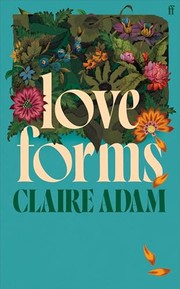
Love Forms
2,153-word summary 10 min read 352 pages in the book
- First published
- 2025
- Publisher
- Faber
- Pages
- 352
- ISBN
- 9780571339549
Reading options
What's inside (9 sections)
The kind of book that waits for you
I read Love Forms in two sittings, with a long gap in between, and the gap did something useful. Claire Adam's second novel, published by Faber in 2025 and longlisted for that year's Booker Prize, is quiet enough that you can put it down and carry it around for a few days without losing the thread. When I picked it up again, I found that I had been thinking about its narrator more than I had been thinking about its plot. That is presumably what the book is for, and it is a rare effect.
The story begins in Trinidad and eventually follows its narrator to south London. It is a book about a secret kept for four decades, but it is not really a mystery in the usual sense. There is no detective and no chase. There is a woman who has spent most of her adult life trying to find a daughter she has never met, and a family that has agreed, silently and then more or less explicitly, not to help her. The tension comes from that arrangement rather than from any reveal.
What grabbed me first was the plainness of the telling. Dawn Bishops speaks in a voice that is matter-of-fact about extraordinary things. She can describe a DNA test and an eight-ring cooker in the same paragraph, and the effect is that both things feel like evidence. The cooker matters because of who noticed it and why. The test matters because of what it might confirm. Adam is very good at making ordinary domestic objects carry a whole history.
The event that nobody names
Dawn is the youngest child of a wealthy Trinidadian family whose name is attached to a successful fruit-juice business. She is sixteen in 1980 when the book goes back to the moment everything turns on. During Carnival she has a brief encounter with a foreign tourist, and afterwards she discovers she is pregnant. The details are deliberately slight. What matters is not the encounter but what the family decides to do about its consequences.
Her parents are humiliated by the scandal, and their response is to make a pact never to speak of it again. This is the central act of the novel, and it is done in the dark, almost literally. Dawn is sent away by boat to a convent in Venezuela. She spends four months there with nuns who deliver her baby girl. She never sees the child. The baby is handed over to the nuns for adoption, and Dawn returns home to resume her schooling as though nothing has happened.
The cruelty of this is difficult to overstate, and Adam does not soften it. The people who do it believe they are acting reasonably. There is no villain shouting orders, just a family protecting its reputation and, in its own view, its daughter's future. The teenager who is sent away is treated as a problem to be moved out of sight. When she comes back, everyone behaves as if the past four months were a small interruption rather than the defining event of her life.
I kept thinking about the phrase the family uses to make this arrangement bearable. They agree not to speak of it, and that silence becomes a kind of inheritance. The baby is not the only thing sent away. The whole subject disappears, and with it goes any chance Dawn might have had of grieving openly or of asking for help. What she learns instead is that some things are not discussable, and that learning this at sixteen shapes a person for life.
Forty years on in south London
The novel then jumps forward about forty years. Dawn is fifty-eight, recently divorced and retired from work as a GP. She lives in London with two grown-up sons. She has taken a job as a receptionist for an estate agent, and the reason she gives is that it leaves her more time for her boys. That detail is quietly revealing. A retired doctor choosing to sit at a desk in an estate agent's office is not doing it for the money or the status. It is a small act of availability, a way of being around for the children she raised instead of the one she lost.
The secret has never stopped shaping her life. Adam describes the absence of her daughter in physical terms, arriving "somewhere in my abdomen." That is the book at its most direct, and it lands because it is so unadorned. This is not a metaphor that Dawn elaborates on. It is simply where she feels the missing person, and she has learned to live with the sensation while continuing to search.
The search itself is patient and largely fruitless. She writes letters. She reads internet adoption forums. She takes DNA tests. She tries to work out which part of Venezuela she was taken to, who the nuns were, and how to make sense of the frightened teenager she once was. Each of these efforts is described without drama, and that is precisely why they are affecting. This is the sort of work that goes nowhere for years, and Adam respects the boredom and the stubbornness of it.
There is a detail in this stretch of the book that I keep returning to, and it is the way Dawn describes the search as work rather than as an adventure. Letter writing takes months. Forums offer the company of strangers who are all waiting for the same kind of news. A DNA test produces numbers that need interpreting, and even then the result points to a region rather than a person. Adam treats all of this with the patience of someone who knows how much of looking is simply waiting. Dawn is a retired doctor, and there is something clinical in the way she gathers information, as if a careful method might make the outcome more likely. It cannot, of course. The search is an act of hope dressed up as research, and the novel lets you see both the hope and the dressing.
Then, late one night, a young woman in Italy makes contact, and many of her details seem to fit. That is as far as I will describe it here, because the book's final movement is better encountered than reported. What I will say is that the arrival of this message changes the pacing completely. Up to that point the novel has moved at the speed of someone turning over the same ground again and again. After it, things accelerate, and the reader is suddenly in a different kind of story.
The family that kept the silence
The most interesting parts of Love Forms are not about the search at all. They are about the way Dawn's family has lived around the secret. Her parents believe they acted in her best interests, and they are genuinely bewildered by her inability to enjoy the good life they helped build for her. They cannot understand why the money and the comfort and the respectability have not done their job. Their confusion is not acted as a defence. It is simply how they see the world.
There is a small scene in which Dawn's mother visits her home in leafy Wandsworth and notices an eight-ring cooker. The mother is delighted by it. For her, this is proof that her daughter has everything a woman could want, and the delight is heartbreaking because Dawn is standing right there in a house built around a loss the mother refuses to acknowledge. The cooker is not a symbol that Adam points at. It is just a cooker, and its owner's pleasure does the work.
Her brothers, her disengaged ex-husband and her sons mostly want to protect her from further hurt. That sounds kind, and it is, but it also keeps her at a distance. Everyone has decided what she can bear, and nobody asks her to decide it for herself. The loss has marked them all, in different ways, and the book is alert to the fact that a secret does not stay contained in the person who keeps it. It spreads outward into the people who love her, shaping what they say and what they avoid saying.
This is where the novel earns its place in the company of serious family fiction. It is not interested in the mechanics of a reunion. It is interested in what silence does across a family over decades, and in the strange loyalty that makes people protect a decision made in fear forty years earlier. Dawn's relatives are not monsters. They are people who have chosen a story about what happened and who cannot bear to hear a different version.
The art of the unsaid
The reviewers picked up on this quality almost immediately. Julie Myerson, writing in The Guardian, said that Adam is "great on the unsaid, the half-said, and the way feelings will unravel and morph over the years." That seems exactly right. The novel's power is in the gaps between what people say and what they mean, and in the slow way that a buried feeling changes shape as a life goes on.
John Self of the Financial Times praised the book for dwelling on inner motivation rather than racing through its surface story. Again, that is fair. If you came to this book expecting a brisk account of a search and a meeting, you would find it oddly paced, because the search is not the point. The point is what the search means to a woman who has organised her life around a private absence. Johanna Thomas-Corr of The Sunday Times identified Adam's defining skill as producing heartbreaking family stories without mawkishness, and the Booker judges said that Dawn's voice "haunts us still, with its beautiful and quiet urgency."
Those are strong words, and I think the book deserves them, with one qualification. The restraint that makes the novel so effective also makes some passages feel too measured. There are stretches in the middle where the emotional temperature barely changes, and I found myself wanting one moment of outright anger from Dawn, one scene where the politeness cracks. Adam withholds it, and the effect is arguably truer to the character she has built. It is also, for a reader in the wrong mood, a little frustrating.
The Tobago ending and what it does
The last pages move to the family's beach house in Tobago, and the book tightens like a thriller. This is the neat trick of the ending. Everything before it has been diffuse, made of letters and waiting and long stretches of inward thought. Then the setting narrows and the people are together in one place, and all the things that have been left unsaid press against one another.
I do not want to describe what happens there in detail, because the pages work largely through accumulation and tone. What I can say is that Adam manages to bring the Trinidad and London halves of the book into the same room without forcing a neat resolution. The past is not undone by the discovery of a fact. The parents still believe they did the right thing. The family still has its habits of protection and avoidance. What changes is that the secret is no longer entirely contained, and the characters have to behave as adults in front of one another.
That is a more demanding outcome than a simple reunion would have been, and it is the reason the book lingers. Love Forms is not interested in the idea that finding the truth sets someone free. It is interested in the harder truth that a life built around an absence does not reorganise itself overnight, even when the absence finally has a name and a face.
What I would tell a friend
Read this slowly, and read it with the knowledge that it is a novel about silence rather than about adoption as an institution. If you want a plot that moves quickly, you may find the first half patient to the point of stillness. If you are willing to sit with a narrator who has learned to speak carefully because she was once made to be silent, it is a rich and unusually controlled book.
The thing I keep returning to is not the message from Italy or the scenes in Tobago. It is Dawn at fifty-eight, working a job she does not need so that she can be near her sons, feeling a loss in her abdomen that nobody in her family will name. That image is small, and it is the whole book. Adam does not ask you to admire her for it. She simply lets you see it, and trusts you to understand what it costs.
FAQ
Is Love Forms based on a true story?
Love Forms is a work of fiction. Claire Adam published it with Faber in 2025, and it was longlisted for that year's Booker Prize.
Where is the novel set?
It begins in Trinidad, moves to a convent in Venezuela for its central backstory, and follows Dawn decades later to south London.
Does the book describe a reunion with the daughter?
A young woman in Italy contacts Dawn late one night, and the final pages, set in Tobago, tighten like a thriller. Adam keeps the outcome restrained rather than sentimental.
Similar books
Good Dirt
A stoneware jar made by an enslaved potter links a prominent Black New England family across a hundred and fifty years of prosperity, grief and buried history.
2,069-word summary · 9 min read
The South
A seventeen-year-old moves to his family's failing fruit orchard in 1990s Malaysia, where a summer love affair unfolds as the household and the land around him…
2,903-word summary · 13 min read

The Nix
A stalled novelist and community college professor goes looking for the mother who left him and finds a radical activist whose rock thrown at a governor made…
2,214-word summary · 10 min read
Only Son
A brief, funny, melancholy debut about a boy whose father dies in 1982 Florida, and the man he becomes, still trying to read the mystery of that loss.
2,170-word summary · 10 min read
Whistler
Ann Patchett's eleventh novel follows a New York teacher who reconnects with a former stepfather at the Met and hears the strange story of a chestnut mare.
2,697-word summary · 12 min read

The Kitchen God's Wife
Amy Tan's second novel pairs a San Jose speech therapist with her Chinese mother, whose account of war, an abusive husband, and a narrow escape comes out in a…
2,896-word summary · 13 min read
The Emperor of Gladness
Ocean Vuong's second novel follows a young addict pulled back from a bridge in a dying Connecticut mill town and into the home of an elderly immigrant woman…
2,693-word summary · 12 min read
Red at the Bone
A girl's coming-of-age ceremony in a Brooklyn brownstone opens a family story shaped by Tulsa, teenage pregnancy, class and a second tragedy on September 11.
2,108-word summary · 9 min read
King of Ashes
A Virginia crematorium, a debt owed to the Black Baron Boys and a family secret pull Roman Carruthers back into a war where everything burns.
2,229-word summary · 10 min read
Hollow Bones
On 11 September 2001, two-month-old Molly Fitzgerald loses her mother at the World Trade Center. She grows up planning for disasters, until a crisis in her new…
2,703-word summary · 12 min read

Good Girl
A nineteen-year-old artist in Berlin, grieving her mother, falls into an unequal romance with an American author who offers escape from the ideal of the good…
2,579-word summary · 11 min read

Detransition, Baby
Torrey Peters's debut follows three Brooklyn adults as an unexpected pregnancy pushes them to imagine an unconventional family. Funny, sharp, and unwilling to…
2,925-word summary · 13 min read

All Adults Here
A widow in upstate New York reconsiders the parent she was after a neighbor's death, then gathers her three grown children for a season of uneasy truths.
2,171-word summary · 10 min read
The Mermaid Chair
Jessie Sullivan returns to her childhood home on Egret Island to care for her agoraphobic mother, then finds her marriage, her faith, and a monk's vow thrown…
2,237-word summary · 10 min read
Manhattan Beach
A Brooklyn girl works the Navy Yard and dives for warships while chasing the gangster who may know why her father vanished.
2,251-word summary · 10 min read

We Are Okay
Marin fled San Francisco after her grandfather vanished and stopped answering anyone. When Mabel visits her college dorm, she has to say what happened.
2,253-word summary · 10 min read
Her Fearful Symmetry
Twins Julia and Valentina inherit a London flat above Highgate Cemetery from an aunt they never met, then find a ghost in it and a family secret.
2,057-word summary · 9 min read
The House We Grew Up In
The Bird family of the Cotswolds breaks apart after a suicide and spends twenty years not talking about what happened.
2,198-word summary · 10 min read

A Spool of Blue Thread
Four generations of the Whitshank family in Baltimore, and the silences, resentments and quiet love they hand down without ever saying so.
2,408-word summary · 11 min read
Where We Belong
Marian's orderly New York life cracks when the daughter she gave up for adoption arrives, and the search for the father forces her to tell the truth.
2,056-word summary · 9 min read
Flight Behavior
Dellarobia Turnbow is stuck in a Tennessee farm marriage until a valley full of monarch butterflies, and the scientist who comes to study them, force her to…
2,051-word summary · 9 min read

And Every Morning the Way Home Gets Longer and Longer
An elderly grandfather, his son, and his grandson share memories and fears as the old man's mind begins to fade, in a short novel about grief and love.
2,078-word summary · 9 min read
The Tiger's Wife
A young doctor in a war-scarred Balkan country chases the stories her grandfather left behind, including a deathless man and a deaf girl who loved an escaped…
2,232-word summary · 10 min read
Maame
Maddie Wright, 25, has spent years as the responsible one in her Ghanaian British family, and the year she finally tries to live for herself is the year…
2,108-word summary · 9 min read
The Accidental Tourist
Grieving Macon writes travel guides for haters of travel, then Muriel intrudes.
2,252-word summary · 10 min read

Kitchen
Orphan Mikage finds home in a kitchen with Yuichi and Eriko after loss.
2,597-word summary · 12 min read
The School for Good Mothers
A mother sent to a reform school fights to keep her daughter under cold surveillance and strict rules.
2,114-word summary · 9 min read

The Deep End of the Ocean
A three year old vanishes at a Chicago hotel reunion, and nine years later the Cappadoras must face his return as a teen raised by someone else while grief…
2,951-word summary · 13 min read

The Berry Pickers
A four year old vanishes from a Maine blueberry camp in 1962, and two families carry the loss for decades until Joe and Norma face the truth.
2,606-word summary · 12 min read
We Are All Completely Beside Ourselves
Rosemary tells of twin sister Fern, a chimp raised as family, and research fallout.
2,058-word summary · 9 min read